Vietnam 5G NTN Market Size, Share & Growth Rate
The Vietnam 5G NTN Market was estimated at USD 784 Million in 2025 and is projected to reach USD 1112 Million by 2032, growing at a CAGR of 5.1% from 2026 to 2032. This growth trajectory is primarily fueled by an urgent need to enhance connectivity in rural areas, where traditional terrestrial networks fall short. As the demand for high-speed, low-latency services escalates, investments in non-terrestrial solutions such as satellites and high-altitude platforms are becoming essential for a comprehensive rollout of 5G across Vietnam.
Vietnam 5G NTN Market Year-wise Growth Rate and Key Drivers
This graph highlights how the Vietnam 5G NTN Market has steadily grown over the years, supported by major growth factors.
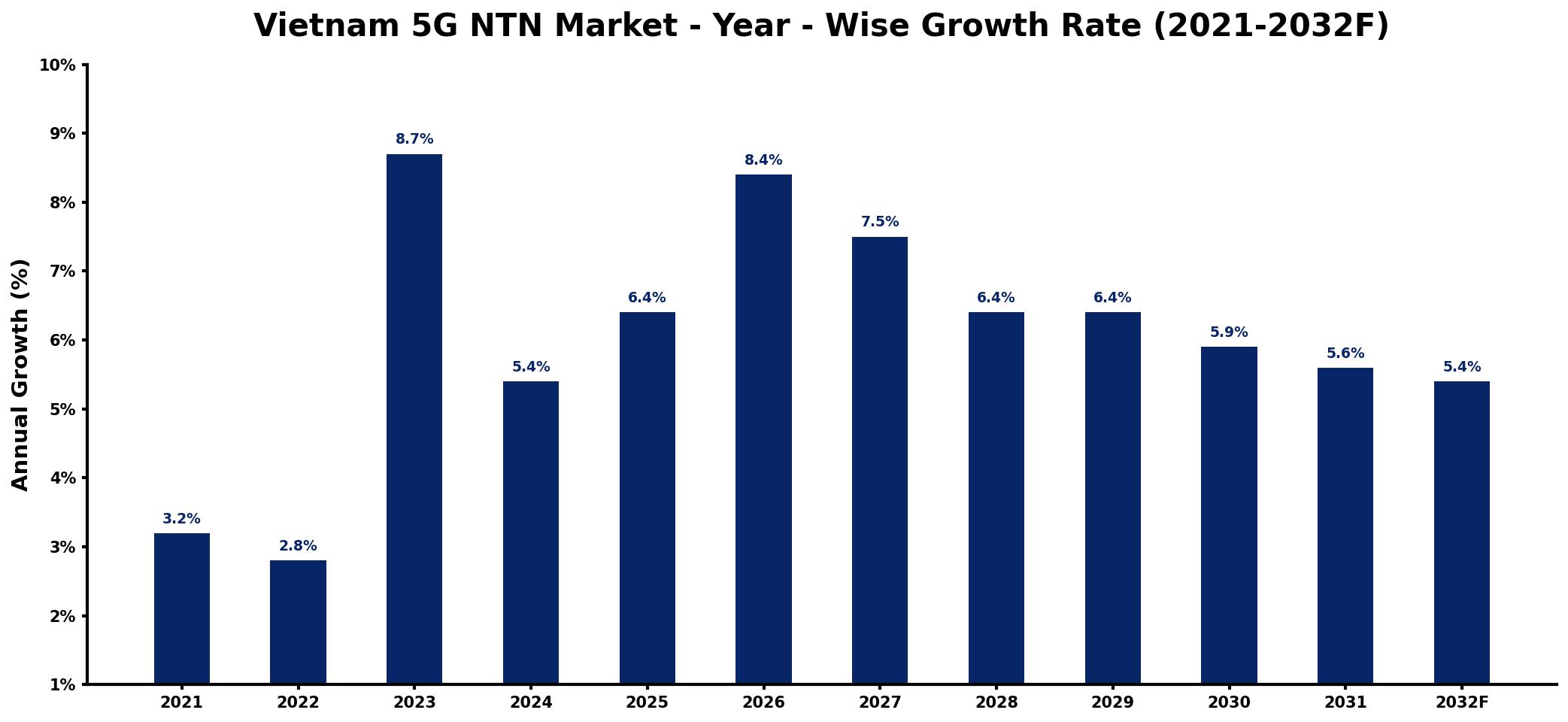
The table below presents the year‑wise growth rates along with the key drivers influencing the market
| Year | Growth Rate | Major Drivers |
| 2021 | 3.2% | Rising demand for connectivity solutions |
| 2022 | 2.8% | Increased investments in infrastructure |
| 2023 | 8.7% | Growing adoption of IoT technologies |
| 2024 | 5.4% | Expansion of smart city initiatives |
| 2025 | 6.4% | Surge in mobile broadband subscriptions |
| 2026 | 8.4% | Emergence of new tech startups |
| 2027 | 7.5% | Enhanced consumer interest in automation |
| 2028 | 6.4% | Development of advanced communication protocols |
| 2029 | 6.4% | Increased focus on digital transformation |
| 2030 | 5.9% | Growing partnerships with telecom providers |
| 2031 | 5.6% | Investment in renewable energy projects |
| 2032 | 5.4% | rising infrastructure development spending |
Note: Market size estimations and growth projections presented in this report are based on 6Wresearch's proprietary forecasting methodology, utilizing the latest available industry data, government publications, and primary research inputs.
Vietnam 5G NTN Market Synopsis
Vietnam is on the cusp of a transformative digital era, with 5G technology poised to reshape connectivity standards nationwide. As the government emphasizes digital inclusion, non-terrestrial networks emerge as a vital component in ensuring that underserved regions gain access to robust internet services.
The 5G NTN market in Vietnam is not just about faster internet; it's a gateway for innovative applications, including IoT solutions that can revolutionize industries such as agriculture and disaster response. By integrating non-terrestrial solutions, Vietnam is set to achieve a more equitable digital landscape, addressing the persistent gap in connectivity.
Vietnam 5G NTN Market Key Takeaways
- The market is estimated to grow significantly, driven by the urgent need for reliable connectivity in remote areas.
- Key drivers include the rising demand for IoT applications and rural broadband solutions.
- Challenges such as infrastructure investment and regulatory hurdles remain but are being actively addressed.
- The post-pandemic landscape offers opportunities for faster deployment of NTN technologies.
- Collaboration between government and private sectors is essential for market advancement.
Evaluation of Restraints in Vietnam 5G NTN Market
The expansion of the Vietnam 5G NTN market faces several significant restraints that could hinder its rapid development. A primary concern revolves around the deployment of essential infrastructure, such as low Earth orbit satellites and high-altitude platforms, which demand substantial capital investment and coordination among various stakeholders. Additionally, navigating the complexities of regulatory frameworks, airspace management, and international collaborations presents considerable challenges. These factors, combined with the need for specialized technical expertise, may slow the implementation of much-needed 5G NTN solutions in Vietnam.
Vietnam 5G NTN Market Trends
Current trends in the Vietnam 5G NTN market reflect a shift towards greater integration of satellite technologies within mainstream telecommunications. Companies are increasingly focusing on partnerships and alliances to accelerate the rollout of NTN solutions. Moreover, the rise in demand for IoT devices and applications is pushing for faster, more reliable connectivity that only non-terrestrial networks can provide, especially in hard-to-reach areas.
Additionally, the push for digital transformation across various sectors—ranging from agriculture to healthcare—is creating unprecedented opportunities for innovative applications that rely on 5G NTN infrastructure. The emphasis on smart cities and enhanced urban planning will further catalyze the demand for robust connectivity solutions.
Vietnam 5G NTN Market Opportunities
Genuine growth opportunities in the Vietnam 5G NTN market lie in tapping into the increasing needs of the IoT sector and advancing the rural broadband agenda. Businesses are encouraged to explore partnerships with telecom providers to develop customized solutions that address specific regional challenges. Moreover, government-backed initiatives aimed at bridging the digital divide present favorable conditions for investments in non-terrestrial network technologies.
Government Initiatives in the Vietnam 5G NTN Market
The Vietnamese government is actively promoting digitalization and infrastructure expansion as part of its broader development strategy. Initiatives to enhance connectivity in rural and underserved areas are being prioritized, encouraging investments in non-terrestrial networks. Public spending is focused on research and development, while incentives are in place to attract foreign investment into the 5G NTN space. These efforts aim to ensure that all citizens can benefit from the advancements in technology.
Future Insights of the Vietnam 5G NTN Market
Looking ahead to the period between 2026 and 2032, the Vietnam 5G NTN market is set to witness significant advancements, driven by sustained demand for reliable, high-speed internet. The synergy between government initiatives and private sector innovation will likely lead to a more resilient infrastructure, effectively integrating non-terrestrial networks into the existing telecommunications framework. As technologies mature and regulatory landscapes evolve, Vietnam could very well emerge as a leader in non-terrestrial network deployment in the Southeast Asian region.
Vietnam 5G NTN Market Latest Developments (2025 - 2026)
In the latest developments within the Vietnam 5G NTN market, there have been notable advancements in regulatory frameworks aimed at expediting satellite licensing processes. Several collaborations between telecom operators and satellite companies are underway to enhance coverage in remote regions. Furthermore, innovations in high-altitude platforms are being tested to ensure their viability for future deployment, paving the way for broader applications of 5G NTN technology in Vietnam.
Vietnam 5G NTN Market - Key Attractiveness of the Report
- 10 Years of Market Numbers
- Historical Data Starting from 2022 to 2025
- Base Year: 2025
- Forecast Data until 2032
- Key Performance Indicators Impacting the Market
- Major Upcoming Developments and Projects
Key Highlights of the Report:
- Vietnam 5G NTN Market Outlook
- Market Size of Vietnam 5G NTN Market, 2025
- Forecast of Vietnam 5G NTN Market, 2032
- Historical Data and Forecast of Vietnam 5G NTN Revenues & Volume for the Period 2022-2032F
- Vietnam 5G NTN Market Trend Evolution
- Vietnam 5G NTN Market Drivers and Challenges
- Vietnam 5G NTN Price Trends
- Vietnam 5G NTN Porter's Five Forces
- Vietnam 5G NTN Industry Life Cycle
- Historical Data and Forecast of Vietnam 5G NTN Market Revenues & Volume By Component for the Period 2022-2032F
- Historical Data and Forecast of Vietnam 5G NTN Market Revenues & Volume By Hardware for the Period 2022-2032F
- Historical Data and Forecast of Vietnam 5G NTN Market Revenues & Volume By Solutions for the Period 2022-2032F
- Historical Data and Forecast of Vietnam 5G NTN Market Revenues & Volume By Services for the Period 2022-2032F
- Historical Data and Forecast of Vietnam 5G NTN Market Revenues & Volume By End-Use Industry for the Period 2022-2032F
- Historical Data and Forecast of Vietnam 5G NTN Market Revenues & Volume By Maritime for the Period 2022-2032F
- Historical Data and Forecast of Vietnam 5G NTN Market Revenues & Volume By Aerospace for the Period 2022-2032F
- Historical Data and Forecast of Vietnam 5G NTN Market Revenues & Volume By Defense for the Period 2022-2032F
- Historical Data and Forecast of Vietnam 5G NTN Market Revenues & Volume By Government for the Period 2022-2032F
- Historical Data and Forecast of Vietnam 5G NTN Market Revenues & Volume By Mining for the Period 2022-2032F
- Historical Data and Forecast of Vietnam 5G NTN Market Revenues & Volume By Application for the Period 2022-2032F
- Historical Data and Forecast of Vietnam 5G NTN Market Revenues & Volume By EMBB for the Period 2022-2032F
- Historical Data and Forecast of Vietnam 5G NTN Market Revenues & Volume By URLLC for the Period 2022-2032F
- Historical Data and Forecast of Vietnam 5G NTN Market Revenues & Volume By MMTC for the Period 2022-2032F
- Vietnam 5G NTN Import Export Trade Statistics
- Market Opportunity Assessment By Component
- Market Opportunity Assessment By End-Use Industry
- Market Opportunity Assessment By Application
- Vietnam 5G NTN Top Companies Market Share
- Vietnam 5G NTN Competitive Benchmarking By Technical and Operational Parameters
- Vietnam 5G NTN Company Profiles
- Vietnam 5G NTN Key Strategic Recommendations






































