Vietnam AC Power Sources Market Size, Share & Growth Rate
The Vietnam AC Power Sources Market was estimated at USD 273 Million in 2025 and is projected to reach USD 385 Million by 2032, growing at a CAGR of 5.0% from 2026 to 2032. This growth trajectory can be attributed to rising industrial automation and the ever-increasing demand for high-precision power solutions. As Vietnamese industries continue to embrace technological advancements and rigorous testing standards, the need for reliable AC power sources will only intensify.
Vietnam AC Power Sources Market Year-wise Growth Rate and Key Drivers
This graph highlights how the Vietnam AC Power Sources Market has steadily grown over the years, supported by major growth factors.
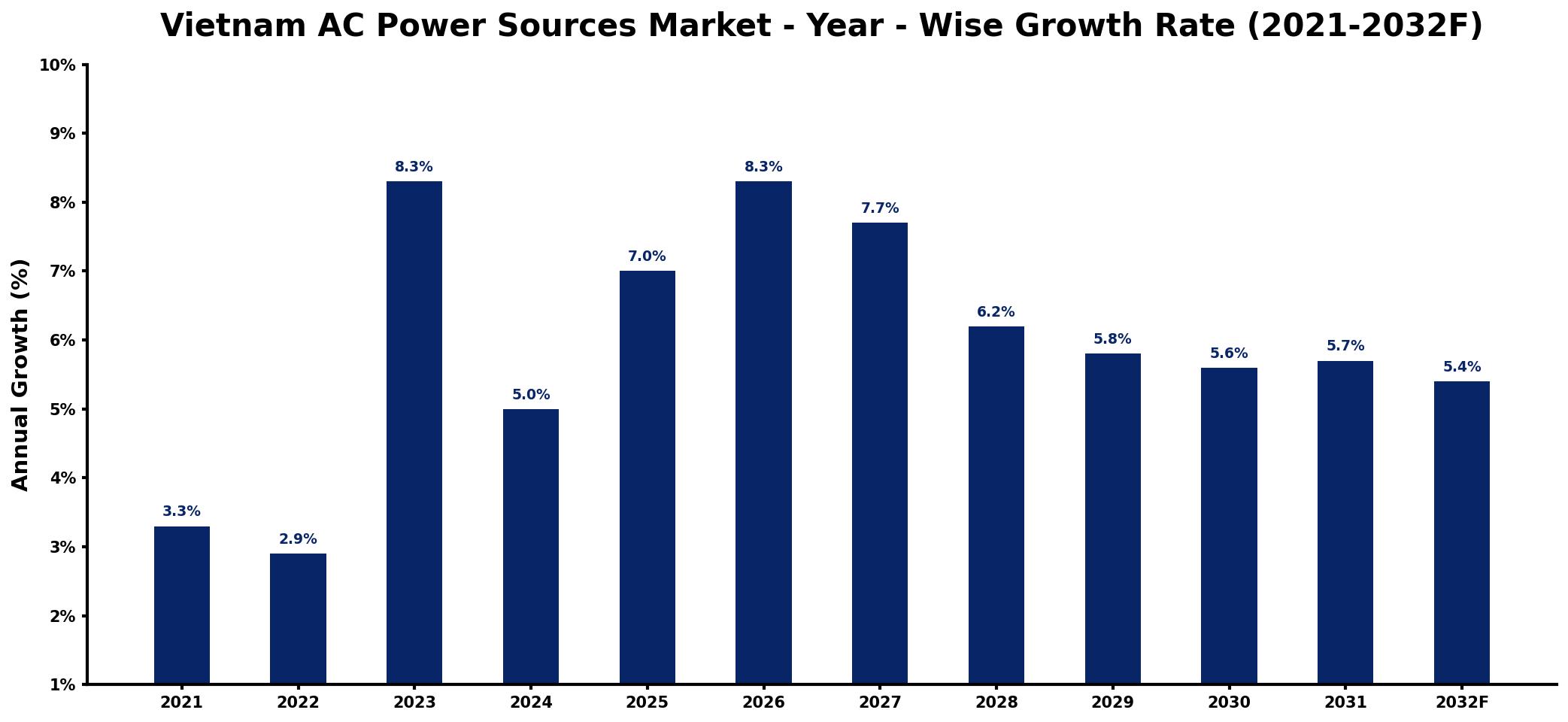
The table below presents the year‑wise growth rates along with the key drivers influencing the market
| Year | Growth Rate | Major Drivers |
| 2021 | 3.3% | Rising demand for renewable energy |
| 2022 | 2.9% | Increased investment in infrastructure |
| 2023 | 8.3% | Expansion of electric vehicle market |
| 2024 | 5.0% | Growing residential solar installations |
| 2025 | 7.0% | Surge in industrial automation projects |
| 2026 | 8.3% | Boost in smart grid technology |
| 2027 | 7.7% | Enhanced government energy policies |
| 2028 | 6.2% | Development of energy storage solutions |
| 2029 | 5.8% | Higher efficiency in energy consumption |
| 2030 | 5.6% | Proliferation of green building practices |
| 2031 | 5.7% | Increased urbanization and electrification |
| 2032 | 5.4% | Advancements in energy management systems |
Note: Market size estimations and growth projections presented in this report are based on 6Wresearch's proprietary forecasting methodology, utilizing the latest available industry data, government publications, and primary research inputs.
Vietnam AC Power Sources Market Synopsis
The Vietnam AC power sources market has witnessed a remarkable surge in recent years, propelled by technological innovations and an expanding industrial base. As companies strive for increased efficiency and reliability, demand for sophisticated AC power solutions has significantly increased, making it a focal point for research and development.
However, the market is at a pivotal moment, as it transitions from recovery following the impacts of the COVID-19 pandemic. With a renewed focus on high-quality and stable power supplies for testing and manufacturing, stakeholders are well-positioned to capitalize on emerging opportunities.
Vietnam AC Power Sources Market Key Takeaways
- Technological advancements are enhancing the precision and efficiency of AC power sources.
- Industrial automation continues to drive demand for reliable power supply solutions.
- The post-pandemic recovery is reshaping market dynamics toward efficiency and stability.
- Market players face challenges related to power quality and cost-effectiveness.
- Government initiatives are promoting energy efficiency in power supply systems.
Evaluation of Restraints in Vietnam AC Power Sources Market
Despite the positive market trajectory, several restraints hinder growth within the Vietnam AC power sources market. The demand for efficient and stable power supply solutions remains critical, yet fulfilling this demand requires addressing power quality standards and ensuring voltage stability. The balance between maintaining high product quality and managing production costs presents ongoing challenges. Additionally, adapting to rapid technological advancements while meeting the stringent requirements of industries poses a unique constraint that market players must navigate.
Vietnam AC Power Sources Market Trends
Several key trends are emerging in the Vietnam AC power sources market. Firstly, there is a notable shift towards the integration of digital control systems that enhance the functionality and precision of AC power sources. Furthermore, an increased focus on energy efficiency and sustainability is driving the development of innovative power solutions. The emphasis on renewable energy sources is also influencing market dynamics, prompting manufacturers to explore hybrid power supply systems that meet modern energy needs.
Vietnam AC Power Sources Market Opportunities
Opportunities for growth in the Vietnam AC power sources market are abundant. As the industrial landscape evolves, there is a growing demand for advanced testing and calibration solutions. Sectors such as electronics manufacturing, automotive, and renewable energy are prime candidates for investment in high-quality AC power sources. Additionally, collaboration between industry stakeholders and research institutions can drive innovation, leading to the development of more efficient and versatile power supply solutions.
Government Initiatives in the Vietnam AC Power Sources Market
The Vietnamese government is actively promoting initiatives that align with energy efficiency and sustainable development goals. Policies encouraging the modernization of industrial infrastructure and the adoption of cutting-edge technologies are creating a favorable environment for market expansion. Furthermore, public spending on energy projects underscores the government's commitment to improving the country's power infrastructure, thereby benefiting the AC power sources market.
Future Insights of the Vietnam AC Power Sources Market
Looking ahead to the period from 2026 to 2032, the Vietnam AC power sources market is set to undergo transformative changes. As industrial automation continues to gain traction, the demand for reliable and precise AC power solutions will escalate. The interplay between technological innovation and market needs will foster the emergence of new products designed for enhanced performance and energy efficiency. Moreover, continued investment in infrastructure and collaboration across sectors will drive growth, ensuring that Vietnam's AC power sources market remains dynamic and responsive to future challenges.
Vietnam AC Power Sources Market Latest Developments (2025 - 2026)
Recent developments in the Vietnam AC power sources market indicate a shift towards integrating advanced technologies to enhance product offerings. Innovations in digital controls and energy management systems are gaining traction, addressing the increasing demand for efficiency in industrial applications. Furthermore, collaborations between manufacturers and research entities are paving the way for breakthrough technologies designed to meet the rigorous standards of modern industries, indicating a positive trend toward more efficient power solutions.
Vietnam AC Power Sources Market - Key Attractiveness of the Report
- 10 Years of Market Numbers
- Historical Data Starting from 2022 to 2025
- Base Year: 2025
- Forecast Data until 2032
- Key Performance Indicators Impacting the Market
- Major Upcoming Developments and Projects
Key Highlights of the Report:
- Vietnam AC Power Sources Market Outlook
- Market Size of Vietnam AC Power Sources Market, 2025
- Forecast of Vietnam AC Power Sources Market, 2032
- Historical Data and Forecast of Vietnam AC Power Sources Revenues & Volume for the Period 2022-2032F
- Vietnam AC Power Sources Market Trend Evolution
- Vietnam AC Power Sources Market Drivers and Challenges
- Vietnam AC Power Sources Price Trends
- Vietnam AC Power Sources Porter's Five Forces
- Vietnam AC Power Sources Industry Life Cycle
- Historical Data and Forecast of Vietnam AC Power Sources Market Revenues & Volume By Phase Type for the Period 2022-2032F
- Historical Data and Forecast of Vietnam AC Power Sources Market Revenues & Volume By Single-phase for the Period 2022-2032F
- Historical Data and Forecast of Vietnam AC Power Sources Market Revenues & Volume By Three-phase for the Period 2022-2032F
- Historical Data and Forecast of Vietnam AC Power Sources Market Revenues & Volume By Modulation Type for the Period 2022-2032F
- Historical Data and Forecast of Vietnam AC Power Sources Market Revenues & Volume By PWM for the Period 2022-2032F
- Historical Data and Forecast of Vietnam AC Power Sources Market Revenues & Volume By Linear for the Period 2022-2032F
- Historical Data and Forecast of Vietnam AC Power Sources Market Revenues & Volume By Application for the Period 2022-2032F
- Historical Data and Forecast of Vietnam AC Power Sources Market Revenues & Volume By Aerospace for the Period 2022-2032F
- Historical Data and Forecast of Vietnam AC Power Sources Market Revenues & Volume By Defense & Government Services for the Period 2022-2032F
- Historical Data and Forecast of Vietnam AC Power Sources Market Revenues & Volume By Energy for the Period 2022-2032F
- Historical Data and Forecast of Vietnam AC Power Sources Market Revenues & Volume By Wireless Communication & Infrastructure for the Period 2022-2032F
- Historical Data and Forecast of Vietnam AC Power Sources Market Revenues & Volume By Consumer Electronics & Appliances for the Period 2022-2032F
- Historical Data and Forecast of Vietnam AC Power Sources Market Revenues & Volume By Others for the Period 2022-2032F
- Vietnam AC Power Sources Import Export Trade Statistics
- Market Opportunity Assessment By Phase Type
- Market Opportunity Assessment By Modulation Type
- Market Opportunity Assessment By Application
- Vietnam AC Power Sources Top Companies Market Share
- Vietnam AC Power Sources Competitive Benchmarking By Technical and Operational Parameters
- Vietnam AC Power Sources Company Profiles
- Vietnam AC Power Sources Key Strategic Recommendations






































