Vietnam Accounts Receivable Accounts Payable Automation Market (2026-2032) | Competitive Landscape, Companies, Forecast, Segmentation, Outlook, Value, Size & Revenue, Share, Industry, Analysis, Trends, Growth
Market Forecast By Type (Cloud-based, On-premises), By Application (SMEs, Large Enterprises) And Competitive Landscape
| Product Code: ETC10066577 | Publication Date: Sep 2024 | Updated Date: Jul 2026 | Product Type: Market Research Report | |
| Publisher: 6Wresearch | Author: Dhaval Chaurasia | No. of Pages: 75 | No. of Figures: 35 | No. of Tables: 20 |
Vietnam Accounts Receivable Accounts Payable Automation Market Growth Rate
According to 6Wresearch internal databases and industry insights, the Vietnam Accounts Receivable Accounts Payable Automation Market is projected to grow at a compound annual growth rate (CAGR) of 13.85% during the forecast period (2026–2032).
Vietnam Accounts Receivable Accounts Payable Automation Market Year-wise Growth Rate and Key Drivers (2022-2032)
This graph illustrates the annual growth rates of the Vietnam Accounts Receivable Accounts Payable Automation Market from 2022 to 2032, highlighting a steady upward trajectory and projected market expansion over the forecast period.
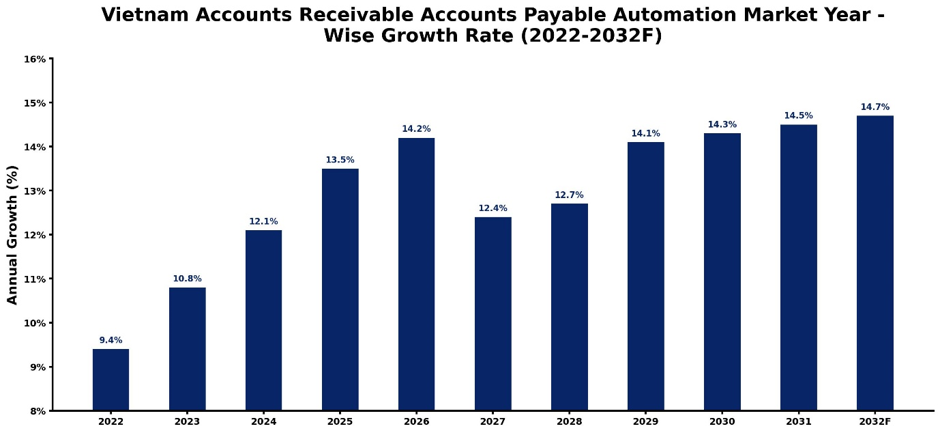
The following table summarizes the historical and forecasted growth rates of the Vietnam Accounts Receivable Accounts Payable Automation Market, along with the rationale behind each year’s performance:
| Year | Estimated Growth (%) | Market Rationale |
| 2022 | 9.4% | Circular 78/2021/TT-BTC e-invoicing rules boosted standardized digital accounting adoption. |
| 2023 | 10.8% | Post-pandemic recovery and restructuring increased transaction volumes and reduced DSO focus. |
| 2024 | 12.1% | Strong audit enforcement and merchant onboarding expanded digital accounting usage. |
| 2025 | 13.5% | Shift to cloud-based, multi-tenant ERP systems replaced legacy accounting platforms. |
| 2026 | 14.2% | AI-based reconciliation and real-time banking integration improved financial accuracy. |
| 2027 | 12.4% | Growth of B2B digital payment systems expanded across industrial hubs like Da Nang and Hai Phong. |
| 2028 | 12.7% | Market consolidation led to standardized solutions and bank-led automated ledger APIs. |
| 2029 | 14.1% | Mid-market adoption increased with affordable multi-currency accounting tools. |
| 2030 | 14.3% | ASEAN payment interoperability accelerated cross-border transaction automation. |
| 2031 | 14.5% | AI-driven automation enabled predictive credit scoring and error-free reconciliation. |
| 2032 | 14.7% | Full digital maturity enabled automated cash-flow optimization across supply chains. |
Topics Covered in the Vietnam Accounts Receivable Accounts Payable Automation Market Report
The Vietnam Accounts Receivable Accounts Payable Automation Market report covers the market by type and application. The report provides a detailed analysis of ongoing market trends, opportunities/high-growth areas, and market drivers that will help stakeholders align strategies based on current and future market dynamics.
Vietnam Accounts Receivable Accounts Payable Automation Market Highlights
| Report Name | Vietnam Accounts Receivable Accounts Payable Automation Market |
| Forecast period | 2026-2032 |
| CAGR | 13.85% |
| Growing Sector | Cloud-based Deployment & SME Sector |
Vietnam Accounts Receivable Accounts Payable Automation Market Synopsis
The Vietnam Accounts Receivable Accounts Payable Automation Market focuses on the software platforms, cloud architectures, and dedicated services designed to digitalize and streamline transactional ledger workflows. AR automation converts traditional invoicing, customer credit underwriting, collections matching, and cash application into intelligent, digitized steps. Conversely, AP automation re-engineers manual invoice data extraction, multi-level purchase order matching, approval routing, and vendor disbursement.
Evaluation of Growth Drivers in Vietnam Accounts Receivable Accounts Payable Automation Market (2026–2032)
Below are some major drivers and their influence on the market dynamics:
| Drivers | Primary Segment Affected | Why It Matters (Evidence) |
| National Electronic Invoicing Mandates | Large Enterprises | Strict tax governance from the General Department of Taxation requires compliant e-invoicing pipelines, making manual processing obsolete. |
| Rapid Expansion of E-Commerce Platforms | Cloud-based Solutions | Explosive high-frequency digital retail transactions necessitate instant, automated payment matching and real-time cash application workflows. |
| Demand for Capital Optimization | SMEs | Volatile credit cycles force expanding businesses to use automated collection engines to lower DSO and maximize internal liquid reserves. |
| Adoption of Next-Gen Technologies | Large Enterprises | The convergence of localized language OCR engines and AI algorithms drives down invoice processing times by over 70%. |
| Supply Chain Digitalization | Cloud-based Solutions | Global manufacturing firms operating out of industrial zones mandate that tier-1 and tier-2 supply vendors adopt automated billing platforms. |
The Vietnam Accounts Receivable Accounts Payable Automation Market is projected to grow at a CAGR of 13.85% during 2026–2032. This expansion reflects a deep structural transition from historically manual paper-and-spreadsheet accounting methods to fully integrated cloud-based microservices. This transition is highly pronounced as local manufacturing ecosystems scale up to support complex export contracts under international trade treaties like the RCEP and CPTPP.
As the number of transactions increases exponentially, it becomes apparent that manual recording of transactions makes cash management difficult, resulting in long payment periods, accounting errors, and costly mistakes on the part of clerical staff. Through the use of advanced automated accounts receivable/accounts payable systems, today’s companies have access to detailed information about their working capital matrices. It allows for systematic planning of payments to vendors and risk assessment of debtors.
Evaluation of Restraints in Vietnam Accounts Receivable Accounts Payable Automation Market
Below are some major restraints and their influence on the market dynamics:
| Restraints | Primary Segment Affected | What This Means (Evidence) |
| High Capital Expenditure Barriers | On-premises Solutions | Upfront hardware infrastructure investments and bespoke core ERP mapping fees frequently deter smaller companies with tighter budgets. |
| Legacy System Incompatibilities | Large Enterprises | Older, proprietary corporate database systems resist modern RESTful API integrations, creating complex custom development delays. |
| Data Privacy & Cybersecurity Risks | Cloud-based Solutions | Storing sensitive corporate payroll and vendor bank credentials on public cloud setups triggers persistent corporate cyber-liability anxieties. |
| Digital Accounting Talent Deficit | Large Enterprises | Local administrative workforces often lack specialized cross-training in modern algorithmic ledger platforms and exceptions management. |
| Inconsistent Vendor Technical Literacy | SMEs | Smaller supply chain networks often fail to submit clean, standardized digital invoices, forcing manual fallback data entry. |
Vietnam Accounts Receivable Accounts Payable Automation Market Challenges
A primary operational challenge in the Vietnam Accounts Receivable Accounts Payable Automation Market is the structural fragmentation of local B2B transaction channels. While consumer retail environments have evolved rapidly toward unified QR and mobile payment apps, business-to-business settlements continue to heavily utilize diverse banking systems, irregular check processing, and manually signed purchase orders.
Integrating all these unstructured data feeds into the automated process becomes an ongoing challenge in terms of integration. In addition, stringent local cross-border currency regulation and unique Vietnamese accounting standards (VAS) require customized compliance matrices. Out-of-the-box software solutions for global use become challenged in being able to map to these requirements seamlessly.
Vietnam Accounts Receivable Accounts Payable Automation Industry Trends
Key trends shaping the dynamics of Vietnam Accounts Receivable Accounts Payable Automation Market include:
- ERP-to-Bank Native API Connectivity: Major local commercial institutions are directly embedding automated accounting nodes into leading systems, facilitating instant ledger updates and touchless transaction reconciliation.
- Mobile Ledger Interfaces for On-the-Go Management: Developers are launching streamlined accounting dashboard applications optimized for mobile viewports, enabling regional factory managers to execute fast supply payment clearances remotely.
- Dynamic Supply Chain Financing Access: Modern software systems are building embedded working capital loan marketplaces, assessing historical ledger performance to unlock fast invoice factoring for cash-strapped sub-contractors.
Investment Opportunities in the Vietnam Accounts Receivable Accounts Payable Automation Market
The investment opportunities in the Vietnam Accounts Receivable Accounts Payable Automation Market include:
- Localized Cloud-Native Platforms Specifically Suited for Medium-Sized Companies: There is huge potential in developing SaaS applications with affordable cloud-based platforms which can deal with all intricacies related to VAS compliance and taxes within the provincial context.
- Automated Intelligent Reconciliation Modules for Existing ERP Infrastructure: Developing middleware solutions which integrate legacy corporate accounting software and the newly added banking feeds is very lucrative in terms of returns on investment.
- Deep-Learning Analytical Tools for Corporate Credit Score underwriting: The development of a module which analyses the payment history within AR systems and assigns customized credit scores for manufacturing supply chains is a vast unexplored market segment.
Top 5 Leading Players in Vietnam Accounts Receivable Accounts Payable Automation Market
Below is primary list of companies dominating the Vietnam Accounts Receivable Accounts Payable Automation Market:
FPT Software
| Company Name | FPT Software |
| Established Year | 1999 |
| Headquarters | Hanoi, Vietnam |
| Official Website | Click Here |
FPT Software provides enterprise-grade robotic process automation (RPA) tools and bespoke financial workflow integration platforms.
MISA Joint Stock Company
| Company Name | MISA Joint Stock Company |
| Established Year | 1994 |
| Headquarters | Hanoi, Vietnam |
| Official Website | Click Here |
MISA offers specialized electronic invoicing and automated ledger management suites designed for small-to-medium enterprises, ensuring native alignment with the latest Vietnamese accounting standards.
CMC Technology & Solution (CMC TS)
| Company Name | CMC Technology & Solution (CMC TS) |
| Established Year | 1993 |
| Headquarters | Hanoi, Vietnam |
| Official Website | Click Here |
The company specializes in deploying advanced multi-cloud business management tools and custom data integration layers, allowing mid-market firms to bridge legacy local infrastructure with international automated financial tools.
SAP Vietnam
| Company Name | SAP Vietnam |
| Established Year | 2008 (Local Subsidiary) |
| Headquarters | Ho Chi Minh City, Vietnam |
| Official Website | Click Here |
SAP Vietnam supplies localized instances of its global enterprise resource planning software, including advanced automated ledger networks and automated supplier marketplaces.
Base.vn (FPT Subsidiary)
| Company Name | Base.vn (FPT Subsidiary) |
| Established Year | 2016 |
| Headquarters | Ho Chi Minh City, Vietnam |
| Official Website | Click Here |
Base.vn operates a popular cloud-based corporate management ecosystem tailored specifically for high-growth Vietnamese businesses.
Government Initiatives being implemented in the Vietnam Accounts Receivable Accounts Payable Automation Market
The Vietnamese government has established clear regulatory frameworks to aggressively push digital transaction management as part of its National Digital Transformation Programme. Law 123/2020/ND-CP and Circular 78/2021/TT-BTC mandate the implementation of the electronic invoicing systems for all operational companies within the country.
In addition, as per Decision No. 749/QD-TTg made by the Prime Minister, the government offers systematic assistance in the form of finance and technology to local small and medium businesses adopting cloud automation software. This ensures removal of old-fashioned entry barriers and creates a favorable regulatory climate for adoption of technology.
Future Insights of the Vietnam Accounts Receivable Accounts Payable Automation Market
The Vietnam accounts receivable accounts payable automation market growth is expected to accelerate over the coming years, supported by the country's accelerating digital transformation, increasing adoption of cloud-based enterprise solutions, and growing demand for automated financial processes. As businesses across manufacturing, retail, banking, healthcare, and logistics seek to improve operational efficiency, organizations are expected to replace manual invoice processing with AI-powered automation platforms that offer real-time payment tracking, automated reconciliation, and intelligent cash flow management.
Market Segmentation Analysis
The report offers a comprehensive study of the following market segments and their leading categories:
By Type: Cloud-Based Architecture Dominates with High Agile Infrastructure Demand
According to Dhaval Chaurasia, Assistant Manager, 6Wresearch, Cloud-based Deployment accounted for a definitive 62.40% market value share of the Vietnam Accounts Receivable Accounts Payable Automation Market in 2025. The huge market presence can be attributed to the instant scalability options, and flexibility offered by web-based architectures. On the other hand, dedicated On-premises deployment will keep seeing application among the strict regulations of banks and certain state-owned enterprises.
By Application: Large Enterprises Secure Majority Share, While SMEs Exhibit Rapid Acceleration
The revenue share of large enterprises stood at 58.70% in the total market revenue of 2025 due to the large number of invoices per month, multiple levels of vendor approvals, and strict audit processes prevalent in multinational manufacturing companies. On the other hand, it is predicted that the revenue generated by Small & Medium Enterprises will grow with an extremely fast CAGR of 14.15% till 2032. This growth is attributed to local prices of software, easy wizard setup process, and government assistance towards digitalization.
Note: Market size estimations and growth projections presented in this report are based on 6Wresearch’s advanced forecasting approach, validated with industry datasets as of June 2026.
Key Attractiveness of the Report:
- 10 Years of Market Numbers
- Historical Data Starting from 2022 to 2025
- Base Year: 2025
- Forecast Data until 2032
- Key Performance Indicators Impacting the Market
- Major Upcoming Developments and Projects
Key Highlights of the Report:
- Vietnam Accounts Receivable Accounts Payable Automation Market Outlook
- Market Size of Vietnam Accounts Receivable Accounts Payable Automation Market, 2025
- Forecast of Vietnam Accounts Receivable Accounts Payable Automation Market, 2032
- Historical Data and Forecast of Vietnam Accounts Receivable Accounts Payable Automation Revenues & Volume for the Period 2022- 2032
- Vietnam Accounts Receivable Accounts Payable Automation Market Trend Evolution
- Vietnam Accounts Receivable Accounts Payable Automation Market Drivers and Challenges
- Vietnam Accounts Receivable Accounts Payable Automation Price Trends
- Vietnam Accounts Receivable Accounts Payable Automation Porter's Five Forces
- Vietnam Accounts Receivable Accounts Payable Automation Industry Life Cycle
- Historical Data and Forecast of Vietnam Accounts Receivable Accounts Payable Automation Market Revenues & Volume By Type for the Period 2022- 2032
- Historical Data and Forecast of Vietnam Accounts Receivable Accounts Payable Automation Market Revenues & Volume By Cloud-based for the Period 2022- 2032
- Historical Data and Forecast of Vietnam Accounts Receivable Accounts Payable Automation Market Revenues & Volume By On-premises for the Period 2022- 2032
- Historical Data and Forecast of Vietnam Accounts Receivable Accounts Payable Automation Market Revenues & Volume By Application for the Period 2022- 2032
- Historical Data and Forecast of Vietnam Accounts Receivable Accounts Payable Automation Market Revenues & Volume By SMEs for the Period 2022- 2032
- Historical Data and Forecast of Vietnam Accounts Receivable Accounts Payable Automation Market Revenues & Volume By Large Enterprises for the Period 2022- 2032
- Vietnam Accounts Receivable Accounts Payable Automation Import Export Trade Statistics
- Market Opportunity Assessment By Type
- Market Opportunity Assessment By Application
- Vietnam Accounts Receivable Accounts Payable Automation Top Companies Market Share
- Vietnam Accounts Receivable Accounts Payable Automation Competitive Benchmarking By Technical and Operational Parameters
- Vietnam Accounts Receivable Accounts Payable Automation Company Profiles
- Vietnam Accounts Receivable Accounts Payable Automation Key Strategic Recommendations
Market Covered
The report offers an extensive study of the following market segments:
By Type
- Cloud-based
- On-premises
By Application
- SMEs
- Large Enterprises
Vietnam Accounts Receivable Accounts Payable Automation Market (2026-2032) : FAQs
The Vietnam Accounts Receivable Accounts Payable Automation Market is projected to expand at a steady compound annual growth rate (CAGR) of 13.85% over the forecast period.
Leading companies include SAP Vietnam, Oracle Vietnam, MISA JSC, Sage, and Zoho Corporation.
Key growth drivers include electronic invoicing regulations, robotic process automation, digital banking integration, and increasing enterprise digitalization.
Investment opportunities are emerging in AI-powered invoice automation, cloud financial platforms, ERP implementation services, and embedded payment technologies.
6Wresearch actively monitors the Vietnam Accounts Receivable Accounts Payable Automation Market and publishes its comprehensive annual report, highlighting emerging trends, growth drivers, revenue analysis, and forecast outlook. Our insights help businesses to make data-backed strategic decisions with ongoing market dynamics. Our analysts track relevent industries related to the Vietnam Accounts Receivable Accounts Payable Automation Market, allowing our clients with actionable intelligence and reliable forecasts tailored to emerging regional needs.
Yes, we provide customisation as per your requirements. To learn more, feel free to contact us on sales@6wresearch.com
| 1 Executive Summary |
| 2 Introduction |
| 2.1 Key Highlights of the Report |
| 2.2 Report Description |
| 2.3 Market Scope & Segmentation |
| 2.4 Research Methodology |
| 2.5 Assumptions |
| 3 Vietnam Accounts Receivable Accounts Payable Automation Market Overview |
| 3.1 Vietnam Country Macro Economic Indicators |
| 3.2 Vietnam Accounts Receivable Accounts Payable Automation Market Revenues & Volume, 2022 & 2032F |
| 3.3 Vietnam Accounts Receivable Accounts Payable Automation Market - Industry Life Cycle |
| 3.4 Vietnam Accounts Receivable Accounts Payable Automation Market - Porter's Five Forces |
| 3.5 Vietnam Accounts Receivable Accounts Payable Automation Market Revenues & Volume Share, By Type, 2022 & 2032F |
| 3.6 Vietnam Accounts Receivable Accounts Payable Automation Market Revenues & Volume Share, By Application, 2022 & 2032F |
| 4 Vietnam Accounts Receivable Accounts Payable Automation Market Dynamics |
| 4.1 Impact Analysis |
| 4.2 Market Drivers |
| 4.2.1 Increasing adoption of digital technologies in businesses in Vietnam |
| 4.2.2 Growing awareness about the benefits of automation in managing accounts receivable and accounts payable |
| 4.2.3 Government initiatives to promote digital transformation in businesses |
| 4.3 Market Restraints |
| 4.3.1 High initial investment costs associated with implementing automation solutions |
| 4.3.2 Resistance to change from traditional manual processes |
| 4.3.3 Lack of skilled professionals to operate and maintain automation systems |
| 5 Vietnam Accounts Receivable Accounts Payable Automation Market Trends |
| 6 Vietnam Accounts Receivable Accounts Payable Automation Market, By Types |
| 6.1 Vietnam Accounts Receivable Accounts Payable Automation Market, By Type |
| 6.1.1 Overview and Analysis |
| 6.1.2 Vietnam Accounts Receivable Accounts Payable Automation Market Revenues & Volume, By Type, 2022- 2032F |
| 6.1.3 Vietnam Accounts Receivable Accounts Payable Automation Market Revenues & Volume, By Cloud-based, 2022- 2032F |
| 6.1.4 Vietnam Accounts Receivable Accounts Payable Automation Market Revenues & Volume, By On-premises, 2022- 2032F |
| 6.2 Vietnam Accounts Receivable Accounts Payable Automation Market, By Application |
| 6.2.1 Overview and Analysis |
| 6.2.2 Vietnam Accounts Receivable Accounts Payable Automation Market Revenues & Volume, By SMEs, 2022- 2032F |
| 6.2.3 Vietnam Accounts Receivable Accounts Payable Automation Market Revenues & Volume, By Large Enterprises, 2022- 2032F |
| 7 Vietnam Accounts Receivable Accounts Payable Automation Market Import-Export Trade Statistics |
| 7.1 Vietnam Accounts Receivable Accounts Payable Automation Market Export to Major Countries |
| 7.2 Vietnam Accounts Receivable Accounts Payable Automation Market Imports from Major Countries |
| 8 Vietnam Accounts Receivable Accounts Payable Automation Market Key Performance Indicators |
| 8.1 Percentage increase in the number of businesses adopting accounts receivable and accounts payable automation solutions |
| 8.2 Average time reduction in processing accounts receivable and accounts payable transactions |
| 8.3 Percentage improvement in data accuracy and error reduction achieved through automation systems |
| 9 Vietnam Accounts Receivable Accounts Payable Automation Market - Opportunity Assessment |
| 9.1 Vietnam Accounts Receivable Accounts Payable Automation Market Opportunity Assessment, By Type, 2022 & 2032F |
| 9.2 Vietnam Accounts Receivable Accounts Payable Automation Market Opportunity Assessment, By Application, 2022 & 2032F |
| 10 Vietnam Accounts Receivable Accounts Payable Automation Market - Competitive Landscape |
| 10.1 Vietnam Accounts Receivable Accounts Payable Automation Market Revenue Share, By Companies, 2025 |
| 10.2 Vietnam Accounts Receivable Accounts Payable Automation Market Competitive Benchmarking, By Operating and Technical Parameters |
| 11 Company Profiles |
| 12 Recommendations |
| 13 Disclaimer |
Global Go To Market Strategy - 2030
Export potential enables firms to identify high-growth global markets with greater confidence by combining advanced trade intelligence with a structured quantitative methodology. The framework analyzes emerging demand trends and country-level import patterns while integrating macroeconomic and trade datasets such as GDP and population forecasts, bilateral import–export flows, tariff structures, elasticity differentials between developed and developing economies, geographic distance, and import demand projections. Using weighted trade values from 2020–2024 as the base period to project country-to-country export potential for 2030, these inputs are operationalized through calculated drivers such as gravity model parameters, tariff impact factors, and projected GDP per-capita growth. Through an analysis of hidden potentials, demand hotspots, and market conditions that are most favorable to success, this method enables firms to focus on target countries, maximize returns, and global expansion with data, backed by accuracy.
By factoring in the projected importer demand gap that is currently unmet and could be potential opportunity, it identifies the potential for the Exporter (Country) among 190 countries, against the general trade analysis, which identifies the biggest importer or exporter.
To discover high-growth global markets and optimize your business strategy:
Click Here
Request Primary Research & Report
- Single User License$ 1,995
- Department License$ 2,400
- Site License$ 3,120
- Global License$ 3,795

Leadership Perspectives from Industry Events
Search
6Wresearch in the News
 Forbes
Citing 6Wresearch analytics to map global infrastructure and pharmaceutical industry trajectories.
 Bloomberg Law
Direct syndication of 6Wresearch's macro data points, capturing complex supply chain shifts.
 Reuters
Tracking industrial manufacturing adjustments and electronic security ecosystem scaling.
 Mint
Mint
Utilizing deep-tech sector market sizing to analyze global automation and robotics.
 The Economic Times
Anchoring features on industrial IoT growth metrics and connected smart-grid devices.
 Business Standard
Featuring strategic evaluations of Advanced Driver Assistance Systems (ADAS) and AI road safety.
 The Hindu
Spotlighting core commercial metrics ranging from unmanned aerial vehicles (UAVs) to consumer durables.
 Financial Express
Anchoring quarterly reviews on cross-border real estate tech and structural hardware manufacturing.
 Yahoo Finance
Syndicating the tracker's $30.1 billion untapped-market findings, spotlighting Japan, the US and China as India's top new-potential importers.
 India Today
Carrying the release on smartphones leading India's export potential to $94 billion by 2031, per 6WExportGTM data.
 Dailyhunt
Distributing the tracker findings to its regional readership, framing India's export diversification into Japan and Mexico.
 PR Newswire Original release
Publishing the full India Export Attractiveness Tracker 2026, detailing new trade corridors across iron ore, LCVs and pharmaceuticals.
 The Industrial
Highlighting the tracker's read on India's semiconductor ambitions and long-term chip-assembly export potential.
 PTI News
Reporting on the $66.81 billion pharmaceuticals export opportunity flagged in the tracker, amid looming US generic-drug tariffs.
 Tribune India
Covering the tracker's tariff-versus-regulation analysis across India's mature export markets in the US, China and UAE.
 ANI News
Amplifying the report's findings on polished diamonds, refined petroleum and medicines as India's core export engines.
 International Business Magazine
Covering the report's insight into how AEB, blind spot detection, and driver monitoring are reshaping India's ADAS market.
 Focus Gaming News
Highlighting the research forecast for Egypt's gambling market, projecting steady growth through 2032.
Thought Leadership and Analyst Meet





Our Clients








Latest Reports
- Austria X-ray Imaging Devices Market (2026-2032)
- Armenia X-ray Imaging Devices Market (2026-2032)
- Antigua and Barbuda X-ray Imaging Devices Market (2026-2032)
- Angola X-ray Imaging Devices Market (2026-2032)
- Andorra X-ray Imaging Devices Market (2026-2032)
- Albania X-ray Imaging Devices Market (2026-2032)
- Afghanistan X-ray Imaging Devices Market (2026-2032)
- United States (US) X-ray Imaging Devices Market (2026-2032)
- United Kingdom (UK) X-ray Imaging Devices Market (2026-2032)
- United Arab Emirates (UAE) X-ray Imaging Devices Market (2026-2032)
Industry Events and Analyst Meet

EV India Expo 2026

HIMTEX 2026

India Refining Summit 2026

India EV Show 2026

EV tech India Expo 2026
Whitepaper
- Middle East & Africa Commercial Security Market Click here to view more.
- Middle East & Africa Fire Safety Systems & Equipment Market Click here to view more.
- GCC Drone Market Click here to view more.
- Middle East Lighting Fixture Market Click here to view more.
- GCC Physical & Perimeter Security Market Click here to view more.


