Vietnam Accumulator Market Size, Share & Growth Rate
The Vietnam Accumulator Market was estimated at USD 435 Million in 2025 and is projected to reach USD 613 Million by 2032, growing at a CAGR of 5.0% from 2026 to 2032. This growth trajectory is significantly driven by the rapid expansion of the automotive sector, particularly with the rising demand for electric vehicles. Additionally, the increasing integration of renewable energy solutions in Vietnam is further propelling the need for reliable accumulator technologies.
Vietnam Accumulator Market Year-wise Growth Rate and Key Drivers
This graph highlights how the Vietnam Accumulator Market has steadily grown over the years, supported by major growth factors.
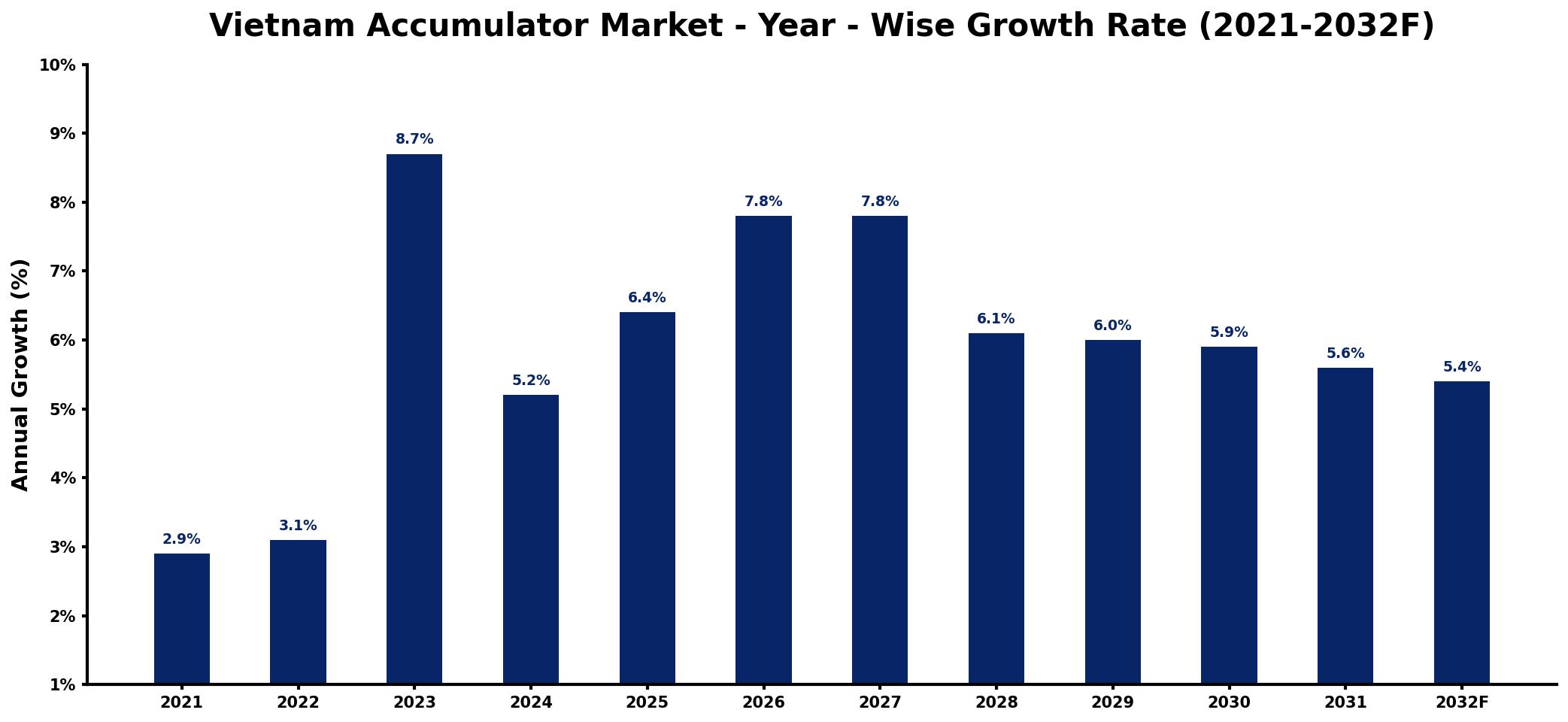
The table below presents the year‑wise growth rates along with the key drivers influencing the market
| Year | Growth Rate | Major Drivers |
| 2021 | 2.9% | Rising energy storage requirements |
| 2022 | 3.1% | Increased renewable energy investments |
| 2023 | 8.7% | Growing electric vehicle adoption |
| 2024 | 5.2% | Expansion of industrial applications |
| 2025 | 6.4% | Surge in smart grid technologies |
| 2026 | 7.8% | Enhanced consumer electronics demand |
| 2027 | 7.8% | Development of large scale projects |
| 2028 | 6.1% | Boost in residential energy solutions |
| 2029 | 6.0% | Emergence of innovative technologies |
| 2030 | 5.9% | growing automotive sector requirements |
| 2031 | 5.6% | Growing demand for backup systems |
| 2032 | 5.4% | Increased focus on sustainability initiatives |
Note: Market size estimations and growth projections presented in this report are based on 6Wresearch's proprietary forecasting methodology, utilizing the latest available industry data, government publications, and primary research inputs.
Vietnam Accumulator Market Synopsis
The Vietnam accumulator market has recently gained momentum, fueled by innovative advancements in battery technology and the burgeoning electric vehicle segment. With growing consumer awareness regarding the environmental benefits of rechargeable batteries, the future of this market appears bright.
As industries pivot towards sustainable energy solutions, the demand for accumulators in solar energy storage and backup systems is on the rise. This shift indicates a transformative period ahead for the Vietnam accumulator market, encouraging investments and research into more efficient and eco-friendly battery solutions.
Vietnam Accumulator Market Key Takeaways
- Strong growth driven by automotive and renewable energy sectors.
- Innovative battery technologies improving performance and sustainability.
- Consumer demand for eco-friendly energy storage solutions rising.
- Challenges remain in maintaining quality and cost-effectiveness.
- COVID-19 recovery has shifted focus towards efficiency and sustainability.
Evaluation of Restraints in Vietnam Accumulator Market
Despite the positive outlook, the Vietnam accumulator market faces several constraints that could hinder growth. One significant challenge is the ongoing need for high-quality and durable energy storage solutions, particularly in the context of electric vehicles and renewable energy applications. As consumers expect higher energy density and cost-effectiveness from their accumulators, manufacturers must continuously innovate while managing production costs and adhering to increasingly stringent energy storage regulations. Additionally, the rapid evolution of accumulator technologies presents a challenge for market players to keep pace with the latest advancements and sustainability standards, which may require substantial investment and adaptation strategies.
Vietnam Accumulator Market Trends
Key trends shaping the Vietnam accumulator market include advancements in battery chemistries, such as lithium-ion and solid-state technologies, which enhance performance metrics like charging speed and lifespan. Moreover, the rising trend of energy decentralization, with consumers adopting home solar systems, creates significant demand for effective storage solutions. Digitalization also plays a role as smart technologies integrate with batteries, optimizing energy management. These trends illustrate a market in transformation, driven by technological innovation and a growing commitment to sustainability.
Vietnam Accumulator Market Opportunities
The Vietnam accumulator market presents robust opportunities for growth and investment. The increasing adoption of electric vehicles opens new avenues for accumulator manufacturers to provide specialized battery solutions tailored to automotive needs. Additionally, the push for solar energy integration across residential and commercial sectors offers significant potential for energy storage applications. Companies that can innovate and develop cost-effective, high-performance accumulators will likely gain a competitive edge in this evolving landscape, highlighting the critical importance of R&D in capturing market share.
Government Initiatives in the Vietnam Accumulator Market
The Vietnamese government is actively supporting the growth of the accumulator market through various initiatives aimed at promoting renewable energy and sustainable technologies. Policies encouraging the adoption of electric vehicles and investments in green technologies are pivotal. Additionally, public spending on infrastructure to support renewable energy solutions and energy-efficient technologies helps to create a favorable environment for manufacturers. These initiatives reflect a broader commitment to achieving sustainability goals and enhancing the overall energy landscape in Vietnam.
Future Insights of the Vietnam Accumulator Market
Looking ahead to 2026-2032, the Vietnam accumulator market is poised for significant evolution. The continued expansion of electric vehicle adoption and solar energy solutions will serve as primary growth drivers. As technology advances, we can expect to see more efficient, longer-lasting batteries that align with consumer expectations for sustainability. Moreover, the integration of digital tools to enhance energy management will further revolutionize how accumulators are utilized across various sectors, ultimately supporting a more resilient and eco-friendly energy ecosystem in Vietnam.
Vietnam Accumulator Market Latest Developments (2025 - 2026)
The Vietnam accumulator market has seen several notable developments in recent months, with industry players focusing on expanding production capabilities and improving battery technologies. Collaborations between private companies and research institutions are increasingly common, aimed at developing next-generation energy storage solutions. Moreover, heightened consumer awareness and government incentives are driving investments into innovative accumulator projects, underscoring a commitment to advancing the industry while prioritizing environmental sustainability.
Vietnam Accumulator Market - Key Attractiveness of the Report
- 10 Years of Market Numbers
- Historical Data Starting from 2022 to 2025
- Base Year: 2025
- Forecast Data until 2032
- Key Performance Indicators Impacting the Market
- Major Upcoming Developments and Projects
Key Highlights of the Report:
- Vietnam Accumulator Market Outlook
- Market Size of Vietnam Accumulator Market, 2025
- Forecast of Vietnam Accumulator Market, 2032
- Historical Data and Forecast of Vietnam Accumulator Revenues & Volume for the Period 2022-2032F
- Vietnam Accumulator Market Trend Evolution
- Vietnam Accumulator Market Drivers and Challenges
- Vietnam Accumulator Price Trends
- Vietnam Accumulator Porter's Five Forces
- Vietnam Accumulator Industry Life Cycle
- Historical Data and Forecast of Vietnam Accumulator Market Revenues & Volume By Type for the Period 2022-2032F
- Historical Data and Forecast of Vietnam Accumulator Market Revenues & Volume By Bladder Accumulator for the Period 2022-2032F
- Historical Data and Forecast of Vietnam Accumulator Market Revenues & Volume By Piston Accumulator for the Period 2022-2032F
- Historical Data and Forecast of Vietnam Accumulator Market Revenues & Volume By Diaphragm Accumulator for the Period 2022-2032F
- Historical Data and Forecast of Vietnam Accumulator Market Revenues & Volume By Application for the Period 2022-2032F
- Historical Data and Forecast of Vietnam Accumulator Market Revenues & Volume By Automobile Industry for the Period 2022-2032F
- Historical Data and Forecast of Vietnam Accumulator Market Revenues & Volume By Construction and Agricultural for the Period 2022-2032F
- Historical Data and Forecast of Vietnam Accumulator Market Revenues & Volume By Machinery for the Period 2022-2032F
- Historical Data and Forecast of Vietnam Accumulator Market Revenues & Volume By Plastics Industry for the Period 2022-2032F
- Historical Data and Forecast of Vietnam Accumulator Market Revenues & Volume By Marine Industry for the Period 2022-2032F
- Historical Data and Forecast of Vietnam Accumulator Market Revenues & Volume By Oil and Gas Industry for the Period 2022-2032F
- Historical Data and Forecast of Vietnam Accumulator Market Revenues & Volume By Sales Channel for the Period 2022-2032F
- Historical Data and Forecast of Vietnam Accumulator Market Revenues & Volume By Direct Channel for the Period 2022-2032F
- Historical Data and Forecast of Vietnam Accumulator Market Revenues & Volume By Indirect Channel for the Period 2022-2032F
- Vietnam Accumulator Import Export Trade Statistics
- Market Opportunity Assessment By Type
- Market Opportunity Assessment By Application
- Market Opportunity Assessment By Sales Channel
- Vietnam Accumulator Top Companies Market Share
- Vietnam Accumulator Competitive Benchmarking By Technical and Operational Parameters
- Vietnam Accumulator Company Profiles
- Vietnam Accumulator Key Strategic Recommendations






































