Vietnam Acephate Market Growth Rate
According to 6Wresearch internal databases and industry insights, the Vietnam Acephate Market is projected to grow at a compound annual growth rate (CAGR) of 4.12% during the forecast period 2026–2032.
Vietnam Acephate Market Year-wise Growth Rate and Key Drivers (2022–2032)
This graph illustrates the annual growth pattern of the Vietnam Acephate Market from 2022 to 2032, highlighting a steady upward trajectory and projected market expansion over the forecast period.
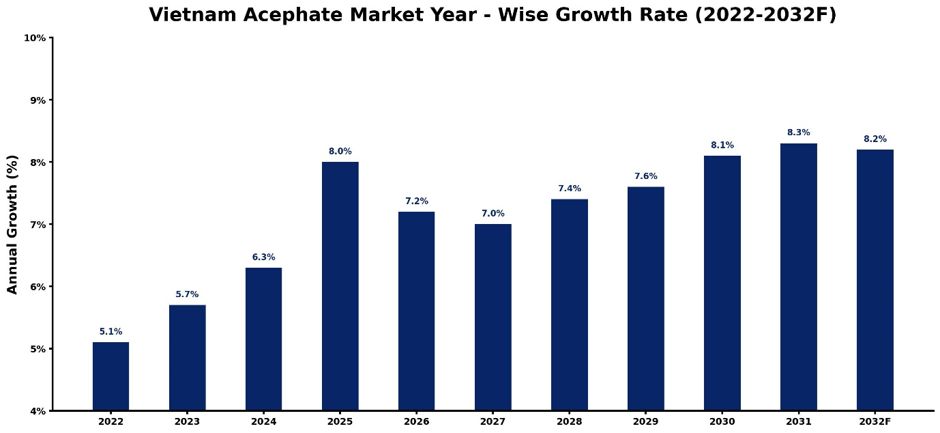
The following table summarizes the historical and forecasted growth rates of the Vietnam Acephate Market, along with the rationale behind each year’s performance.
| Year | Estimated Growth (%) | Market Rationale |
| 2022 | 5.1% | Recovery in agricultural production increased insecticide consumption across major crop regions. |
| 2023 | 5.7% | Development of fruit and vegetable exports encouraged greater pest management practices. |
| 2024 | 6.3% | Rising incidence of insect infestations supported higher insecticide applications. |
| 2025 | 8% | Increased cultivation of rice, coffee, and horticultural crops boosted acephate demand. |
| 2026 | 7.2% | Government emphasis on improving crop productivity supported pesticide adoption. |
| 2027 | 7% | Stable agricultural output augment demand despite increasing regulatory oversight. |
| 2028 | 7.4% | Commercial farming investments expanded insecticide utilization across high-value crops. |
| 2029 | 7.6% | Growing demand for export-quality produce encouraged efficient pest control solutions. |
| 2030 | 8.1% | Technological improvements in pesticide application supported market growth. |
| 2031 | 8.3% | Expansion of commercial agriculture sustained insecticide consumption. |
| 2032 | 8.2% | Continued modernization of crop protection practices supported long-term demand. |
Topics Covered in the Vietnam Acephate Market Report
The Vietnam Acephate Market report covers the market by type, application, and end-user. The report provides a comprehensive assessment of current industry trends, growth opportunities, market dynamics, regulatory developments, competitive landscape, and strategic recommendations for industry participants.
Vietnam Acephate Market Highlights
| Report Name | Vietnam Acephate Market |
| Forecast period | 2026-2032 |
| CAGR | 4.12% |
| Growing Sector | Agriculture |
Vietnam Acephate Market Synopsis
The Vietnam Acephate Market is witnessing steady growth due to increased agricultural production, increase in planting of export crops and the need to reduce loss of crops due to infestations. Vietnam is one of the top producers in Southeast Asia of rice, coffee, pepper, fruits, and vegetables, which require efficient measures of crop protection. While the environmental legislation continues to promote the proper use of pesticides, acephate plays an important role in the IPM as an insecticide. Rising investments in commercial farming and improved agricultural productivity are expected to sustain market growth during the forecast period.
Evaluation of Growth Drivers in Vietnam Acephate Market (2026–2032)
Below are some major drivers and their influence on the market dynamics:
| Drivers | Primary Segment Affected | Why It Matters (Evidence) |
| Expansion of commercial crop cultivation | Agriculture | Larger cultivated areas increase demand for effective insecticides. |
| Rising pest infestation levels | Spray | Frequent pest outbreaks require regular crop protection applications. |
| Growth in export-oriented horticulture | Agriculture | Export-quality produce requires improved pest management practices. |
| Adoption of integrated pest management | Organo Phosphorus | Farmers continue using systemic insecticides within IPM programs. |
| Modernization of farming practices | Commercial | Precision of mechanical farming helps in proper use of pesticides. |
The Vietnam Acephate Market is expected to record stable growth, exhibiting a CAGR of nearly 4.12% throughout the forecast period (2026-2032), due to the rising demand for food production, increased commercial farming, and increased awareness regarding yield optimization of crops. The agriculture sector plays an important role in the economy of Vietnam, motivating the farmers to adopt pest management systems. Although regulatory authorities continue promoting safer pesticide use and integrated pest management, acephate remains an important solution for controlling economically damaging insect populations across several high-value crops.
Evaluation of Restraints in Vietnam Acephate Market
Below are some major restraints and their influence on the market dynamics:
| Restraints | Primary Segment Affected | What This Means (Evidence) |
| Tightening pesticide regulations | Organo Phosphorus | Regulatory reviews may limit usage under certain agricultural conditions. |
| Growing preference for bio-pesticides | Natural Sources | Farmers are gradually adopting environmentally friendly alternatives. |
| Environmental residue concerns | Agriculture | The increased emphasis on sustainability in agricultural practices affects pesticide choice. |
| Export residue compliance requirements | Commercial | stringent MRL rules in international markets dictate proper pesticide management. |
| Farmer awareness regarding safe handling | Spray | Malpractice may result in inefficiency and risks. |
Vietnam Acephate Market Challenges
The Vietnam acephate industry faces challenges associated with stricter environmental regulations, increasing adoption of biological crop protection products, and growing export requirements concerning pesticide residue levels. International buyers are demanding greater compliance with maximum residue limits (MRLs), requiring farmers to optimize pesticide application schedules. Additionally, sustainable agriculture initiatives encourage reduced dependence on conventional organophosphorus insecticides, prompting manufacturers to invest in safer formulations and responsible usage programs.
Vietnam Acephate Market Trends
Prominent trends include:
- Surge in IPM practices – IPM practice involves a combination of chemicals and biological control of pests in order to enhance crop protection without using excessive pesticides.
- Increase in demand from fruit and vegetables – The export-oriented horticulture segment remains a driver for the demand for insecticides owing to quality standards.
- Adoption of precision agriculture – GPS controlled spraying equipment and pesticide applications by drones have become more efficient.
- Better-trained farmers – Extension services provide growers with knowledge on how to use pesticides responsibly and manage resistance.
- Safer formulations development – Manufacturers focus on formulating products that ensure high efficacy and minimum environmental burden.
Investment Opportunities in the Vietnam Acephate Market
Some strategic opportunities present in the Vietnam Acephate Market are mentioned below:
- Investment in Precision Spraying Technologies – The growing adoption of precision agriculture in Vietnam creates opportunities for investments in drone-based pesticide application systems, GPS-guided sprayers, and smart spraying equipment.
- Development of Digital Crop Protection Solutions – Investors can capitalize on integrated precision farming platforms that combine weather forecasting, pest monitoring, and optimized acephate application recommendations.
- Farmer Training and Capacity Building Programs – Investment in farmer education initiatives focusing on proper pesticide application, dosage management, and safe handling practices can improve product effectiveness while strengthening brand credibility.
Top 5 Leading Players in Vietnam Acephate Market
Given below is a list of players operating in the Vietnam Acephate Market:
1. ADAMA Vietnam
| Company Name | ADAMA Vietnam |
| Established Year | 1945 |
| Headquarters | Airport City, Israel |
| Official Website | Click Here |
ADAMA supports Vietnamese farmers with pest management solutions designed to improve agricultural productivity across rice, vegetables, and commercial crops.
2. Bayer Vietnam
| Company Name | Bayer Vietnam |
| Established Year | 1863 |
| Headquarters | Leverkusen, Germany |
| Official Website | Click Here |
Bayer Vietnam provides advanced crop protection technologies, integrated pest management solutions, and farmer advisory services. Its agricultural portfolio supports sustainable farming and high-quality crop production.
3. Syngenta Vietnam
| Company Name | Syngenta Vietnam |
| Established Year | 2000 |
| Headquarters | Basel, Switzerland |
| Official Website | Click Here |
Syngenta Vietnam works closely with growers to improve crop health and pest resistance management.
4. BASF Vietnam
| Company Name | BASF Vietnam |
| Established Year | 1865 |
| Headquarters | Ludwigshafen, Germany |
| Official Website | Click Here |
BASF develops innovative crop protection products and sustainable agricultural technologies that improve farm productivity while supporting environmental stewardship across Vietnam's agricultural sector.
5. UPL Vietnam
| Company Name | UPL Vietnam |
| Established Year | 1969 |
| Headquarters | Mumbai, India |
| Official Website | Click Here |
UPL focuses on improving crop yields through effective pest management and farmer support programs.
Government Initiatives being implemented in the Vietnam Acephate Market
The Vietnamese government also seeks to develop sustainable agriculture by means of the National Action Plan on Integrated Pest Management (IPM), which encourages the effective use of pesticides while minimizing their overuse. The Ministry of Agriculture and Environment conducts educational programs on the proper handling of pesticides as well as the adherence to international maximum residue levels (MRLs) for the export of agricultural products. Furthermore, strategies developed for the development of sustainable agriculture include precision farming and crop protection practices.
Future Insights of the Vietnam Acephate Market
The Vietnam Acephate Market is expected to experience moderate yet stable expansion through 2032, supported by rising food production requirements, increasing commercial agriculture, and continuous improvements in crop protection practices. While biological pesticides will gradually gain market share, acephate is likely to remain an important solution for managing economically significant insect pests in several crop categories. Future growth will depend on responsible pesticide stewardship, technological advancements in application systems, and compliance with evolving environmental regulations.
Market Segmentation Analysis
This report offers a comprehensive study of the following market segments and their leading categories:
By Type – Organo Phosphorus Dominates the Market
According to Sumit Sagar, Senior Research Analyst, 6Wresearch, Organo Phosphorus insecticides represented approximately 63.8% of the market revenue in 2025, primarily due to their proven effectiveness against a broad spectrum of insect pests, systemic mode of action, and widespread adoption across rice, coffee, fruit, and vegetable cultivation. The Organo Phosphorus segment is projected to grow at a CAGR of 4.12% during 2026–2032, supported by continued demand for reliable crop protection solutions despite increasing emphasis on integrated pest management.
By Application – Spray Leads the Market
The Spray application segment captured nearly 78.4% of market revenue in 2025, owing to its operational convenience, compatibility with conventional and precision spraying equipment, and widespread use across large-scale agricultural fields. The Spray segment is anticipated to expand at a CAGR of 4.35% through 2032, driven by increasing adoption of mechanized spraying technologies, drone-assisted pesticide application, and commercial farming practices.
By End-User – Agriculture Holds the Largest Market Share
Agricultural sector accounted for the largest market segment of around 85.6% of revenues in 2025 in the Vietnam acephate market share owing to the wide plantation of various crops such as rice, coffee, vegetables, fruits, and others which require pest control from time to time. Agricultural sector is anticipated to register a CAGR of 4.48% during 2026-2032 on account of growing investments in commercial agriculture and productivity enhancement initiatives.
Note: Market size estimations and growth projections presented in this report are based on 6Wresearch's advanced forecasting approach, validated with industry datasets as of June 2026.
Key Attractiveness of the Report
- 10 Years of Market Numbers
- Historical Data Starting from 2022 to 2025
- Base Year: 2025
- Forecast Data until 2032
- Key Performance Indicators Impacting the Market
Key Highlights of the Report:
- Vietnam Acephate Market Outlook
- Market Size of Vietnam Acephate Market, 2025
- Forecast of Vietnam Acephate Market, 2032
- Historical Data and Forecast of Vietnam Acephate Revenues & Volume for the Period 2022 - 2032
- Vietnam Acephate Market Trend Evolution
- Vietnam Acephate Market Drivers and Challenges
- Vietnam Acephate Price Trends
- Vietnam Acephate Porter's Five Forces
- Vietnam Acephate Industry Life Cycle
- Historical Data and Forecast of Vietnam Acephate Market Revenues & Volume By Type for the Period 2022 - 2032
- Historical Data and Forecast of Vietnam Acephate Market Revenues & Volume By Organo Chlorine for the Period 2022 - 2032
- Historical Data and Forecast of Vietnam Acephate Market Revenues & Volume By Organo Phosphorus for the Period 2022 - 2032
- Historical Data and Forecast of Vietnam Acephate Market Revenues & Volume By Carbamate for the Period 2022 - 2032
- Historical Data and Forecast of Vietnam Acephate Market Revenues & Volume By Arsenicals for the Period 2022 - 2032
- Historical Data and Forecast of Vietnam Acephate Market Revenues & Volume By Natural Sources for the Period 2022 - 2032
- Historical Data and Forecast of Vietnam Acephate Market Revenues & Volume By Others for the Period 2022 - 2032
- Historical Data and Forecast of Vietnam Acephate Market Revenues & Volume By Application for the Period 2022 - 2032
- Historical Data and Forecast of Vietnam Acephate Market Revenues & Volume By Spray for the Period 2022 - 2032
- Historical Data and Forecast of Vietnam Acephate Market Revenues & Volume By Dipping Vat for the Period 2022 - 2032
- Historical Data and Forecast of Vietnam Acephate Market Revenues & Volume By Hand Dressing for the Period 2022 - 2032
- Historical Data and Forecast of Vietnam Acephate Market Revenues & Volume By Others for the Period 2022 - 2032
- Historical Data and Forecast of Vietnam Acephate Market Revenues & Volume By End-User for the Period 2022 - 2032
- Historical Data and Forecast of Vietnam Acephate Market Revenues & Volume By Agriculture for the Period 2022 - 2032
- Historical Data and Forecast of Vietnam Acephate Market Revenues & Volume By Animal Husbandry for the Period 2022 - 2032
- Historical Data and Forecast of Vietnam Acephate Market Revenues & Volume By Commercial for the Period 2022 - 2032
- Historical Data and Forecast of Vietnam Acephate Market Revenues & Volume By Others for the Period 2022 - 2032
- Vietnam Acephate Import Export Trade Statistics
- Market Opportunity Assessment By Type
- Market Opportunity Assessment By Application
- Market Opportunity Assessment By End-User
- Vietnam Acephate Top Companies Market Share
- Vietnam Acephate Competitive Benchmarking By Technical and Operational Parameters
- Vietnam Acephate Company Profiles
- Vietnam Acephate Key Strategic Recommendations
Market Covered
The report offers an extensive study of the following market segments:
By Type
- Organo Chlorine
- Organo Phosphorus
- Carbamate
- Arsenicals
- Natural Sources
- Others
By Application
- Spray
- Dipping Vat
- Hand Dressing
- Others
By End-User
- Agriculture
- Animal Husbandry
- Commercial
- Others






































