Vietnam Acoustic Guitar Market Size, Share & Growth Rate
The Vietnam Acoustic Guitar Market was estimated at USD 288 Million in 2025 and is projected to reach USD 408 Million by 2032, growing at a CAGR of 5.1% from 2026 to 2032. This growth trajectory is underscored by a deepening passion for music among the Vietnamese populace, driven by music education programs and cultural events that foster an appreciation for musical instruments. Additionally, the surge in local and international music festivals is propelling the demand for acoustic guitars, making them increasingly accessible and desirable.
Vietnam Acoustic Guitar Market Year-wise Growth Rate and Key Drivers
This graph highlights how the Vietnam Acoustic Guitar Market has steadily grown over the years, supported by major growth factors.
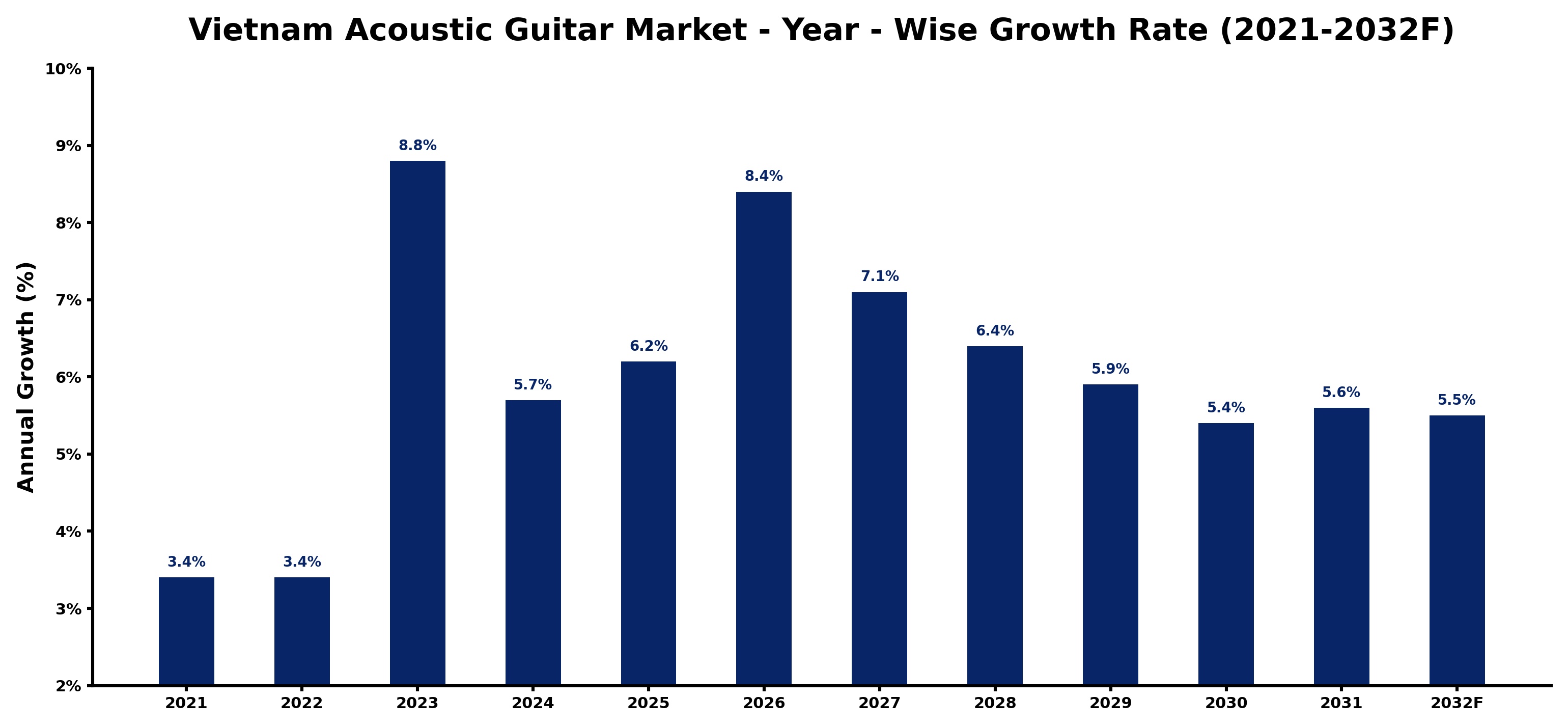
The table below presents the year‑wise growth rates along with the key drivers influencing the market
| Year | Growth Rate | Major Drivers |
| 2021 | 3.4% | Domestic guitar factories upgrade machinery for export competitiveness growth |
| 2022 | 3.4% | Technology integration enhances efficiency in acoustic guitar manufacturing processes |
| 2023 | 8.8% | Foreign investment in guitar manufacturing enhances export capabilities |
| 2024 | 5.7% | Export demand for musical instruments fueled local production capacity |
| 2025 | 6.2% | Skilled labor availability boosts Vietnam's acoustic guitar export capacity |
| 2026 | 8.4% | Foreign investment bolstered acoustic guitar production technology adoption |
| 2027 | 7.1% | Foreign investment influx boosts guitar manufacturing capacity and exports |
| 2028 | 6.4% | Local wood sourcing boosted acoustic guitar production capabilities |
| 2029 | 5.9% | Strategic foreign investment bolstered Vietnam's guitar manufacturing capacity |
| 2030 | 5.4% | Advanced CNC machinery adoption boosts precision acoustic guitar production |
| 2031 | 5.6% | Domestic wood processing upgrades boost acoustic guitar export capacity |
| 2032 | 5.5% | Investment in skilled labor boosts acoustic guitar manufacturing capacity |
Note - Market size estimations and growth projections presented in this report are based on 6Wresearch’s advanced forecasting approach, validated with industry datasets as of June 2026.
Vietnam Acoustic Guitar Market Synopsis
Recent momentum in the Vietnam Acoustic Guitar Market highlights a vibrant interplay between tradition and modernity. As both amateur and professional musicians flock to embrace the acoustic guitar's versatility, the market is witnessing a renaissance fueled by a cultural shift toward music-making as a popular leisure activity. Looking ahead, the market is set to experience a robust expansion as the interest in music continues to burgeon, creating ample opportunities for industry players.
While the pandemic temporarily disrupted the market, a shift in consumer behavior toward home-based music activities has emerged, signaling resilience in demand. This duality of recent challenges and brightening prospects offers a complex yet promising picture for stakeholders keen on tapping into the Vietnamese acoustic guitar landscape.
Vietnam Acoustic Guitar Market Key Takeaways
- The market is driven by a growing passion for music and cultural significance of acoustic guitars among Vietnamese consumers.
- Local manufacturers and international brands are expanding their offerings, catering to diverse consumer preferences.
- Education programs and music events are vital in fostering community engagement and interest in acoustic guitars.
- Despite challenges, there is a persistent demand for innovative designs and quality craftsmanship within the market.
- Overall market recovery post-pandemic indicates a resilient demand for acoustic guitars among enthusiasts.
Evaluation of Restraints in Vietnam Acoustic Guitar Market
Despite promising growth, the Vietnam Acoustic Guitar Market faces notable restraints. The influx of numerous brands leads to intense competition, making differentiation challenging for manufacturers. This saturation often results in a race to the bottom regarding pricing, which can compromise the quality of production. Additionally, manufacturers must innovate continuously to meet consumer expectations for unique features and designs while managing production costs efficiently. Balancing these factors is crucial for maintaining competitive advantage in a rapidly evolving market.
Vietnam Acoustic Guitar Market Trends
Several trends are shaping the Vietnam Acoustic Guitar Market, notably the rise of online music education and digital platforms that facilitate music learning. The use of social media to showcase musical talent is driving a new wave of interest in acoustic guitars. Furthermore, sustainability trends are gaining traction, with a growing number of manufacturers focusing on eco-friendly materials and production methods. These trends indicate a shift towards a more conscious consumer base that values both musical expression and environmental responsibility.
Vietnam Acoustic Guitar Market Opportunities
The market presents genuine growth opportunities, particularly in expanding the range of affordable yet high-quality acoustic guitars to reach a broader audience. Additionally, partnerships with educational institutions to integrate acoustic guitar programs can further embed the instrument in the cultural fabric of Vietnam. Emphasizing local craftsmanship and unique design elements can also attract discerning consumers seeking authenticity in their musical instruments. These strategies could significantly enhance market penetration and boost brand loyalty.
Government Initiatives in the Vietnam Acoustic Guitar Market
The Vietnamese government has initiated several programs aimed at promoting cultural heritage through music, which inherently supports the acoustic guitar market. Public spending on arts and education has led to an increase in music programs across schools and communities. Additionally, the government has encouraged local craftsmanship by providing incentives for artisans and small manufacturers, fostering an environment where acoustic guitars can thrive as both artistic and cultural expressions.
Future Insights of the Vietnam Acoustic Guitar Market
Looking ahead to the 2026-2032 period, the Vietnam Acoustic Guitar Market is poised for significant evolution. As music continues to weave itself into the daily lives of Vietnamese people, demand for acoustic guitars is expected to rise steadily. Technological advancements in guitar manufacturing and the growing influence of online music platforms will likely reshape consumer preferences, pushing for innovative designs and features. The sustained interest in music education will further solidify the role of acoustic guitars as integral to Vietnam's vibrant musical landscape.
Vietnam Acoustic Guitar Market Latest Developments (May 2025 - June 2026)
Recent developments in the Vietnam Acoustic Guitar Market have focused on enhancing product offerings and distribution channels. Companies are increasingly adopting digital platforms for direct sales, which have gained traction amid changing consumer behaviors. Concurrently, there's a surge in collaborations with music influencers to promote acoustic guitars, reflecting a strategic shift toward engaging younger audiences. These trends are indicative of a market that is adapting rapidly to both consumer demands and technological advancements.
Vietnam Acoustic Guitar Market - Key Attractiveness of the Report
- 10 Years of Market Numbers
- Historical Data Starting from 2022 to 2025
- Base Year: 2025
- Forecast Data until 2032
- Key Performance Indicators Impacting the Market
- Major Upcoming Developments and Projects
Key Highlights of the Report:
- Vietnam Acoustic Guitar Market Outlook
- Market Size of Vietnam Acoustic Guitar Market, 2025
- Forecast of Vietnam Acoustic Guitar Market, 2032
- Historical Data and Forecast of Vietnam Acoustic Guitar Revenues & Volume for the Period 2022-2032F
- Vietnam Acoustic Guitar Market Trend Evolution
- Vietnam Acoustic Guitar Market Drivers and Challenges
- Vietnam Acoustic Guitar Price Trends
- Vietnam Acoustic Guitar Porter's Five Forces
- Vietnam Acoustic Guitar Industry Life Cycle
- Historical Data and Forecast of Vietnam Acoustic Guitar Market Revenues & Volume By Product for the Period 2022-2032F
- Historical Data and Forecast of Vietnam Acoustic Guitar Market Revenues & Volume By Nylon/gut Stringed Guitars for the Period 2022-2032F
- Historical Data and Forecast of Vietnam Acoustic Guitar Market Revenues & Volume By Steel Stringed Guitars for the Period 2022-2032F
- Historical Data and Forecast of Vietnam Acoustic Guitar Market Revenues & Volume By Other for the Period 2022-2032F
- Historical Data and Forecast of Vietnam Acoustic Guitar Market Revenues & Volume By Application for the Period 2022-2032F
- Historical Data and Forecast of Vietnam Acoustic Guitar Market Revenues & Volume By Perform for the Period 2022-2032F
- Historical Data and Forecast of Vietnam Acoustic Guitar Market Revenues & Volume By Teaching for the Period 2022-2032F
- Historical Data and Forecast of Vietnam Acoustic Guitar Market Revenues & Volume By Other for the Period 2022-2032F
- Vietnam Acoustic Guitar Import Export Trade Statistics
- Market Opportunity Assessment By Product
- Market Opportunity Assessment By Application
- Vietnam Acoustic Guitar Top Companies Market Share
- Vietnam Acoustic Guitar Competitive Benchmarking By Technical and Operational Parameters
- Vietnam Acoustic Guitar Company Profiles
- Vietnam Acoustic Guitar Key Strategic Recommendations






































