Vietnam Acrylic Sheet Market Growth Rate
According to 6Wresearch internal databases and industry insights, the Vietnam Acrylic Sheet Market is projected to grow at a steady compound annual growth rate (CAGR) of 6.85% during the forecast period 2026–2032.
Vietnam Acrylic Sheet Market Year-wise Growth Rate and Key Drivers (2022-2032)
This graph illustrates the annual growth rates of the Vietnam Acrylic Sheet Market from 2022 to 2032, highlighting a steady upward trajectory and projected market expansion over the forecast period.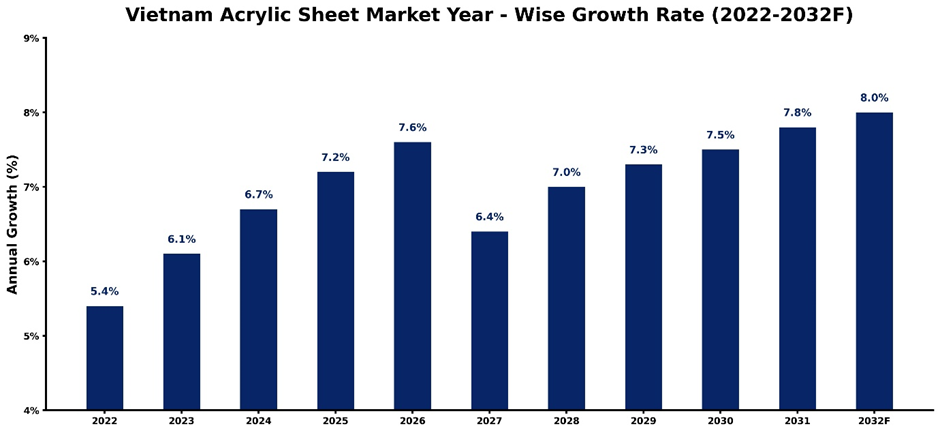
The following table summarizes the historical and forecasted growth rates of the Vietnam Acrylic Sheet Market, along with the rationale behind each year’s performance:
| Years | Estimated Growth (%) | Market Rationale |
| 2022 | 5.4% | Post-pandemic supply chain normalization and rebound in commercial interior fit-outs across Hanoi and Ho Chi Minh City. |
| 2023 | 6.1% | Surge in out-of-home (OOH) advertising displays and retail store renovations in major urban centers. |
| 2024 | 6.7% | Expansion of the electronics manufacturing cluster in Northern Vietnam driving demand for static-dissipative PMMA sheets. |
| 2025 | 7.2% | Rising residential glazing and skylight construction under energy-efficient building standard initiatives. |
| 2026 | 7.6% | High demand for cell cast sheets in premium architectural facades and sanitary ware manufacturing. |
| 2027 | 6.4% | Temporary price adjustments following global feedstock (MMA monomer) cost realignments. |
| 2028 | 7% | Increased adoption of UV-resistant extruded sheets in public transportation and infrastructure projects. |
| 2029 | 7.3% | Rapid rollout of modern Quick Service Restaurants (QSR) and illuminated retail signage networks. |
| 2030 | 7.5% | Acceleration in green building certifications favoring lightweight, recyclable acrylic glazing over glass. |
| 2031 | 7.8% | Strategic shift toward high-impact automotive exterior and interior trim components. |
| 2032 | 8% | Maturation of local casting plants with high-volume export capabilities into regional ASEAN markets. |
Topics Covered in the Vietnam Acrylic Sheet Market Report
The Vietnam Acrylic Sheet Market Report provides a comprehensive analysis based on Technology, Application, and End User. It offers detailed insights into key industry trends, growth drivers, emerging opportunities, competitive developments, and high-growth segments. The report presents an objective assessment of current dynamics and future prospects, enabling stakeholders to make informed business decisions and develop effective strategies aligned with the evolving industry landscape.
Vietnam Acrylic Sheet Market Highlights
| Report Name | Vietnam Acrylic Sheet Market |
| Forecast period | 2026-2032 |
| CAGR | 6.85% |
| Growing Sector | Architecture & Construction |
Vietnam Acrylic Sheet Market Synopsis
The Vietnam Acrylic Sheet Market consists of PMMA (polymethyl methacrylate) thermoplastic sheets produced through cell casting, continuous casting, or extrusion techniques. Highly prized for their optical transparency (capable of transmitting up to 92% of visible light), low weight (1/2 the weight of glass), excellent toughness, and weathering capability, acrylic sheets play a key role as a building material in architecture, communication, and manufacturing. The market is experiencing structural growth as a result of changes in its infrastructure and industrial development.
Evaluation of Growth Drivers in Vietnam Acrylic Sheet Market (2026–2032)
Below are major growth drivers and their influence on market dynamics:
| Drivers | Primary Segment Affected | Why It Matters (Evidence) |
| Urban Construction & Infrastructure Boom | Architecture & Construction | Vietnam’s urban construction sector expanding at over 7.2% annually, driving demand for shatterproof glazing. |
| Expansion of Organized Retail & Signage | Visual Comm. & Retail | Retail space expansion in tier-1 cities fueling high demand for edge-lit LED acrylic panels. |
| Growth of Electronics Manufacturing | Electronics & Energy | Tech hubs in Bac Ninh and Binh Duong requiring anti-static acrylic covers for precision assembly lines. |
| Emergence of Domestic Sanitaryware Facilities | Sanitary Ware | Local sanitaryware producers shifting to vacuum-formed cross-linked acrylic sheets for bathtubs. |
| Transition to Lightweight Transportation | Automotive & Transportation | Vehicle assembly plants adopting high-impact PMMA for lighting covers and interior trim panels. |
Vietnam Acrylic Sheet Market is projected to grow at a CAGR of 6.85% during 2026–2032. This growth trajectory is strongly anchored by macro-economic indicators, including country’s projected annual GDP growth rate of 6.3% to 6.8%, an urbanization rate reaching nearly 45% by 2030, and foreign direct investment (FDI) disbursements exceeding to a massive rate. Additionally, there has been an 8.1% rise in the construction production within the industrial sector in Vietnam on a yearly basis, contributing to the need for weather-resistant plastic sheets. On the other hand, there is 12.5% annual growth in QSRs in urban centers, which translates to high use of thermoformed acrylic signs.
Evaluation of Restraints in Vietnam Acrylic Sheet Market
Below are major restraints impacting market development:
| Restraints | Primary Segment Affected | What This Means (Evidence) |
| Feedstock Volatility (MMA Pricing) | Extruded Acrylic Sheets | Raw Methyl Methacrylate (MMA) resin costs fluctuate with global crude oil prices, straining fabricator margins. |
| Competition from Polycarbonate Substitutes | Architecture & Construction | High-impact polycarbonate sheets challenge acrylic in extreme thermal or ballistic application niches. |
| Dependence on Imported Chemical Monomers | Cell Cast Acrylic Sheets | Domestic casting lines rely heavily on raw MMA monomer imports from Taiwan, Japan, and South Korea. |
| Surge in Low-Grade Recycled Imports | Visual Comm. & Retail | Unregulated low-cost recycled sheets cause quality inconsistency in outdoor signage applications. |
| Environmental & Microplastic Regulations | Electronics & Energy | Stricter industrial waste management policies increasing recycling overheads for plastic processing units. |
Vietnam Acrylic Sheet Market Challenges
A key challenge confronting the Vietnam Acrylic Sheet Market is the intense cost sensitivity combined with raw material vulnerability. Since local production facilities rely on imported Methyl Methacrylate (MMA) petrochemical feedstock, price fluctuations in global crude oil where raw MMA prices can swing up to 18–22% within a single fiscal quarter severely impact small and medium fabricator margins.
Additionally, Vietnam’s industrial recycling rate for engineering plastics remains under 15%, leaving processing plants vulnerable to upcoming green procurement mandates under Vietnam’s National Action Plan on Sustainable Consumption and Production. The market is also faced with elevated freight rates, where the costs of transporting heavy plastic sheets rose by 14% on a yearly basis during periods of supply chain disruption, shrinking profit margin for regional distributors.
Vietnam Acrylic Sheet Market Trends
Key trends shaping the Vietnam acrylic sheet market growth are outlined below:
- Adoption of Cast Acrylic in Architectural Facades: Architects are now replacing conventional heavy plates of glass with UV treated and solar tinted cell cast acrylics panels which cut the structure's dead weight by 50% and are better in terms of sound damping and light diffusion in modern high-rise buildings.
- Integration of LED-Guiding Light Panels (LGP): The emergence of smart cities and digital signs is driving the need for special micro-patterned acrylic sheets that can be used in edge-lit LED panels, ensuring uniform lighting with energy savings of 30%.
- Expansion of In-House Thermoforming Capabilities: Sign manufacturing and furniture businesses in Vietnam are purchasing CNC router machines and thermoforming equipment, thereby fueling the demand for cast acrylic sheets that can be drawn using vacuum molding without causing crazing on the sheet surface.
Investment Opportunities in the Vietnam Acrylic Sheet Market
Potential investment opportunities in the Vietnam Acrylic Sheet Market include the following:
- Development of Anti-Glare & Scratch-Resistant Hard-Coated Sheets: Establishing hard-coating lines in Northern industrial zones presents high-value growth, supplying customized anti-reflective panels for consumer electronics and automotive instrument displays assembled locally.
- Local Production of Sanitary-Grade Cross-Linked Acrylic: Creating cross-linked sanitary cast acrylic sheets in Vietnam to cater to the growing demand from local sanitary-ware producers as a result of real estate boom.
- Regional Distribution Centers in Southern Industrial Corridors: Development of fabrication and logistics centers in Binh Duong and Long An provinces to cater to exports in Thailand, Cambodia and ASEAN bloc.
Top Players in Vietnam Acrylic Sheet Market
The following is a comprehensive list of key companies operating in the Vietnam Acrylic Sheet Market:
1. Cheng Hung Co., Ltd.
| Company Name | Cheng Hung Co., Ltd. |
| Established Year | 1987 |
| Headquarters | Binh Duong Province, Vietnam |
| Official Website | Click Here |
Cheng Hung Co., Ltd. produces clear, colored, frosted, and specialty acrylic sheets for applications including advertising, signage, lighting, architecture, and industrial fabrication.
2. Cho Chen Industry Co., Ltd.
| Company Name | Cho Chen Industry Co., Ltd. |
| Established Year | 1977 |
| Headquarters | Taiwan (Vietnam manufacturing facility in Dong Nai Province) |
| Official Website | Click Here |
The company specializes in high-clarity acrylic sheets, translucent sheets, colored panels, and customized acrylic solutions for architectural, display, signage, and industrial applications.
3. Mitsubishi Chemical Group (SHINKOLITE™ Acrylic Sheet)
| Company Name | Mitsubishi Chemical Group (SHINKOLITE™ Acrylic Sheet) |
| Established Year | 1933 |
| Headquarters | Tokyo, Japan |
| Official Website | Click Here |
The company provides continuous cast and extruded acrylic sheets for high-end display panels, optical applications, lighting systems, architectural glazing, and industrial uses in Vietnam.
4. Evonik Industries (PLEXIGLAS® Acrylic Products)
| Company Name | Evonik Industries (PLEXIGLAS® Acrylic Products) |
| Established Year | — |
| Headquarters | Essen, Germany |
| Official Website | Click Here |
Evonik supplies high-performance acrylic materials for architectural, automotive, aviation, lighting, and industrial applications in Vietnam through its international supply network.
Government Initiatives Being Implemented in the Vietnam Acrylic Sheet Market
The Vietnamese government has been promoting the development of the chemical, plastics, and supporting industries under its broader industrialization strategy, encouraging domestic production of advanced materials such as polymers, plastics, and engineered sheets. These initiatives help acrylic sheet manufacturers by improving access to industrial infrastructure, attracting foreign manufacturers, and supporting the growth of downstream sectors such as construction, advertising, automotive components, electronics, and lighting.
One major initiative influencing the acrylic sheet industry is Vietnam’s focus on developing the chemical industry and high-value manufacturing sector. Through strategies such as the Vietnam Chemical Industry Development Strategy to 2030 with a vision toward 2040, the government aims to strengthen domestic chemical production, improve material supply chains, and encourage investment in advanced chemical products.
Future Insights of the Vietnam Acrylic Sheet Market
Vietnam Acrylic Sheet Market is positioned for robust growth, supported by the national master plan to increase industrial manufacturing’s GDP share to over 30%. With per capita plastic sheet consumption in Vietnam projected to grow from 1.2 kg to 2.8 kg over the decade, domestic casting and extrusion capacity will expand significantly. The rapid development of urban metro networks in Hanoi and Ho Chi Minh City—incorporating over 150 km of noise barriers and transit partitions—will generate persistent demand for high-gauge extruded acrylic panels.
Market Segmentation Analysis
This report presents a detailed analysis of the market segments along with their leading categories.
By Technology – Cell Cast Acrylic Sheets Lead Market Share, Extruded Acrylic Sheets to Show the Fastest Growth
Cell Cast Acrylic Sheets secured a dominant 58.60% share of the Vietnam Acrylic Sheet market in 2025. This leading position is anchored by the material’s superior molecular weight, optical clarity (92% light transmission), high thermal stability, and ease of custom fabrication. On the other hand, Extruded Acrylic Sheets are projected to advance at the fastest CAGR of 7.35% during 2026–2032, propelled by their exceptional thickness tolerance, cost-efficiency in high-volume runs, and increasing adoption in automated LED lighting, retail POP displays, and standardized electronic shield covers.
By Application – Architecture & Construction Dominates Usage While Visual Communication & Retail Application to Grow Rapidly
According to Sumit Sagar, Senior Research Analyst, 6Wresearch, Architecture & Construction held the largest market share at 34.20% in 2025, driven by major investments in the infrastructure of Vietnam where architects are choosing acrylic sheets to make skylights, acoustic walls for expressways, facades, and partitions due to its excellent impact strength (17 times more than glass) and light weight. At the same time, the Visual Communication & Retail Application Segment is projected to grow at a CAGR of 7.12% up to 2032 due to growing number of retail chains.
Note: Market size estimations and growth projections presented in this report are based on 6Wresearch's proprietary forecasting methodology, utilizing the latest available industry data, government publications, and primary research inputs.
Key Attractiveness of the Report
- 10 Years of Market Numbers
- Historical Data Starting from 2022 to 2025
- Base Year: 2025
- Forecast Data until 2032
- Key Performance Indicators Impacting the Market
- Major Upcoming Developments and Projects
Key Highlights of the Report:
- Vietnam Acrylic Sheet Market Outlook
- Market Size of Vietnam Acrylic Sheet Market, 2025
- Forecast of Vietnam Acrylic Sheet Market, 2032
- Historical Data and Forecast of Vietnam Acrylic Sheet Revenues & Volume for the Period 2022-2032
- Vietnam Acrylic Sheet Market Trend Evolution
- Vietnam Acrylic Sheet Market Drivers and Challenges
- Vietnam Acrylic Sheet Price Trends
- Vietnam Acrylic Sheet Porter's Five Forces
- Vietnam Acrylic Sheet Industry Life Cycle
- Historical Data and Forecast of Vietnam Acrylic Sheet Market Revenues & Volume By Technology for the Period 2022-2032
- Historical Data and Forecast of Vietnam Acrylic Sheet Market Revenues & Volume By Cell Cast for the Period 2022-2032
- Historical Data and Forecast of Vietnam Acrylic Sheet Market Revenues & Volume By Extruded for the Period 2022-2032
- Historical Data and Forecast of Vietnam Acrylic Sheet Market Revenues & Volume By Continuous Cast for the Period 2022-2032
- Historical Data and Forecast of Vietnam Acrylic Sheet Market Revenues & Volume By Application for the Period 2022-2032
- Historical Data and Forecast of Vietnam Acrylic Sheet Market Revenues & Volume By Architecture & Construction for the Period 2022-2032
- Historical Data and Forecast of Vietnam Acrylic Sheet Market Revenues & Volume By Furniture & Design for the Period 2022-2032
- Historical Data and Forecast of Vietnam Acrylic Sheet Market Revenues & Volume By Automotive & Transportation for the Period 2022-2032
- Historical Data and Forecast of Vietnam Acrylic Sheet Market Revenues & Volume By Visual Comm. & Retail for the Period 2022-2032
- Historical Data and Forecast of Vietnam Acrylic Sheet Market Revenues & Volume By Electronics & Energy for the Period 2022-2032
- Historical Data and Forecast of Vietnam Acrylic Sheet Market Revenues & Volume By Medical for the Period 2022-2032
- Historical Data and Forecast of Vietnam Acrylic Sheet Market Revenues & Volume By Sanitary for the Period 2022-2032
- Vietnam Acrylic Sheet Import Export Trade Statistics
- Market Opportunity Assessment By Technology
- Market Opportunity Assessment By Application
- Vietnam Acrylic Sheet Top Companies Market Share
- Vietnam Acrylic Sheet Competitive Benchmarking By Technical and Operational Parameters
- Vietnam Acrylic Sheet Company Profiles
- Vietnam Acrylic Sheet Key Strategic Recommendations
Market Covered
The report offers an extensive study of the following market segments:
By Technology
- Cell Cast
- Extruded
- Continuous Cast
By Application
- Architecture & Construction
- Furniture & Design
- Automotive & Transportation
- Visual Communication & Retail
- Electronics & Energy
- Medical
- Sanitary






































