Vietnam Active Space Debris Removal Market Size, Share & Growth Rate
The Vietnam Active Space Debris Removal Market was estimated at USD 472 Million in 2025 and is projected to reach USD 671 Million by 2032, growing at a CAGR of 5.2% from 2026 to 2032. This growth trajectory is primarily fueled by Vietnam's burgeoning space program, which is marked by an increase in satellite launches and missions. As the nation escalates its space activities, the imperative to mitigate space debris becomes vital, fostering an urgent need for innovative solutions in active debris removal.
Vietnam Active Space Debris Removal Market Year-wise Growth Rate and Key Drivers
This graph highlights how the Vietnam Active Space Debris Removal Market has steadily grown over the years, supported by major growth factors.
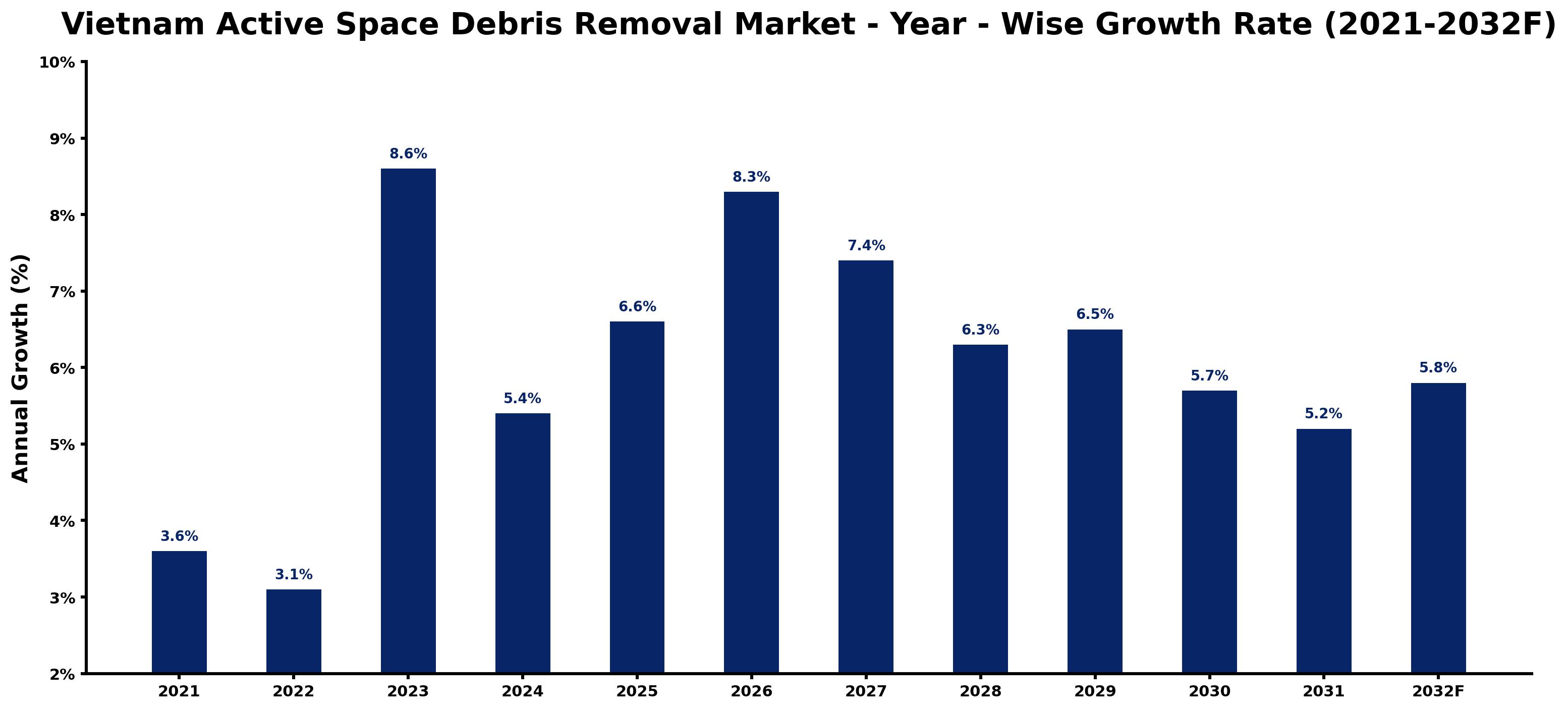
The table below presents the year‑wise growth rates along with the key drivers influencing the market
| Year | Growth Rate | Major Drivers |
| 2021 | 3.6% | Increasing industrial infrastructure investments |
| 2022 | 3.1% | Increasing industrial infrastructure investments |
| 2023 | 8.6% | Government infrastructure modernization initiatives |
| 2024 | 5.4% | Increasing smart city development projects |
| 2025 | 6.6% | Expansion of commercial construction activities |
| 2026 | 8.3% | Expansion of commercial construction activities |
| 2027 | 7.4% | Growing urbanization and commercial development |
| 2028 | 6.3% | Increasing industrial automation investments |
| 2029 | 6.5% | Expansion of commercial construction activities |
| 2030 | 5.7% | Increasing smart city development projects |
| 2031 | 5.2% | Expansion of manufacturing activities |
| 2032 | 5.8% | Expansion of transportation and logistics networks |
Note - Market size estimations and growth projections presented in this report are based on 6Wresearch’s advanced forecasting approach, validated with industry datasets as of June 2026.
Vietnam Active Space Debris Removal Market Synopsis
The Vietnam Active Space Debris Removal market is experiencing significant momentum, reflecting a heightened awareness of the dangers posed by space debris. As the country advances its space initiatives, it is positioning itself to proactively tackle the challenges of debris accumulation. With aspirations to enhance its space capabilities, Vietnam is at the cusp of embracing robust active debris removal technologies.
Looking ahead, Vietnam aims to contribute meaningfully to global efforts in ensuring the sustainability of space operations. Collaborations with international space agencies are pivotal, enabling the transfer of advanced technologies and expertise. These partnerships will be instrumental in developing Vietnam's own space debris removal capabilities and advancing its participation in international frameworks for space governance.
Vietnam Active Space Debris Removal Market Key Takeaways
- The market is driven by an escalating number of satellite launches and a rising volume of space debris.
- Vietnam's commitment to enhancing its indigenous space capabilities is shaping its approach to debris management.
- Partnerships with global space agencies are crucial for technological advancement in debris removal solutions.
- The financial sustainability of active debris removal operations presents ongoing challenges.
- Increased global awareness of space sustainability is promoting investments in active debris removal technologies.
Evaluation of Restraints in Vietnam Active Space Debris Removal Market
While the Vietnam Active Space Debris Removal market shows promise, several restraints limit its growth. One of the primary challenges is the significant capital investment required to develop and deploy effective debris removal technologies. These missions necessitate detailed planning, rigorous testing, and the establishment of a robust operational framework. Additionally, the complexities inherent in international cooperation and coordination impede progress, necessitating diplomatic engagement and technical negotiations among various stakeholders. The high costs associated with these initiatives pose a further constraint, as Vietnam balances budgetary priorities across its broader space exploration objectives.
Vietnam Active Space Debris Removal Market Trends
Emerging trends in the Vietnam Active Space Debris Removal market reflect a growing recognition of the need for innovative solutions. Technologies such as robotic arms, nets, and harpoons are gaining traction for actively capturing and removing debris. The rise of small satellites and emerging space startups is further stimulating a competitive landscape that encourages investment in novel debris removal methods. Furthermore, there is an increasing emphasis on sustainability within the space sector, as stakeholders seek to address environmental concerns and ensure safe operational environments for current and future missions.
Vietnam Active Space Debris Removal Market Opportunities
Significant growth opportunities exist for Vietnam in the active space debris removal domain. By harnessing international expertise, Vietnam can develop advanced technologies tailored to its specific needs. There is also potential for collaboration on research initiatives focused on debris characterization and mitigation strategies. The anticipated increase in satellite launches will not only drive demand for debris removal services but also create a market for related technologies, offering avenues for investment and innovation within the domestic space industry.
Government Initiatives in the Vietnam Active Space Debris Removal Market
The Vietnamese government has recognized the importance of space sustainability and is committed to developing an effective framework for space debris management. Current initiatives focus on enhancing domestic capabilities in space exploration and technology development. By supporting research and fostering partnerships with international organizations, the government aims to position Vietnam as a contributor to global space governance. Investments in space technology infrastructure and education also form part of its broader strategy to strengthen its standing in the international space community.
Future Insights of the Vietnam Active Space Debris Removal Market
As we look toward 2026-2032, the Vietnam Active Space Debris Removal market is poised for substantial growth. With increasing satellite deployments, the urgency for effective debris management solutions will amplify. Ongoing investments in research and development will likely yield advancements in removal technologies and operational strategies. Furthermore, as Vietnam strengthens its collaborative relationships with global space entities, the country will enhance its capabilities and contribute to the broader dialogue on sustainable space practices. The trajectory of this market hinges on innovation, cooperation, and a proactive approach to mitigating space debris.
Vietnam Active Space Debris Removal Market Latest Developments (May 2025 - June 2026)
Recent developments in the Vietnam Active Space Debris Removal market indicate a growing focus on collaboration and technology transfer. Various stakeholders are engaging in discussions to establish partnerships aimed at developing indigenous capabilities. Notable advances in debris capture technologies are being explored, reflecting the global industry's momentum towards ensuring the sustainability of space operations. As Vietnam enhances its participation in international forums, the exchange of knowledge and expertise is expected to accelerate progress in debris management.
Vietnam Active Space Debris Removal Market - Key Attractiveness of the Report
- 10 Years of Market Numbers
- Historical Data Starting from 2022 to 2025
- Base Year: 2025
- Forecast Data until 2032
- Key Performance Indicators Impacting the Market
- Major Upcoming Developments and Projects
Key Highlights of the Report:
- Vietnam Active Space Debris Removal Market Outlook
- Market Size of Vietnam Active Space Debris Removal Market, 2025
- Forecast of Vietnam Active Space Debris Removal Market, 2032
- Historical Data and Forecast of Vietnam Active Space Debris Removal Revenues & Volume for the Period 2022-2032F
- Vietnam Active Space Debris Removal Market Trend Evolution
- Vietnam Active Space Debris Removal Market Drivers and Challenges
- Vietnam Active Space Debris Removal Price Trends
- Vietnam Active Space Debris Removal Porter's Five Forces
- Vietnam Active Space Debris Removal Industry Life Cycle
- Historical Data and Forecast of Vietnam Active Space Debris Removal Market Revenues & Volume By Debris Size for the Period 2022-2032F
- Historical Data and Forecast of Vietnam Active Space Debris Removal Market Revenues & Volume By Between 1 mm and 1 cm for the Period 2022-2032F
- Historical Data and Forecast of Vietnam Active Space Debris Removal Market Revenues & Volume By Between 1 cm to 10 cm for the Period 2022-2032F
- Historical Data and Forecast of Vietnam Active Space Debris Removal Market Revenues & Volume By More than 10 cm for the Period 2022-2032F
- Historical Data and Forecast of Vietnam Active Space Debris Removal Market Revenues & Volume By End-users for the Period 2022-2032F
- Historical Data and Forecast of Vietnam Active Space Debris Removal Market Revenues & Volume By Commercial for the Period 2022-2032F
- Historical Data and Forecast of Vietnam Active Space Debris Removal Market Revenues & Volume By Defense for the Period 2022-2032F
- Vietnam Active Space Debris Removal Import Export Trade Statistics
- Market Opportunity Assessment By Debris Size
- Market Opportunity Assessment By End-users
- Vietnam Active Space Debris Removal Top Companies Market Share
- Vietnam Active Space Debris Removal Competitive Benchmarking By Technical and Operational Parameters
- Vietnam Active Space Debris Removal Company Profiles
- Vietnam Active Space Debris Removal Key Strategic Recommendations






































