Vietnam Agriculture Market Size, Share & Growth Rate
The Vietnam Agriculture Market was estimated at USD 174 Million in 2025 and is projected to reach USD 246 Million by 2032, growing at a CAGR of 5.1% from 2026 to 2032. This robust growth trajectory is propelled by factors such as modern farming techniques, increasing investments in agri-tech, and the rising demand for organic produce. The strong governmental support for agricultural modernization is also playing a pivotal role in driving productivity and sustainability in the sector.
Vietnam Agriculture Market Year-wise Growth Rate and Key Drivers
This graph highlights how the Vietnam Agriculture Market has steadily grown over the years, supported by major growth factors.
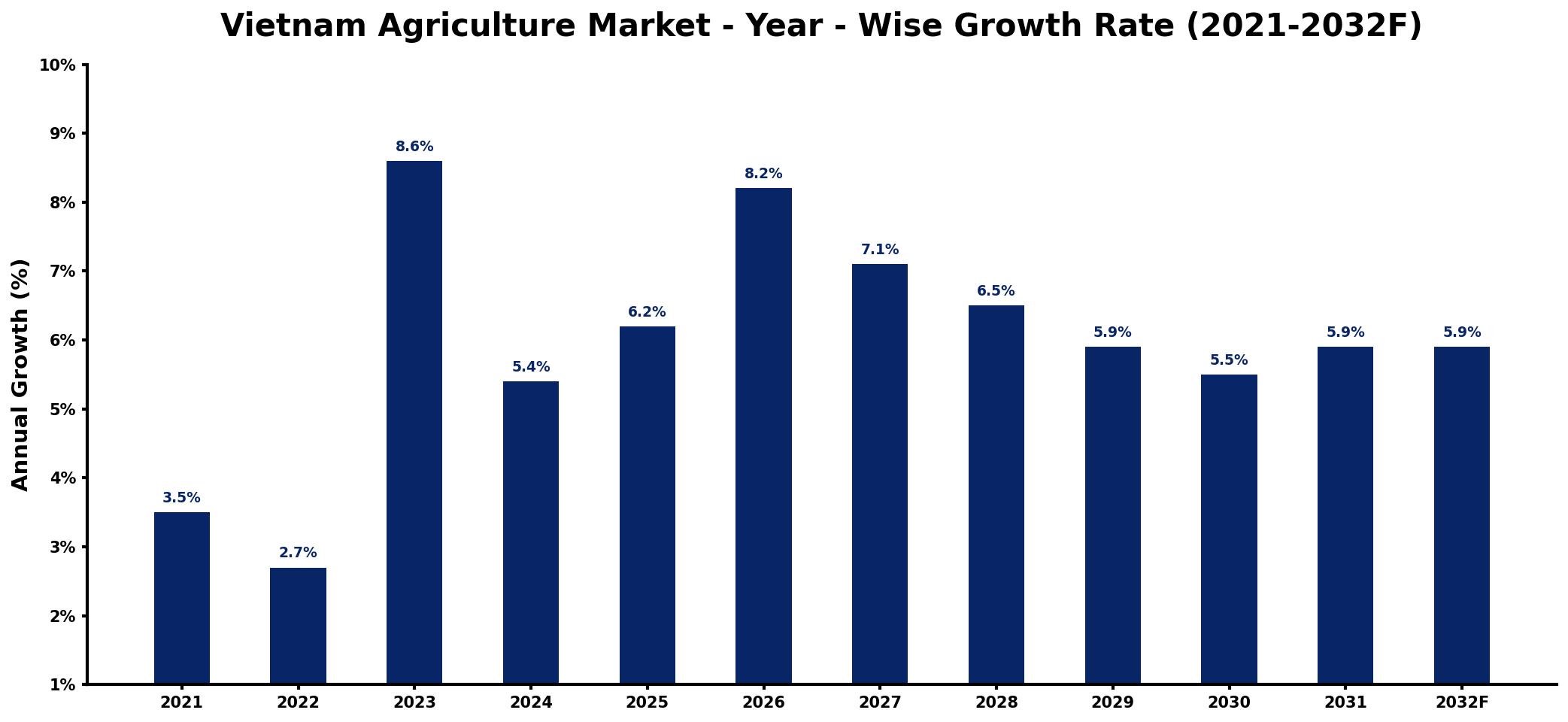
The table below presents the year‑wise growth rates along with the key drivers influencing the market
| Year | Growth Rate | Major Drivers |
| 2021 | 3.5% | Rising consumer health consciousness |
| 2022 | 2.7% | Increased export market opportunities |
| 2023 | 8.6% | Technological advancements in production |
| 2024 | 5.4% | Growing organic food demand |
| 2025 | 6.2% | Expansion of irrigation infrastructure |
| 2026 | 8.2% | Government support for innovation |
| 2027 | 7.1% | Diversification of crop varieties |
| 2028 | 6.5% | Emergence of sustainable practices |
| 2029 | 5.9% | Strengthening local supply chains |
| 2030 | 5.5% | Investment in agricultural technology |
| 2031 | 5.9% | Growing urban population demand |
| 2032 | 5.9% | Focus on climate resilient practices |
Note: Market size estimations and growth projections presented in this report are based on 6Wresearch's proprietary forecasting methodology, utilizing the latest available industry data, government publications, and primary research inputs.
Vietnam Agriculture Market Synopsis
Vietnams agricultural landscape is witnessing a transformative shift, marked by the integration of technology and modern practices. The sector remains a cornerstone of the Vietnamese economy, employing a vast portion of the workforce while ensuring national food security.
From crop cultivation to aquaculture, the diversity within the agriculture market underpins its significance. Enhanced global trade ties and an increasing focus on quality have compelled Vietnamese farmers to adopt more efficient practices, catering to both domestic and international demands.
Vietnam Agriculture Market Key Takeaways
- The agriculture sector is critical for Vietnam, contributing significantly to employment and food security.
- Government initiatives are effectively pushing modernization and mechanization within the agricultural landscape.
- Growing population and income levels are fostering increased demand for a diverse range of agricultural products.
- Climate change poses significant challenges, necessitating sustainable practices to ensure long-term viability.
- The pandemic highlighted the urgent need for digitalization to bolster resilience in agricultural supply chains.
Evaluation of Restraints in Vietnam Agriculture Market
Despite the positive growth prospects, the Vietnam agriculture market faces several restraints that could inhibit its potential. A significant hurdle is the reliance on traditional farming practices, which can lead to lower productivity levels. Moreover, limited access to advanced technology and finance hampers the ability of farmers to innovate and invest. Climate change continues to threaten crop yields, necessitating a shift toward sustainable practices. Additionally, land use and tenure issues complicate long-term agricultural planning, while competition from imported goods challenges local producers to maintain their market share.
Vietnam Agriculture Market Trends
The Vietnam agriculture market is evolving rapidly, with several trends shaping its future. The adoption of organic farming is becoming increasingly mainstream, driven by consumer preferences for healthy and sustainable food options. Additionally, digital agriculture is gaining traction, with more farmers leveraging technology for precision farming, supply chain management, and market access. The push for eco-friendly practices is also shaping agricultural production methods, as farmers seek to reduce their environmental impact while maximizing yields.
Vietnam Agriculture Market Opportunities
Significant growth opportunities abound within the Vietnam agriculture market. The increasing demand for organic and high-quality produce opens new avenues for producers willing to invest in modern farming techniques. There is also an unmet need for agri-tech solutions that facilitate efficient farming practices and improve supply chain logistics. Furthermore, as Vietnam strengthens its position in global trade agreements, exporters can look forward to expanded markets for their agricultural goods. Investment in sustainable practices and green technologies will likely yield long-term benefits, positioning Vietnamese agriculture competitively on the global stage.
Government Initiatives in the Vietnam Agriculture Market
The Vietnamese government is actively promoting policies aimed at enhancing agricultural productivity and sustainability. Initiatives focus on modernizing irrigation systems, subsidizing agricultural machinery, and encouraging research and development in agri-tech. Additionally, various programs aim to bolster support for farmers, providing them with access to credit, training, and market information. These government efforts are critical in paving the way for a resilient and competitive agriculture sector, capable of meeting both domestic and international demands.
Future Insights of the Vietnam Agriculture Market
Looking ahead to 2026-2032, the Vietnam agriculture market is poised for significant evolution. As modernization efforts take root, the integration of advanced technologies will likely enhance productivity while promoting sustainability. The growing emphasis on organic products and eco-friendly farming practices aligns with global consumer trends, providing a valuable opportunity for growth. Additionally, continued governmental support and favorable trade agreements will foster an environment conducive to investment and innovation. Overall, the future of Vietnams agriculture sector holds promise, with numerous pathways for growth and adaptation.
Vietnam Agriculture Market Latest Developments (2025 - 2026)
In recent months, there has been a marked increase in collaborations between local farmers and technology firms, aimed at enhancing productivity through smart agriculture solutions. Additionally, various initiatives focusing on sustainable farming practices have been launched, aligning with global sustainability goals. The agricultural sector is also witnessing a resurgence in investment as demand for organic produce continues to rise. Overall, the landscape is becoming increasingly dynamic, with stakeholders adapting to emerging challenges and opportunities.
Vietnam Agriculture Market - Key Attractiveness of the Report
- 10 Years of Market Numbers
- Historical Data Starting from 2022 to 2025
- Base Year: 2025
- Forecast Data until 2032
- Key Performance Indicators Impacting the Market
- Major Upcoming Developments and Projects
Key Highlights of the Report:
- Vietnam Agriculture Market Outlook
- Market Size of Vietnam Agriculture Market, 2025
- Forecast of Vietnam Agriculture Market, 2032
- Historical Data and Forecast of Vietnam Agriculture Revenues & Volume for the Period 2022-2032F
- Vietnam Agriculture Market Trend Evolution
- Vietnam Agriculture Market Drivers and Challenges
- Vietnam Agriculture Price Trends
- Vietnam Agriculture Porter's Five Forces
- Vietnam Agriculture Industry Life Cycle
- Historical Data and Forecast of Vietnam Agriculture Market Revenues & Volume By Type for the Period 2022-2032F
- Historical Data and Forecast of Vietnam Agriculture Market Revenues & Volume By Animal Produce for the Period 2022-2032F
- Historical Data and Forecast of Vietnam Agriculture Market Revenues & Volume By Crop Production for the Period 2022-2032F
- Historical Data and Forecast of Vietnam Agriculture Market Revenues & Volume By Distribution Channel for the Period 2022-2032F
- Historical Data and Forecast of Vietnam Agriculture Market Revenues & Volume By Supermarkets/Hypermarkets for the Period 2022-2032F
- Historical Data and Forecast of Vietnam Agriculture Market Revenues & Volume By Convenience Stores for the Period 2022-2032F
- Historical Data and Forecast of Vietnam Agriculture Market Revenues & Volume By E-Commerce for the Period 2022-2032F
- Historical Data and Forecast of Vietnam Agriculture Market Revenues & Volume By Others for the Period 2022-2032F
- Historical Data and Forecast of Vietnam Agriculture Market Revenues & Volume By Nature for the Period 2022-2032F
- Historical Data and Forecast of Vietnam Agriculture Market Revenues & Volume By Organic for the Period 2022-2032F
- Historical Data and Forecast of Vietnam Agriculture Market Revenues & Volume By Conventional for the Period 2022-2032F
- Vietnam Agriculture Import Export Trade Statistics
- Market Opportunity Assessment By Type
- Market Opportunity Assessment By Distribution Channel
- Market Opportunity Assessment By Nature
- Vietnam Agriculture Top Companies Market Share
- Vietnam Agriculture Competitive Benchmarking By Technical and Operational Parameters
- Vietnam Agriculture Company Profiles
- Vietnam Agriculture Key Strategic Recommendations






































