Vietnam AI in Education Market Size & Growth Rate (2026-2032)
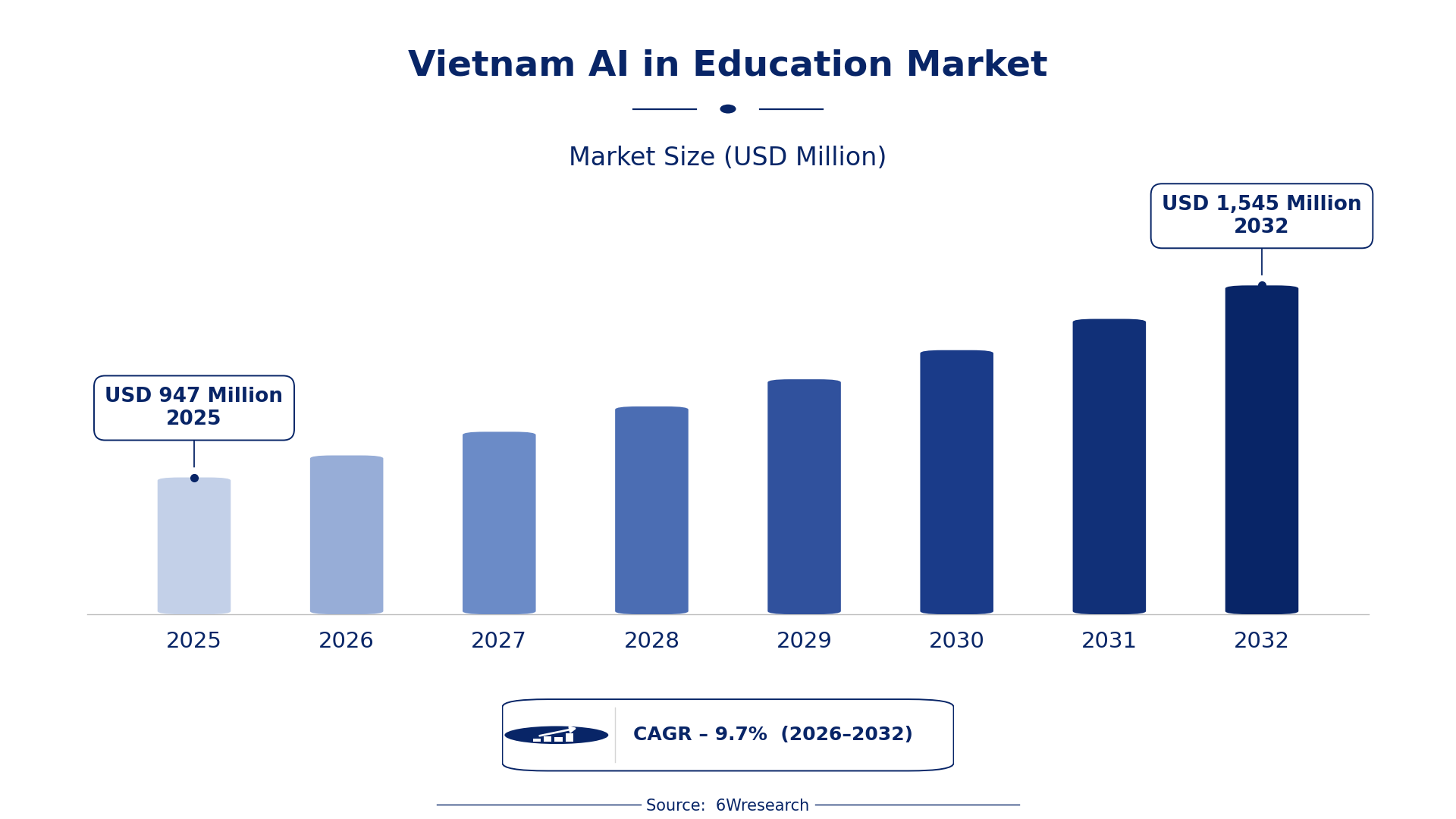
The Vietnam AI in Education Market was estimated at USD 947 Million in 2025 and is projected to reach USD 1545 Million by 2032, growing at a CAGR of 9.7% from 2026 to 2032.
Vietnam AI in Education Market Synopsis
The rapid integration of AI technologies in Vietnam's education sector reflects a growing demand for personalized learning solutions. As educational institutions strive to enhance student engagement and outcomes, AI tools are increasingly seen as essential for modernizing traditional teaching approaches.
This market is not only driven by a desire for improved learning experiences but also by the necessity for efficient administrative processes. Institutions are turning to AI for tasks ranging from automated grading to data analytics, highlighting a clear shift towards technology-enhanced education.
Vietnam AI in Education Market Year-wise Growth Rate and Key Drivers
This graph illustrates the annual growth rates of the Vietnam AI in Education Market from 2021 to 2032, highlighting a steady upward trajectory and projected expansion over the forecast period.
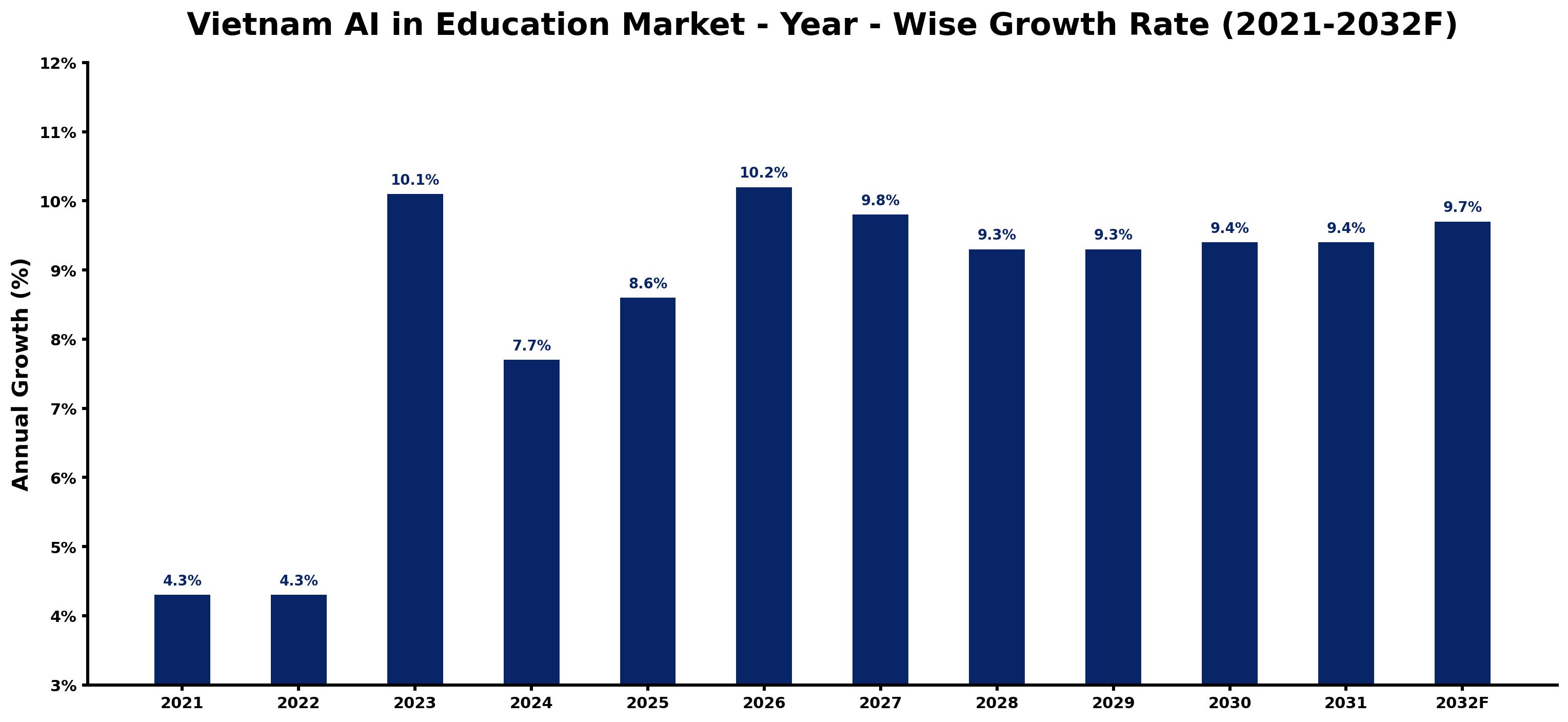
The table below presents the year‑wise growth rates along with the key drivers influencing the market
| Year | Growth Rate | Major Drivers |
| 2021 | 4.3% | Government initiatives boosting EdTech adoption nationwide |
| 2022 | 4.3% | Increased demand for personalized learning solutions |
| 2023 | 10.1% | AI curriculum integration supported by education authorities |
| 2024 | 7.7% | Growth in online learning platforms post-pandemic |
| 2025 | 8.6% | Rising youth population driving education technology needs |
| 2026 | 10.2% | Investment in smart classroom technologies by universities |
| 2027 | 9.8% | Public-private partnerships enhancing AI education tools |
| 2028 | 9.3% | Focus on STEM education reforms across schools |
| 2029 | 9.3% | Improved internet access facilitating AI learning resources |
| 2030 | 9.4% | Government grants for AI research in education expansion |
| 2031 | 9.4% | Corporate training programs adopting AI for vocational skills |
| 2032 | 9.7% | Collaboration with global EdTech firms advancing local solutions |
Note: Market size estimations and growth projections presented in this report are based on 6Wresearch's proprietary forecasting methodology, utilizing the latest available industry data, government publications, and primary research inputs.
Vietnam AI in Education Market Key Takeaways
Below are some of the specific key takeaways from the market, including:
- The increasing adoption of AI in educational institutions is reshaping teaching methodologies across Vietnam.
- AI-driven solutions are recognized for their ability to provide tailored educational experiences for students.
- Challenges related to digital infrastructure and access disparities remain critical hurdles for widespread AI implementation.
- The impact of the COVID-19 pandemic has accelerated the demand for online and remote learning solutions.
- Government initiatives are playing a crucial role in fostering a supportive environment for AI in education.
Evaluation of Restraints in Vietnam AI in Education Market
The Vietnam AI in Education market faces notable restraints primarily stemming from the country's varied socio-economic landscape. Many regions struggle with inadequate technological infrastructure, limiting access to AI-powered educational tools. on top of that, the integration of these technologies must navigate concerns surrounding data privacy and security. Addressing these issues is essential for unlocking the full potential of AI in education.
Vietnam AI in Education Market Trends
The landscape of the Vietnam AI in Education market is influenced by several key trends. There is a marked increase in the use of intelligent tutoring systems, which adapt to individual student needs, fostering better learning outcomes. Simultaneously, the shift towards hybrid learning models is driving the development of AI tools that facilitate both online and in-person education. The emphasis on data analytics also continues to grow, with institutions seeking insights to enhance curriculum design and student performance.
Vietnam AI in Education Market Opportunities
Opportunities abound in the Vietnam AI in Education market, particularly in partnerships between technology providers and educational institutions. There is significant potential for investment in AI tools that focus on remote learning and personalized education. on top of that, as the government prioritizes digital literacy and tech integration, companies that align their offerings with these objectives stand to gain a competitive edge.
Government Initiatives in the Vietnam AI in Education Market
Government policy is increasingly shaping the Vietnam AI in Education market, reflecting a commitment to modernizing the educational framework. Public sector priorities are focused on enhancing digital infrastructure and ensuring equitable access to technology. These initiatives are crucial in addressing the challenges faced by educational institutions across the country.
- A national digital infrastructure upgrade programme is currently underway, aimed at improving internet access in rural and underserved areas.
- A regulatory framework established in 2023 mandates the integration of AI tools in educational curriculums across public schools.
- Ongoing public-private partnerships are being developed to enhance teacher training programmes in AI technologies.
- A planned initiative to introduce AI-driven assessment tools is expected to launch by 2026, targeting primary and secondary education levels.
- Recent investments in AI educational technology were announced in late 2022 to support innovative teaching practices in universities.
Future Insights of the Vietnam AI in Education Market
Looking ahead to 2026-2032, the Vietnam AI in Education market is set for transformative growth as institutions increasingly adopt advanced technologies. The focus will likely shift toward integrating AI tools that not only enhance learning but also streamline administrative tasks. As the government continues to support AI initiatives, the potential for innovation will expand, creating a more efficient and equitable educational environment.
Vietnam AI in Education Market Latest Developments
Recent activity in the Vietnam AI in Education market has highlighted a strong momentum towards integrating AI technologies within educational frameworks. Institutions are actively exploring innovative solutions to enhance learning experiences, reflecting a broader trend towards technology adoption in education.
- A major technology vendor launched a new AI-based learning platform in early 2023, which aims to personalize educational content for students.
- An ongoing initiative started in mid-2023 focuses on developing AI-driven analytics tools for better academic performance monitoring.
- A partnership was formed in Q3 2023 between several universities and tech firms to create AI-enhanced curricula.
- Upcoming workshops are planned for early 2024 to train educators in utilizing AI tools effectively in classrooms.
Vietnam AI in Education Market - Key Attractiveness of the Report
- 10 Years of Market Numbers
- Historical Data Starting from 2022 to 2025
- Base Year: 2025
- Forecast Data until 2032
- Key Performance Indicators Impacting the Market
- Major Upcoming Developments and Projects
Key Highlights of the Report:
- Vietnam AI in Education Market Outlook
- Market Size of Vietnam AI in Education Market, 2025
- Forecast of Vietnam AI in Education Market, 2032
- Historical Data and Forecast of Vietnam AI in Education Revenues & Volume for the Period 2022-2032F
- Vietnam AI in Education Market Trend Evolution
- Vietnam AI in Education Market Drivers and Challenges
- Vietnam AI in Education Price Trends
- Vietnam AI in Education Porter's Five Forces
- Vietnam AI in Education Industry Life Cycle
- Historical Data and Forecast of Vietnam AI in Education Market Revenues & Volume By Technology for the Period 2022-2032F
- Historical Data and Forecast of Vietnam AI in Education Market Revenues & Volume By Deep Learning and Machine Learning for the Period 2022-2032F
- Historical Data and Forecast of Vietnam AI in Education Market Revenues & Volume By Natural Language Processing (NLP) for the Period 2022-2032F
- Historical Data and Forecast of Vietnam AI in Education Market Revenues & Volume By Component for the Period 2022-2032F
- Historical Data and Forecast of Vietnam AI in Education Market Revenues & Volume By Solutions for the Period 2022-2032F
- Historical Data and Forecast of Vietnam AI in Education Market Revenues & Volume By Services for the Period 2022-2032F
- Historical Data and Forecast of Vietnam AI in Education Market Revenues & Volume By Application for the Period 2022-2032F
- Historical Data and Forecast of Vietnam AI in Education Market Revenues & Volume By Virtual Facilitators and Learning Environments for the Period 2022-2032F
- Historical Data and Forecast of Vietnam AI in Education Market Revenues & Volume By Intelligent Tutoring Systems (ITS) for the Period 2022-2032F
- Historical Data and Forecast of Vietnam AI in Education Market Revenues & Volume By Content Delivery Systems for the Period 2022-2032F
- Historical Data and Forecast of Vietnam AI in Education Market Revenues & Volume By Fraud and Risk Management for the Period 2022-2032F
- Historical Data and Forecast of Vietnam AI in Education Market Revenues & Volume By Student-initiated learning for the Period 2022-2032F
- Historical Data and Forecast of Vietnam AI in Education Market Revenues & Volume By Others for the Period 2022-2032F
- Historical Data and Forecast of Vietnam AI in Education Market Revenues & Volume By Deployment for the Period 2022-2032F
- Historical Data and Forecast of Vietnam AI in Education Market Revenues & Volume By Cloud for the Period 2022-2032F
- Historical Data and Forecast of Vietnam AI in Education Market Revenues & Volume By On-premises for the Period 2022-2032F
- Historical Data and Forecast of Vietnam AI in Education Market Revenues & Volume By End for the Period 2022-2032F
- Historical Data and Forecast of Vietnam AI in Education Market Revenues & Volume By Educational Institutes for the Period 2022-2032F
- Historical Data and Forecast of Vietnam AI in Education Market Revenues & Volume By Educational Publishers for the Period 2022-2032F
- Historical Data and Forecast of Vietnam AI in Education Market Revenues & Volume By Others for the Period 2022-2032F
- Vietnam AI in Education Import Export Trade Statistics
- Market Opportunity Assessment By Technology
- Market Opportunity Assessment By Component
- Market Opportunity Assessment By Application
- Market Opportunity Assessment By Deployment
- Market Opportunity Assessment By End
- Vietnam AI in Education Top Companies Market Share
- Vietnam AI in Education Competitive Benchmarking By Technical and Operational Parameters
- Vietnam AI in Education Company Profiles
- Vietnam AI in Education Key Strategic Recommendations






































