Vietnam Air Traffic Control (ATC) Equipment Market Size, Share & Growth Rate
The Vietnam Air Traffic Control (ATC) Equipment Market was estimated at USD 1239 Million in 2025 and is projected to reach USD 2013 Million by 2032, growing at a CAGR of 7.2% from 2026 to 2032. This remarkable growth trajectory is primarily driven by the surging demand for air travel, spurred by Vietnam's burgeoning economy and increasing tourism influx. As air traffic intensifies, there is a pressing requirement for sophisticated ATC systems to ensure the safe and efficient management of flights across Vietnam's expanding airspace.
Vietnam Air Traffic Control (ATC) Equipment Market Year-wise Growth Rate and Key Drivers
This graph highlights how the Vietnam Air Traffic Control (ATC) Equipment Market has steadily grown over the years, supported by major growth factors.
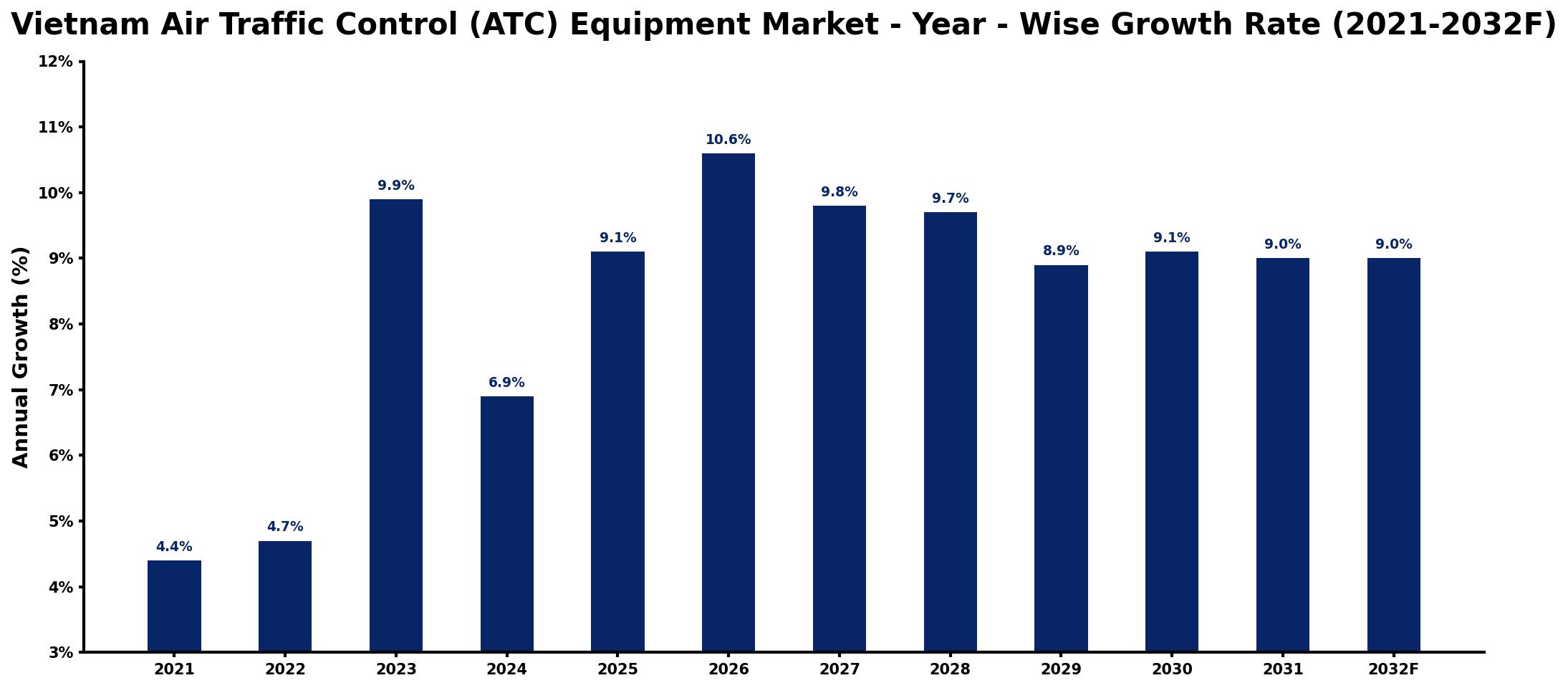
The table below presents the year‑wise growth rates along with the key drivers influencing the market
| Year | Growth Rate | Major Drivers |
| 2021 | 4.4% | Increased aviation sector investments |
| 2022 | 4.7% | Rising passenger travel demand |
| 2023 | 9.9% | strengthening international trade flows |
| 2024 | 6.9% | Technological advancements in navigation |
| 2025 | 9.1% | Government infrastructure development projects |
| 2026 | 10.6% | Growth in cargo transport services |
| 2027 | 9.8% | expanding healthcare application demand |
| 2028 | 9.7% | Strengthened international trade agreements |
| 2029 | 8.9% | Increased tourism and travel activities |
| 2030 | 9.1% | increased capital investment inflows |
| 2031 | 9.0% | Rising public safety regulations |
| 2032 | 9.0% | Growing focus on environmental sustainability |
Note: Market size estimations and growth projections presented in this report are based on 6Wresearch's proprietary forecasting methodology, utilizing the latest available industry data, government publications, and primary research inputs.
Vietnam Air Traffic Control (ATC) Equipment Market Synopsis
The air traffic control equipment sector in Vietnam is witnessing a period of transformative growth, necessitated by the swift modernization of the aviation landscape. The surge in both domestic and international flights underscores the critical need for advanced radar systems, communication tools, navigation aids, and surveillance technologies to enhance operational safety.
Recent government investments have prioritized infrastructure upgrades in response to the rising air traffic demand. Enhanced regulatory frameworks and adherence to international aviation standards further motivate the adoption of advanced ATC equipment, solidifying Vietnam's position as a key regional aviation hub.
Vietnam Air Traffic Control (ATC) Equipment Market Key Takeaways
- The market is anticipated to grow significantly, driven by rising air travel demand and infrastructure investments.
- Modernization efforts focus on enhancing safety and operational efficiency in air traffic management.
- The strategic geographic location of Vietnam boosts investments in state-of-the-art ATC technology.
- Technological upgrades are essential yet pose financial challenges for stakeholders.
- The aviation industry is recovering post-COVID-19, prompting renewed interest in ATC equipment investments.
Evaluation of Restraints in Vietnam Air Traffic Control (ATC) Equipment Market
Despite the promising growth outlook, the Vietnam ATC equipment market grapples with significant constraints. The high costs associated with technological upgrades remain a prominent concern for many operators, particularly as the sector works to comply with international standards. Additionally, as air traffic continues to rise, airspace congestion presents a logistical hurdle that complicates efficient management. To address these challenges, stakeholders must prioritize investment in both advanced technologies and skilled personnel capable of operating them.
Vietnam Air Traffic Control (ATC) Equipment Market Trends
Key trends are emerging as the Vietnam ATC equipment market evolves. The integration of artificial intelligence and machine learning technologies into air traffic management systems is gaining traction, offering enhanced predictive capabilities and operational efficiency. Furthermore, the push towards sustainable aviation practices is influencing the development of eco-friendly ATC solutions. The ongoing emphasis on data-driven decision-making is also reshaping the way air traffic controllers manage real-time operations, ultimately improving safety and reliability.
Vietnam Air Traffic Control (ATC) Equipment Market Opportunities
There are substantial growth opportunities within the Vietnam ATC equipment market, particularly in the realm of public-private partnerships aimed at infrastructure development. As the government commits to bolstering aviation safety and efficiency, investment in next-generation ATC technologies is poised to rise. Additionally, the rise of low-cost carriers is likely to increase overall flight frequency, necessitating further investments in air traffic control solutions. These factors, combined with ongoing tourism growth, signify a fertile ground for new entrants and existing players alike.
Government Initiatives in the Vietnam Air Traffic Control (ATC) Equipment Market
The Vietnamese government has launched various initiatives to modernize the aviation infrastructure and air traffic management systems. These initiatives include increased funding for ATC equipment upgrades and a strategic focus on aligning with international aviation standards. Such government support is crucial, as it not only enhances the safety and efficiency of air travel but also attracts foreign investment in the countrys aviation sector.
Future Insights of the Vietnam Air Traffic Control (ATC) Equipment Market
Looking ahead to 2026-2032, the Vietnam ATC equipment market is set to flourish, propelled by continuous investment in modernization and expansion projects. The combination of a recovering aviation sector, increased flight volumes, and improved safety regulations will likely sustain the market's growth momentum. As new technologies emerge, the emphasis will shift toward systems that not only enhance capacity but also promote sustainability and environmental responsibility within the aviation industry.
Vietnam Air Traffic Control (ATC) Equipment Market Latest Developments (2025 - 2026)
The air traffic control equipment landscape is evolving rapidly, with recent developments focusing on the implementation of advanced surveillance technologies and enhanced communication systems. As stakeholders emphasize reliability and efficiency, there is a notable trend towards integrating smart technologies that allow for real-time data analysis. Collaborative efforts between government and private sectors are also witnessing a rise, aiming to streamline infrastructure projects that enhance ATC capabilities across the nation.
Vietnam Air Traffic Control (ATC) Equipment Market - Key Attractiveness of the Report
- 10 Years of Market Numbers
- Historical Data Starting from 2022 to 2025
- Base Year: 2025
- Forecast Data until 2032
- Key Performance Indicators Impacting the Market
- Major Upcoming Developments and Projects
Key Highlights of the Report:
- Vietnam Air Traffic Control (ATC) Equipment Market Outlook
- Market Size of Vietnam Air Traffic Control (ATC) Equipment Market, 2025
- Forecast of Vietnam Air Traffic Control (ATC) Equipment Market, 2032
- Historical Data and Forecast of Vietnam Air Traffic Control (ATC) Equipment Revenues & Volume for the Period 2022-2032F
- Vietnam Air Traffic Control (ATC) Equipment Market Trend Evolution
- Vietnam Air Traffic Control (ATC) Equipment Market Drivers and Challenges
- Vietnam Air Traffic Control (ATC) Equipment Price Trends
- Vietnam Air Traffic Control (ATC) Equipment Porter's Five Forces
- Vietnam Air Traffic Control (ATC) Equipment Industry Life Cycle
- Historical Data and Forecast of Vietnam Air Traffic Control (ATC) Equipment Market Revenues & Volume By Product for the Period 2022-2032F
- Historical Data and Forecast of Vietnam Air Traffic Control (ATC) Equipment Market Revenues & Volume By Communications Equipment for the Period 2022-2032F
- Historical Data and Forecast of Vietnam Air Traffic Control (ATC) Equipment Market Revenues & Volume By Navigation Equipment for the Period 2022-2032F
- Historical Data and Forecast of Vietnam Air Traffic Control (ATC) Equipment Market Revenues & Volume By Surveillance Equipment for the Period 2022-2032F
- Historical Data and Forecast of Vietnam Air Traffic Control (ATC) Equipment Market Revenues & Volume By Air Traffic Control Equipment Application Outlook (USD Million, 2023-2032) for the Period 2022-2032F
- Historical Data and Forecast of Vietnam Air Traffic Control (ATC) Equipment Market Revenues & Volume By Commercial Aircraft for the Period 2022-2032F
- Historical Data and Forecast of Vietnam Air Traffic Control (ATC) Equipment Market Revenues & Volume By Private Aircraft for the Period 2022-2032F
- Historical Data and Forecast of Vietnam Air Traffic Control (ATC) Equipment Market Revenues & Volume By Military Aircraft for the Period 2022-2032F
- Vietnam Air Traffic Control (ATC) Equipment Import Export Trade Statistics
- Market Opportunity Assessment By Product
- Vietnam Air Traffic Control (ATC) Equipment Top Companies Market Share
- Vietnam Air Traffic Control (ATC) Equipment Competitive Benchmarking By Technical and Operational Parameters
- Vietnam Air Traffic Control (ATC) Equipment Company Profiles
- Vietnam Air Traffic Control (ATC) Equipment Key Strategic Recommendations






































