Vietnam Aircraft Seat Upholstery Market Size, Share & Growth Rate
The Vietnam Aircraft Seat Upholstery Market was estimated at USD 442 Million in 2025 and is projected to reach USD 723 Million by 2032, growing at a CAGR of 7.3% from 2026 to 2032. This promising growth trajectory is driven by the rising number of air travelers in Vietnam, alongside airlines' increasing commitment to enhancing passenger comfort through quality upholstery. As the domestic and international aviation sectors continue to expand, there is a notable uptick in investments aimed at improving the overall in-flight experience.
Vietnam Aircraft Seat Upholstery Market Year-wise Growth Rate and Key Drivers
This graph highlights how the Vietnam Aircraft Seat Upholstery Market has steadily grown over the years, supported by major growth factors.
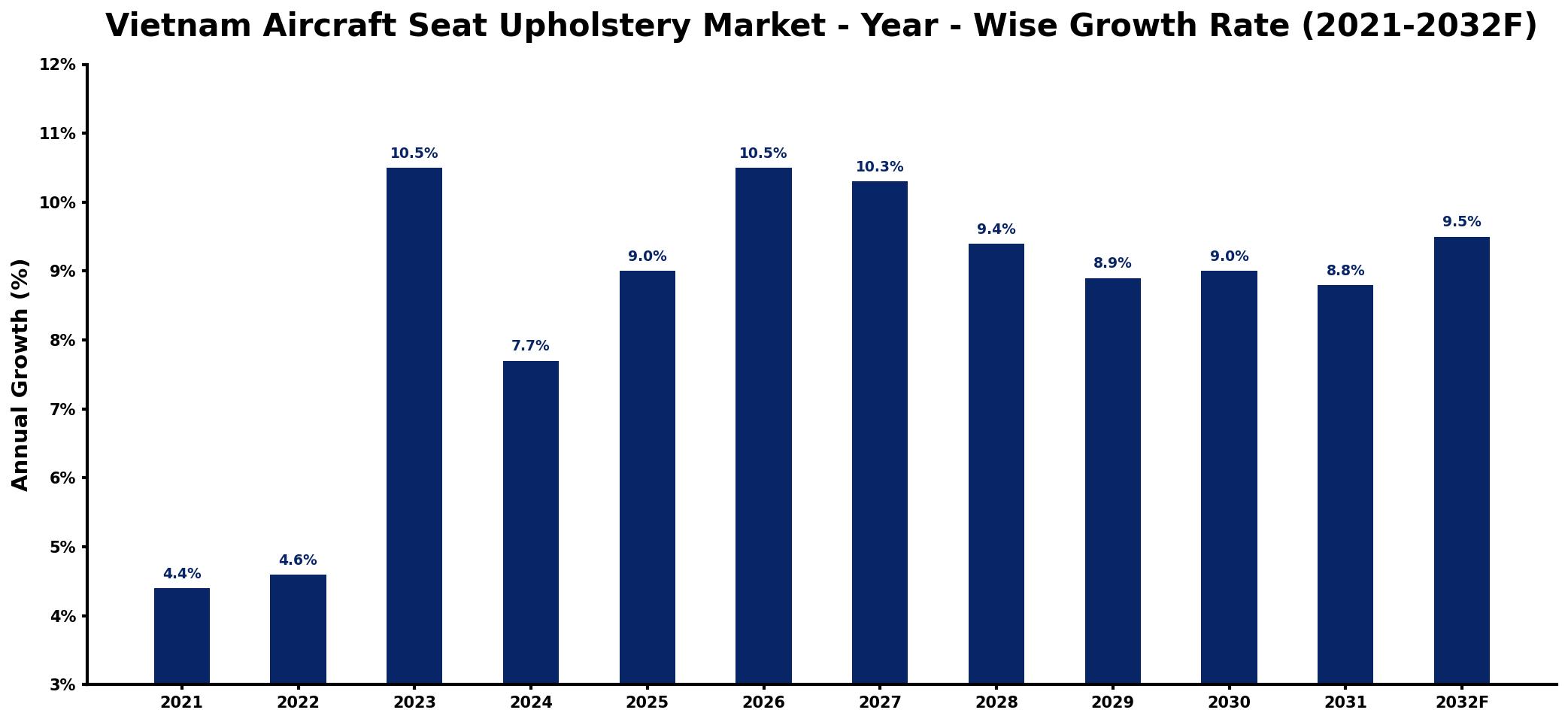
The table below presents the year‑wise growth rates along with the key drivers influencing the market
| Year | Growth Rate | Major Drivers |
| 2021 | 4.4% | Rising demand for aviation travel |
| 2022 | 4.6% | Increased investments in fleet expansion |
| 2023 | 10.5% | Growth in domestic air travel |
| 2024 | 7.7% | Expansion of regional airline networks |
| 2025 | 9.0% | Technological advancements in materials |
| 2026 | 10.5% | Sustainability initiatives in aviation |
| 2027 | 10.3% | Higher passenger comfort expectations |
| 2028 | 9.4% | Revival of luxury travel segments |
| 2029 | 8.9% | Emerging markets boosting air travel |
| 2030 | 9.0% | Enhanced safety regulations driving upgrades |
| 2031 | 8.8% | expanding industrial usage applications |
| 2032 | 9.5% | Continued focus on passenger experience |
Note: Market size estimations and growth projections presented in this report are based on 6Wresearch's proprietary forecasting methodology, utilizing the latest available industry data, government publications, and primary research inputs.
Vietnam Aircraft Seat Upholstery Market Synopsis
The Vietnam aircraft seat upholstery market is currently witnessing dynamic growth, driven by the surge in air travel and a growing awareness of passenger comfort. Airlines are increasingly prioritizing high-quality upholstery that not only meets safety standards but also elevates the overall aesthetic appeal of their aircraft interiors.
As a critical component of the aviation industry, the upholstery market is adapting to new consumer preferences, with passengers now placing a higher emphasis on comfort, durability, and easy maintenance. This shift is compelling airlines to explore innovative and sustainable upholstery solutions that align with both their operational needs and environmental commitments.
Vietnam Aircraft Seat Upholstery Market Key Takeaways
- The market is closely linked to the expanding aviation sector, with increasing air traffic driving demand for improved upholstery solutions.
- Airlines are investing in high-quality materials that enhance passenger experience while minimizing maintenance costs.
- Environmental sustainability is becoming a crucial factor, with a focus on eco-friendly upholstery options gaining traction.
- Recent disruptions, including the COVID-19 pandemic, have prompted manufacturers to reassess their strategies and target diverse markets.
- Market growth presents significant opportunities for innovation in material development and design integration.
Evaluation of Restraints in Vietnam Aircraft Seat Upholstery Market
Despite the positive growth outlook, the Vietnam aircraft seat upholstery market faces several constraints. Stringent safety regulations dictate the materials that can be used, necessitating a balance between lightweight options and fire-resistant properties. Meeting these regulatory standards while addressing passenger comfort remains a primary challenge. Furthermore, the need to adapt to growing environmental concerns complicates the selection process for upholstery materials, as manufacturers strive to ensure that their offerings are both sustainable and compliant with aviation standards.
Vietnam Aircraft Seat Upholstery Market Trends
Key trends shaping the Vietnam aircraft seat upholstery market include a shift towards smart upholstery solutions that integrate technology for enhanced passenger experience. The advent of antimicrobial and easy-to-clean materials reflects a growing demand for hygiene and convenience, particularly in a post-pandemic landscape. Additionally, there is an observable trend toward customization, where airlines seek to differentiate their brand through unique upholstery designs that resonate with their target audiences.
Vietnam Aircraft Seat Upholstery Market Opportunities
The current landscape presents multiple avenues for growth within the Vietnam aircraft seat upholstery market. There is an increasing demand for sustainable and eco-friendly upholstery materials, which opens doors for innovative product development. Moreover, opportunities exist in collaborations with design firms to create bespoke upholstery solutions that cater to the evolving tastes of travelers. As airlines continue to modernize their fleets, the refurbishment market also holds promise for upholstery suppliers willing to invest in high-quality, long-lasting materials.
Government Initiatives in the Vietnam Aircraft Seat Upholstery Market
Government initiatives aimed at bolstering the aviation sector indirectly impact the aircraft seat upholstery market. Efforts to enhance airport infrastructure and expand domestic and international flight routes stimulate air travel demand, thereby driving the need for improved seating solutions. Additionally, policies promoting sustainable practices within the aviation industry encourage the adoption of eco-friendly upholstery materials, reflecting a broader commitment to environmental stewardship.
Future Insights of the Vietnam Aircraft Seat Upholstery Market
Looking ahead to 2026-2032, the Vietnam aircraft seat upholstery market is poised for substantial growth. The ongoing expansion of the aviation industry, combined with a growing consumer focus on comfort and aesthetics, will continue to drive investments in high-quality upholstery solutions. The convergence of sustainability and technology will likely shape the next wave of innovations, offering manufacturers and airlines opportunities to meet evolving passenger expectations while adhering to safety and environmental standards.
Vietnam Aircraft Seat Upholstery Market Latest Developments (2025 - 2026)
Recent developments in the Vietnam aircraft seat upholstery market indicate a strong recovery from the impacts of COVID-19, with airlines ramping up refurbishment projects and exploring new materials. There has been a notable increase in collaboration between upholstery manufacturers and airlines to develop bespoke designs that enhance passenger comfort and align with brand identities. Moreover, innovations in sustainable materials are gaining attention as the industry moves towards greener practices.
Vietnam Aircraft Seat Upholstery Market - Key Attractiveness of the Report
- 10 Years of Market Numbers
- Historical Data Starting from 2022 to 2025
- Base Year: 2025
- Forecast Data until 2032
- Key Performance Indicators Impacting the Market
- Major Upcoming Developments and Projects
Key Highlights of the Report:
- Vietnam Aircraft Seat Upholstery Market Outlook
- Market Size of Vietnam Aircraft Seat Upholstery Market, 2025
- Forecast of Vietnam Aircraft Seat Upholstery Market, 2032
- Historical Data and Forecast of Vietnam Aircraft Seat Upholstery Revenues & Volume for the Period 2022-2032F
- Vietnam Aircraft Seat Upholstery Market Trend Evolution
- Vietnam Aircraft Seat Upholstery Market Drivers and Challenges
- Vietnam Aircraft Seat Upholstery Price Trends
- Vietnam Aircraft Seat Upholstery Porter's Five Forces
- Vietnam Aircraft Seat Upholstery Industry Life Cycle
- Historical Data and Forecast of Vietnam Aircraft Seat Upholstery Market Revenues & Volume By Material Type for the Period 2022-2032F
- Historical Data and Forecast of Vietnam Aircraft Seat Upholstery Market Revenues & Volume By Fabric for the Period 2022-2032F
- Historical Data and Forecast of Vietnam Aircraft Seat Upholstery Market Revenues & Volume By Leather for the Period 2022-2032F
- Historical Data and Forecast of Vietnam Aircraft Seat Upholstery Market Revenues & Volume By Vinyl for the Period 2022-2032F
- Historical Data and Forecast of Vietnam Aircraft Seat Upholstery Market Revenues & Volume By Seat Cover Type for the Period 2022-2032F
- Historical Data and Forecast of Vietnam Aircraft Seat Upholstery Market Revenues & Volume By Bottom Covers for the Period 2022-2032F
- Historical Data and Forecast of Vietnam Aircraft Seat Upholstery Market Revenues & Volume By Back Rest for the Period 2022-2032F
- Historical Data and Forecast of Vietnam Aircraft Seat Upholstery Market Revenues & Volume By Armrests for the Period 2022-2032F
- Historical Data and Forecast of Vietnam Aircraft Seat Upholstery Market Revenues & Volume By Headrests for the Period 2022-2032F
- Historical Data and Forecast of Vietnam Aircraft Seat Upholstery Market Revenues & Volume By Seat Rear Pockets for the Period 2022-2032F
- Historical Data and Forecast of Vietnam Aircraft Seat Upholstery Market Revenues & Volume By Seat Type for the Period 2022-2032F
- Historical Data and Forecast of Vietnam Aircraft Seat Upholstery Market Revenues & Volume By First Class for the Period 2022-2032F
- Historical Data and Forecast of Vietnam Aircraft Seat Upholstery Market Revenues & Volume By Business Class for the Period 2022-2032F
- Historical Data and Forecast of Vietnam Aircraft Seat Upholstery Market Revenues & Volume By Premium Economy Class for the Period 2022-2032F
- Historical Data and Forecast of Vietnam Aircraft Seat Upholstery Market Revenues & Volume By Economy Class for the Period 2022-2032F
- Historical Data and Forecast of Vietnam Aircraft Seat Upholstery Market Revenues & Volume By Aircraft Type for the Period 2022-2032F
- Historical Data and Forecast of Vietnam Aircraft Seat Upholstery Market Revenues & Volume By Narrow-body Aircraft for the Period 2022-2032F
- Historical Data and Forecast of Vietnam Aircraft Seat Upholstery Market Revenues & Volume By Wide-body Aircraft for the Period 2022-2032F
- Historical Data and Forecast of Vietnam Aircraft Seat Upholstery Market Revenues & Volume By Very Large Aircraft for the Period 2022-2032F
- Historical Data and Forecast of Vietnam Aircraft Seat Upholstery Market Revenues & Volume By Regional Transport Aircraft for the Period 2022-2032F
- Historical Data and Forecast of Vietnam Aircraft Seat Upholstery Market Revenues & Volume By Business Jets for the Period 2022-2032F
- Historical Data and Forecast of Vietnam Aircraft Seat Upholstery Market Revenues & Volume By General Aviation Aircraft for the Period 2022-2032F
- Historical Data and Forecast of Vietnam Aircraft Seat Upholstery Market Revenues & Volume By Helicopters for the Period 2022-2032F
- Vietnam Aircraft Seat Upholstery Import Export Trade Statistics
- Market Opportunity Assessment By Material Type
- Market Opportunity Assessment By Seat Cover Type
- Market Opportunity Assessment By Seat Type
- Market Opportunity Assessment By Aircraft Type
- Vietnam Aircraft Seat Upholstery Top Companies Market Share
- Vietnam Aircraft Seat Upholstery Competitive Benchmarking By Technical and Operational Parameters
- Vietnam Aircraft Seat Upholstery Company Profiles
- Vietnam Aircraft Seat Upholstery Key Strategic Recommendations






































