Vietnam Aluminium chloride Market Size, Share & Growth Rate
The Vietnam Aluminium chloride Market was estimated at USD 752 Million in 2025 and is projected to reach USD 1066 Million by 2032, growing at a CAGR of 5.1% from 2026 to 2032. This growth trajectory is being fueled by the compound's essential role in water treatment processes, particularly in improving water quality as environmental concerns escalate. Additionally, the pharmaceutical and chemical industries are leveraging aluminium chloride for diverse applications, further supporting robust market expansion.
Vietnam Aluminium chloride Market Year-wise Growth Rate and Key Drivers
This graph highlights how the Vietnam Aluminium chloride Market has steadily grown over the years, supported by major growth factors.
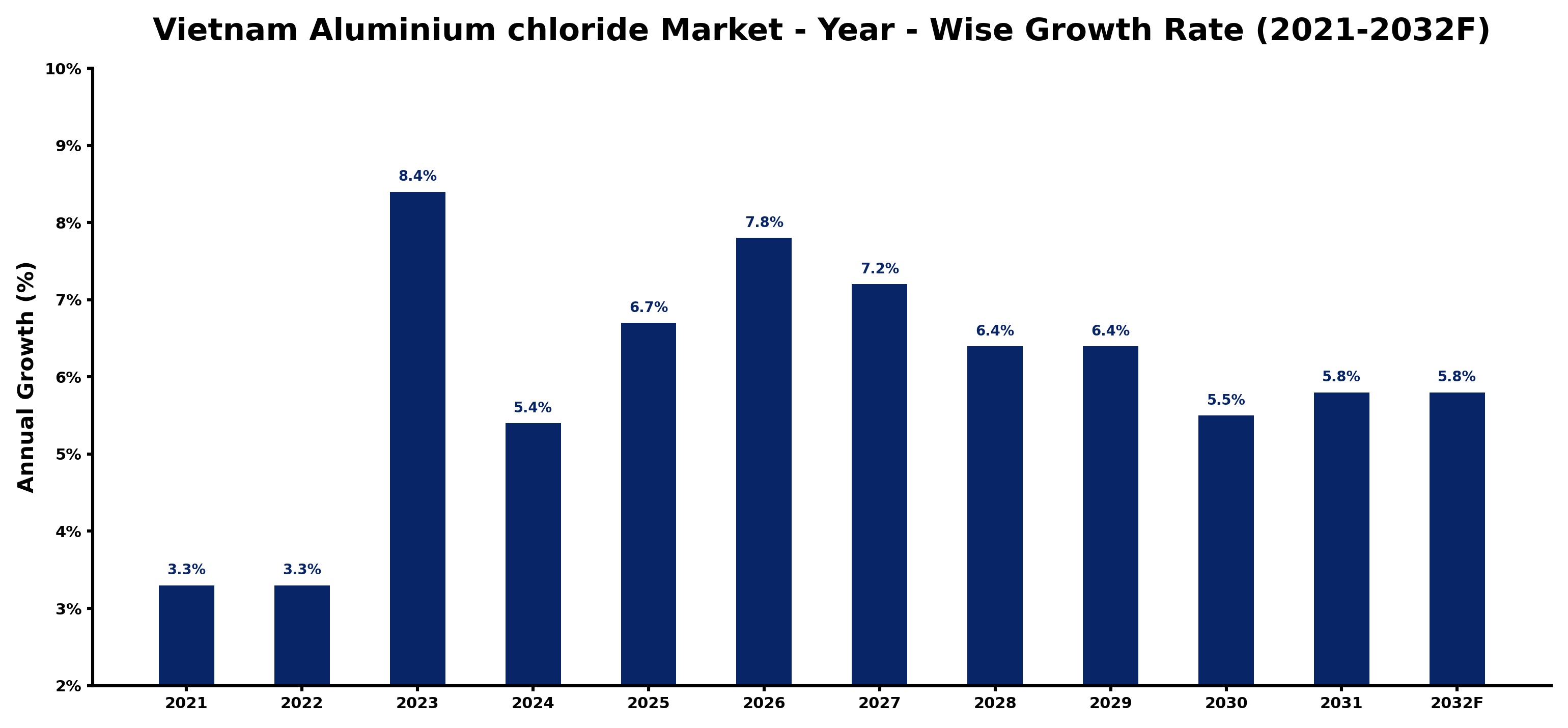
The table below presents the year‑wise growth rates along with the key drivers influencing the market
| Year | Growth Rate | Major Drivers |
| 2021 | 3.3% | Manufacturing investments boosted local production of aluminum chloride supply |
| 2022 | 3.3% | New automotive assembly lines boost aluminium chloride demand for coatings |
| 2023 | 8.4% | Technology upgrades in aluminum processing enhance export competitiveness significantly |
| 2024 | 5.4% | Aluminium chloride production efficiencies enhance export manufacturing competitiveness |
| 2025 | 6.7% | Export driven automotive assembly expansion boosts aluminium chloride demand |
| 2026 | 7.8% | Foreign investments in local aluminum facilities boosted export capabilities |
| 2027 | 7.2% | Aluminium chloride production efficiency boosted by export demand shifts |
| 2028 | 6.4% | Automotive assembly expansion boosts demand for aluminum chloride production |
| 2029 | 6.4% | Vietnam’s aluminum chloride production supports growing automotive assembly demands |
| 2030 | 5.5% | Foreign investment boosts local aluminium chloride production capacity |
| 2031 | 5.8% | Automation upgrades in chemical processing enhanced aluminium chloride production efficiency |
| 2032 | 5.8% | Export growth in automotive parts boosts aluminum chloride demand |
Note - Market size estimations and growth projections presented in this report are based on 6Wresearch’s advanced forecasting approach, validated with industry datasets as of June 2026.
Vietnam Aluminium chloride Market Synopsis
Recent market momentum in Vietnam indicates a rising demand for aluminium chloride, largely driven by increased industrial activities and heightened regulatory emphasis on water management. However, as the market evolves, there is an anticipated shift towards sustainable practices and greater transparency in product safety, which will shape future demand dynamics.
As industries adapt to changing regulations and consumer preferences, the aluminium chloride market is expected to explore innovative applications that enhance its utility across various sectors. The focus on research and development is likely to yield advanced formulations, catering to the growing need for effective water treatment solutions and other industrial applications.
Vietnam Aluminium chloride Market Key Takeaways
- The market is driven by significant demand from water treatment, pharmaceuticals, and chemical industries.
- Environmental sustainability initiatives are pushing the adoption of aluminium chloride in Vietnam.
- Investment in R&D is fostering innovations, enhancing product efficiency across applications.
- Post-COVID-19 recovery is anticipated as industrial operations resume, revitalizing market demand.
- Compliance with stringent environmental regulations is becoming increasingly vital for market players.
Evaluation of Restraints in Vietnam Aluminium chloride Market
The Vietnam Aluminium chloride Market faces notable restraints primarily linked to environmental and health concerns. The production and disposal of aluminium compounds can lead to significant environmental impacts, which necessitate adherence to strict regulations. Manufacturers are under pressure to adopt cleaner production methods and ensure product safety, adding to operational costs and potentially limiting growth. Additionally, increasing public scrutiny regarding the health implications of aluminium use demands transparency and accountability in the industry.
Vietnam Aluminium chloride Market Trends
Current trends indicate a pronounced shift towards eco-friendly practices within the aluminium chloride market. There is a growing interest in developing less hazardous formulations, driven by both regulatory requirements and consumer preferences for sustainable products. Furthermore, advancements in technology are enabling more efficient production processes, enhancing the overall effectiveness of aluminium chloride as a coagulant in water treatment.
Vietnam Aluminium chloride Market Opportunities
Opportunities for growth within the Vietnam Aluminium chloride Market lie primarily in the expanding water treatment sector. As urbanization continues, the demand for clean water is set to rise, positioning aluminium chloride as a critical component in water purification. Additionally, new developments in pharmaceutical applications present significant avenues for market expansion, especially as the healthcare sector emphasizes innovative treatments and drug formulations.
Government Initiatives in the Vietnam Aluminium chloride Market
The Vietnamese government is increasingly recognizing the importance of sustainable water management and environmental protection. Policies are being implemented to enhance public spending on water infrastructure, which includes the use of aluminium chloride in treatment processes. Furthermore, programs aimed at promoting cleaner production methods are gaining traction, fostering a more favorable regulatory landscape for aluminium chloride manufacturers.
Future Insights of the Vietnam Aluminium chloride Market
Looking ahead to 2026-2032, the Vietnam Aluminium chloride Market is poised for significant advancements. The confluence of technological innovation and heightened environmental awareness will likely drive the development of more effective and sustainable aluminium chloride solutions. Additionally, as Vietnam continues to strengthen its water treatment infrastructure, the demand for aluminium chloride will remain robust, supporting ongoing market expansion.
Vietnam Aluminium chloride Market Latest Developments (May 2025 - June 2026)
Recent developments in the Vietnam Aluminium chloride Market reflect a proactive response to evolving industry needs. Manufacturers are increasingly focusing on enhancing product formulations to meet regulatory standards and consumer expectations. There is also a notable increase in partnerships aimed at bolstering research efforts, which aim to innovate applications of aluminium chloride in both the water treatment and pharmaceutical sectors.
Vietnam Aluminium chloride Market - Key Attractiveness of the Report
- 10 Years of Market Numbers
- Historical Data Starting from 2022 to 2025
- Base Year: 2025
- Forecast Data until 2032
- Key Performance Indicators Impacting the Market
- Major Upcoming Developments and Projects
Key Highlights of the Report:
- Vietnam Aluminium chloride Market Outlook
- Market Size of Vietnam Aluminium chloride Market, 2025
- Forecast of Vietnam Aluminium chloride Market, 2032
- Historical Data and Forecast of Vietnam Aluminium chloride Revenues & Volume for the Period 2022-2032F
- Vietnam Aluminium chloride Market Trend Evolution
- Vietnam Aluminium chloride Market Drivers and Challenges
- Vietnam Aluminium chloride Price Trends
- Vietnam Aluminium chloride Porter's Five Forces
- Vietnam Aluminium chloride Industry Life Cycle
- Historical Data and Forecast of Vietnam Aluminium chloride Market Revenues & Volume By Production Method for the Period 2022-2032F
- Historical Data and Forecast of Vietnam Aluminium chloride Market Revenues & Volume By Chlorination of aluminium for the Period 2022-2032F
- Historical Data and Forecast of Vietnam Aluminium chloride Market Revenues & Volume By Crystallization of anhydrous aluminium chloride from solution of HCL for the Period 2022-2032F
- Historical Data and Forecast of Vietnam Aluminium chloride Market Revenues & Volume By Reaction of bauxite with coke and chlorine for the Period 2022-2032F
- Historical Data and Forecast of Vietnam Aluminium chloride Market Revenues & Volume By Application for the Period 2022-2032F
- Historical Data and Forecast of Vietnam Aluminium chloride Market Revenues & Volume By Waste water treatment for the Period 2022-2032F
- Historical Data and Forecast of Vietnam Aluminium chloride Market Revenues & Volume By Inks for the Period 2022-2032F
- Historical Data and Forecast of Vietnam Aluminium chloride Market Revenues & Volume By Synthetic rubber for the Period 2022-2032F
- Historical Data and Forecast of Vietnam Aluminium chloride Market Revenues & Volume By Lubricants for the Period 2022-2032F
- Historical Data and Forecast of Vietnam Aluminium chloride Market Revenues & Volume By Wood Preservatives for the Period 2022-2032F
- Historical Data and Forecast of Vietnam Aluminium chloride Market Revenues & Volume By Others for the Period 2022-2032F
- Historical Data and Forecast of Vietnam Aluminium chloride Market Revenues & Volume By End-use Industries for the Period 2022-2032F
- Historical Data and Forecast of Vietnam Aluminium chloride Market Revenues & Volume By Chemicals for the Period 2022-2032F
- Historical Data and Forecast of Vietnam Aluminium chloride Market Revenues & Volume By Pharmaceuticals for the Period 2022-2032F
- Historical Data and Forecast of Vietnam Aluminium chloride Market Revenues & Volume By Agrochemicals for the Period 2022-2032F
- Historical Data and Forecast of Vietnam Aluminium chloride Market Revenues & Volume By Metal Production for the Period 2022-2032F
- Historical Data and Forecast of Vietnam Aluminium chloride Market Revenues & Volume By Pulp & Paper for the Period 2022-2032F
- Historical Data and Forecast of Vietnam Aluminium chloride Market Revenues & Volume By Others for the Period 2022-2032F
- Vietnam Aluminium chloride Import Export Trade Statistics
- Market Opportunity Assessment By Production Method
- Market Opportunity Assessment By Application
- Market Opportunity Assessment By End-use Industries
- Vietnam Aluminium chloride Top Companies Market Share
- Vietnam Aluminium chloride Competitive Benchmarking By Technical and Operational Parameters
- Vietnam Aluminium chloride Company Profiles
- Vietnam Aluminium chloride Key Strategic Recommendations






































