Vietnam Aluminium Sulphate Market Size, Share & Growth Rate
The Vietnam Aluminium Sulphate Market was estimated at USD 315 Million in 2025 and is projected to reach USD 443 Million by 2032, growing at a CAGR of 5.0% from 2026 to 2032. This growth trajectory is fueled by the rising demand for water treatment solutions, driven by population growth and urbanization. The pulp and paper industry's persistent reliance on aluminium sulphate for production processes further bolsters the market, highlighting its integral role in supporting Vietnam's industrial landscape.
Vietnam Aluminium Sulphate Market Year-wise Growth Rate and Key Drivers
This graph highlights how the Vietnam Aluminium Sulphate Market has steadily grown over the years, supported by major growth factors.
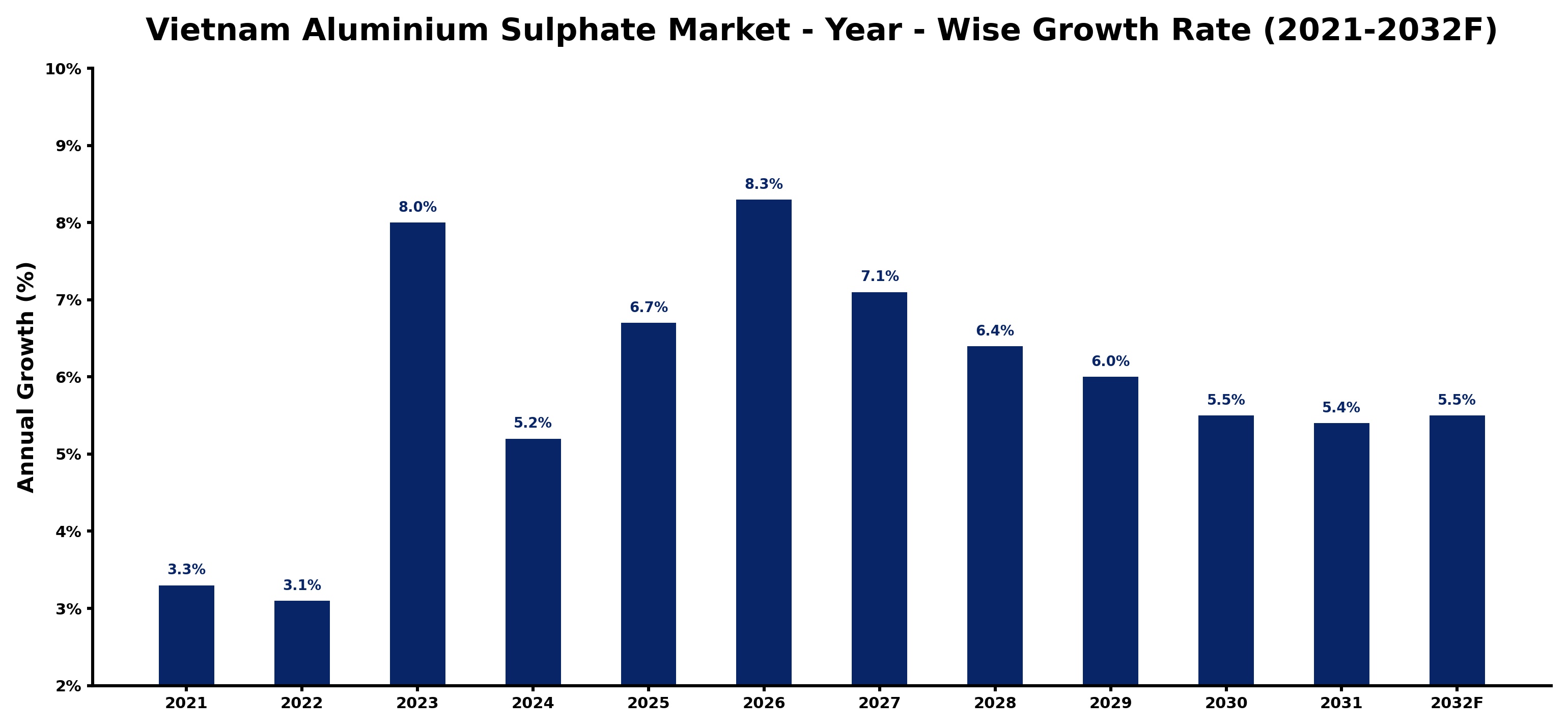
The table below presents the year‑wise growth rates along with the key drivers influencing the market
| Year | Growth Rate | Major Drivers |
| 2021 | 3.3% | Increased demand for water treatment |
| 2022 | 3.1% | Growing construction sector utilization |
| 2023 | 8.0% | Rising agricultural applications expanded |
| 2024 | 5.2% | Enhanced industrial applications growth |
| 2025 | 6.7% | Demand for paper production increased |
| 2026 | 8.3% | Expansion of chemical manufacturing facilities |
| 2027 | 7.1% | Increased focus on environmental regulations |
| 2028 | 6.4% | Rising awareness of water quality |
| 2029 | 6.0% | Growth in food processing industry |
| 2030 | 5.5% | Increased usage in textile industry |
| 2031 | 5.4% | Surge in construction projects ongoing |
| 2032 | 5.5% | Rising demand for eco-friendly products |
Note - Market size estimations and growth projections presented in this report are based on 6Wresearch's advanced forecasting approach, validated with industry datasets as of June 2026.
Vietnam Aluminium Sulphate Market Synopsis
The most significant force currently shaping the Vietnam Aluminium Sulphate Market is the increasing emphasis on water quality and environmental sustainability. As urban areas expand and population densities rise, the necessity for efficient water purification methods becomes ever more critical.
Moreover, stringent government regulations aimed at ensuring clean water access are pushing industries to adopt more effective treatment chemicals. This dynamic creates a favorable environment for aluminium sulphate, positioning it as a vital resource in meeting both regulatory and consumer demands.
Vietnam Aluminium Sulphate Market Key Takeaways
- The market is projected to expand significantly, driven by urbanization and environmental concerns.
- Aluminium sulphate remains essential in both water treatment and pulp & paper manufacturing.
- Technological advancements are critical for enhancing production efficiency and sustainability.
- Market players must navigate increasing environmental regulations impacting production processes.
- Opportunities exist in developing innovative solutions that cater to sustainable practices.
Evaluation of Restraints in Vietnam Aluminium Sulphate Market
The Vietnam Aluminium Sulphate Market faces notable constraints primarily due to environmental concerns surrounding its production. The manufacturing process of aluminium sulphate is resource-intensive and generates significant waste, leading to increased regulatory scrutiny. This results in elevated production costs, which can hinder competitiveness against alternative water treatment chemicals. Moreover, the market's growth may be stifled by economic fluctuations impacting raw material availability and pricing, creating an intricate landscape for stakeholders.
Vietnam Aluminium Sulphate Market Trends
Current trends in the Vietnam Aluminium Sulphate Market are leaning towards sustainability and efficiency. Companies are increasingly investing in innovative production technologies that minimize environmental impact while maximizing output. Furthermore, there is a growing awareness of the importance of eco-friendly practices among consumers and businesses alike, driving demand for more sustainable treatment solutions. These trends are not only shaping the market's growth but also redefining the standards for product offerings.
Vietnam Aluminium Sulphate Market Opportunities
The landscape of opportunities in the Vietnam Aluminium Sulphate Market is rich, particularly in sectors focusing on green technology and sustainable production. Companies that can innovate in terms of reducing waste and energy consumption are likely to capture significant market share. Additionally, the ongoing push for improved water treatment solutions in both urban and rural settings presents lucrative avenues for growth. As infrastructure developments continue, aligning with governmental initiatives for sustainable practices will also enhance market positioning.
Government Initiatives in the Vietnam Aluminium Sulphate Market
The Vietnamese government is actively promoting initiatives aimed at enhancing water quality and treatment capabilities. Regulatory frameworks are being established to ensure that industries comply with environmental standards, thereby driving demand for effective treatment chemicals like aluminium sulphate. Public spending on water infrastructure projects further supports the market's growth, enabling the development of modern facilities capable of meeting rising demand for clean water across the nation.
Future Insights of the Vietnam Aluminium Sulphate Market
Looking ahead, the Vietnam Aluminium Sulphate Market is poised for steady growth from 2026 to 2032. As urbanization continues to accelerate, the need for efficient water treatment methods will remain paramount. The integration of innovative production processes and technologies will be key in addressing the environmental concerns associated with aluminium sulphate manufacturing. Stakeholders who can adapt to these trends while maintaining product quality will likely find themselves at a competitive advantage in this evolving market.
Vietnam Aluminium Sulphate Market Latest Developments (May 2025 - June 2026)
In recent months, the industry has witnessed a shift towards more sustainable practices, with several players investing in advanced production technologies. Initiatives to reduce waste and enhance energy efficiency have become prevalent, reflecting a broader commitment to environmental responsibility. Furthermore, discussions surrounding regulatory updates indicate that the government is increasingly focused on ensuring compliance among manufacturers, which may lead to further changes in market dynamics.
Vietnam Aluminium Sulphate Market - Key Attractiveness of the Report
- 10 Years of Market Numbers
- Historical Data Starting from 2022 to 2025
- Base Year: 2025
- Forecast Data until 2032
- Key Performance Indicators Impacting the Market
- Major Upcoming Developments and Projects
Key Highlights of the Report:
- Vietnam Aluminium Sulphate Market Outlook
- Market Size of Vietnam Aluminium Sulphate Market, 2025
- Forecast of Vietnam Aluminium Sulphate Market, 2032
- Historical Data and Forecast of Vietnam Aluminium Sulphate Revenues & Volume for the Period 2022-2032F
- Vietnam Aluminium Sulphate Market Trend Evolution
- Vietnam Aluminium Sulphate Market Drivers and Challenges
- Vietnam Aluminium Sulphate Price Trends
- Vietnam Aluminium Sulphate Porter's Five Forces
- Vietnam Aluminium Sulphate Industry Life Cycle
- Historical Data and Forecast of Vietnam Aluminium Sulphate Market Revenues & Volume By Applications for the Period 2022-2032F
- Historical Data and Forecast of Vietnam Aluminium Sulphate Market Revenues & Volume By Food and beverages industry for the Period 2022-2032F
- Historical Data and Forecast of Vietnam Aluminium Sulphate Market Revenues & Volume By Health care industry for the Period 2022-2032F
- Historical Data and Forecast of Vietnam Aluminium Sulphate Market Revenues & Volume By Water purification and water treatment plants for the Period 2022-2032F
- Historical Data and Forecast of Vietnam Aluminium Sulphate Market Revenues & Volume By Pepper industry for the Period 2022-2032F
- Historical Data and Forecast of Vietnam Aluminium Sulphate Market Revenues & Volume By Others for the Period 2022-2032F
- Historical Data and Forecast of Vietnam Aluminium Sulphate Market Revenues & Volume By Functionality for the Period 2022-2032F
- Historical Data and Forecast of Vietnam Aluminium Sulphate Market Revenues & Volume By As an additive for the Period 2022-2032F
- Historical Data and Forecast of Vietnam Aluminium Sulphate Market Revenues & Volume By As BOD and COD removal for the Period 2022-2032F
- Historical Data and Forecast of Vietnam Aluminium Sulphate Market Revenues & Volume By Colour removal for the Period 2022-2032F
- Historical Data and Forecast of Vietnam Aluminium Sulphate Market Revenues & Volume By Cell separation for the Period 2022-2032F
- Historical Data and Forecast of Vietnam Aluminium Sulphate Market Revenues & Volume By Product Form for the Period 2022-2032F
- Historical Data and Forecast of Vietnam Aluminium Sulphate Market Revenues & Volume By Liquid for the Period 2022-2032F
- Historical Data and Forecast of Vietnam Aluminium Sulphate Market Revenues & Volume By Solid for the Period 2022-2032F
- Vietnam Aluminium Sulphate Import Export Trade Statistics
- Market Opportunity Assessment By Applications
- Market Opportunity Assessment By Functionality
- Market Opportunity Assessment By Product Form
- Vietnam Aluminium Sulphate Top Companies Market Share
- Vietnam Aluminium Sulphate Competitive Benchmarking By Technical and Operational Parameters
- Vietnam Aluminium Sulphate Company Profiles
- Vietnam Aluminium Sulphate Key Strategic Recommendations






































