Vietnam Ammonium Bisulfite Market Size, Share & Growth Rate
The Vietnam Ammonium Bisulfite Market was estimated at USD 407 Million in 2025 and is projected to reach USD 573 Million by 2032, growing at a CAGR of 5.0% from 2026 to 2032. This growth trajectory is underpinned by the rising demand from the food and beverage sector, where ammonium bisulfite is crucial for preserving various products. Additionally, the water treatment and pulp and paper industries are increasingly incorporating this chemical to meet regulatory standards and enhance operational efficiency.
Vietnam Ammonium Bisulfite Market Year-wise Growth Rate and Key Drivers
This graph highlights how the Vietnam Ammonium Bisulfite Market has steadily grown over the years, supported by major growth factors.
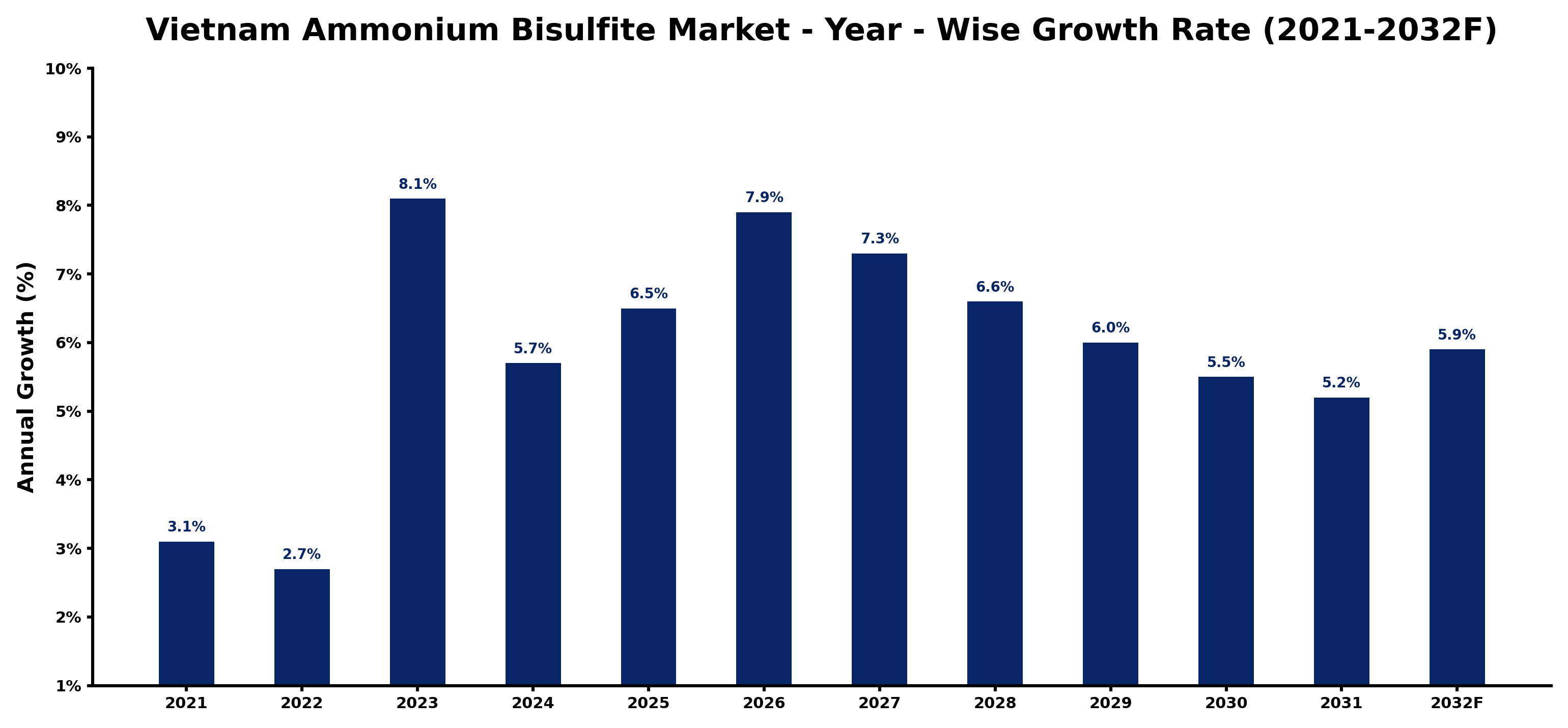
The table below presents the year‑wise growth rates along with the key drivers influencing the market
| Year | Growth Rate | Major Drivers |
| 2021 | 3.1% | Rising demand for food additives |
| 2022 | 2.7% | Increased industrial applications emerging |
| 2023 | 8.1% | Growing awareness of sustainability benefits |
| 2024 | 5.7% | Expansion of chemical manufacturing facilities |
| 2025 | 6.5% | Enhanced regulatory support for production |
| 2026 | 7.9% | Technological advancements in processing |
| 2027 | 7.3% | Rising popularity of eco-friendly products |
| 2028 | 6.6% | Increased investments in research development |
| 2029 | 6.0% | Growing export opportunities in Asia |
| 2030 | 5.5% | Strengthened partnerships with local distributors |
| 2031 | 5.2% | Diversification of product offerings available |
| 2032 | 5.9% | Consumer preference for quality ingredients |
Note - Market size estimations and growth projections presented in this report are based on 6Wresearch's advanced forecasting approach, validated with industry datasets as of June 2026.
Vietnam Ammonium Bisulfite Market Synopsis
The most significant force currently shaping the Vietnam Ammonium Bisulfite Market is the heightened focus on environmental conservation. As industries expand, the need for effective water treatment solutions that mitigate chemical exposure is becoming paramount. Ammonium bisulfite's role in dechlorination processes is critical in achieving cleaner water standards, thereby driving its demand.
Furthermore, the food processing sector is also a key player, as the compound is extensively used as a preservative. This dual demand from both environmental and food safety perspectives is carving a promising outlook for ammonium bisulfite in Vietnam's market landscape.
Vietnam Ammonium Bisulfite Market Key Takeaways
- The market is driven primarily by applications in food preservation and water treatment processes.
- Regulatory compliance and environmental standards are critical factors influencing industry dynamics.
- Continuous research and innovation in production methods are enhancing the efficiency of ammonium bisulfite.
- COVID-19 disruptions have led to strategic pivots in production and supply chain management.
- Key players in the market are adopting sustainable practices to meet evolving consumer and regulatory demands.
Evaluation of Restraints in Vietnam Ammonium Bisulfite Market
While the Vietnam Ammonium Bisulfite Market exhibits robust growth potential, several restraints challenge its advancement. The market remains closely tied to the performance of the pulp and paper industry, which can experience cyclical downturns due to changing consumer habits and economic fluctuations. Additionally, the increasing stringency of environmental regulations necessitates significant investment in compliance technologies and processes. Such investments can pose financial burdens on manufacturers, especially smaller firms striving to maintain competitiveness in the market. Furthermore, concerns regarding the safe handling and storage of ammonium bisulfite introduce operational risks that need to be meticulously managed to protect workers and communities.
Vietnam Ammonium Bisulfite Market Trends
Currently, there are several noteworthy trends shaping the Vietnam Ammonium Bisulfite Market. A growing emphasis on sustainable production practices is prompting manufacturers to explore greener alternatives and innovate processes that minimize environmental impacts. Concurrently, the shift toward digital solutions in various industries, including packaging and distribution, is fostering the need for efficient chemical applications like ammonium bisulfite. This trend is especially pronounced in sectors such as food processing, where maintaining product quality during transport and storage is paramount.
Vietnam Ammonium Bisulfite Market Opportunities
The Vietnam Ammonium Bisulfite Market holds several opportunities for growth and investment. With the expanding food and beverage sector, there is potential for increased use of ammonium bisulfite as a preservative. Additionally, as industries seek to enhance their environmental profiles, manufacturers can invest in innovative production methods that reduce chemical emissions, positioning themselves as leaders in sustainable chemical solutions. Furthermore, emerging applications in water treatment systems present lucrative avenues for businesses to explore, particularly as urbanization and industrialization continue to rise in Vietnam.
Government Initiatives in the Vietnam Ammonium Bisulfite Market
The Vietnamese government is actively promoting initiatives aimed at improving water quality and environmental standards, which indirectly benefit the ammonium bisulfite market. Policies focusing on reducing chemical emissions and enhancing water treatment processes are being prioritized. Furthermore, the government is investing in research and development programs to encourage sustainable practices within the chemical sector, creating an ecosystem conducive to innovation and responsible manufacturing.
Future Insights of the Vietnam Ammonium Bisulfite Market
Looking ahead to 2026-2032, the Vietnam Ammonium Bisulfite Market is poised for sustained growth driven by evolving industry demands and regulatory pressures. The increasing awareness around environmental conservation will likely lead to heightened consumption of ammonium bisulfite in water treatment applications. Additionally, as the food industry continues to expand, the compound's role as a preservative will gain even more significance. Overall, strategic investments in cleaner production technologies and the exploration of new applications will be critical for market players aiming to thrive in this dynamic landscape.
Vietnam Ammonium Bisulfite Market Latest Developments (May 2025 - June 2026)
Recent developments in the Vietnam Ammonium Bisulfite Market indicate a growing trend towards modernization in production techniques. Several manufacturers are implementing innovative strategies to enhance operational efficiency and reduce environmental impacts. Additionally, there is a noticeable shift towards collaborative efforts among industry stakeholders to establish standardized practices that ensure safe handling and storage of ammonium bisulfite. This direction aims to align with government initiatives promoting sustainability and compliance.
Vietnam Ammonium Bisulfite Market - Key Attractiveness of the Report
- 10 Years of Market Numbers
- Historical Data Starting from 2022 to 2025
- Base Year: 2025
- Forecast Data until 2032
- Key Performance Indicators Impacting the Market
- Major Upcoming Developments and Projects
Key Highlights of the Report:
- Vietnam Ammonium Bisulfite Market Outlook
- Market Size of Vietnam Ammonium Bisulfite Market, 2025
- Forecast of Vietnam Ammonium Bisulfite Market, 2032
- Historical Data and Forecast of Vietnam Ammonium Bisulfite Revenues & Volume for the Period 2022-2032F
- Vietnam Ammonium Bisulfite Market Trend Evolution
- Vietnam Ammonium Bisulfite Market Drivers and Challenges
- Vietnam Ammonium Bisulfite Price Trends
- Vietnam Ammonium Bisulfite Porter's Five Forces
- Vietnam Ammonium Bisulfite Industry Life Cycle
- Historical Data and Forecast of Vietnam Ammonium Bisulfite Market Revenues & Volume By Type for the Period 2022-2032F
- Historical Data and Forecast of Vietnam Ammonium Bisulfite Market Revenues & Volume By Pharmaceutical Grade for the Period 2022-2032F
- Historical Data and Forecast of Vietnam Ammonium Bisulfite Market Revenues & Volume By Chemical Grade for the Period 2022-2032F
- Historical Data and Forecast of Vietnam Ammonium Bisulfite Market Revenues & Volume By Application for the Period 2022-2032F
- Historical Data and Forecast of Vietnam Ammonium Bisulfite Market Revenues & Volume By Reducing Agent for the Period 2022-2032F
- Historical Data and Forecast of Vietnam Ammonium Bisulfite Market Revenues & Volume By Medicine for the Period 2022-2032F
- Historical Data and Forecast of Vietnam Ammonium Bisulfite Market Revenues & Volume By Dye Intermediates for the Period 2022-2032F
- Historical Data and Forecast of Vietnam Ammonium Bisulfite Market Revenues & Volume By Other for the Period 2022-2032F
- Vietnam Ammonium Bisulfite Import Export Trade Statistics
- Market Opportunity Assessment By Type
- Market Opportunity Assessment By Application
- Vietnam Ammonium Bisulfite Top Companies Market Share
- Vietnam Ammonium Bisulfite Competitive Benchmarking By Technical and Operational Parameters
- Vietnam Ammonium Bisulfite Company Profiles
- Vietnam Ammonium Bisulfite Key Strategic Recommendations






































