Vietnam Ammonium Hydroxide Market Size, Share & Growth Rate
The Vietnam Ammonium Hydroxide Market was estimated at USD 211 Million in 2025 and is projected to reach USD 297 Million by 2032, growing at a CAGR of 5.0% from 2026 to 2032. This growth trajectory is largely fueled by the expanding agricultural sector, which relies heavily on ammonium hydroxide as a key nitrogen source for fertilizers. Additionally, the continuous advancements in the chemical manufacturing processes are enhancing production efficiency and sustainability, further driving demand.
Vietnam Ammonium Hydroxide Market Year-wise Growth Rate and Key Drivers
This graph highlights how the Vietnam Ammonium Hydroxide Market has steadily grown over the years, supported by major growth factors.
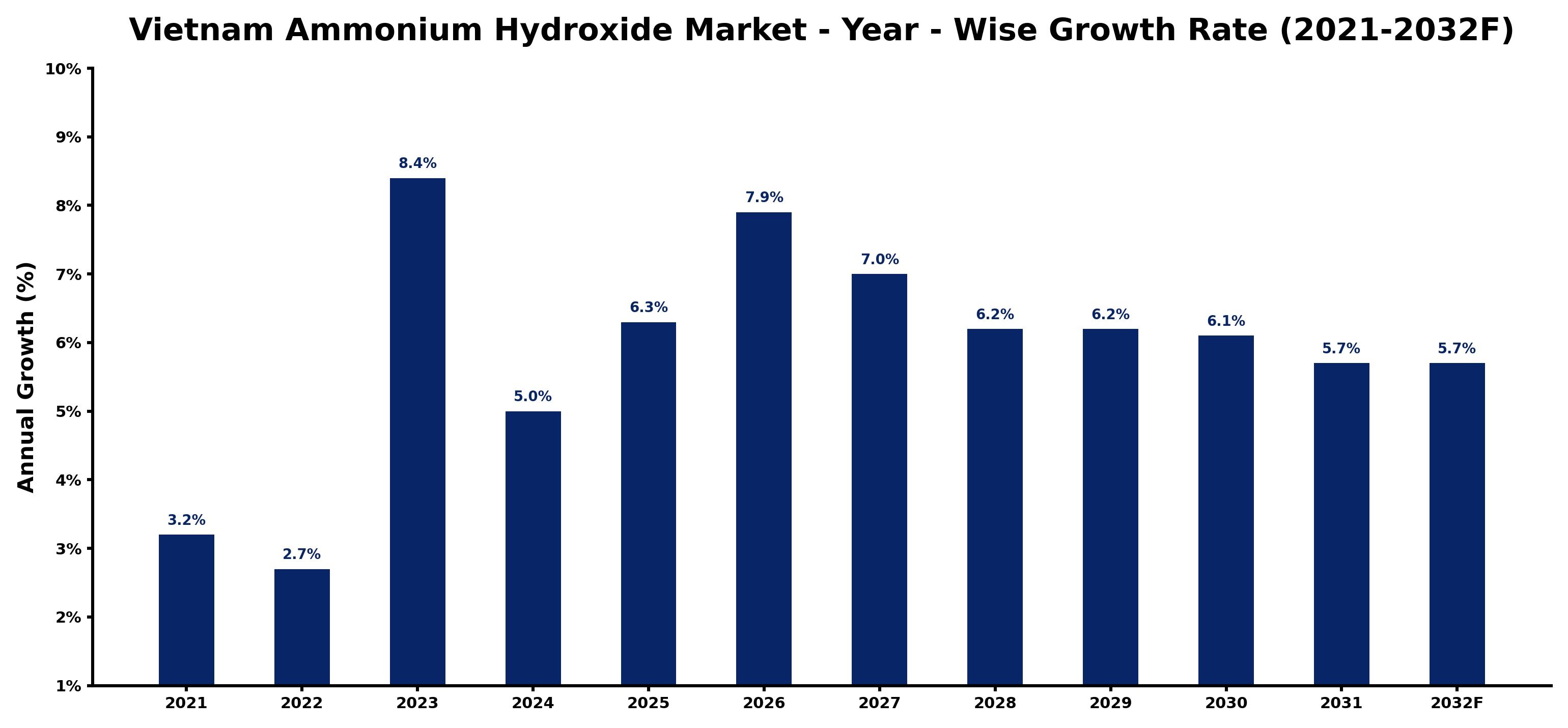
The table below presents the year‑wise growth rates along with the key drivers influencing the market
| Year | Growth Rate | Major Drivers |
| 2021 | 3.2% | Rapid growth in telecom and data center sectors |
| 2022 | 2.7% | Increasing adoption of advanced technologies |
| 2023 | 8.4% | Increasing smart city development projects |
| 2024 | 5.0% | Rapid growth in telecom and data center sectors |
| 2025 | 6.3% | Increasing adoption of advanced technologies |
| 2026 | 7.9% | Rising electricity demand across industries |
| 2027 | 7.0% | Growing renewable energy integration projects |
| 2028 | 6.2% | Rapid growth in telecom and data center sectors |
| 2029 | 6.2% | Rapid growth in telecom and data center sectors |
| 2030 | 6.1% | Increasing smart city development projects |
| 2031 | 5.7% | Increasing smart city development projects |
| 2032 | 5.7% | Increasing adoption of advanced technologies |
Note - Market size estimations and growth projections presented in this report are based on 6Wresearch’s advanced forecasting approach, validated with industry datasets as of June 2026.
Vietnam Ammonium Hydroxide Market Synopsis
The Vietnam ammonium hydroxide market plays a crucial role in the nation's industrial framework, serving diverse sectors including agriculture and pharmaceuticals. The increasing adoption of ammonium hydroxide in sustainable agricultural practices is indicative of the sector's shift towards eco-friendly solutions.
Furthermore, the chemical industry is witnessing robust growth, with ammonium hydroxide being pivotal in various manufacturing processes. The interplay of demand from these sectors and the need for compliance with environmental standards shapes the market landscape.
Vietnam Ammonium Hydroxide Market Key Takeaways
- The market is significantly influenced by the agricultural and chemical industries, which are key consumers of ammonium hydroxide.
- Technological advancements are enhancing production capabilities, contributing to market growth.
- Stringent safety and environmental regulations necessitate investment in treatment facilities.
- The COVID-19 pandemic temporarily disrupted supply chains, but recovery is underway as industries resume operations.
- Prominent market players maintain competitive advantages through adherence to quality standards and innovation.
Evaluation of Restraints in Vietnam Ammonium Hydroxide Market
Despite its growth potential, the Vietnam ammonium hydroxide market faces notable restraints. Safety and environmental concerns present significant challenges, as the handling and storage of ammonium hydroxide involve inherent risks. Companies must navigate complex regulatory landscapes that impose stringent waste disposal and emission standards, often leading to increased operational costs. Additionally, the market's reputation hinges on building trust regarding the safe use of ammonium hydroxide, which can impact consumer perception and demand.
Vietnam Ammonium Hydroxide Market Trends
The market is currently witnessing several transformative trends. The increasing preference for sustainable agricultural practices has led to a higher demand for ammonium hydroxide as an eco-friendly nitrogen source. Furthermore, advancements in technology are facilitating more efficient production methods, reducing costs, and minimizing environmental footprints. The ongoing focus on regulatory compliance and safety standards is also shaping operational practices across the industry.
Vietnam Ammonium Hydroxide Market Opportunities
The Vietnam ammonium hydroxide market presents lucrative growth opportunities, particularly in expanding its application in agriculture and manufacturing sectors. Investment in R&D for innovative production techniques and eco-friendly formulations can position companies favorably. Moreover, collaboration with agricultural stakeholders to promote the benefits of ammonium hydroxide as a sustainable solution can further enhance market penetration and profitability.
Government Initiatives in the Vietnam Ammonium Hydroxide Market
The Vietnamese government is actively promoting initiatives aimed at enhancing agricultural productivity and sustainability. These policies may include public spending on agricultural technology and incentives for chemical manufacturers to adopt eco-friendly practices. Additionally, stricter environmental regulations are pushing industries toward more sustainable operations, ultimately benefiting the ammonium hydroxide market.
Future Insights of the Vietnam Ammonium Hydroxide Market
Looking ahead to the period from 2026 to 2032, the Vietnam ammonium hydroxide market is poised for significant expansion. The continued growth in agriculture and chemical industries, coupled with increased awareness of sustainable practices, will drive demand. Moreover, as production technologies evolve, the market is likely to see enhanced efficiency and reduced costs, setting a favorable landscape for investment and development.
Vietnam Ammonium Hydroxide Market Latest Developments (May 2025 - June 2026)
In recent months, the Vietnamese ammonium hydroxide market has observed an uptick in interest from agricultural stakeholders looking for innovative nitrogen solutions. There have also been notable advancements in production technologies that align with sustainability goals, reflecting a shift toward more responsible manufacturing practices. The overall market sentiment remains positive as players adapt to emerging regulations and consumer demands.
Vietnam Ammonium Hydroxide Market - Key Attractiveness of the Report
- 10 Years of Market Numbers
- Historical Data Starting from 2022 to 2025
- Base Year: 2025
- Forecast Data until 2032
- Key Performance Indicators Impacting the Market
- Major Upcoming Developments and Projects
Key Highlights of the Report:
- Vietnam Ammonium Hydroxide Market Outlook
- Market Size of Vietnam Ammonium Hydroxide Market, 2025
- Forecast of Vietnam Ammonium Hydroxide Market, 2032
- Historical Data and Forecast of Vietnam Ammonium Hydroxide Revenues & Volume for the Period 2022-2032F
- Vietnam Ammonium Hydroxide Market Trend Evolution
- Vietnam Ammonium Hydroxide Market Drivers and Challenges
- Vietnam Ammonium Hydroxide Price Trends
- Vietnam Ammonium Hydroxide Porter's Five Forces
- Vietnam Ammonium Hydroxide Industry Life Cycle
- Historical Data and Forecast of Vietnam Ammonium Hydroxide Market Revenues & Volume By End-Use Industry for the Period 2022-2032F
- Historical Data and Forecast of Vietnam Ammonium Hydroxide Market Revenues & Volume By Pharmaceutical for the Period 2022-2032F
- Historical Data and Forecast of Vietnam Ammonium Hydroxide Market Revenues & Volume By Food & Beverage for the Period 2022-2032F
- Historical Data and Forecast of Vietnam Ammonium Hydroxide Market Revenues & Volume By Personal Care for the Period 2022-2032F
- Historical Data and Forecast of Vietnam Ammonium Hydroxide Market Revenues & Volume By Chemical for the Period 2022-2032F
- Historical Data and Forecast of Vietnam Ammonium Hydroxide Market Revenues & Volume By Agriculture for the Period 2022-2032F
- Historical Data and Forecast of Vietnam Ammonium Hydroxide Market Revenues & Volume By Others for the Period 2022-2032F
- Historical Data and Forecast of Vietnam Ammonium Hydroxide Market Revenues & Volume By Application for the Period 2022-2032F
- Historical Data and Forecast of Vietnam Ammonium Hydroxide Market Revenues & Volume By Leaving agent for the Period 2022-2032F
- Historical Data and Forecast of Vietnam Ammonium Hydroxide Market Revenues & Volume By Acid Neutraliser for the Period 2022-2032F
- Historical Data and Forecast of Vietnam Ammonium Hydroxide Market Revenues & Volume By Flavour enhancer for the Period 2022-2032F
- Historical Data and Forecast of Vietnam Ammonium Hydroxide Market Revenues & Volume By Others for the Period 2022-2032F
- Historical Data and Forecast of Vietnam Ammonium Hydroxide Market Revenues & Volume By Source for the Period 2022-2032F
- Historical Data and Forecast of Vietnam Ammonium Hydroxide Market Revenues & Volume By Natural for the Period 2022-2032F
- Historical Data and Forecast of Vietnam Ammonium Hydroxide Market Revenues & Volume By Chemical for the Period 2022-2032F
- Vietnam Ammonium Hydroxide Import Export Trade Statistics
- Market Opportunity Assessment By End-Use Industry
- Market Opportunity Assessment By Application
- Market Opportunity Assessment By Source
- Vietnam Ammonium Hydroxide Top Companies Market Share
- Vietnam Ammonium Hydroxide Competitive Benchmarking By Technical and Operational Parameters
- Vietnam Ammonium Hydroxide Company Profiles
- Vietnam Ammonium Hydroxide Key Strategic Recommendations






































