Vietnam Analog Timer Market Size, Share & Growth Rate
The Vietnam Analog Timer Market was estimated at USD 304 Million in 2025 and is projected to reach USD 429 Million by 2032, growing at a CAGR of 5.0% from 2026 to 2032. This growth trajectory is underpinned by the increasing reliance on analog timers across both household and industrial sectors, where precise timing is essential. As Vietnamese consumers and businesses continue to value simplicity and reliability in their timing solutions, the demand for these devices is set to increase significantly.
Vietnam Analog Timer Market Year-wise Growth Rate and Key Drivers
This graph highlights how the Vietnam Analog Timer Market has steadily grown over the years, supported by major growth factors.
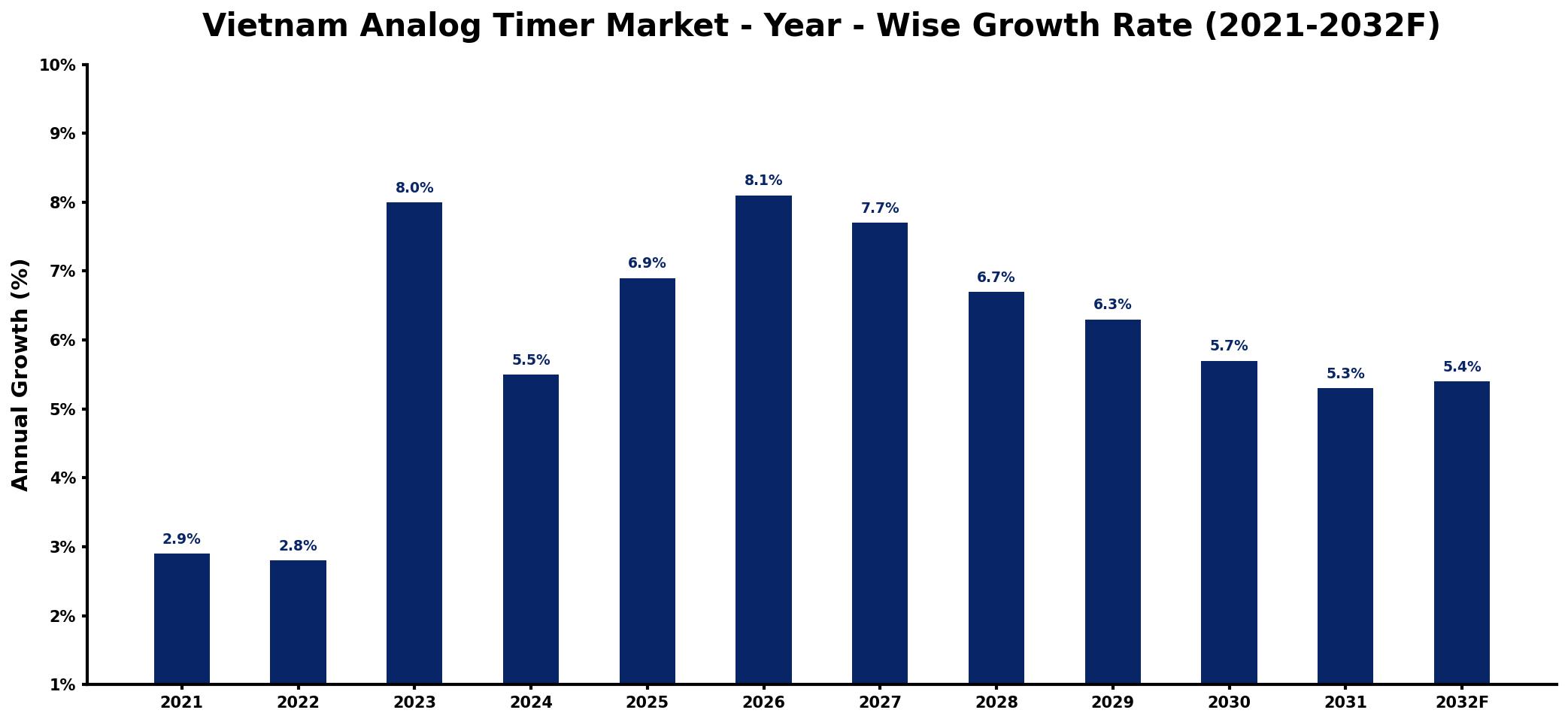
The table below presents the year‑wise growth rates along with the key drivers influencing the market
| Year | Growth Rate | Major Drivers |
| 2021 | 2.9% | Rising consumer electronics demand |
| 2022 | 2.8% | Increased household automation investments |
| 2023 | 8.0% | Growth in smart home applications |
| 2024 | 5.5% | Expansion of industrial automation sector |
| 2025 | 6.9% | Surge in energy efficiency initiatives |
| 2026 | 8.1% | Growing interest in DIY projects |
| 2027 | 7.7% | Increase in residential construction activities |
| 2028 | 6.7% | Development of renewable energy solutions |
| 2029 | 6.3% | Boost in agricultural technology adoption |
| 2030 | 5.7% | increased overall sector activity |
| 2031 | 5.3% | Rising awareness of energy conservation |
| 2032 | 5.4% | enhanced product quality standards |
Note: Market size estimations and growth projections presented in this report are based on 6Wresearch's proprietary forecasting methodology, utilizing the latest available industry data, government publications, and primary research inputs.
Vietnam Analog Timer Market Synopsis
In Vietnam, analog timers are gaining traction as essential tools for various applications, from culinary tasks to industrial processes. These devices not only enhance time management but also support efficient workflow in both residential and commercial settings. The demand for analog timers is also reflective of the cultural importance placed on precise timing in cooking and gardening, further embedding them into the daily lives of Vietnamese consumers.
The versatility of analog timers has carved a unique niche in the Vietnamese market, allowing for applications ranging from household chores to industrial automation. Their user-friendly design appeals to a broad demographic, including those who may be less familiar with digital technologies. This unique position enables the analog timer market in Vietnam to thrive amidst the evolution of consumer preferences.
Vietnam Analog Timer Market Key Takeaways
- The market is propelled by the growing industrial and household applications of analog timers.
- Analog timers are recognized for their simplicity, reliability, and effectiveness in time management.
- The market is adapting to changing consumer behavior and preferences while maintaining traditional product lines.
- Key manufacturers are diversifying their offerings to include advanced features while retaining core analog functionalities.
- Competition from digital timers necessitates strategic marketing to highlight the advantages of analog solutions.
Evaluation of Restraints in Vietnam Analog Timer Market
Despite the promising growth outlook, the Vietnam analog timer market faces notable challenges. The primary restraint is the growing consumer preference for digital timers, which are often perceived as more advanced and user-friendly. Additionally, the rapid adoption of smart home devices further shifts consumer attention away from traditional analog products. Manufacturers must navigate these challenges by emphasizing the unique benefits of analog timers, such as their durability and ease of use, while also considering potential innovations that could enhance their appeal.
Vietnam Analog Timer Market Trends
The current landscape of the Vietnam analog timer market is characterized by several emerging trends. One key trend is the increasing integration of analog timers into smart home systems, where their simplicity complements digital counterparts. Additionally, there is a growing awareness among consumers regarding sustainability, prompting manufacturers to explore eco-friendly materials and production processes. These factors collectively aim to enhance product appeal and broaden market reach.
Vietnam Analog Timer Market Opportunities
The Vietnam analog timer market presents substantial growth opportunities, especially in sectors such as home improvement and culinary arts. As urbanization continues to rise, an influx of new households creates a burgeoning market for reliable kitchen and gardening timers. Furthermore, there is potential for collaboration with local manufacturers to enhance product customization, catering to specific consumer needs and preferences, which could significantly boost market penetration.
Government Initiatives in the Vietnam Analog Timer Market
The Vietnamese government is actively promoting initiatives that support technological advancement and manufacturing efficiency across various sectors, including consumer electronics. Programs aimed at fostering local production capabilities and improving supply chain resilience are beneficial for the analog timer market. Moreover, public spending on infrastructure and industrial development can indirectly stimulate demand for time management solutions, as operational efficiency becomes a priority for emerging industries.
Future Insights of the Vietnam Analog Timer Market
Looking ahead to 2026-2032, the Vietnam analog timer market is poised for significant transformation. As businesses increasingly prioritize efficiency and productivity, the need for reliable timing solutions will remain paramount. Innovations that marry traditional analog functionalities with contemporary needs will likely emerge, ensuring the relevance of analog timers in a tech-forward market. The sustained growth trajectory reflects a promising future for both manufacturers and consumers alike.
Vietnam Analog Timer Market Latest Developments (2025 - 2026)
Recent developments in the Vietnam analog timer market indicate a shift towards enhanced product designs and features that appeal to a broader consumer base. Companies are actively engaging in marketing campaigns to highlight the durability and ease of use of analog timers. Furthermore, manufacturers are exploring partnerships and collaborations to integrate analog timers into emerging smart home ecosystems, demonstrating a commitment to innovation while maintaining the core attributes that define these trusted devices.
Vietnam Analog Timer Market - Key Attractiveness of the Report
- 10 Years of Market Numbers
- Historical Data Starting from 2022 to 2025
- Base Year: 2025
- Forecast Data until 2032
- Key Performance Indicators Impacting the Market
- Major Upcoming Developments and Projects
Key Highlights of the Report:
- Vietnam Analog Timer Market Outlook
- Market Size of Vietnam Analog Timer Market, 2025
- Forecast of Vietnam Analog Timer Market, 2032
- Historical Data and Forecast of Vietnam Analog Timer Revenues & Volume for the Period 2022-2032F
- Vietnam Analog Timer Market Trend Evolution
- Vietnam Analog Timer Market Drivers and Challenges
- Vietnam Analog Timer Price Trends
- Vietnam Analog Timer Porter's Five Forces
- Vietnam Analog Timer Industry Life Cycle
- Historical Data and Forecast of Vietnam Analog Timer Market Revenues & Volume By Type for the Period 2022-2032F
- Historical Data and Forecast of Vietnam Analog Timer Market Revenues & Volume By DIN Rail Mount for the Period 2022-2032F
- Historical Data and Forecast of Vietnam Analog Timer Market Revenues & Volume By Panel Mount for the Period 2022-2032F
- Historical Data and Forecast of Vietnam Analog Timer Market Revenues & Volume By Plug-in Mount for the Period 2022-2032F
- Historical Data and Forecast of Vietnam Analog Timer Market Revenues & Volume By Application for the Period 2022-2032F
- Historical Data and Forecast of Vietnam Analog Timer Market Revenues & Volume By Industrial Devices for the Period 2022-2032F
- Historical Data and Forecast of Vietnam Analog Timer Market Revenues & Volume By Lighting Systems for the Period 2022-2032F
- Historical Data and Forecast of Vietnam Analog Timer Market Revenues & Volume By Others for the Period 2022-2032F
- Vietnam Analog Timer Import Export Trade Statistics
- Market Opportunity Assessment By Type
- Market Opportunity Assessment By Application
- Vietnam Analog Timer Top Companies Market Share
- Vietnam Analog Timer Competitive Benchmarking By Technical and Operational Parameters
- Vietnam Analog Timer Company Profiles
- Vietnam Analog Timer Key Strategic Recommendations






































