Vietnam Animal Horn Market Size, Share & Growth Rate
The Vietnam Animal Horn Market was estimated at USD 1305 Million in 2025 and is projected to reach USD 1852 Million by 2032, growing at a CAGR of 5.1% from 2026 to 2032. This growth trajectory is driven primarily by the enduring cultural significance of animal horns in traditional practices and crafts. As artisans continue to produce decorative and medicinal items using locally sourced horns, the market benefits from both domestic demand and a burgeoning interest in sustainable and ethically sourced handicrafts.
Vietnam Animal Horn Market Year-wise Growth Rate and Key Drivers
This graph highlights how the Vietnam Animal Horn Market has steadily grown over the years, supported by major growth factors.
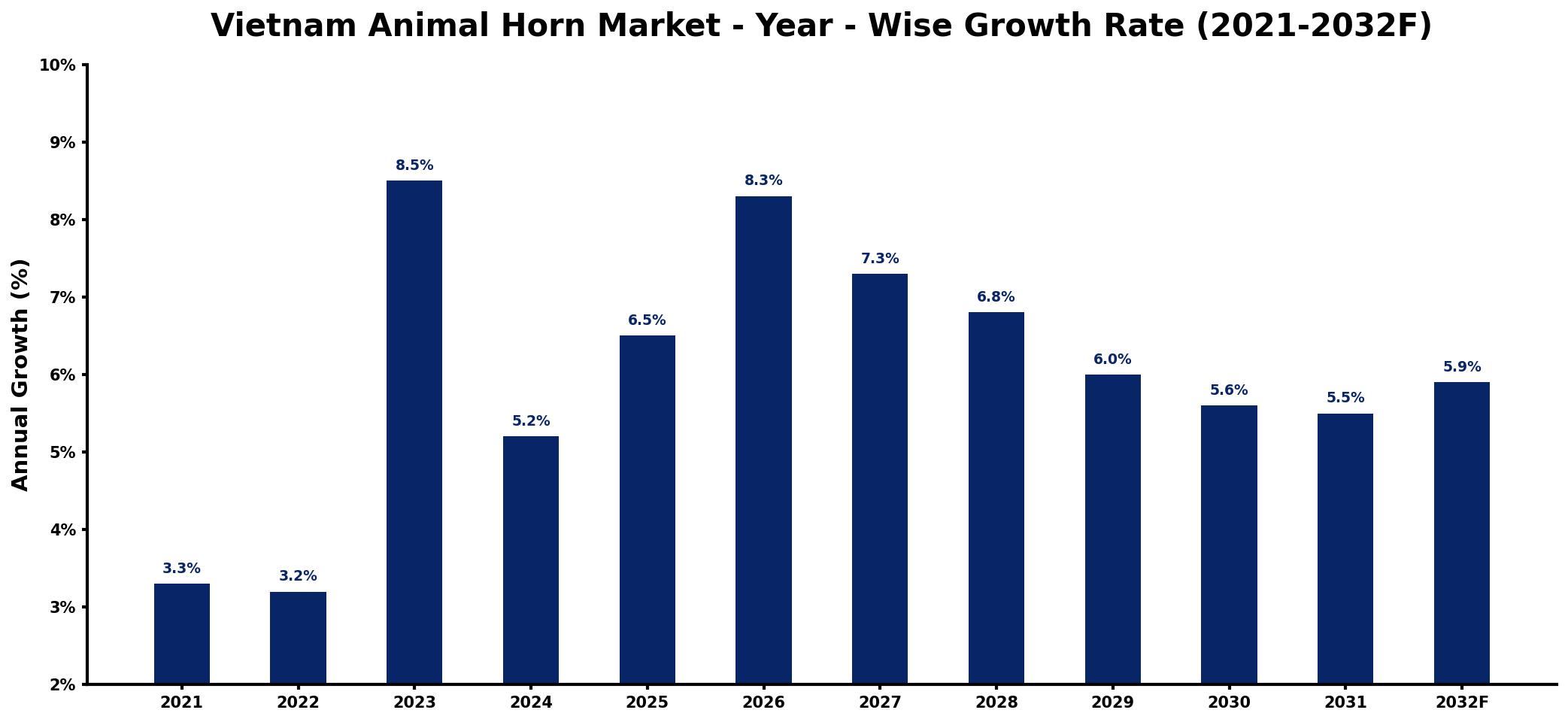
The table below presents the year‑wise growth rates along with the key drivers influencing the market
| Year | Growth Rate | Major Drivers |
| 2021 | 3.3% | Rising demand for traditional crafts |
| 2022 | 3.2% | Increased investment in sustainable sourcing |
| 2023 | 8.5% | Growing popularity in luxury markets |
| 2024 | 5.2% | Expanding export opportunities abroad |
| 2025 | 6.5% | Strengthened regulations on wildlife trade |
| 2026 | 8.3% | Boost in artisanal production techniques |
| 2027 | 7.3% | Heightened awareness of cultural significance |
| 2028 | 6.8% | Emerging market for decorative items |
| 2029 | 6.0% | Growing interest in natural remedies |
| 2030 | 5.6% | Increased collaboration among stakeholders |
| 2031 | 5.5% | Expansion of niche product offerings |
| 2032 | 5.9% | Strengthened community-based conservation efforts |
Note: Market size estimations and growth projections presented in this report are based on 6Wresearch's proprietary forecasting methodology, utilizing the latest available industry data, government publications, and primary research inputs.
Vietnam Animal Horn Market Synopsis
Cultural heritage stands as the strongest force shaping the Vietnam Animal Horn Market today. The symbolic value of animal horns, particularly from water buffalo and other domesticated species, is deeply rooted in Vietnamese traditions, impacting various ceremonies and medicinal practices. This cultural tie has fostered a resilient domestic demand that remains largely insulated from fluctuations in international markets.
The artisan community plays a pivotal role, crafting unique horn products that blend tradition with modern aesthetics. These handcrafted items cater to niche markets, promoting the preservation of traditional methods while driving economic activity in local communities. As awareness of ethical sourcing grows, there is a concerted effort among artisans to align their practices with sustainability principles.
Vietnam Animal Horn Market Key Takeaways
- The market is primarily driven by cultural significance and traditional practices surrounding the use of animal horns.
- Artisanship in crafting decorative and medicinal items remains a vital component of market dynamics.
- Domestic demand is proving resilient despite challenges associated with international wildlife regulations.
- Ethical sourcing and animal welfare are becoming increasingly important in shaping consumer preferences.
- Market growth is expected to be supported by the revitalization of cultural heritage and local crafts.
Evaluation of Restraints in Vietnam Animal Horn Market
Despite its robust demand, the Vietnam Animal Horn Market faces significant constraints primarily stemming from legal and ethical considerations. International regulations aimed at curtailing illegal wildlife trade pose restrictions that can hinder sourcing practices. Furthermore, public awareness of animal welfare issues is rising, compelling artisans and traders to ensure that their practices adhere to ethical standards. Such challenges necessitate a careful balancing act between fulfilling market demand and adhering to responsible sourcing practices.
Vietnam Animal Horn Market Trends
Current trends in the Vietnam Animal Horn Market show a growing inclination towards sustainability and ethical consumption. There is an increasing appreciation for handcrafted items, with consumers opting for unique, artisan-produced products over mass-produced alternatives. Additionally, the incorporation of animal horn materials in contemporary jewelry and home décor reflects a blending of traditional craftsmanship with modern design sensibilities. Digital platforms are also being leveraged by artisans to expand their reach and showcase their work to a global audience.
Vietnam Animal Horn Market Opportunities
The market offers genuine growth opportunities in the realms of sustainable tourism and cultural heritage promotion. As Vietnam positions itself as a destination for cultural experiences, there is potential for increased demand for artisanal animal horn products from tourists seeking authentic Vietnamese handicrafts. Furthermore, collaborations with eco-conscious brands and initiatives that promote fair trade practices can enhance market visibility and create new revenue streams for artisans.
Government Initiatives in the Vietnam Animal Horn Market
The Vietnamese government has been actively promoting cultural heritage preservation, which includes support for traditional crafts and artisans. Initiatives aimed at enhancing public awareness about sustainable practices and responsible sourcing are gaining traction. Programs that provide training and resources to local artisans help ensure the continuation of traditional crafting methods while aligning with ethical standards. Through various cultural and economic policies, the government seeks to balance market growth with conservation efforts.
Future Insights of the Vietnam Animal Horn Market
Looking ahead to 2026-2032, the Vietnam Animal Horn Market is poised for steady growth, underpinned by the dual forces of cultural preservation and ethical consumerism. As global attention towards sustainability intensifies, the local artisan community is expected to adapt, adopting more sustainable practices that align with consumer expectations. The integration of technology, such as e-commerce platforms, will likely enhance market access and visibility, enabling artisans to tap into a broader audience while remaining committed to their cultural roots.
Vietnam Animal Horn Market Latest Developments (2025 - 2026)
Recent industry developments reflect a growing emphasis on ethical sourcing and sustainability in the Vietnam Animal Horn Market. Artisans are increasingly engaging with local communities to promote responsible practices and share their knowledge of traditional crafting techniques. Furthermore, various initiatives aimed at educating consumers about the cultural significance of animal horn products are gaining traction, which is expected to bolster demand in the coming years. Collaborative projects that highlight the intersection of culture and sustainability are also emerging, enhancing the profile of this unique market.
Vietnam Animal Horn Market - Key Attractiveness of the Report
- 10 Years of Market Numbers
- Historical Data Starting from 2022 to 2025
- Base Year: 2025
- Forecast Data until 2032
- Key Performance Indicators Impacting the Market
- Major Upcoming Developments and Projects
Key Highlights of the Report:
- Vietnam Animal Horn Market Outlook
- Market Size of Vietnam Animal Horn Market, 2025
- Forecast of Vietnam Animal Horn Market, 2032
- Historical Data and Forecast of Vietnam Animal Horn Revenues & Volume for the Period 2022-2032F
- Vietnam Animal Horn Market Trend Evolution
- Vietnam Animal Horn Market Drivers and Challenges
- Vietnam Animal Horn Price Trends
- Vietnam Animal Horn Porter's Five Forces
- Vietnam Animal Horn Industry Life Cycle
- Historical Data and Forecast of Vietnam Animal Horn Market Revenues & Volume By Distribution Channel for the Period 2022-2032F
- Historical Data and Forecast of Vietnam Animal Horn Market Revenues & Volume By Online for the Period 2022-2032F
- Historical Data and Forecast of Vietnam Animal Horn Market Revenues & Volume By Offline for the Period 2022-2032F
- Historical Data and Forecast of Vietnam Animal Horn Market Revenues & Volume By Application for the Period 2022-2032F
- Historical Data and Forecast of Vietnam Animal Horn Market Revenues & Volume By Commercial for the Period 2022-2032F
- Historical Data and Forecast of Vietnam Animal Horn Market Revenues & Volume By Cosmetics & Personal Care for the Period 2022-2032F
- Historical Data and Forecast of Vietnam Animal Horn Market Revenues & Volume By Others for the Period 2022-2032F
- Vietnam Animal Horn Import Export Trade Statistics
- Market Opportunity Assessment By Distribution Channel
- Market Opportunity Assessment By Application
- Vietnam Animal Horn Top Companies Market Share
- Vietnam Animal Horn Competitive Benchmarking By Technical and Operational Parameters
- Vietnam Animal Horn Company Profiles
- Vietnam Animal Horn Key Strategic Recommendations






































