Vietnam Anise Seed Market Size, Share & Growth Rate
The Vietnam Anise Seed Market was estimated at USD 283 Million in 2025 and is projected to reach USD 399 Million by 2032, growing at a CAGR of 5.0% from 2026 to 2032. This upward trajectory is primarily fueled by the increasing domestic consumption of anise seeds in traditional Vietnamese cuisine and the growing export opportunities to international markets. Furthermore, the rising trend toward herbal remedies and natural flavorings contributes significantly to the demand dynamics within this vibrant market.
Vietnam Anise Seed Market Growth Rate Analysis (2021-2032)
The Vietnam Anise Seed Market has been on an upward trajectory, showcasing growth rates of 3.1% in 2021, followed by a slight decline to 2.7% in 2022. However, a robust recovery occurred in 2023, with an impressive 8.4% growth, fueled by increasing domestic and export demand. This surge can be attributed to higher consumer interest in natural flavorings and health-conscious products. Moving forward, the market is projected to maintain strong momentum, with growth rates expected to reach 7.7% by 2026. Key drivers include enhanced agricultural practices, government support for spice cultivation, and rising investments in digital supply chain technologies that improve distribution efficiency, all contributing to a favorable business landscape for anise seed producers in Vietnam.
Vietnam Anise Seed Market Year-wise Growth Rate and Key Drivers
This graph highlights how the Vietnam Anise Seed Market has steadily grown over the past five years, supported by major growth factors.
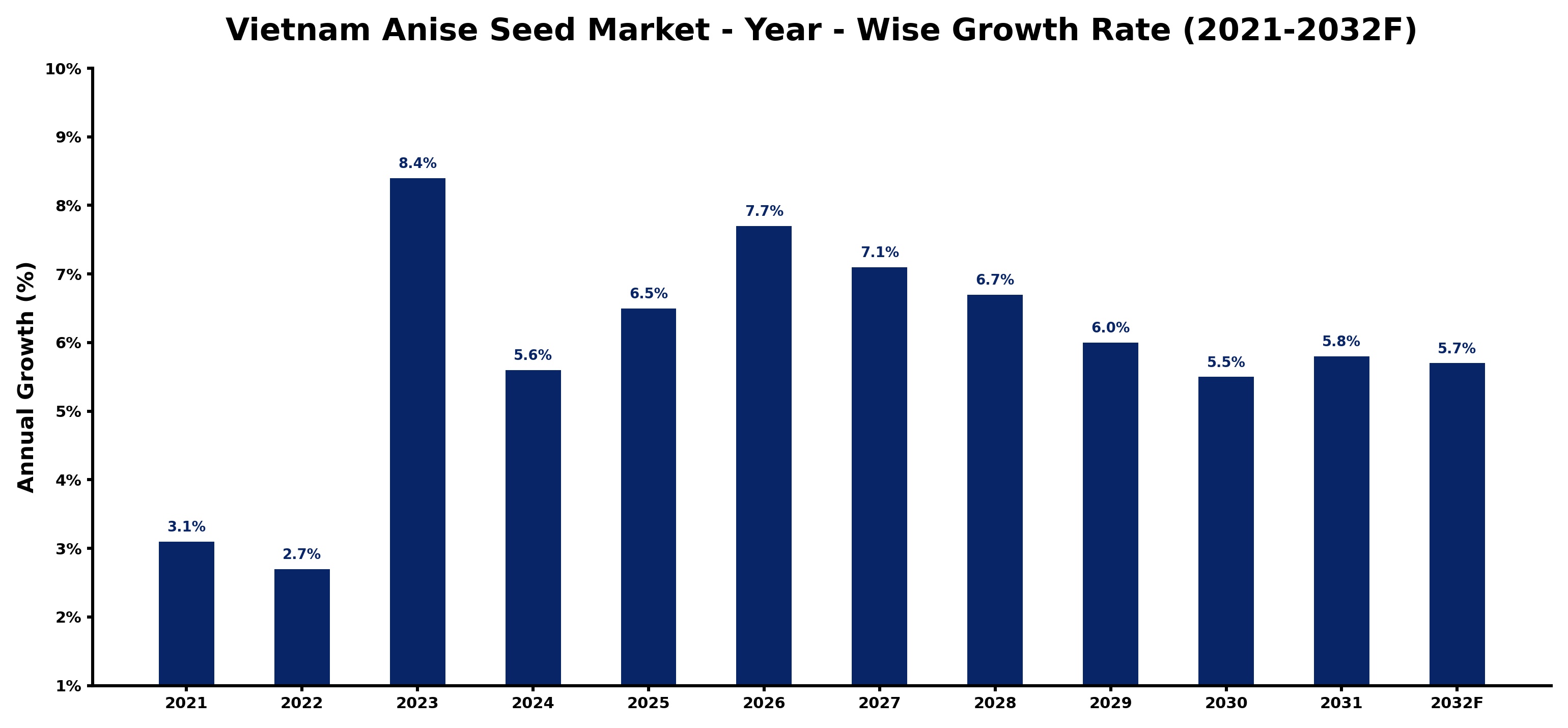
The table below presents the year‑wise growth rates along with the key drivers influencing the market
| Year | Growth Rate | Major Drivers |
| 2021 | 3.1% | Rising demand for herbal products |
| 2022 | 2.7% | Increased culinary use in restaurants |
| 2023 | 8.4% | Export opportunities expanded significantly |
| 2024 | 5.6% | Health benefits promoted consumer interest |
| 2025 | 6.5% | Growing popularity in traditional medicine |
| 2026 | 7.7% | Culinary innovation drove product usage |
| 2027 | 7.1% | Sustainable farming practices gained traction |
| 2028 | 6.7% | Increased awareness of flavor profiles |
| 2029 | 6.0% | E-commerce growth enhanced market reach |
| 2030 | 5.5% | Consumer interest in organic options |
| 2031 | 5.8% | Collaboration with local farmers expanded |
| 2032 | 5.7% | Cultural festivals promoted spice usage |
Note - Market size estimations and growth projections presented in this report are based on 6Wresearch's advanced forecasting approach, validated with industry datasets as of June 2026.
Vietnam Anise Seed Market Synopsis
Anise seeds hold a unique position in Vietnam's culinary landscape, infusing a distinct flavor into many beloved dishes, from traditional pho to various herbal teas. This flavor profile is not only appreciated locally but has also caught the attention of international markets, bolstering the export sector and increasing overall demand for high-quality anise seeds.
The cultivation of anise seeds in Vietnam is also intertwined with sustainable agricultural practices, reflecting the country's commitment to eco-friendly farming. This alignment with environmental consciousness is appealing to a growing demographic of health-conscious consumers, further expanding market potential.
Vietnam Anise Seed Market Key Takeaways
- The market is heavily influenced by traditional culinary uses and increasing interest in herbal medicine.
- Export opportunities are significantly contributing to market growth, with demand from both food and pharmaceutical industries.
- Quality control is critical for maintaining market trust, particularly for exports.
- Sustainable farming practices are becoming a significant factor for both producers and consumers.
- The impact of COVID-19 has necessitated adaptations in supply chain management and consumer engagement strategies.
Evaluation of Restraints in Vietnam Anise Seed Market
Despite its robust growth trajectory, the Vietnam Anise Seed market faces considerable restraints, particularly in terms of quality assurance and environmental sensitivities. Ensuring that anise seeds meet international quality standards is paramount, yet challenges like pesticide residues and contamination pose risks to market access. Moreover, anise seed cultivation is inherently vulnerable to environmental factors, necessitating careful management of climatic conditions. The competition with other spices adds further complexity to market positioning and growth potential.
Vietnam Anise Seed Market Trends
A significant trend within the Vietnam Anise Seed market is the increasing consumer preference for organic and sustainably sourced ingredients. As health and wellness continue to take precedence in consumer choices, the shift towards natural flavors rather than synthetic additives is gaining momentum. Additionally, there is a growing appreciation for the medicinal properties of anise seeds, aligning with a broader shift toward holistic health practices. The market is also seeing innovations in processing and packaging that enhance the product's appeal in both domestic and export markets.
Vietnam Anise Seed Market Opportunities
The future of the Vietnam Anise Seed market is bright, with abundant opportunities for growth and investment. Expanding into new international markets, particularly in regions that emphasize organic and natural food products, presents lucrative possibilities. Additionally, the integration of technology in agriculture—such as precision farming and improved irrigation techniques—can enhance yield quality and sustainability. Consumers' increasing interest in culinary diversity also opens avenues for innovative product applications in both food and beverage sectors.
Government Initiatives in the Vietnam Anise Seed Market
The Vietnamese government is actively promoting the cultivation and export of agricultural products, including anise seeds. This includes various initiatives aimed at improving agricultural practices, enhancing supply chain efficiency, and supporting farmers in accessing new markets. Policies that encourage sustainable farming practices and provide financial incentives for adopting eco-friendly methods further bolster the potential for growth within the anise seed sector. Collaboration with industry stakeholders to enhance quality control standards is also a focus area for public spending.
Future Insights of the Vietnam Anise Seed Market
Looking ahead to the period between 2026 and 2032, the Vietnam Anise Seed market is set to experience substantial transformation. As domestic demand continues to rise, fueled by both culinary trends and the growing herbal wellness movement, producers will need to prioritize quality and sustainability. Innovations in agricultural techniques and supply chain management will be crucial in meeting these demands. Furthermore, the evolving landscape of international trade agreements could enhance export opportunities, solidifying Vietnam's position as a key player in the global anise seed market.
Vietnam Anise Seed Market Latest Developments (May 2025 - June 2026)
Recent developments in the Vietnam Anise Seed market indicate a renewed focus on quality assurance protocols and sustainable farming practices. The introduction of new certification standards aimed at improving product quality is expected to gain traction among producers. Additionally, there is a marked increase in collaborative initiatives between farmers and exporters to enhance the overall supply chain efficiency, allowing for better market access for high-quality anise seeds. Consumers are also showing heightened interest in locally sourced products, aligning with broader trends in culinary practices.
Vietnam Anise Seed Market - Key Attractiveness of the Report
- 10 Years of Market Numbers
- Historical Data Starting from 2022 to 2025
- Base Year: 2025
- Forecast Data until 2032
- Key Performance Indicators Impacting the Market
- Major Upcoming Developments and Projects
Key Highlights of the Report:
- Vietnam Anise Seed Market Outlook
- Market Size of Vietnam Anise Seed Market, 2025
- Forecast of Vietnam Anise Seed Market, 2032F
- Historical Data and Forecast of Vietnam Anise Seed Revenues & Volume for the Period 2022-2032F
- Vietnam Anise Seed Market Trend Evolution
- Vietnam Anise Seed Market Drivers and Challenges
- Vietnam Anise Seed Price Trends
- Vietnam Anise Seed Porter's Five Forces
- Vietnam Anise Seed Industry Life Cycle
- Historical Data and Forecast of Vietnam Anise Seed Market Revenues & Volume By Form for the Period 2022-2032F
- Historical Data and Forecast of Vietnam Anise Seed Market Revenues & Volume By Whole for the Period 2022-2032F
- Historical Data and Forecast of Vietnam Anise Seed Market Revenues & Volume By Ground for the Period 2022-2032F
- Historical Data and Forecast of Vietnam Anise Seed Market Revenues & Volume By Oil for the Period 2022-2032F
- Historical Data and Forecast of Vietnam Anise Seed Market Revenues & Volume By Application for the Period 2022-2032F
- Historical Data and Forecast of Vietnam Anise Seed Market Revenues & Volume By Pharma for the Period 2022-2032F
- Historical Data and Forecast of Vietnam Anise Seed Market Revenues & Volume By Food and beverages for the Period 2022-2032F
- Historical Data and Forecast of Vietnam Anise Seed Market Revenues & Volume By Personal care & Cosmetic for the Period 2022-2032F
- Historical Data and Forecast of Vietnam Anise Seed Market Revenues & Volume By Others for the Period 2022-2032F
- Historical Data and Forecast of Vietnam Anise Seed Market Revenues & Volume By Distribution Channel for the Period 2022-2032F
- Historical Data and Forecast of Vietnam Anise Seed Market Revenues & Volume By Business to Business (B2B) for the Period 2022-2032F
- Historical Data and Forecast of Vietnam Anise Seed Market Revenues & Volume By Business to Consumers (B2C) for the Period 2022-2032F
- Vietnam Anise Seed Import Export Trade Statistics
- Market Opportunity Assessment By Form
- Market Opportunity Assessment By Application
- Market Opportunity Assessment By Distribution Channel
- Vietnam Anise Seed Top Companies Market Share
- Vietnam Anise Seed Competitive Benchmarking By Technical and Operational Parameters
- Vietnam Anise Seed Company Profiles
- Vietnam Anise Seed Key Strategic Recommendations






































