Vietnam Antiparasitics Drugs Market Size, Share & Growth Rate
The Vietnam Antiparasitics Drugs Market was estimated at USD 281 Million in 2025 and is projected to reach USD 396 Million by 2032, growing at a CAGR of 5.0% from 2026 to 2032. This growth trajectory is significantly driven by the high prevalence of parasitic infections in the country, coupled with increased public awareness and government initiatives aimed at disease prevention. As the healthcare landscape evolves, innovation in drug development further positions the market for sustained expansion.
Vietnam Antiparasitics Drugs Market Year-wise Growth Rate and Key Drivers
This graph highlights how the Vietnam Antiparasitics Drugs Market has steadily grown over the years, supported by major growth factors.
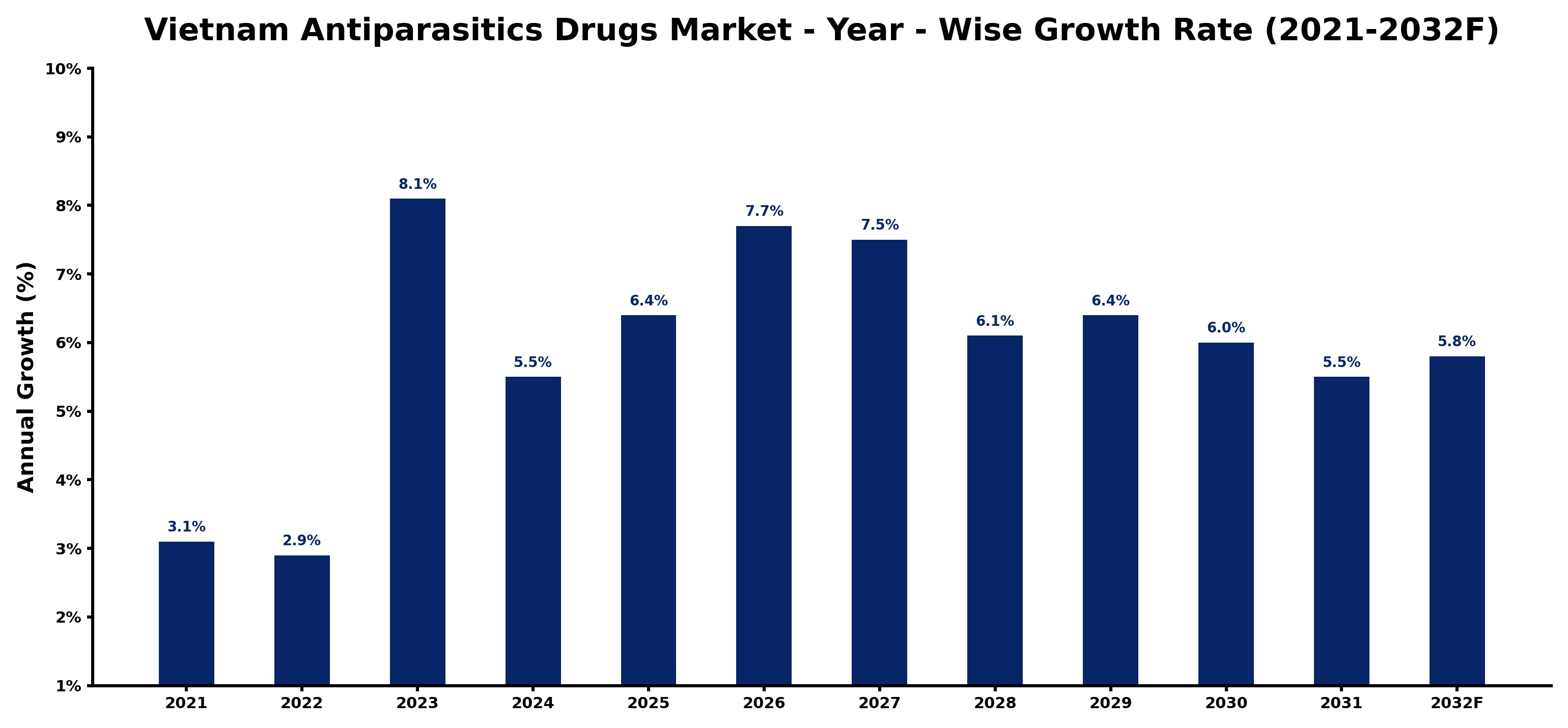
The table below presents the year‑wise growth rates along with the key drivers influencing the market
| Year | Growth Rate | Major Drivers |
| 2021 | 3.1% | Foreign direct investments boosted Vietnam’s pharmaceutical manufacturing capacity |
| 2022 | 2.9% | Investment in biotechnology elevates antiparasitic drug production capabilities |
| 2023 | 8.1% | Increased export demand boosts domestic antiparasitic drug production capacity |
| 2024 | 5.5% | Technological upgrades in production lines boost antiparasitics manufacturing efficiency |
| 2025 | 6.4% | Increased demand for antiparasitic drugs drives local manufacturing investment |
| 2026 | 7.7% | Increased export demand boosts local antiparasitics manufacturing capacity |
| 2027 | 7.5% | Technology integration in pharmaceutical manufacturing enhances antiparasitic drug efficiency |
| 2028 | 6.1% | New partnerships enhance capacity for antiparasitic drug exports |
| 2029 | 6.4% | Increased foreign investment boosts local production of antiparasitics |
| 2030 | 6.0% | Foreign investments boost local production capacity for antiparasitics |
| 2031 | 5.5% | Foreign investments boosted capacity for antiparasitic drug production |
| 2032 | 5.8% | Higher domestic consumption of antiparasitics boosts pharmaceutical manufacturing capacity |
Note - Market size estimations and growth projections presented in this report are based on 6Wresearch’s advanced forecasting approach, validated with industry datasets as of June 2026.
Vietnam Antiparasitics Drugs Market Synopsis
In Vietnam, the demand for antiparasitic drugs has surged due to the country's favorable climate, which facilitates the growth of various parasites. This has resulted in a persistent need for effective treatments to combat these infections, influencing the market's dynamics significantly.
Furthermore, public health initiatives and educational campaigns have played a crucial role in enhancing awareness about parasitic diseases. The intertwining of animal health with human well-being underscores the necessity of antiparasitic interventions, reinforcing their critical position in Vietnam's healthcare framework.
Vietnam Antiparasitics Drugs Market Key Takeaways
- The Vietnam antiparasitics drugs market is projected to grow steadily, reflecting increased healthcare investments.
- Government initiatives significantly influence market accessibility and awareness regarding parasitic infections.
- Continuous drug development and research are vital to combat the challenge of resistance among parasites.
- Public health campaigns are essential in addressing the prevalence of parasitic diseases effectively.
- There exists a growing linkage between animal and human health that drives demand for antiparasitic treatments.
Evaluation of Restraints in Vietnam Antiparasitics Drugs Market
Despite the promising growth, the Vietnam antiparasitics drugs market faces significant hurdles. One major constraint is the challenge of ensuring that antiparasitic medications remain effective, accessible, and affordable to the broader population. The prevalence of drug resistance amongst parasites complicates treatment protocols and necessitates ongoing research for new drug developments. Additionally, the public health infrastructure must be bolstered to effectively mitigate the widespread implications of parasitic infections. Comprehensive public health strategies, including awareness campaigns, are essential in addressing these issues while ensuring the sustained growth of the market.
Vietnam Antiparasitics Drugs Market Trends
A notable trend in the Vietnam antiparasitics drugs market is the increasing incorporation of advanced biotechnology into drug development. This shift is aimed at enhancing the efficacy and safety of antiparasitic treatments. Furthermore, there is a rising emphasis on integrated healthcare approaches that address both human and animal health, fostering collaborative efforts to tackle parasitic diseases. Digital health solutions, including telemedicine, are also becoming more prevalent, enabling better patient management and access to treatments.
Vietnam Antiparasitics Drugs Market Opportunities
Investment opportunities in the Vietnam antiparasitics drugs market are expanding, particularly in research and development initiatives aimed at combating drug resistance. Companies focusing on innovative delivery systems and combination therapies are poised to gain a competitive edge. Additionally, public-private partnerships can enhance healthcare outreach, facilitating broader access to antiparasitic treatments. As Vietnam strengthens its healthcare infrastructure post-pandemic, the focus on preventive health and disease management will further unlock potential growth avenues.
Government Initiatives in the Vietnam Antiparasitics Drugs Market
The Vietnamese government has demonstrated a strong commitment to tackling parasitic infections through various health programs and initiatives. Increased public spending on healthcare, including disease prevention and management, reflects a strategic approach to enhancing national health outcomes. Policies promoting accessibility of essential medicines and improving healthcare infrastructure are vital components of this strategy, further reinforcing the importance of antiparasitic drugs in the nation's health agenda.
Future Insights of the Vietnam Antiparasitics Drugs Market
Looking ahead, the Vietnam antiparasitics drugs market is likely to experience significant advancements driven by technological innovations and heightened public health consciousness. Between 2026 and 2032, a focus on sustainable practices in drug production and distribution will emerge as key to meeting the growing demand. As the market adapts to evolving healthcare needs, the integration of comprehensive health solutions that address both prevention and treatment will shape its future trajectory.
Vietnam Antiparasitics Drugs Market Latest Developments (May 2025 - June 2026)
In recent months, the Vietnam antiparasitics drugs market has observed a series of strategic collaborations aimed at enhancing research capabilities and expanding the range of available treatments. Key stakeholders are increasingly focusing on addressing the challenges posed by drug resistance through collaborative research initiatives. Furthermore, there has been a notable increase in public awareness campaigns, aimed at educating citizens about the dangers of parasitic infections and the importance of prevention measures.
Vietnam Antiparasitics Drugs Market - Key Attractiveness of the Report
- 10 Years of Market Numbers
- Historical Data Starting from 2022 to 2025
- Base Year: 2025
- Forecast Data until 2032
- Key Performance Indicators Impacting the Market
- Major Upcoming Developments and Projects
Key Highlights of the Report:
- Vietnam Antiparasitics Drugs Market Outlook
- Market Size of Vietnam Antiparasitics Drugs Market, 2025
- Forecast of Vietnam Antiparasitics Drugs Market, 2032
- Historical Data and Forecast of Vietnam Antiparasitics Drugs Revenues & Volume for the Period 2022-2032F
- Vietnam Antiparasitics Drugs Market Trend Evolution
- Vietnam Antiparasitics Drugs Market Drivers and Challenges
- Vietnam Antiparasitics Drugs Price Trends
- Vietnam Antiparasitics Drugs Porter's Five Forces
- Vietnam Antiparasitics Drugs Industry Life Cycle
- Historical Data and Forecast of Vietnam Antiparasitics Drugs Market Revenues & Volume By Route of Administration for the Period 2022-2032F
- Historical Data and Forecast of Vietnam Antiparasitics Drugs Market Revenues & Volume By Oral for the Period 2022-2032F
- Historical Data and Forecast of Vietnam Antiparasitics Drugs Market Revenues & Volume By Injectable for the Period 2022-2032F
- Historical Data and Forecast of Vietnam Antiparasitics Drugs Market Revenues & Volume By Topical for the Period 2022-2032F
- Historical Data and Forecast of Vietnam Antiparasitics Drugs Market Revenues & Volume By Drug class for the Period 2022-2032F
- Historical Data and Forecast of Vietnam Antiparasitics Drugs Market Revenues & Volume By Anthelmintics for the Period 2022-2032F
- Historical Data and Forecast of Vietnam Antiparasitics Drugs Market Revenues & Volume By Antiprotozoals for the Period 2022-2032F
- Historical Data and Forecast of Vietnam Antiparasitics Drugs Market Revenues & Volume By Others for the Period 2022-2032F
- Historical Data and Forecast of Vietnam Antiparasitics Drugs Market Revenues & Volume By Distribution Channel for the Period 2022-2032F
- Historical Data and Forecast of Vietnam Antiparasitics Drugs Market Revenues & Volume By Hospital Pharmacies for the Period 2022-2032F
- Historical Data and Forecast of Vietnam Antiparasitics Drugs Market Revenues & Volume By Retail Pharmacies for the Period 2022-2032F
- Historical Data and Forecast of Vietnam Antiparasitics Drugs Market Revenues & Volume By Online Pharmacies for the Period 2022-2032F
- Vietnam Antiparasitics Drugs Import Export Trade Statistics
- Market Opportunity Assessment By Route of Administration
- Market Opportunity Assessment By Drug class
- Market Opportunity Assessment By Distribution Channel
- Vietnam Antiparasitics Drugs Top Companies Market Share
- Vietnam Antiparasitics Drugs Competitive Benchmarking By Technical and Operational Parameters
- Vietnam Antiparasitics Drugs Company Profiles
- Vietnam Antiparasitics Drugs Key Strategic Recommendations






































