Vietnam Apiculture Market Size, Share & Growth Rate
The Vietnam Apiculture Market was estimated at USD 336 Million in 2025 and is projected to reach USD 476 Million by 2032, growing at a CAGR of 5.1% from 2026 to 2032. This remarkable growth trajectory is primarily driven by the rising consumer awareness of the health benefits of honey, which is increasingly recognized as a natural and nutritious sweetener. Additionally, the governments proactive support for beekeeping practices further solidifies the market's potential.
Vietnam Apiculture Market Year-wise Growth Rate and Key Drivers
This graph highlights how the Vietnam Apiculture Market has steadily grown over the years, supported by major growth factors.
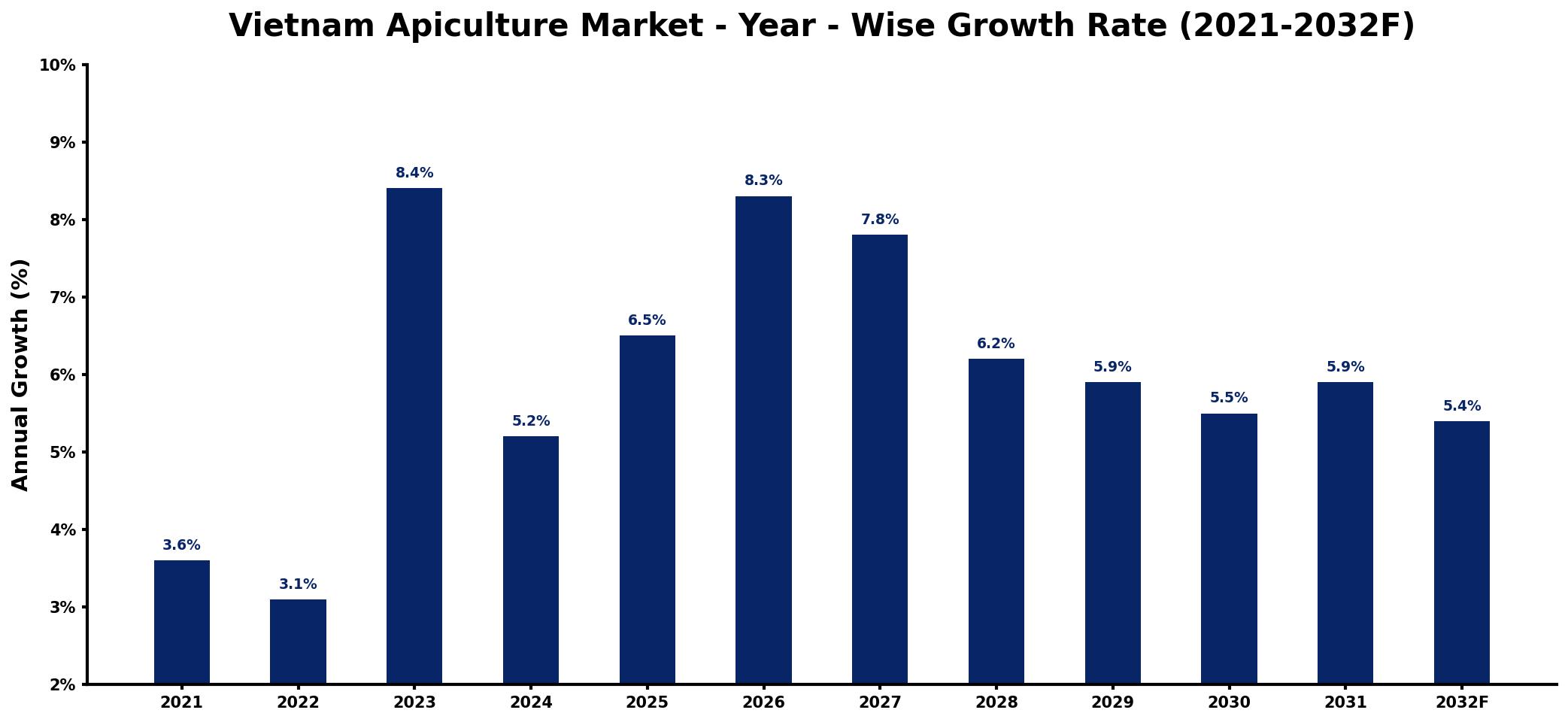
The table below presents the year‑wise growth rates along with the key drivers influencing the market
| Year | Growth Rate | Major Drivers |
| 2021 | 3.6% | Rising consumer health awareness |
| 2022 | 3.1% | Growth in organic food demand |
| 2023 | 8.4% | Increased investment in agriculture |
| 2024 | 5.2% | Expansion of export markets |
| 2025 | 6.5% | Technological advancements in farming |
| 2026 | 8.3% | Growing popularity of natural products |
| 2027 | 7.8% | Strengthening rural economic development |
| 2028 | 6.2% | Surge in local farming initiatives |
| 2029 | 5.9% | Increase in eco-friendly practices |
| 2030 | 5.5% | Development of sustainable supply chains |
| 2031 | 5.9% | Enhancement of agricultural education programs |
| 2032 | 5.4% | increased production capacity utilization |
Note: Market size estimations and growth projections presented in this report are based on 6Wresearch's proprietary forecasting methodology, utilizing the latest available industry data, government publications, and primary research inputs.
Vietnam Apiculture Market Synopsis
The most influential force shaping the Vietnam Apiculture Market today is the growing health consciousness among consumers. As people seek healthier alternatives to refined sugars, honey has emerged as a favored choice, boosting both local consumption and export prospects.
Investments in modern beekeeping techniques and equipment by Vietnamese apiarists are vital to enhancing honey production quality. This drive not only elevates the status of Vietnamese honey in global markets but also opens avenues in beeswax and royal jelly processing, making the market a multi-faceted opportunity for growth.
Vietnam Apiculture Market Key Takeaways
- The increasing recognition of honey's health benefits is propelling market demand.
- Government initiatives are fostering an environment conducive to beekeeping expansion.
- Vietnam's unique flora supports the production of distinctive and high-quality honey.
- Eco-tourism and agro-tourism are becoming significant avenues for market engagement.
- The market is well-positioned to cater to the growing global demand for organic and natural bee products.
Evaluation of Restraints in Vietnam Apiculture Market
The Vietnam Apiculture Market faces several notable constraints that impede its growth. Pesticide use in agriculture poses a significant threat to bee populations, directly impacting honey production and sustainability. Climate change further complicates the landscape, affecting flowering patterns and nectar availability essential for beekeeping. Additionally, diseases and pests can devastate bee colonies, leading to reduced yields. Small-scale beekeepers often encounter market access challenges, limiting their distribution capabilities, while maintaining stringent quality standards for export can be a formidable hurdle for many producers.
Vietnam Apiculture Market Trends
Emerging trends in the Vietnam Apiculture Market indicate a growing shift towards organic and sustainably produced honey. As consumers increasingly prioritize health and sustainability, there is a notable demand for products that are free from pesticides and artificial additives. Moreover, the integration of technology in beekeeping practices is enhancing productivity and efficiency, enabling beekeepers to monitor hive health and production levels in real-time. The rise of online marketplaces is also transforming how honey and bee products reach consumers, broadening market access for both large and small producers.
Vietnam Apiculture Market Opportunities
Significant growth and investment opportunities abound within the Vietnam Apiculture Market. The burgeoning export potential of Vietnamese honey is a major area for development, particularly as international markets seek authentic and high-quality natural products. Additionally, the burgeoning interest in health supplements, such as royal jelly and propolis, offers lucrative avenues for diversification. By focusing on sustainable practices and fostering organic certification, beekeepers can tap into niche markets that are increasingly lucrative.
Government Initiatives in the Vietnam Apiculture Market
The Vietnamese government has taken substantial steps to promote the apiculture industry, implementing training programs designed to educate beekeepers on modern practices and techniques. Various subsidies and financial incentives are available to those entering or expanding their beekeeping operations. Research initiatives aimed at improving honey production and quality standards also underpin governmental support, reflecting a commitment to sustaining and advancing this vital sector.
Future Insights of the Vietnam Apiculture Market
Looking ahead to the period from 2026 to 2032, the Vietnam Apiculture Market is poised for significant evolution. The confluence of rising health consciousness, robust government support, and increased international demand for organic products positions the market for ongoing growth. Beekeepers who leverage technology and maintain high standards of quality will likely see substantial benefits. Additionally, as eco-tourism continues to flourish, beekeepers who can effectively engage consumers through educational experiences will find themselves at a competitive advantage.
Vietnam Apiculture Market Latest Developments (2025 - 2026)
Recent developments in the Vietnam Apiculture Market indicate a growing focus on sustainable practices and organic certification among beekeepers. Companies are increasingly adopting eco-friendly technologies to optimize honey production while minimizing environmental impact. Additionally, as consumer interest in online shopping rises, many producers are exploring digital platforms to broaden their market reach. Initiatives promoting local honey varieties and regional specialties are gaining traction, further enhancing the appeal of Vietnamese honey in both local and export markets.
Vietnam Apiculture Market - Key Attractiveness of the Report
- 10 Years of Market Numbers
- Historical Data Starting from 2022 to 2025
- Base Year: 2025
- Forecast Data until 2032
- Key Performance Indicators Impacting the Market
- Major Upcoming Developments and Projects
Key Highlights of the Report:
- Vietnam Apiculture Market Outlook
- Market Size of Vietnam Apiculture Market, 2025
- Forecast of Vietnam Apiculture Market, 2032
- Historical Data and Forecast of Vietnam Apiculture Revenues & Volume for the Period 2022-2032F
- Vietnam Apiculture Market Trend Evolution
- Vietnam Apiculture Market Drivers and Challenges
- Vietnam Apiculture Price Trends
- Vietnam Apiculture Porter's Five Forces
- Vietnam Apiculture Industry Life Cycle
- Historical Data and Forecast of Vietnam Apiculture Market Revenues & Volume By Product Type for the Period 2022-2032F
- Historical Data and Forecast of Vietnam Apiculture Market Revenues & Volume By Honey for the Period 2022-2032F
- Historical Data and Forecast of Vietnam Apiculture Market Revenues & Volume By Beeswax for the Period 2022-2032F
- Historical Data and Forecast of Vietnam Apiculture Market Revenues & Volume By Live-bees for the Period 2022-2032F
- Historical Data and Forecast of Vietnam Apiculture Market Revenues & Volume By Others for the Period 2022-2032F
- Historical Data and Forecast of Vietnam Apiculture Market Revenues & Volume By Application for the Period 2022-2032F
- Historical Data and Forecast of Vietnam Apiculture Market Revenues & Volume By Medical for the Period 2022-2032F
- Historical Data and Forecast of Vietnam Apiculture Market Revenues & Volume By Food Beverages for the Period 2022-2032F
- Historical Data and Forecast of Vietnam Apiculture Market Revenues & Volume By Cosmetics for the Period 2022-2032F
- Historical Data and Forecast of Vietnam Apiculture Market Revenues & Volume By Others for the Period 2022-2032F
- Vietnam Apiculture Import Export Trade Statistics
- Market Opportunity Assessment By Product Type
- Market Opportunity Assessment By Application
- Vietnam Apiculture Top Companies Market Share
- Vietnam Apiculture Competitive Benchmarking By Technical and Operational Parameters
- Vietnam Apiculture Company Profiles
- Vietnam Apiculture Key Strategic Recommendations






































