Vietnam Application Security Market Size & Growth Rate (2026-2032)
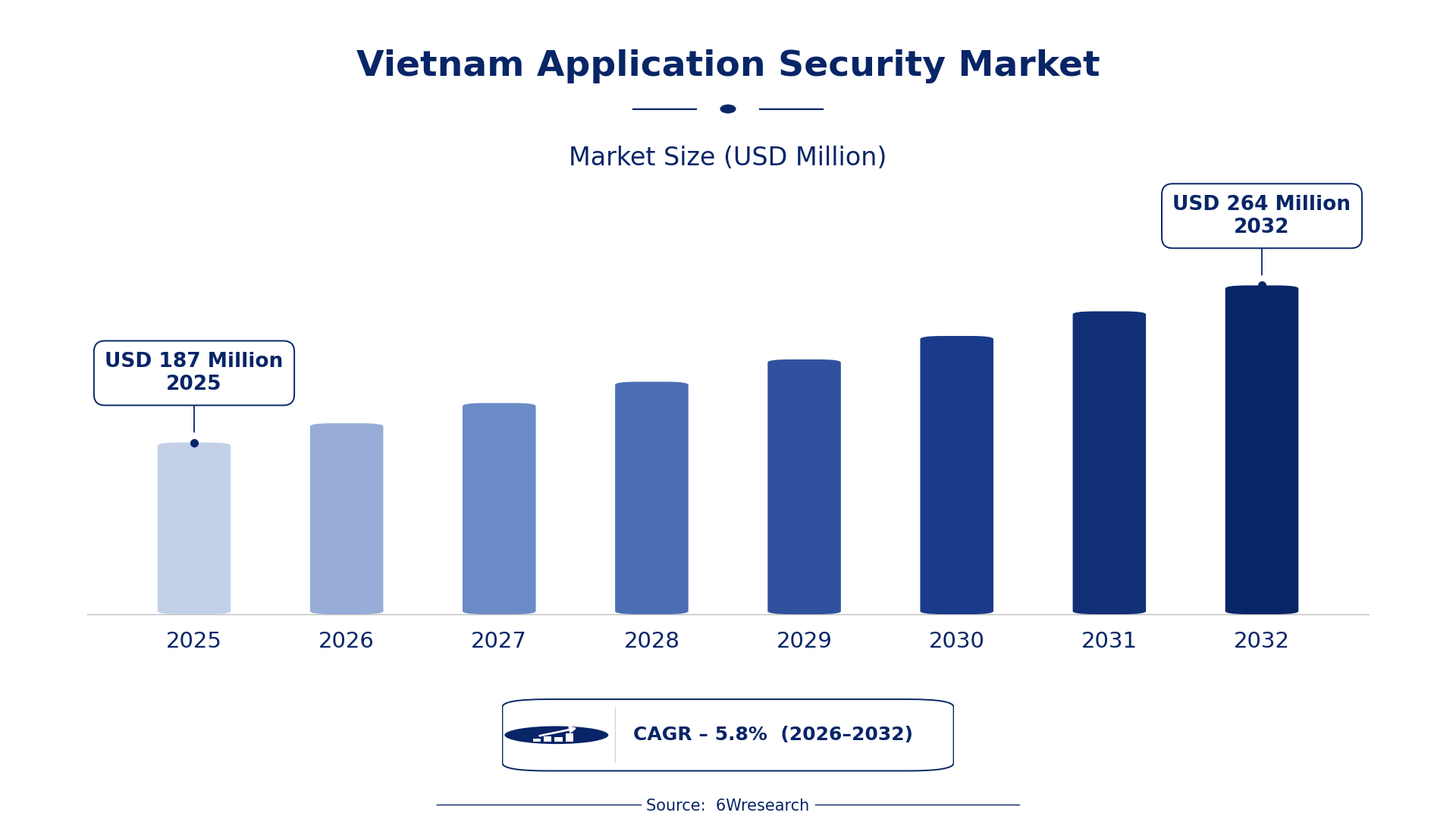
The Vietnam Application Security Market was estimated at USD 187 Million in 2025 and is projected to reach USD 264 Million by 2032, growing at a CAGR of 5.8% from 2026 to 2032.
Vietnam Application Security Market Synopsis
The Vietnam Application Security Market is at a crucial juncture, driven by an increasing number of cyber threats targeting applications. As organizations pivot towards digital transformation, securing their applications has become imperative, leading to substantial investments in security solutions.
However, this momentum must be balanced with the challenges of rapidly evolving software development practices. Companies are under pressure to innovate while simultaneously ensuring that their application security measures remain effective and up-to-date.
Vietnam Application Security Market Year-wise Growth Rate and Key Drivers
This graph illustrates the annual growth rates of the Vietnam Application Security Market from 2021 to 2032, highlighting a steady upward trajectory and projected expansion over the forecast period.
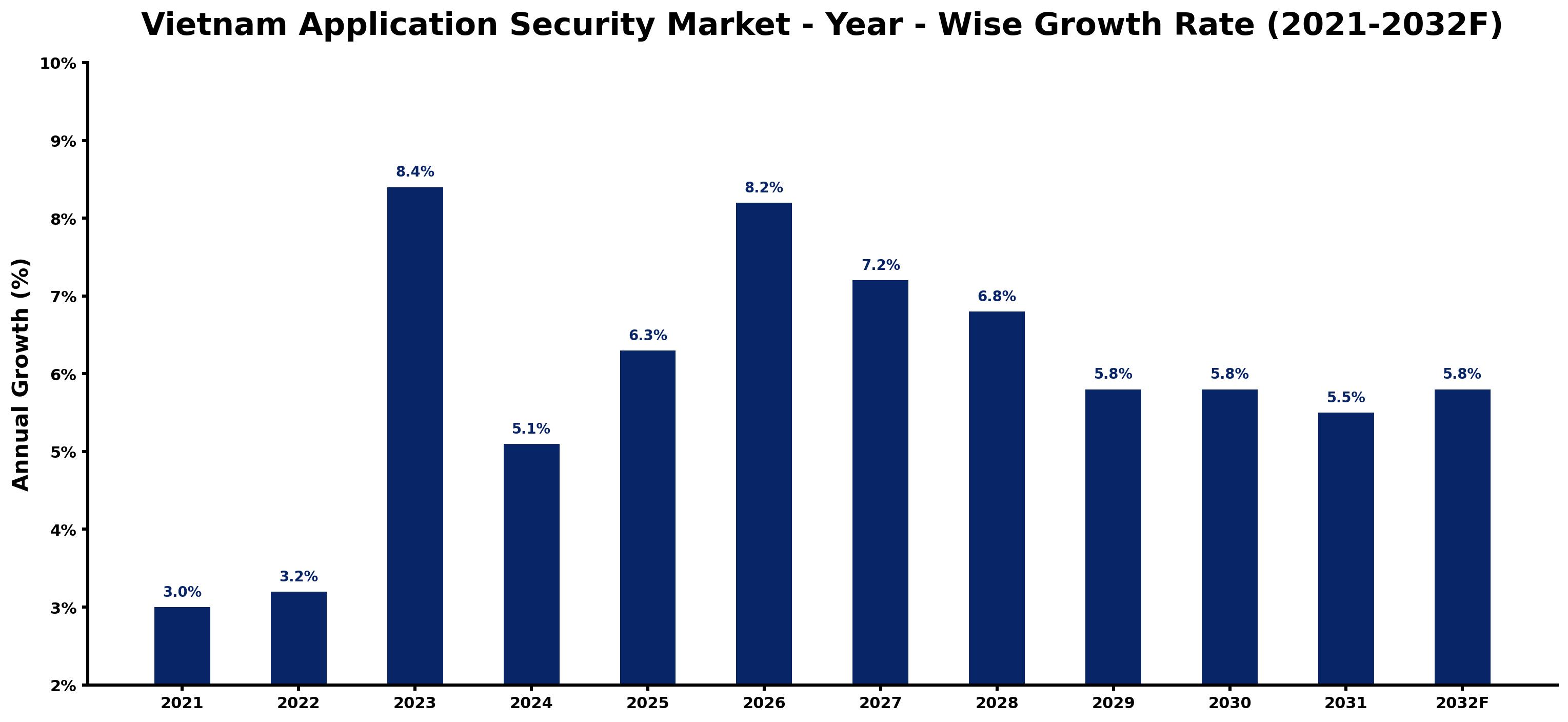
The table below presents the year‑wise growth rates along with the key drivers influencing the market
| Year | Growth Rate | Major Drivers |
| 2021 | 3.0% | Ministry of Information's cybersecurity regulations foster market growth. |
| 2022 | 3.2% | Rising fintech startups demand robust application protection solutions. |
| 2023 | 8.4% | Increased public awareness of cyber threats boosts security adoption. |
| 2024 | 5.1% | Government digital transformation initiative accelerates application security investments. |
| 2025 | 6.3% | Growing mobile app usage heightens security demand in Vietnam. |
| 2026 | 8.2% | Local enterprises prioritize compliance with data protection laws. |
| 2027 | 7.2% | Surge in cloud-based services necessitates enhanced security protocols. |
| 2028 | 6.8% | Development of smart cities increases demand for secure applications. |
| 2029 | 5.8% | Rising incidences of cyberattacks drive need for application security. |
| 2030 | 5.8% | Investment in digital identity solutions enhances application protection strategies. |
| 2031 | 5.5% | Increasing remote work trends necessitate secure application infrastructure. |
| 2032 | 5.8% | Corporate partnerships focus on improving cybersecurity measures. |
Note: Market size estimations and growth projections presented in this report are based on 6Wresearch's proprietary forecasting methodology, utilizing the latest available industry data, government publications, and primary research inputs.
Vietnam Application Security Market Key Takeaways
Below are some of the specific key takeaways from the market, including:
- The market is experiencing growth due to increased adoption of mobile and web applications across sectors.
- Organizations are prioritizing investment in application security to mitigate risks associated with data breaches.
- Dynamic security solutions are emerging to counteract fast-evolving cyber threats.
- Legislative initiatives are shaping the regulatory framework within which application security solutions operate.
- The COVID-19 pandemic acted as a catalyst for heightened awareness and investments in application security.
Evaluation of Restraints in Vietnam Application Security Market
The Vietnam Application Security Market faces several restraints that hinder its full potential. One of the primary concerns is the ability of organizations to keep pace with the rapid evolution of software development methodologies. Security measures need constant adaptation to prevent vulnerabilities from being exploited. Companies are also challenged by the need to maintain a balance between usability and security, which can complicate the implementation of necessary protections. on top of that, the heightened sophistication of cyber threats demands advanced security solutions, which can be resource-intensive to deploy and manage.
Vietnam Application Security Market Trends
Key trends are reshaping the Vietnam Application Security Market. Increasing reliance on cloud-based solutions is propelling demand for security measures tailored to cloud applications. on top of that, the adoption of DevSecOps practices is gaining traction, encouraging security to be integrated into every phase of the development cycle. Another notable trend is the emphasis on compliance with data protection regulations, pushing organizations to seek solutions that not only secure applications but also ensure regulatory adherence.
Vietnam Application Security Market Opportunities
The market presents several lucrative opportunities for growth. There is a notable demand for advanced analytics and AI-driven security solutions that can proactively identify and mitigate threats. As companies increasingly migrate to cloud environments, developing security solutions specifically for cloud applications will be critical. Additionally, the ongoing digital transformation initiatives across various industries create opportunities for tailored security products and services that meet unique organizational needs.
Government Initiatives in the Vietnam Application Security Market
Vietnam's government is actively influencing the Application Security Market through various initiatives aimed at enhancing cybersecurity. The regulatory environment is evolving, with a focus on creating frameworks that support secure application development and deployment. This governmental focus is vital as it shapes compliance standards and encourages private sector investment in security solutions.
- A recently completed initiative includes the implementation of a national cybersecurity strategy aimed at strengthening the security infrastructure across digital platforms.
- Current efforts include the rollout of training programs to enhance the cybersecurity skills of IT professionals, ensuring a skilled workforce to tackle emerging threats.
- A planned initiative focuses on establishing public-private partnerships to develop innovative cybersecurity solutions, set to be launched by late 2025.
- In 2023, regulations were updated to enforce stricter compliance for companies handling sensitive data, promoting the adoption of application security measures.
- Upcoming projects will establish dedicated cybersecurity task forces to address application security vulnerabilities across critical sectors.
Future Insights of the Vietnam Application Security Market
Looking ahead to 2026-2032, the Vietnam Application Security Market is expected to continue its upward trajectory, fueled by ongoing digital transformation. The integration of AI and machine learning into security solutions will enhance threat detection and response capabilities. As organizations recognize the critical need for application security, especially in an increasingly interconnected world, the emphasis will shift towards comprehensive security strategies that encompass not just technology but also people and processes. Companies that can innovate and adapt to changing demands will emerge as leaders in this burgeoning market.
Vietnam Application Security Market Latest Developments
In the past year, the Vietnam Application Security Market has seen dynamic developments reflecting a growing emphasis on enhancing application security measures. Organizations are increasingly prioritizing the integration of security within their software development processes, creating a fertile ground for new security solutions.
- A major technology vendor launched an advanced application security testing tool in early 2023, aimed at addressing vulnerabilities in both web and mobile applications.
- An initiative that began in mid-2023 focuses on upgrading cybersecurity training for developers, improving their understanding of secure coding practices.
- A collaborative project between industry stakeholders was announced, aiming to develop standardized security protocols for application development, expected to kick off by Q1 2024.
- A leading regional operator has started implementing real-time monitoring solutions to enhance the security posture of their applications, an effort currently underway.
- Upcoming in late 2024, a government-backed grant program will support startups focusing on innovative application security technologies.
Vietnam Application Security Market - Key Attractiveness of the Report
- 10 Years of Market Numbers
- Historical Data Starting from 2022 to 2025
- Base Year: 2025
- Forecast Data until 2032
- Key Performance Indicators Impacting the Market
- Major Upcoming Developments and Projects
Key Highlights of the Report:
- Vietnam Application Security Market Outlook
- Market Size of Vietnam Application Security Market, 2025
- Forecast of Vietnam Application Security Market, 2032
- Historical Data and Forecast of Vietnam Application Security Revenues & Volume for the Period 2022-2032F
- Vietnam Application Security Market Trend Evolution
- Vietnam Application Security Market Drivers and Challenges
- Vietnam Application Security Price Trends
- Vietnam Application Security Porter's Five Forces
- Vietnam Application Security Industry Life Cycle
- Historical Data and Forecast of Vietnam Application Security Market Revenues & Volume By Component for the Period 2022-2032F
- Historical Data and Forecast of Vietnam Application Security Market Revenues & Volume By Software Tools (SAST and DAST) for the Period 2022-2032F
- Historical Data and Forecast of Vietnam Application Security Market Revenues & Volume By Services for the Period 2022-2032F
- Historical Data and Forecast of Vietnam Application Security Market Revenues & Volume By Type for the Period 2022-2032F
- Historical Data and Forecast of Vietnam Application Security Market Revenues & Volume By Web Application Security for the Period 2022-2032F
- Historical Data and Forecast of Vietnam Application Security Market Revenues & Volume By Mobile Application Security for the Period 2022-2032F
- Historical Data and Forecast of Vietnam Application Security Market Revenues & Volume By Deployment Mode for the Period 2022-2032F
- Historical Data and Forecast of Vietnam Application Security Market Revenues & Volume By On-premises for the Period 2022-2032F
- Historical Data and Forecast of Vietnam Application Security Market Revenues & Volume By Cloud for the Period 2022-2032F
- Historical Data and Forecast of Vietnam Application Security Market Revenues & Volume By Organization Size for the Period 2022-2032F
- Historical Data and Forecast of Vietnam Application Security Market Revenues & Volume By Large Enterprises for the Period 2022-2032F
- Historical Data and Forecast of Vietnam Application Security Market Revenues & Volume By SMEs for the Period 2022-2032F
- Historical Data and Forecast of Vietnam Application Security Market Revenues & Volume By Vertical Healthcare for the Period 2022-2032F
- Historical Data and Forecast of Vietnam Application Security Market Revenues & Volume By Healthcare for the Period 2022-2032F
- Historical Data and Forecast of Vietnam Application Security Market Revenues & Volume By BFSI for the Period 2022-2032F
- Vietnam Application Security Import Export Trade Statistics
- Market Opportunity Assessment By Component
- Market Opportunity Assessment By Type
- Market Opportunity Assessment By Deployment Mode
- Market Opportunity Assessment By Organization Size
- Market Opportunity Assessment By Vertical Healthcare
- Vietnam Application Security Top Companies Market Share
- Vietnam Application Security Competitive Benchmarking By Technical and Operational Parameters
- Vietnam Application Security Company Profiles
- Vietnam Application Security Key Strategic Recommendations






































