Vietnam Artificial Intelligence Platform Market Size & Growth Rate (2026-2032)
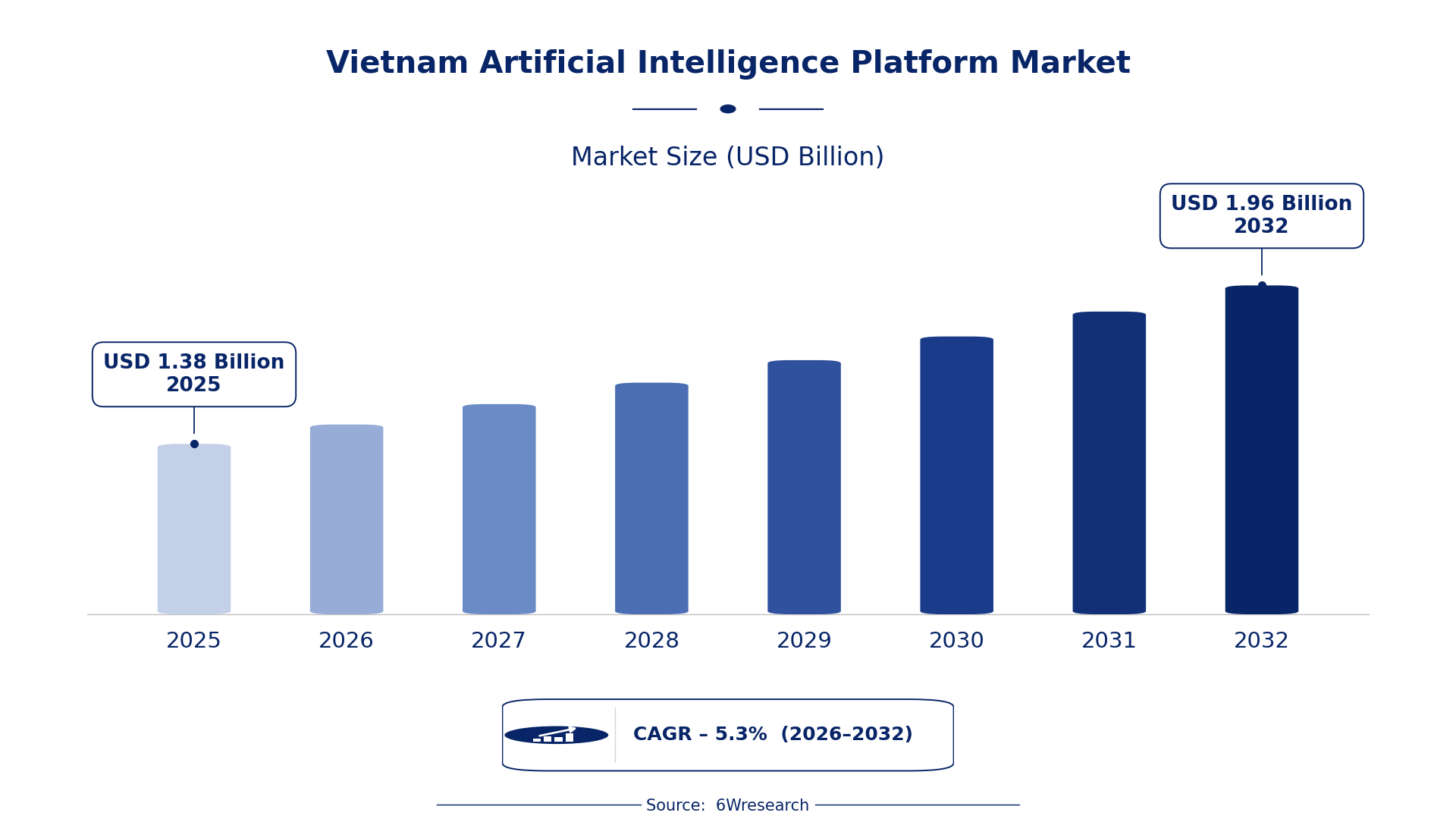
The Vietnam Artificial Intelligence Platform Market was estimated at USD 1381 Million in 2025 and is projected to reach USD 1959 Million by 2032, growing at a CAGR of 5.3% from 2026 to 2032.
Vietnam Artificial Intelligence Platform Market Synopsis
As Vietnamese businesses increasingly recognize the value of integrating AI into their operations, the demand for AI platforms has surged. Organizations are not just looking to enhance efficiency; they aim to redefine their customer interactions and operational workflows through cutting-edge AI technologies.
The market is characterized by strong growth across various sectors, including healthcare, finance, and retail. These industries are leveraging AI for improved decision-making, predictive analytics, and automation, underscoring a significant shift towards data-driven strategies in Vietnam.
Vietnam Artificial Intelligence Platform Market Year-wise Growth Rate and Key Drivers
This graph illustrates the annual growth rates of the Vietnam Artificial Intelligence Platform Market from 2021 to 2032, highlighting a steady upward trajectory and projected expansion over the forecast period.
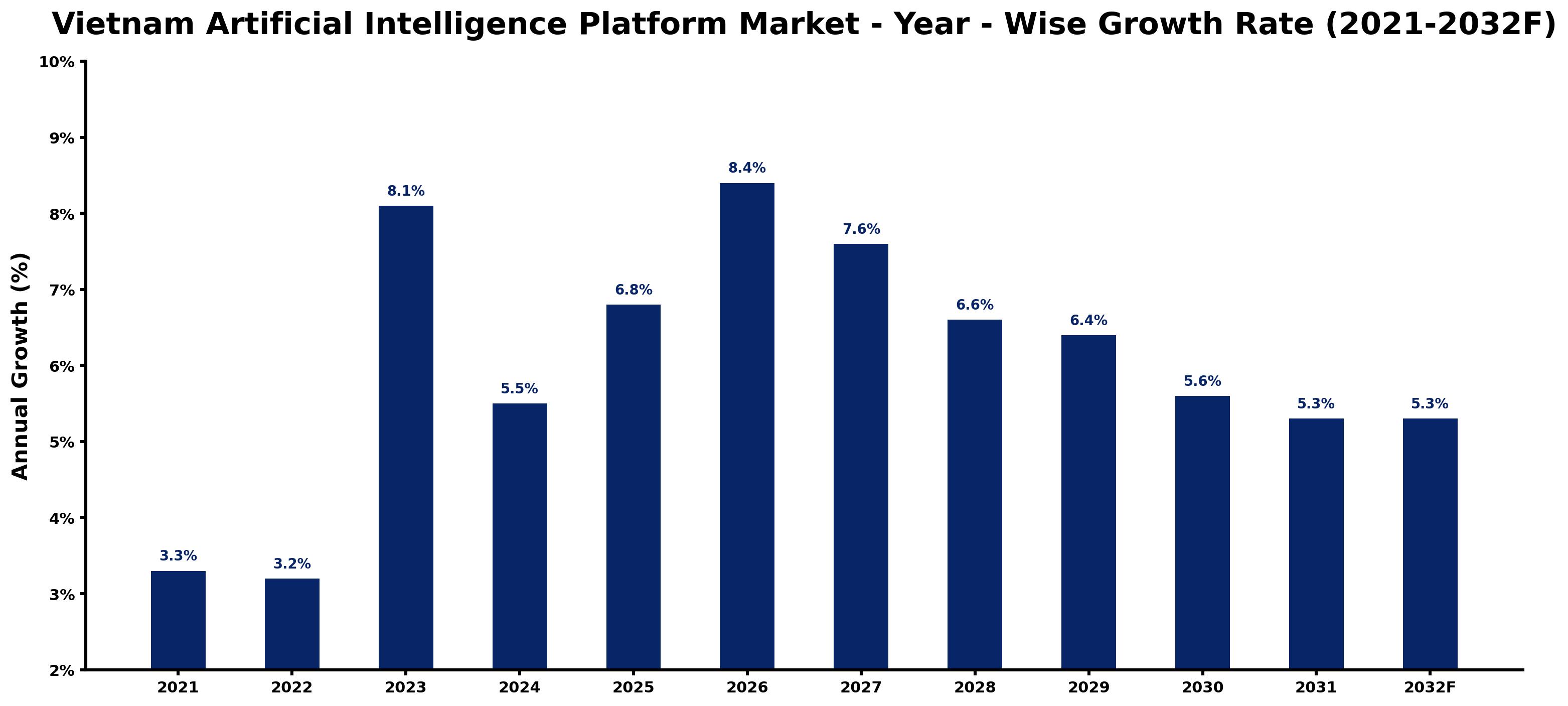
The table below presents the year‑wise growth rates along with the key drivers influencing the market
| Year | Growth Rate | Major Drivers |
| 2021 | 3.3% | Vietnam's national strategy for AI development launched. |
| 2022 | 3.2% | Increased investment from FPT Corporation in AI solutions. |
| 2023 | 8.1% | Government funding for AI research and training programs. |
| 2024 | 5.5% | Growing local startups focusing on AI applications. |
| 2025 | 6.8% | Adoption of AI in healthcare by Vietnam’s Ministry of Health. |
| 2026 | 8.4% | Rising mobile internet penetration boosting AI platform usage. |
| 2027 | 7.6% | Emergence of AI-driven financial services in Vietnam. |
| 2028 | 6.6% | Supportive regulatory framework encouraging AI innovation. |
| 2029 | 6.4% | Enhanced AI integration in Vietnamese smart city policies. |
| 2030 | 5.6% | Vietnamese universities expanding AI-related degree programs. |
| 2031 | 5.3% | Partnerships between businesses for AI technology advancements. |
| 2032 | 5.3% | Increasing consumer acceptance of AI in daily life. |
Note: Market size estimations and growth projections presented in this report are based on 6Wresearch's proprietary forecasting methodology, utilizing the latest available industry data, government publications, and primary research inputs.
Vietnam Artificial Intelligence Platform Market Key Takeaways
Below are some of the specific key takeaways from the market, including:
- The market is rapidly expanding due to increased AI adoption across multiple sectors.
- Government initiatives are creating a favorable environment for AI innovation and investment.
- Data quality issues pose challenges, affecting the effectiveness of AI implementations.
- There is a notable shortage of skilled AI professionals, impacting growth potential.
- COVID-19 has accelerated the integration of AI solutions in various industries.
Evaluation of Restraints in Vietnam Artificial Intelligence Platform Market
The Vietnam Artificial Intelligence Platform Market is held back by several critical restraints. A prominent issue is the shortage of skilled AI professionals, which limits the ability of businesses to adopt and implement advanced AI technologies effectively. on top of that, concerns regarding data privacy and regulatory compliance create additional hurdles for organizations. The reliance on high-quality data is paramount for AI success, yet many companies struggle to access and maintain such data. As a result, the path to full AI integration remains fraught with challenges.
Vietnam Artificial Intelligence Platform Market Trends
The current trend in the Vietnam Artificial Intelligence Platform Market is a marked shift towards automation and data analytics. Organizations are increasingly deploying machine learning and natural language processing to enhance customer engagement and operational efficiency. The rise of hybrid AI solutions, combining on-premises and cloud technologies, is also notable as businesses seek flexibility and scalability. on top of that, ethical AI practices are gaining traction, driving companies to address bias and transparency in their algorithms.
Vietnam Artificial Intelligence Platform Market Opportunities
Emerging opportunities in the Vietnam Artificial Intelligence Platform Market are substantial. The healthcare sector, in particular, is ripe for innovation through AI-driven diagnostics and patient management systems. Additionally, the financial industry is leveraging AI for fraud detection and risk assessment. Startups focusing on niche AI applications, such as localized customer service chatbots, are finding fertile ground. As businesses continue to seek tailored AI solutions, the demand for specialized platforms will likely increase.
Government Initiatives in the Vietnam Artificial Intelligence Platform Market
The Vietnamese government plays a crucial role in fostering the development of the AI sector. By establishing supportive policies and initiatives, the government aims to enhance the country’s technological capabilities and global competitiveness. A clear regulatory framework is emerging, focusing on ethical AI use and data protection, which is vital for building public trust in AI technologies.
- A recently completed initiative focused on developing a national AI strategy aimed at enhancing research and education in AI technologies.
- A current program is underway to establish AI innovation hubs across major cities, promoting collaboration between academia and industry.
- Upcoming legislation is expected to introduce tax incentives for AI startups to stimulate investment in this burgeoning sector.
- The government is currently reviewing regulations to ensure data privacy aligns with international standards, reinforcing trust in AI applications.
- A planned public-private partnership aims to boost AI integration in public services by 2028.
Future Insights of the Vietnam Artificial Intelligence Platform Market
Looking ahead to 2026-2032, the Vietnam Artificial Intelligence Platform Market is set to evolve significantly. Companies will increasingly prioritize AI as a central component of their digital transformation strategies. Enhanced collaboration between the public and private sectors will likely yield innovative solutions tailored to local needs. As AI technologies mature, expect a greater focus on transparency and ethical considerations, fostering an environment of trust that will encourage wider adoption.
Vietnam Artificial Intelligence Platform Market Latest Developments
Over the past year, the Vietnam Artificial Intelligence Platform Market has seen a flurry of activity driven by the urgent need for technological solutions. Businesses are increasingly adopting AI tools to respond to market demands and enhance operational resilience. This trend is evident across various sectors as they pivot towards data-centric approaches.
- A new AI-driven analytics platform was launched in early 2023, aimed at improving operational efficiency for manufacturing companies.
- An initiative that began in late 2022 and is currently ongoing focuses on integrating AI into educational institutions, enhancing learning experiences through personalized content.
- A partnership was formed in Q1 2023 between technology firms to develop AI solutions specifically for the healthcare sector, aimed at streamlining patient care processes.
- Upcoming in mid-2023 is a rollout of a nationwide AI training program, designed to upskill professionals and address the talent shortage in the market.
Vietnam Artificial Intelligence Platform Market - Key Attractiveness of the Report
- 10 Years of Market Numbers
- Historical Data Starting from 2022 to 2025
- Base Year: 2025
- Forecast Data until 2032
- Key Performance Indicators Impacting the Market
- Major Upcoming Developments and Projects
Key Highlights of the Report:
- Vietnam Artificial Intelligence Platform Market Outlook
- Market Size of Vietnam Artificial Intelligence Platform Market, 2025
- Forecast of Vietnam Artificial Intelligence Platform Market, 2032
- Historical Data and Forecast of Vietnam Artificial Intelligence Platform Revenues & Volume for the Period 2022-2032F
- Vietnam Artificial Intelligence Platform Market Trend Evolution
- Vietnam Artificial Intelligence Platform Market Drivers and Challenges
- Vietnam Artificial Intelligence Platform Price Trends
- Vietnam Artificial Intelligence Platform Porter's Five Forces
- Vietnam Artificial Intelligence Platform Industry Life Cycle
- Historical Data and Forecast of Vietnam Artificial Intelligence Platform Market Revenues & Volume By Component for the Period 2022-2032F
- Historical Data and Forecast of Vietnam Artificial Intelligence Platform Market Revenues & Volume By Tools for the Period 2022-2032F
- Historical Data and Forecast of Vietnam Artificial Intelligence Platform Market Revenues & Volume By Services for the Period 2022-2032F
- Historical Data and Forecast of Vietnam Artificial Intelligence Platform Market Revenues & Volume By Application for the Period 2022-2032F
- Historical Data and Forecast of Vietnam Artificial Intelligence Platform Market Revenues & Volume By Forecasts and prescriptive models for the Period 2022-2032F
- Historical Data and Forecast of Vietnam Artificial Intelligence Platform Market Revenues & Volume By Chatbots for the Period 2022-2032F
- Historical Data and Forecast of Vietnam Artificial Intelligence Platform Market Revenues & Volume By Speech recognition for the Period 2022-2032F
- Historical Data and Forecast of Vietnam Artificial Intelligence Platform Market Revenues & Volume By Text recognition for the Period 2022-2032F
- Historical Data and Forecast of Vietnam Artificial Intelligence Platform Market Revenues & Volume By Others for the Period 2022-2032F
- Historical Data and Forecast of Vietnam Artificial Intelligence Platform Market Revenues & Volume By Deployment Mode for the Period 2022-2032F
- Historical Data and Forecast of Vietnam Artificial Intelligence Platform Market Revenues & Volume By Cloud for the Period 2022-2032F
- Historical Data and Forecast of Vietnam Artificial Intelligence Platform Market Revenues & Volume By On-Premises for the Period 2022-2032F
- Historical Data and Forecast of Vietnam Artificial Intelligence Platform Market Revenues & Volume By Tools for the Period 2022-2032F
- Historical Data and Forecast of Vietnam Artificial Intelligence Platform Market Revenues & Volume By NLP for the Period 2022-2032F
- Historical Data and Forecast of Vietnam Artificial Intelligence Platform Market Revenues & Volume By ML for the Period 2022-2032F
- Vietnam Artificial Intelligence Platform Import Export Trade Statistics
- Market Opportunity Assessment By Component
- Market Opportunity Assessment By Application
- Market Opportunity Assessment By Deployment Mode
- Market Opportunity Assessment By Tools
- Vietnam Artificial Intelligence Platform Top Companies Market Share
- Vietnam Artificial Intelligence Platform Competitive Benchmarking By Technical and Operational Parameters
- Vietnam Artificial Intelligence Platform Company Profiles
- Vietnam Artificial Intelligence Platform Key Strategic Recommendations






































