Vietnam Artificial Wood Beams Market Size, Share & Growth Rate
The Vietnam Artificial Wood Beams Market was estimated at USD 399 Million in 2025 and is projected to reach USD 565 Million by 2032, growing at a CAGR of 5.1% from 2026 to 2032. This growth trajectory is primarily fueled by the burgeoning construction and real estate sectors in Vietnam, alongside increasing urbanization and government initiatives aimed at affordable housing. As developers and architects seek sustainable alternatives to traditional wood, the demand for artificial wood beams is anticipated to rise significantly.
Vietnam Artificial Wood Beams Market Year-wise Growth Rate and Key Drivers
This graph highlights how the Vietnam Artificial Wood Beams Market has steadily grown over the years, supported by major growth factors.
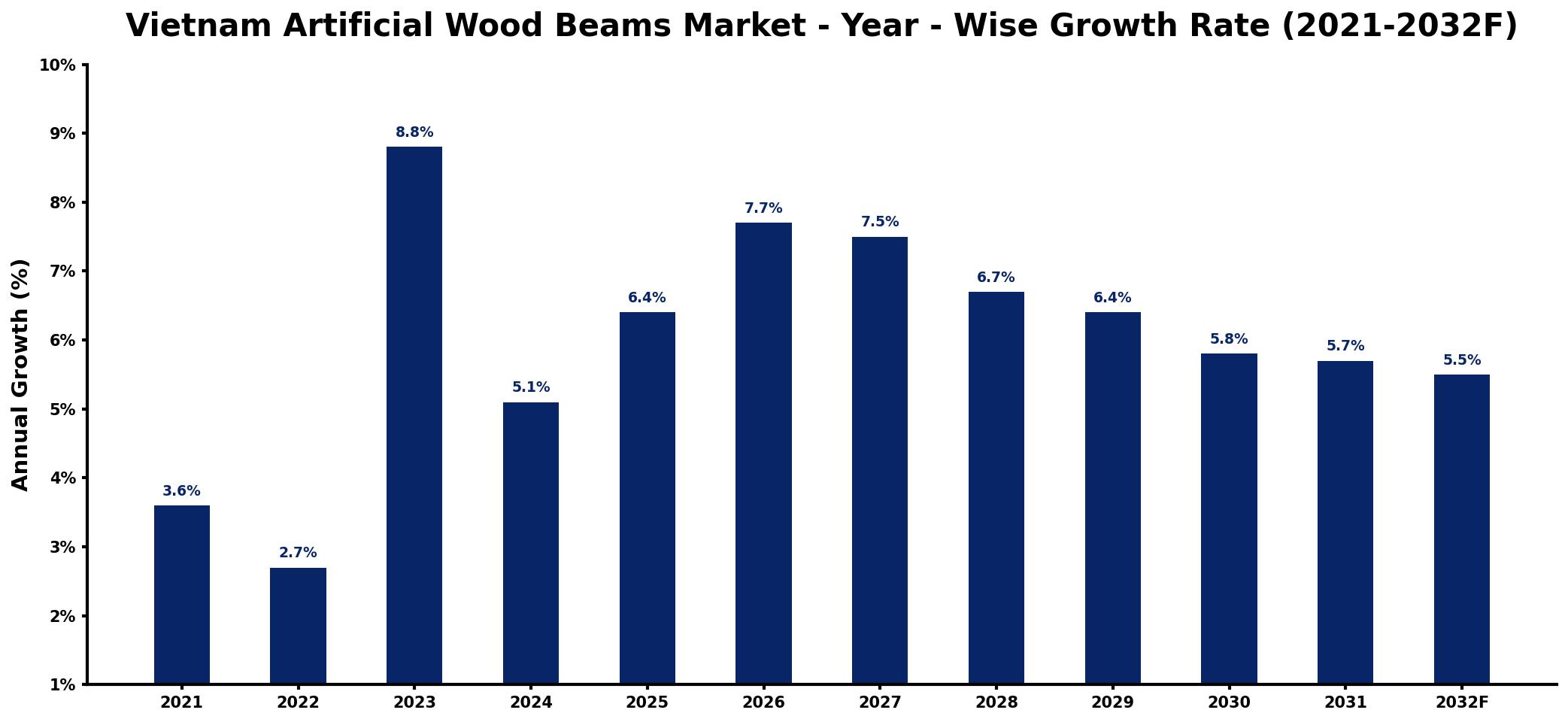
The table below presents the year‑wise growth rates along with the key drivers influencing the market
| Year | Growth Rate | Major Drivers |
| 2021 | 3.6% | Rising construction sector demands |
| 2022 | 2.7% | Increased residential housing projects |
| 2023 | 8.8% | Growing preference for eco-friendly materials |
| 2024 | 5.1% | Expansion in renovation activities |
| 2025 | 6.4% | Surge in commercial infrastructure investments |
| 2026 | 7.7% | Higher demand for sustainable solutions |
| 2027 | 7.5% | Boost in government construction initiatives |
| 2028 | 6.7% | Advancements in manufacturing technology |
| 2029 | 6.4% | Increased awareness of environmental benefits |
| 2030 | 5.8% | Growth in export opportunities |
| 2031 | 5.7% | Rising urbanization and population growth |
| 2032 | 5.5% | Strengthening of green building regulations |
Note: Market size estimations and growth projections presented in this report are based on 6Wresearch's proprietary forecasting methodology, utilizing the latest available industry data, government publications, and primary research inputs.
Vietnam Artificial Wood Beams Market Synopsis
Currently, the strongest force shaping the Vietnam Artificial Wood Beams Market is the rapid expansion of urban infrastructure. The ongoing initiatives to develop urban living spaces are driving the need for durable and visually appealing building materials, where artificial wood beams are emerging as a preferred choice. Their capacity to combine aesthetic appeal with structural integrity makes them increasingly popular among developers and architects alike.
Additionally, the governments emphasis on environmentally responsible construction practices is significantly influencing market dynamics. As stakeholders in the construction industry adopt sustainable practices, artificial wood beams, which can often be produced using recycled materials, are becoming an essential component of modern building projects.
Vietnam Artificial Wood Beams Market Key Takeaways
- The market is driven by robust growth in the construction and real estate sectors.
- Urbanization and infrastructure developments are primary growth factors.
- Sustainability concerns are pushing the adoption of eco-friendly building materials.
- Government initiatives are facilitating the expansion of affordable housing projects.
- Companies are increasingly focusing on innovative manufacturing processes to meet market demand.
Evaluation of Restraints in Vietnam Artificial Wood Beams Market
Despite the promising growth trajectory, the Vietnam Artificial Wood Beams Market grapples with challenges related to sustainable sourcing. As demand escalates, the need for materials that meet environmental standards becomes critical. The reliance on non-renewable resources can pose risks to sustainability, and manufacturers must therefore adapt by prioritizing eco-friendly practices and obtaining relevant certifications. Failure to do so may hinder the market's growth as consumers increasingly seek transparency and accountability in sourcing.
Vietnam Artificial Wood Beams Market Trends
Several trends are currently shaping the Vietnam Artificial Wood Beams Market. First and foremost, the shift towards smart buildings is driving technological innovation in the materials used. Manufacturers are exploring new composite materials that enhance durability while maintaining aesthetic qualities. Furthermore, the growing trend of minimalistic and modern architectural designs is propelling the demand for sleek, artificial wood beams that complement contemporary aesthetics. Lastly, increasing collaboration between architects and manufacturers is fostering a creative environment where customized solutions can emerge.
Vietnam Artificial Wood Beams Market Opportunities
The Vietnam Artificial Wood Beams Market presents significant growth and investment opportunities, particularly in the realm of sustainable construction. Companies that innovate in creating products from recycled or upcycled materials are likely to capture a burgeoning segment of environmentally conscious consumers. Additionally, as public infrastructure projects gain momentum, there lies an opportunity for manufacturers to establish long-term partnerships with government entities, leading to potentially lucrative contracts for large-scale developments.
Government Initiatives in the Vietnam Artificial Wood Beams Market
The Vietnamese government is actively promoting various policies aimed at stimulating the construction industry, with a particular focus on affordable housing initiatives. Public spending on infrastructure projects is being increased, leading to a heightened demand for building materials, including artificial wood beams. Moreover, regulations promoting sustainable construction practices are encouraging manufacturers to adopt greener production methods, thus aligning with both local and international environmental standards.
Future Insights of the Vietnam Artificial Wood Beams Market
Looking ahead to 2026-2032, the Vietnam Artificial Wood Beams Market is poised for substantial growth as urbanization continues to accelerate. Innovations in production technologies and material science will further enhance product offerings, catering to a broad range of applications in both residential and commercial sectors. The increasing integration of digital tools in construction processes will also facilitate smoother supply chains, enabling quicker responses to market demands. Additionally, as consumers become more environmentally aware, the push for sustainable materials is expected to transform the landscape, compelling manufacturers to invest in greener solutions.
Vietnam Artificial Wood Beams Market Latest Developments (2025 - 2026)
Recent developments in the Vietnam Artificial Wood Beams Market indicate a shift towards more sustainable production practices among manufacturers. Many are implementing advanced technologies to enhance the durability and aesthetic appeal of artificial wood beams while minimizing environmental impact. Furthermore, collaborative efforts between local authorities and private sector stakeholders have emerged to promote eco-friendly building initiatives and public infrastructure projects, paving the way for increased market activity in the upcoming years.
Vietnam Artificial Wood Beams Market - Key Attractiveness of the Report
- 10 Years of Market Numbers
- Historical Data Starting from 2022 to 2025
- Base Year: 2025
- Forecast Data until 2032
- Key Performance Indicators Impacting the Market
- Major Upcoming Developments and Projects
Key Highlights of the Report:
- Vietnam Artificial Wood Beams Market Outlook
- Market Size of Vietnam Artificial Wood Beams Market, 2025
- Forecast of Vietnam Artificial Wood Beams Market, 2032
- Historical Data and Forecast of Vietnam Artificial Wood Beams Revenues & Volume for the Period 2022-2032F
- Vietnam Artificial Wood Beams Market Trend Evolution
- Vietnam Artificial Wood Beams Market Drivers and Challenges
- Vietnam Artificial Wood Beams Price Trends
- Vietnam Artificial Wood Beams Porter's Five Forces
- Vietnam Artificial Wood Beams Industry Life Cycle
- Historical Data and Forecast of Vietnam Artificial Wood Beams Market Revenues & Volume By Product Type for the Period 2022-2032F
- Historical Data and Forecast of Vietnam Artificial Wood Beams Market Revenues & Volume By U-shaped Beams for the Period 2022-2032F
- Historical Data and Forecast of Vietnam Artificial Wood Beams Market Revenues & Volume By Box Beams for the Period 2022-2032F
- Historical Data and Forecast of Vietnam Artificial Wood Beams Market Revenues & Volume By Arched Beams for the Period 2022-2032F
- Historical Data and Forecast of Vietnam Artificial Wood Beams Market Revenues & Volume By Decorative Beams for the Period 2022-2032F
- Historical Data and Forecast of Vietnam Artificial Wood Beams Market Revenues & Volume By Others for the Period 2022-2032F
- Historical Data and Forecast of Vietnam Artificial Wood Beams Market Revenues & Volume By Material Type for the Period 2022-2032F
- Historical Data and Forecast of Vietnam Artificial Wood Beams Market Revenues & Volume By Thermoplastic for the Period 2022-2032F
- Historical Data and Forecast of Vietnam Artificial Wood Beams Market Revenues & Volume By Thermosetting for the Period 2022-2032F
- Historical Data and Forecast of Vietnam Artificial Wood Beams Market Revenues & Volume By Others for the Period 2022-2032F
- Historical Data and Forecast of Vietnam Artificial Wood Beams Market Revenues & Volume By End Users for the Period 2022-2032F
- Historical Data and Forecast of Vietnam Artificial Wood Beams Market Revenues & Volume By Residential for the Period 2022-2032F
- Historical Data and Forecast of Vietnam Artificial Wood Beams Market Revenues & Volume By Commercial for the Period 2022-2032F
- Vietnam Artificial Wood Beams Import Export Trade Statistics
- Market Opportunity Assessment By Product Type
- Market Opportunity Assessment By Material Type
- Market Opportunity Assessment By End Users
- Vietnam Artificial Wood Beams Top Companies Market Share
- Vietnam Artificial Wood Beams Competitive Benchmarking By Technical and Operational Parameters
- Vietnam Artificial Wood Beams Company Profiles
- Vietnam Artificial Wood Beams Key Strategic Recommendations






































