Vietnam Auto Parts And Accessories Market Size, Share & Growth Rate
The Vietnam Auto Parts And Accessories Market was estimated at USD 1302 Million in 2025 and is projected to reach USD 1847 Million by 2032, growing at a CAGR of 5.1% from 2026 to 2032. This positive trajectory is driven by a combination of factors, including the robust expansion of the automotive manufacturing sector in Vietnam, increased disposable incomes, and a burgeoning middle-class population eager for vehicle ownership. Moreover, ongoing urbanization is further fueling demand for aftermarket products and personalized accessories.
Vietnam Auto Parts And Accessories Market Year-wise Growth Rate and Key Drivers
This graph highlights how the Vietnam Auto Parts And Accessories Market has steadily grown over the years, supported by major growth factors.
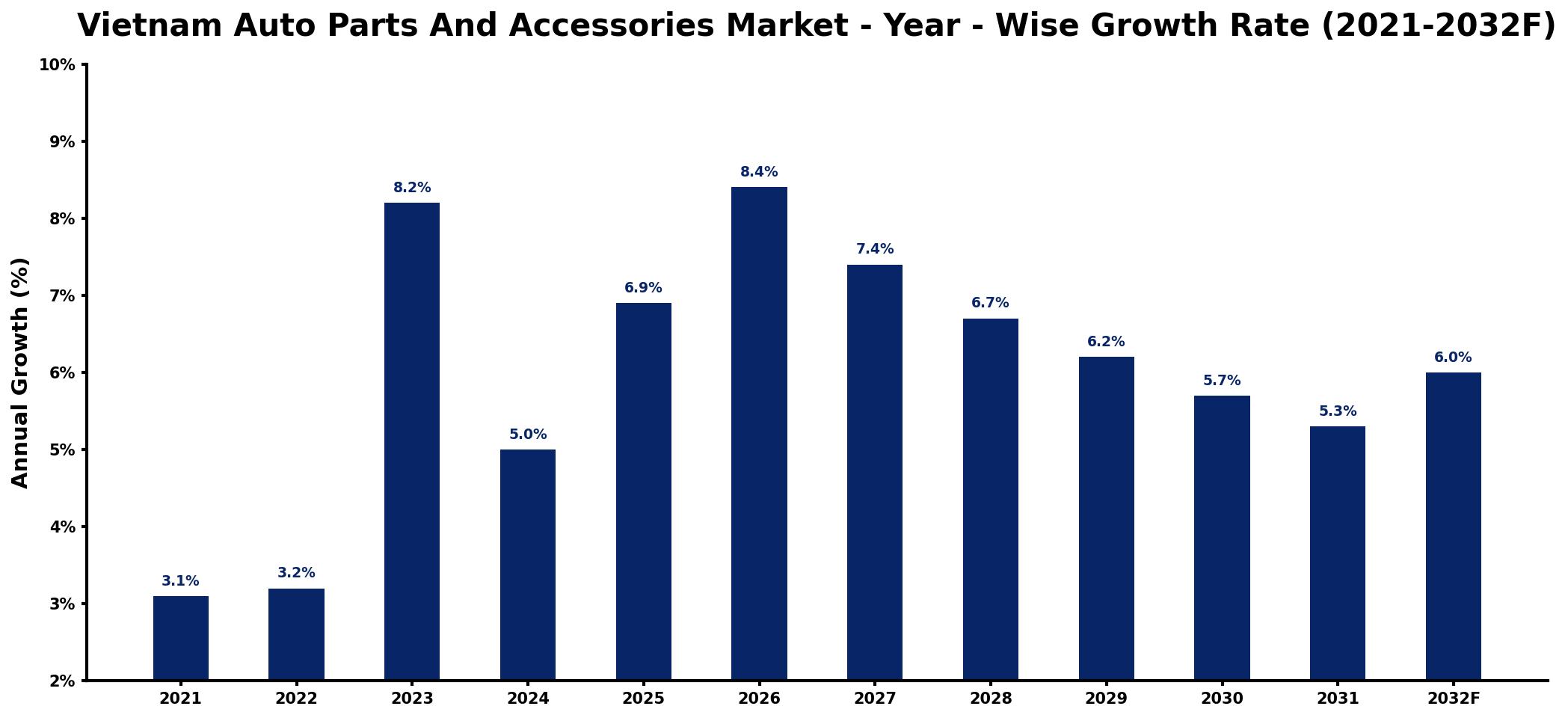
The table below presents the year‑wise growth rates along with the key drivers influencing the market
| Year | Growth Rate | Major Drivers |
| 2021 | 3.1% | Rising consumer vehicle ownership rates |
| 2022 | 3.2% | Increased domestic manufacturing capabilities |
| 2023 | 8.2% | Expansion of e-commerce platforms |
| 2024 | 5.0% | Growth in electric vehicle adoption |
| 2025 | 6.9% | Higher disposable income levels |
| 2026 | 8.4% | Investment in transportation infrastructure |
| 2027 | 7.4% | increased pharmaceutical industry usage |
| 2028 | 6.7% | Increasing demand for fuel efficiency |
| 2029 | 6.2% | expanding manufacturing base activity |
| 2030 | 5.7% | Technological advancements in manufacturing |
| 2031 | 5.3% | rising export shipment volumes |
| 2032 | 6.0% | Rising popularity of aftermarket solutions |
Note: Market size estimations and growth projections presented in this report are based on 6Wresearch's proprietary forecasting methodology, utilizing the latest available industry data, government publications, and primary research inputs.
Vietnam Auto Parts And Accessories Market Synopsis
In recent years, the Vietnam auto parts and accessories market has seen considerable momentum, primarily fueled by rising vehicle purchases and expanding infrastructure. However, as the market matures, it is positioned to evolve rapidly with increasing technological advancements and shifting consumer preferences toward electric and hybrid vehicles.
Looking ahead, the market is poised for significant transformation, driven by the rise of innovative products and a keen focus on sustainability. As consumers demand higher-quality products that comply with environmental regulations, manufacturers will need to adapt and innovate to stay competitive and meet these new consumer expectations.
Vietnam Auto Parts And Accessories Market Key Takeaways
- The market is anticipated to grow significantly, supported by rising vehicle ownership and urbanization.
- Competition remains intense, with both local and international manufacturers striving to differentiate through innovation.
- The increasing adoption of electric and hybrid vehicles is expected to open new market segments and opportunities.
- Quality control and safety remain top priorities as the market combats counterfeit products.
- Infrastructure developments will play a crucial role in supporting the markets growth trajectory.
Evaluation of Restraints in Vietnam Auto Parts And Accessories Market
Despite the growth potential, the Vietnam auto parts and accessories market grapples with significant challenges. Chief among these is the prevalence of counterfeit products, which undermines quality and consumer safety. Additionally, the absence of standardized regulations complicates matters for manufacturers seeking to ensure product quality. Moreover, cheaper imports exert pressure on domestic players, potentially stifling local innovation. The demand for environmentally friendly products is also pushing the market to adapt swiftly to stricter emission regulations and consumer preferences.
Vietnam Auto Parts And Accessories Market Trends
Several trends are reshaping the landscape of the Vietnam auto parts and accessories market. Notably, there is a marked increase in the integration of smart technologies within automotive parts, enhancing vehicle performance and user experience. The shift toward eco-friendly materials and components is gaining traction as consumers become more environmentally conscious. Moreover, the rise of e-commerce platforms is transforming how consumers purchase auto parts, offering convenience and a wider range of choices. This digital shift could further stimulate growth as online sales become a key distribution channel.
Vietnam Auto Parts And Accessories Market Opportunities
The growth of the Vietnam auto parts and accessories market presents numerous opportunities for businesses willing to innovate and adapt. The increasing demand for electric and hybrid vehicles opens new avenues for suppliers of specialized components such as batteries, electric motors, and regenerative braking systems. Additionally, as consumer preferences shift toward personalization, aftermarket accessories that cater to unique tastes and enhance vehicle aesthetics can expect to see rising demand. Investment in research and development focused on sustainability and efficiency will also position businesses favorably in this evolving market landscape.
Government Initiatives in the Vietnam Auto Parts And Accessories Market
The Vietnamese government is actively promoting the development of the auto parts and accessories sector through various initiatives. Public spending on infrastructure is increasing, aiming to bolster automotive manufacturing and distribution networks. Additionally, policies encouraging foreign investments and technological collaborations are set to enhance local production capabilities. Programs aimed at reducing emissions and promoting electric vehicles will further incentivize businesses to innovate and invest in sustainable solutions, ensuring alignment with global environmental standards.
Future Insights of the Vietnam Auto Parts And Accessories Market
Looking forward to 2026-2032, the Vietnam auto parts and accessories market is anticipated to experience dynamic shifts. As consumer preferences evolve, manufacturers will need to pivot toward higher-quality, innovative solutions that prioritize environmental responsibility. The growth of the electric vehicle market will drive demand for advanced technology and components. Furthermore, as urbanization continues, the demand for personalized automotive accessories is likely to surge, presenting businesses with substantial growth opportunities. Companies that successfully navigate these changes will be well-positioned to capitalize on Vietnam's burgeoning automotive landscape.
Vietnam Auto Parts And Accessories Market Latest Developments (2025 - 2026)
Recently, the Vietnam auto parts and accessories market has witnessed notable advancements, particularly in technology integration within vehicle components. Manufacturers are increasingly focusing on enhancing supply chain efficiency to mitigate past disruptions. Concurrently, there is a noticeable shift towards sustainability, with businesses investing in eco-friendly practices and materials. These trends signify a robust commitment to innovation and adapting to consumer needs, positioning the market for sustained growth in the coming years.
Vietnam Auto Parts And Accessories Market - Key Attractiveness of the Report
- 10 Years of Market Numbers
- Historical Data Starting from 2022 to 2025
- Base Year: 2025
- Forecast Data until 2032
- Key Performance Indicators Impacting the Market
- Major Upcoming Developments and Projects
Key Highlights of the Report:
- Vietnam Auto Parts And Accessories Market Outlook
- Market Size of Vietnam Auto Parts And Accessories Market, 2025
- Forecast of Vietnam Auto Parts And Accessories Market, 2032
- Historical Data and Forecast of Vietnam Auto Parts And Accessories Revenues & Volume for the Period 2022-2032F
- Vietnam Auto Parts And Accessories Market Trend Evolution
- Vietnam Auto Parts And Accessories Market Drivers and Challenges
- Vietnam Auto Parts And Accessories Price Trends
- Vietnam Auto Parts And Accessories Porter's Five Forces
- Vietnam Auto Parts And Accessories Industry Life Cycle
- Historical Data and Forecast of Vietnam Auto Parts And Accessories Market Revenues & Volume By Product for the Period 2022-2032F
- Historical Data and Forecast of Vietnam Auto Parts And Accessories Market Revenues & Volume By Driveline & Powertrain for the Period 2022-2032F
- Historical Data and Forecast of Vietnam Auto Parts And Accessories Market Revenues & Volume By Interiors & Exteriors for the Period 2022-2032F
- Historical Data and Forecast of Vietnam Auto Parts And Accessories Market Revenues & Volume By Electronics for the Period 2022-2032F
- Historical Data and Forecast of Vietnam Auto Parts And Accessories Market Revenues & Volume By Bodies & Chassis for the Period 2022-2032F
- Historical Data and Forecast of Vietnam Auto Parts And Accessories Market Revenues & Volume By Wheel & Tires for the Period 2022-2032F
- Historical Data and Forecast of Vietnam Auto Parts And Accessories Market Revenues & Volume By Others for the Period 2022-2032F
- Historical Data and Forecast of Vietnam Auto Parts And Accessories Market Revenues & Volume By Application for the Period 2022-2032F
- Historical Data and Forecast of Vietnam Auto Parts And Accessories Market Revenues & Volume By OEMs for the Period 2022-2032F
- Historical Data and Forecast of Vietnam Auto Parts And Accessories Market Revenues & Volume By Aftermarket for the Period 2022-2032F
- Vietnam Auto Parts And Accessories Import Export Trade Statistics
- Market Opportunity Assessment By Product
- Market Opportunity Assessment By Application
- Vietnam Auto Parts And Accessories Top Companies Market Share
- Vietnam Auto Parts And Accessories Competitive Benchmarking By Technical and Operational Parameters
- Vietnam Auto Parts And Accessories Company Profiles
- Vietnam Auto Parts And Accessories Key Strategic Recommendations






































