Vietnam Automotive Drive Shaft Market Size, Share & Growth Rate
The Vietnam Automotive Drive Shaft Market was estimated at USD 1004 Million in 2025 and is projected to reach USD 1432 Million by 2032, growing at a CAGR of 5.2% from 2026 to 2032. This robust growth trajectory is fueled by Vietnams increasing automotive production and export activities, spurred by rising consumer demand and income levels. As manufacturers invest in advanced drive shaft technologies, their focus on durability and efficiency is expected to further propel market expansion.
Vietnam Automotive Drive Shaft Market Year-wise Growth Rate and Key Drivers
This graph highlights how the Vietnam Automotive Drive Shaft Market has steadily grown over the years, supported by major growth factors.
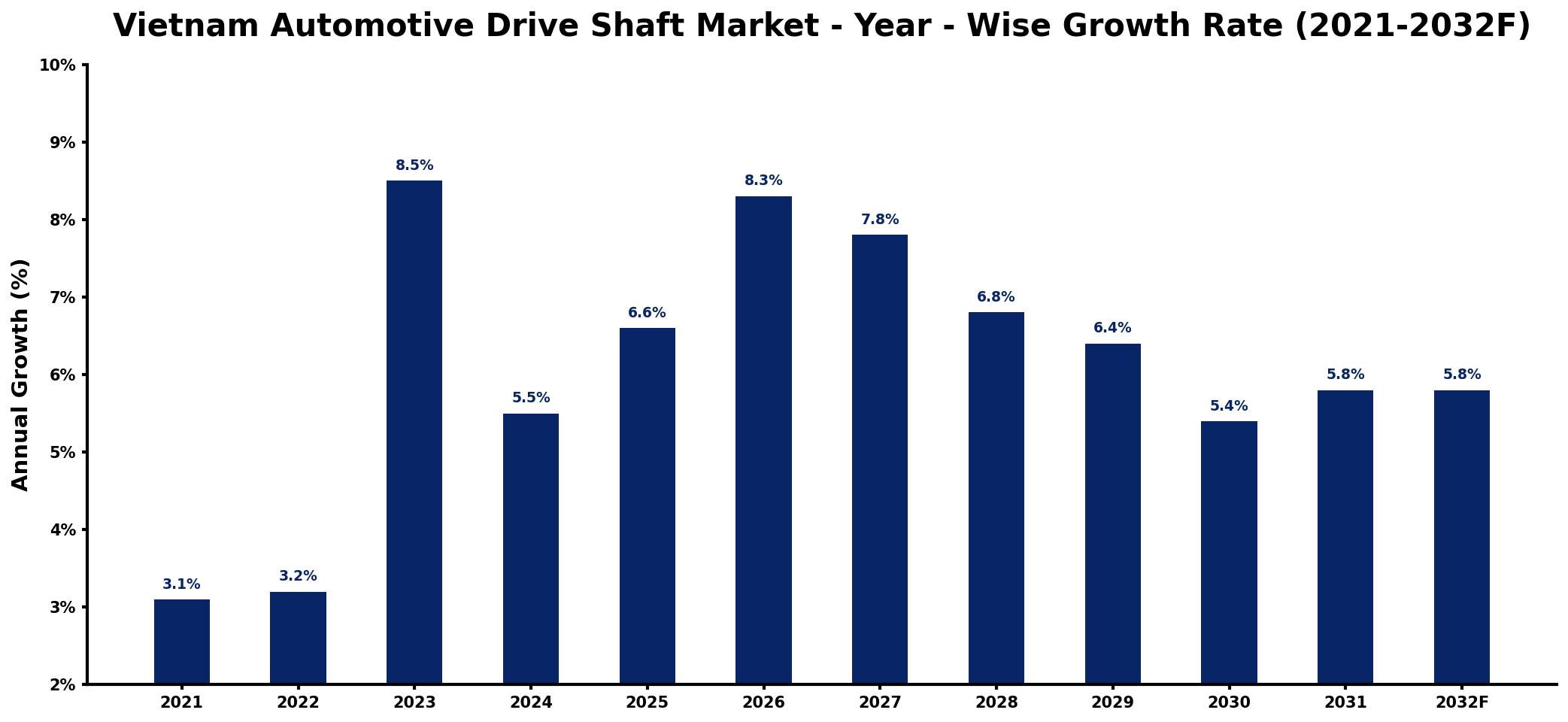
The table below presents the year‑wise growth rates along with the key drivers influencing the market
| Year | Growth Rate | Major Drivers |
| 2021 | 3.1% | Rising vehicle production rates |
| 2022 | 3.2% | Increased consumer purchasing power |
| 2023 | 8.5% | Expansion of electric vehicle market |
| 2024 | 5.5% | improved processing technologies adoption |
| 2025 | 6.6% | Higher demand for fuel efficiency |
| 2026 | 8.3% | Technological advancements in manufacturing |
| 2027 | 7.8% | Strengthening aftermarket service sector |
| 2028 | 6.8% | Emerging markets driving sales |
| 2029 | 6.4% | expanding healthcare application demand |
| 2030 | 5.4% | Increased focus on sustainability |
| 2031 | 5.8% | Growth in regional trade agreements |
| 2032 | 5.8% | Rising popularity of hybrid vehicles |
Note: Market size estimations and growth projections presented in this report are based on 6Wresearch's proprietary forecasting methodology, utilizing the latest available industry data, government publications, and primary research inputs.
Vietnam Automotive Drive Shaft Market Synopsis
The strongest force shaping the Vietnam automotive drive shaft market today is the remarkable growth of the automotive sector. With a burgeoning middle class and rising disposable incomes, there is a palpable demand for vehicles that offer superior performance and reliability, making quality drive shafts an essential component. Additionally, as international automakers set up operations in Vietnam, the pressure to meet global standards intensifies.
As automotive manufacturers focus on creating vehicles that comply with stricter emissions regulations, the demand for innovative drive shaft solutions is rising. This evolution is prompting local suppliers to enhance their production capabilities and invest in research and development, ensuring they remain competitive within this dynamic market.
Vietnam Automotive Drive Shaft Market Key Takeaways
- Significant market growth is driven by expanding automotive production and export activities.
- The demand for high-performance drive shafts is crucial for vehicle efficiency and safety.
- Technological advancements are reshaping product offerings in the drive shaft sector.
- The market faces challenges related to quality control and investment in R&D, particularly for smaller manufacturers.
- The overall economic stability of Vietnam directly impacts market performance and growth prospects.
Evaluation of Restraints in Vietnam Automotive Drive Shaft Market
Despite its promising growth, the Vietnam automotive drive shaft market encounters several restraints that limit its potential. A significant concern is the gap in technological advancement among local manufacturers, particularly compared to international competitors. Investing in R&D can be a substantial financial burden, particularly for smaller firms that may lack the necessary resources. Furthermore, the market faces challenges in maintaining quality control and adhering to international standards, which are critical for safety and reliability. Fluctuations in the automotive industry, driven by changes in production rates and consumer preferences, add another layer of complexity for manufacturers trying to navigate these dynamics.
Vietnam Automotive Drive Shaft Market Trends
Emerging trends in the Vietnam automotive drive shaft market include a notable shift towards lightweight materials to enhance vehicle fuel efficiency. Additionally, the integration of electric drivetrains is prompting manufacturers to explore alternative drive mechanisms that can complement traditional drive shafts. The growing emphasis on sustainability is also encouraging companies to focus on eco-friendly manufacturing practices, further driving innovation in the sector. These trends signal a transformative period for the drive shaft market, as companies adapt to evolving consumer expectations and technological advancements.
Vietnam Automotive Drive Shaft Market Opportunities
The opportunities for growth within the Vietnam automotive drive shaft market are substantial. As Vietnam continues to position itself as a manufacturing hub for the automotive industry, there is an increasing need for reliable and innovative components. Collaborations between local manufacturers and global automotive brands present a significant avenue for investment and technology transfer. Furthermore, the rising trend of electric vehicles (EVs) provides a unique opportunity for drive shaft manufacturers to develop specialized products that meet the requirements of this rapidly evolving sector.
Government Initiatives in the Vietnam Automotive Drive Shaft Market
The Vietnamese government has recognized the importance of the automotive industry for economic development and is actively promoting initiatives to support its growth. Policies aimed at enhancing local manufacturing capabilities include incentives for research and development, tax breaks for automotive exports, and subsidies for green technologies. Additionally, the government is investing in infrastructure improvements that facilitate smoother logistics for automotive parts, making the market more attractive for both local and foreign investors.
Future Insights of the Vietnam Automotive Drive Shaft Market
Looking ahead to the period between 2026 and 2032, the Vietnam automotive drive shaft market is poised for notable advancements. With continued government support and rising consumer demand, the market is expected to witness increased investment in advanced manufacturing technologies. The focus on sustainability and efficiency will likely drive innovation in product development. Moreover, as the domestic automotive industry scales new heights, the demand for high-quality drive shafts will remain critical, ultimately shaping the future landscape of this sector.
Vietnam Automotive Drive Shaft Market Latest Developments (2025 - 2026)
Recent industry developments indicate a significant shift towards advanced manufacturing techniques and materials in the automotive drive shaft sector. Manufacturers are increasingly adopting automation and digital technologies to enhance production efficiency. Additionally, collaborations between local firms and international automotive companies are becoming more common, paving the way for improved standards and quality control. As the market adapts to changing consumer preferences, the focus on eco-friendly solutions continues to gain momentum, influencing future product offerings.
Vietnam Automotive Drive Shaft Market - Key Attractiveness of the Report
- 10 Years of Market Numbers
- Historical Data Starting from 2022 to 2025
- Base Year: 2025
- Forecast Data until 2032
- Key Performance Indicators Impacting the Market
- Major Upcoming Developments and Projects
Key Highlights of the Report:
- Vietnam Automotive Drive Shaft Market Outlook
- Market Size of Vietnam Automotive Drive Shaft Market, 2025
- Forecast of Vietnam Automotive Drive Shaft Market, 2032
- Historical Data and Forecast of Vietnam Automotive Drive Shaft Revenues & Volume for the Period 2022-2032F
- Vietnam Automotive Drive Shaft Market Trend Evolution
- Vietnam Automotive Drive Shaft Market Drivers and Challenges
- Vietnam Automotive Drive Shaft Price Trends
- Vietnam Automotive Drive Shaft Porter's Five Forces
- Vietnam Automotive Drive Shaft Industry Life Cycle
- Historical Data and Forecast of Vietnam Automotive Drive Shaft Market Revenues & Volume By Design Type for the Period 2022-2032F
- Historical Data and Forecast of Vietnam Automotive Drive Shaft Market Revenues & Volume By Hollow Shaft for the Period 2022-2032F
- Historical Data and Forecast of Vietnam Automotive Drive Shaft Market Revenues & Volume By Solid Shaft for the Period 2022-2032F
- Historical Data and Forecast of Vietnam Automotive Drive Shaft Market Revenues & Volume By Position Type for the Period 2022-2032F
- Historical Data and Forecast of Vietnam Automotive Drive Shaft Market Revenues & Volume By Rear Axle for the Period 2022-2032F
- Historical Data and Forecast of Vietnam Automotive Drive Shaft Market Revenues & Volume By Front Axle for the Period 2022-2032F
- Historical Data and Forecast of Vietnam Automotive Drive Shaft Market Revenues & Volume By Vehicle Type for the Period 2022-2032F
- Historical Data and Forecast of Vietnam Automotive Drive Shaft Market Revenues & Volume By Passenger Cars for the Period 2022-2032F
- Historical Data and Forecast of Vietnam Automotive Drive Shaft Market Revenues & Volume By Commercial Vehicles for the Period 2022-2032F
- Vietnam Automotive Drive Shaft Import Export Trade Statistics
- Market Opportunity Assessment By Design Type
- Market Opportunity Assessment By Position Type
- Market Opportunity Assessment By Vehicle Type
- Vietnam Automotive Drive Shaft Top Companies Market Share
- Vietnam Automotive Drive Shaft Competitive Benchmarking By Technical and Operational Parameters
- Vietnam Automotive Drive Shaft Company Profiles
- Vietnam Automotive Drive Shaft Key Strategic Recommendations






































