Vietnam Automotive Seat Belts Market Size, Share & Growth Rate
The Vietnam Automotive Seat Belts Market was estimated at USD 808 Million in 2025 and is projected to reach USD 1146 Million by 2032, growing at a CAGR of 5.1% from 2026 to 2032. This growth trajectory is fueled by increasing governmental regulations focused on occupant safety and a heightened consumer awareness regarding road safety. As the local automotive industry continues to evolve, manufacturers are compelled to innovate their seat belt technologies, ensuring compliance with these stringent standards while addressing consumer demands for enhanced safety features.
Vietnam Automotive Seat Belts Market Growth Rate Analysis (2021-2032)
The Vietnam automotive seat belts market is witnessing a robust upward trend, with growth rates peaking at 8.8% in 2023. This surge is driven by increased consumer awareness of safety standards and government policies promoting vehicle safety. After a modest growth of 3.6% in 2021 and a slowdown to 2.9% in 2022, the market rebounded significantly as local automotive manufacturing gained momentum, supported by infrastructure investments. Forecasts indicate sustained growth, with projections of 7.9% in 2026 and 5.5% by 2032, highlighting a continued push towards modernization and adherence to international safety norms. The integration of advanced technologies is anticipated to further elevate consumer demand for high-quality seat belts.
Vietnam Automotive Seat Belts Market Year-wise Growth Rate and Key Drivers
This graph highlights how the Vietnam Automotive Seat Belts Market has steadily grown over the past five years, supported by major growth factors.
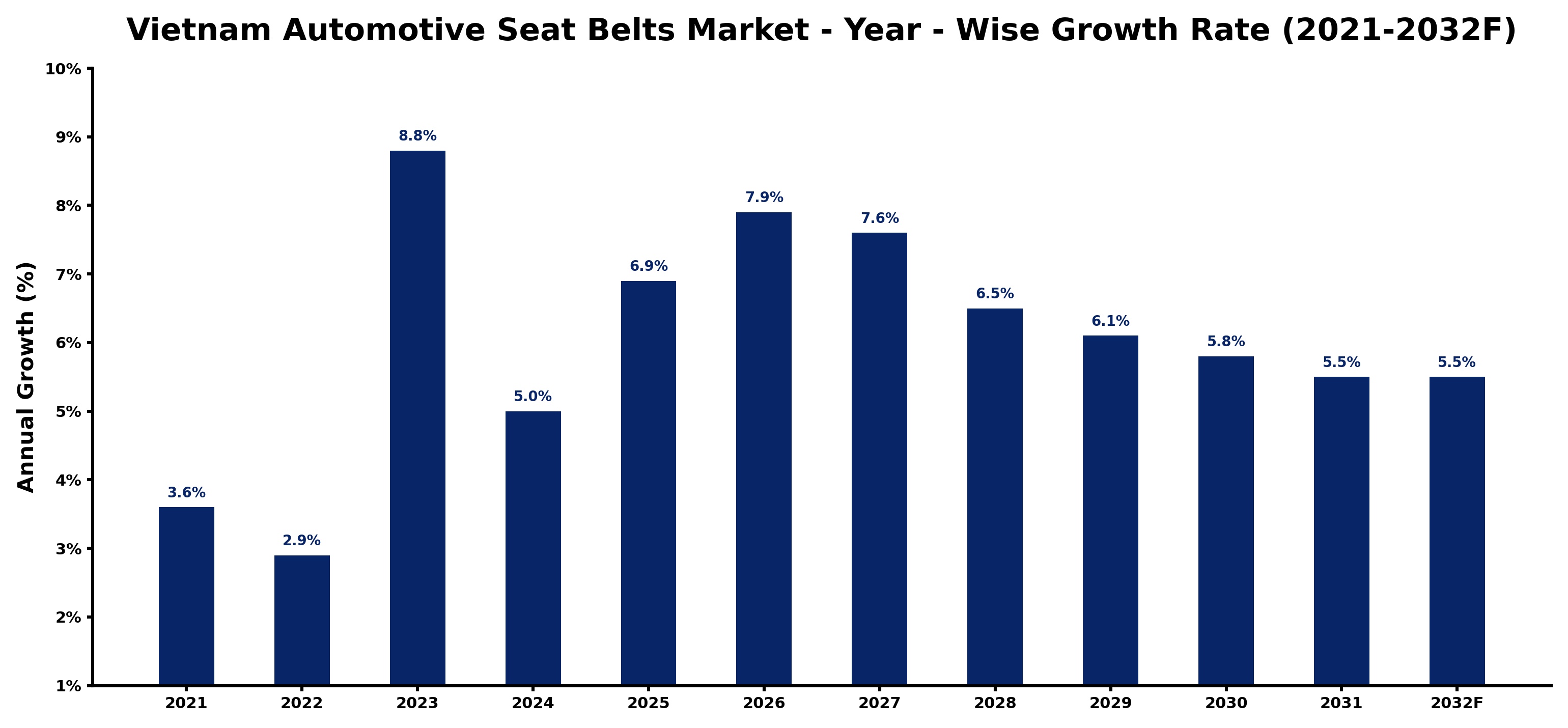
The table below presents the year‑wise growth rates along with the key drivers influencing the market
| Year | Growth Rate | Major Drivers |
| 2021 | 3.6% | Increased vehicle production rates |
| 2022 | 2.9% | Rising consumer safety awareness |
| 2023 | 8.8% | Government regulations enhanced standards |
| 2024 | 5.0% | Technological advancements improved designs |
| 2025 | 6.9% | Growing automotive industry demand |
| 2026 | 7.9% | Expansion of manufacturing facilities |
| 2027 | 7.6% | Rising disposable income levels |
| 2028 | 6.5% | Increased export opportunities emerging |
| 2029 | 6.1% | Enhanced distribution networks developed |
| 2030 | 5.8% | Sustainability trends influenced choices |
| 2031 | 5.5% | Consumer preference for safety features |
| 2032 | 5.5% | Collaborations with automotive manufacturers |
Note - Market size estimations and growth projections presented in this report are based on 6Wresearch's advanced forecasting approach, validated with industry datasets as of June 2026.
Vietnam Automotive Seat Belts Market Synopsis
The strongest force shaping the Vietnam Automotive Seat Belts Market today is the rigorous enforcement of safety regulations. The government's commitment to reducing road fatalities has prompted an overhaul of existing standards, thereby mandating the installation of advanced seat belt systems in vehicles. This regulatory landscape not only ensures that manufacturers meet compliance benchmarks but also strengthens consumer confidence in vehicle safety.
In addition to regulatory pressures, the local market is experiencing a significant uptick in demand due to increasing vehicle ownership. As more Vietnamese citizens acquire personal vehicles, the need for effective occupant safety systems grows correspondingly. Manufacturers are leveraging this opportunity to introduce innovative solutions, such as smart seat belts, aimed at bolstering overall vehicle safety.
Vietnam Automotive Seat Belts Market Key Takeaways
- The market is driven primarily by strict safety regulations and a growing emphasis on passenger safety.
- Innovations in seat belt technology, including smart features, are gaining traction among manufacturers.
- Post-pandemic recovery has revitalized the automotive sector, boosting demand for seat belts.
- Consumer awareness of the importance of safety equipment is significantly influencing market dynamics.
- Competitive pressures from other safety technologies, like airbags, present ongoing challenges to market growth.
Evaluation of Restraints in Vietnam Automotive Seat Belts Market
While the Vietnam Automotive Seat Belts Market is poised for growth, several restraints are holding it back. The stringent safety regulations necessitate that manufacturers engage in continuous research and development efforts to meet evolving standards, which can be resource-intensive. Additionally, the competitive landscape includes alternative safety restraint systems like airbags and advanced driver assistance technologies that may detract from the demand for traditional seat belts. Economic fluctuations also pose risks, influencing consumer purchasing power and preferences.
Vietnam Automotive Seat Belts Market Trends
Currently, one of the prevailing trends in the Vietnam Automotive Seat Belts Market is the adoption of smart technologies that enhance functionality and safety. These innovations include features such as seat belt reminders and integrated crash sensors that provide real-time feedback to drivers. Additionally, sustainability trends are driving manufacturers to explore eco-friendly materials for seat belt production. This trend aligns with the global movement towards more environmentally responsible automotive solutions, presenting both challenges and opportunities for market players.
Vietnam Automotive Seat Belts Market Opportunities
The future of the Vietnam Automotive Seat Belts Market is bright with numerous opportunities for growth and investment. As the automotive sector expands, particularly with electric and hybrid vehicles, there is a distinct opportunity for the integration of advanced seat belt technologies tailored to these new vehicle types. Furthermore, the burgeoning aftermarket for automotive parts opens avenues for manufacturers to innovate and diversify their product offerings, catering to an increasingly safety-conscious consumer base.
Government Initiatives in the Vietnam Automotive Seat Belts Market
The Vietnamese government has been proactive in enhancing road safety through policy initiatives that promote the use of seat belts. This includes public awareness campaigns designed to educate drivers about the importance of seat belt usage and strict enforcement measures for non-compliance. Additionally, investments in infrastructure aimed at improving overall road safety complement these efforts, creating a favorable environment for the automotive seat belts market to thrive.
Future Insights of the Vietnam Automotive Seat Belts Market
Looking ahead to 2026-2032, the Vietnam Automotive Seat Belts Market is expected to continue its upward trajectory. As the automotive landscape evolves with the introduction of new technologies and vehicles, there will be an increasing demand for innovative seat belt solutions that prioritize safety and user comfort. Coupled with the ongoing emphasis on regulatory compliance, companies that can anticipate and respond to these trends will be well-positioned to capitalize on emerging opportunities in this dynamic market.
Vietnam Automotive Seat Belts Market Latest Developments (May 2025 - June 2026)
Recent industry directions indicate a focus on integrating advanced safety technologies within the seat belt segment. Innovations such as adjustable seat belts with personalized fitting options are gaining attention. Furthermore, collaborations between automotive manufacturers and tech firms are paving the way for smarter safety solutions, aiming to enhance overall vehicle safety beyond traditional offerings.
Vietnam Automotive Seat Belts Market - Key Attractiveness of the Report
- 10 Years of Market Numbers
- Historical Data Starting from 2022 to 2025
- Base Year: 2025
- Forecast Data until 2032
- Key Performance Indicators Impacting the Market
- Major Upcoming Developments and Projects
Key Highlights of the Report:
- Vietnam Automotive Seat Belts Market Outlook
- Market Size of Vietnam Automotive Seat Belts Market, 2025
- Forecast of Vietnam Automotive Seat Belts Market, 2032F
- Historical Data and Forecast of Vietnam Automotive Seat Belts Revenues & Volume for the Period 2022-2032F
- Vietnam Automotive Seat Belts Market Trend Evolution
- Vietnam Automotive Seat Belts Market Drivers and Challenges
- Vietnam Automotive Seat Belts Price Trends
- Vietnam Automotive Seat Belts Porter's Five Forces
- Vietnam Automotive Seat Belts Industry Life Cycle
- Historical Data and Forecast of Vietnam Automotive Seat Belts Market Revenues & Volume By Type for the Period 2022-2032F
- Historical Data and Forecast of Vietnam Automotive Seat Belts Market Revenues & Volume By 2-point Seatbelt for the Period 2022-2032F
- Historical Data and Forecast of Vietnam Automotive Seat Belts Market Revenues & Volume By 3-point Seatbelt for the Period 2022-2032F
- Historical Data and Forecast of Vietnam Automotive Seat Belts Market Revenues & Volume By Vehicle for the Period 2022-2032F
- Historical Data and Forecast of Vietnam Automotive Seat Belts Market Revenues & Volume By Passenger Cars for the Period 2022-2032F
- Historical Data and Forecast of Vietnam Automotive Seat Belts Market Revenues & Volume By Light Commercial Vehicles for the Period 2022-2032F
- Historical Data and Forecast of Vietnam Automotive Seat Belts Market Revenues & Volume By Heavy Commercial Vehicles for the Period 2022-2032F
- Historical Data and Forecast of Vietnam Automotive Seat Belts Market Revenues & Volume By Component for the Period 2022-2032F
- Historical Data and Forecast of Vietnam Automotive Seat Belts Market Revenues & Volume By Webbing strap for the Period 2022-2032F
- Historical Data and Forecast of Vietnam Automotive Seat Belts Market Revenues & Volume By Retractor for the Period 2022-2032F
- Historical Data and Forecast of Vietnam Automotive Seat Belts Market Revenues & Volume By Buckle for the Period 2022-2032F
- Historical Data and Forecast of Vietnam Automotive Seat Belts Market Revenues & Volume By Tongue for the Period 2022-2032F
- Historical Data and Forecast of Vietnam Automotive Seat Belts Market Revenues & Volume By Pillar Loop for the Period 2022-2032F
- Historical Data and Forecast of Vietnam Automotive Seat Belts Market Revenues & Volume By Distribution Channels for the Period 2022-2032F
- Historical Data and Forecast of Vietnam Automotive Seat Belts Market Revenues & Volume By OEM for the Period 2022-2032F
- Historical Data and Forecast of Vietnam Automotive Seat Belts Market Revenues & Volume By Aftermarket for the Period 2022-2032F
- Vietnam Automotive Seat Belts Import Export Trade Statistics
- Market Opportunity Assessment By Type
- Market Opportunity Assessment By Vehicle
- Market Opportunity Assessment By Component
- Market Opportunity Assessment By Distribution Channels
- Vietnam Automotive Seat Belts Top Companies Market Share
- Vietnam Automotive Seat Belts Competitive Benchmarking By Technical and Operational Parameters
- Vietnam Automotive Seat Belts Company Profiles
- Vietnam Automotive Seat Belts Key Strategic Recommendations






































