Vietnam Automotive Wheel Rims Market Size, Share & Growth Rate
The Vietnam Automotive Wheel Rims Market was estimated at USD 415 Million in 2025 and is projected to reach USD 587 Million by 2032, growing at a CAGR of 5.1% from 2026 to 2032. This growth trajectory is largely driven by the burgeoning automotive sector within Vietnam, spurred by rising disposable incomes and an increasing preference for vehicle customization. As the production of automobiles escalates, the demand for high-quality and aesthetically appealing wheel rims continues to rise, demonstrating the market's responsiveness to consumer preferences.
Vietnam Automotive Wheel Rims Market Growth Rate Analysis (2021-2032)
The Vietnam automotive wheel rims market is experiencing robust growth, highlighted by an impressive increase of 8.7% in 2023 following a steady rise of 3.4% in 2022. This surge can be attributed to heightened consumer demand, spurred by increasing vehicle ownership and a shift towards advanced manufacturing technologies, which enhance rim design and performance. Sustained investments in infrastructure and the government's focus on the energy transition are also playing crucial roles. Although growth is projected to moderate to 5.3% in 2024, the market is expected to maintain an upward trend, averaging around 6.6% to 7.8% through 2026, reflecting ongoing economic development and expanding automobile sector innovations.
Vietnam Automotive Wheel Rims Market Year-wise Growth Rate and Key Drivers
This graph highlights how the Vietnam Automotive Wheel Rims Market has steadily grown over the past five years, supported by major growth factors.
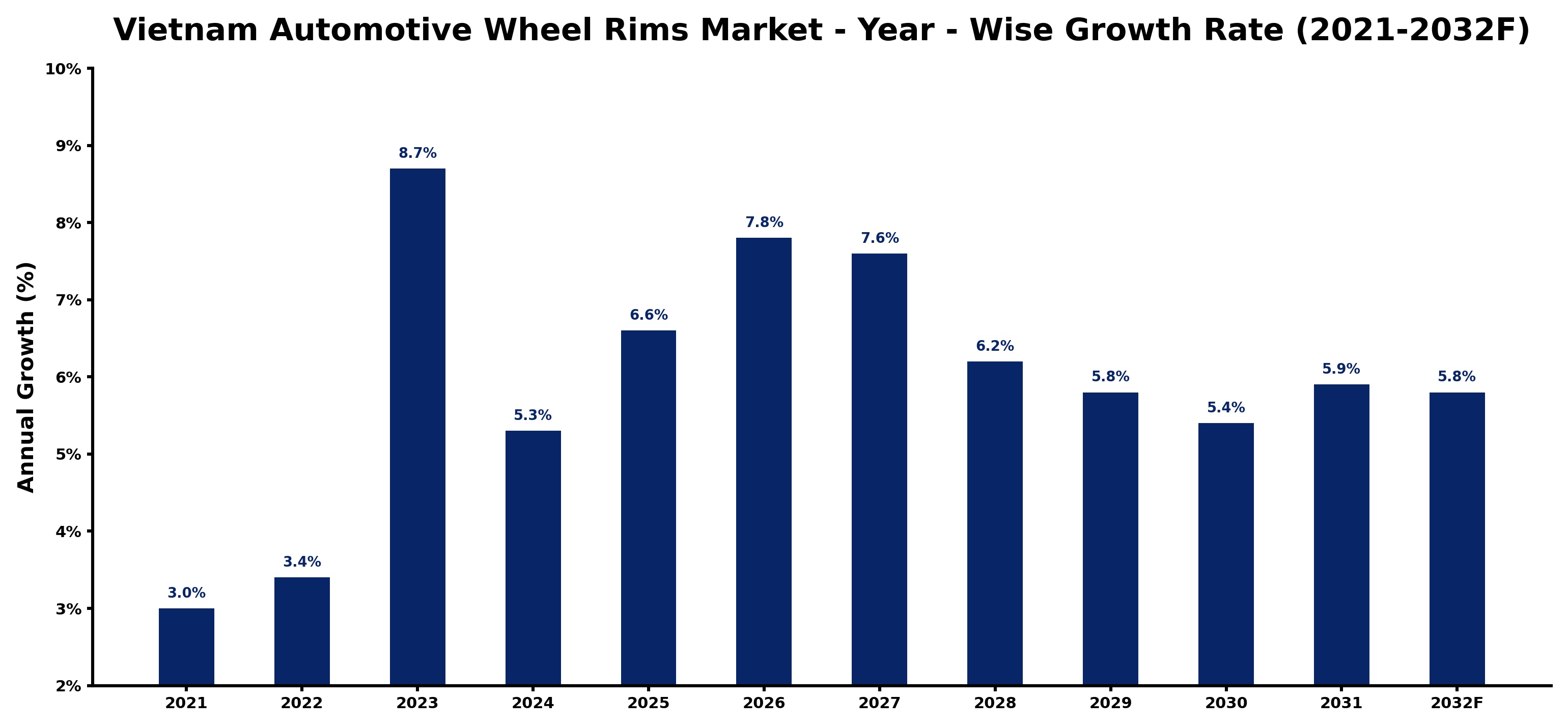
The table below presents the year‑wise growth rates along with the key drivers influencing the market
| Year | Growth Rate | Major Drivers |
| 2021 | 3.0% | Rising automotive production demands rims |
| 2022 | 3.4% | Increased vehicle sales drive demand |
| 2023 | 8.7% | Electric vehicle market expansion influences |
| 2024 | 5.3% | Infrastructure development boosts automotive sector |
| 2025 | 6.6% | Growing consumer preference for customization |
| 2026 | 7.8% | Technological advancements enhance rim performance |
| 2027 | 7.6% | Sustainability trends promote lightweight materials |
| 2028 | 6.2% | Rising disposable income supports upgrades |
| 2029 | 5.8% | Enhanced safety standards drive innovation |
| 2030 | 5.4% | Automotive exports increase rim requirements |
| 2031 | 5.9% | Collaborations with manufacturers expand offerings |
| 2032 | 5.8% | E-commerce growth facilitates consumer access |
Note - Market size estimations and growth projections presented in this report are based on 6Wresearch’s advanced forecasting approach, validated with industry datasets as of June 2026.
Vietnam Automotive Wheel Rims Market Synopsis
Consumer demand for lightweight and stylish wheel rims is the strongest force shaping the Vietnam Automotive Wheel Rims Market right now. As more Vietnamese consumers prioritize both vehicle performance and design, manufacturers are compelled to innovate and diversify their offerings to align with these evolving preferences.
Furthermore, supportive government initiatives aimed at boosting the automotive industry create a favorable environment for the wheel rims market. Infrastructure improvements and policies that encourage domestic vehicle production are enhancing market growth, providing manufacturers with opportunities to capitalize on an expanding customer base.
Vietnam Automotive Wheel Rims Market Key Takeaways
- The Vietnam Automotive Wheel Rims Market is poised for sustained growth driven by increased automobile production.
- Innovative designs and lightweight materials are essential to meet consumer expectations for performance and aesthetics.
- Government support plays a vital role in shaping the market landscape, facilitating further investment.
- The market must adapt to technological advancements, particularly in electric and autonomous vehicles.
- Quality assurance remains a critical focus for manufacturers in response to consumer demand.
Evaluation of Restraints in Vietnam Automotive Wheel Rims Market
Despite promising growth prospects, the Vietnam Automotive Wheel Rims Market faces notable restraints. One significant challenge is the pressure to maintain high-quality standards while simultaneously managing production costs. As consumers become more discerning regarding performance and aesthetics, manufacturers must invest in advanced technologies and materials, which can strain their resources. Additionally, the emergence of electric and autonomous vehicles necessitates a re-evaluation of production capabilities to meet new requirements, thereby posing a strategic challenge in an evolving market landscape.
Vietnam Automotive Wheel Rims Market Trends
Several trends are currently shaping the Vietnam Automotive Wheel Rims Market. The shift towards lightweight materials, such as aluminum and advanced composites, is gaining momentum as manufacturers seek to enhance vehicle performance and fuel efficiency. Furthermore, a growing trend toward customization is evident, with consumers increasingly seeking unique designs that reflect their personal style. The introduction of smart technologies in wheel rim design, aimed at improving safety and performance monitoring, is also emerging as a key focus area.
Vietnam Automotive Wheel Rims Market Opportunities
Genuine growth and investment opportunities lie in the development of innovative wheel rim designs that cater to both aesthetic and functional needs. Manufacturers that can successfully incorporate lightweight materials and smart technologies into their products stand to gain a competitive edge. Additionally, tapping into the growing trend of electric vehicles by creating specialized rims that suit their unique specifications presents an untapped market avenue. Collaborations with automotive manufacturers to provide tailor-made solutions can also pave the way for lucrative partnerships.
Government Initiatives in the Vietnam Automotive Wheel Rims Market
The Vietnamese government has implemented various initiatives aimed at revitalizing the automotive sector, which in turn positively impacts the automotive wheel rims market. Policies that encourage local production, promote investment in manufacturing technology, and enhance infrastructure are critical in fostering a robust environment for market growth. Furthermore, the government's focus on developing sustainable automotive solutions aligns with global trends towards electrification, presenting new avenues for innovation within the wheel rims market.
Future Insights of the Vietnam Automotive Wheel Rims Market
Looking ahead to 2026-2032, the Vietnam Automotive Wheel Rims Market is anticipated to experience transformative growth driven by technological advancements and shifting consumer preferences. As the automotive sector embraces electric and autonomous vehicles, the demand for specialized wheel rims that can accommodate new technologies will rise. Moreover, the increasing emphasis on sustainability and environmental responsibility is likely to push manufacturers toward the adoption of eco-friendly materials, further reshaping the competitive landscape and product offerings in this market.
Vietnam Automotive Wheel Rims Market Latest Developments (May 2025 - June 2026)
In recent months, the Vietnam Automotive Wheel Rims Market has seen an influx of innovative product launches aimed at enhancing vehicle performance and aesthetics. Manufacturers are focusing on developing lightweight and durable materials in response to evolving consumer preferences. Collaborative efforts between automotive manufacturers and rim producers have also intensified, aiming to create bespoke solutions tailored to the needs of electric vehicles. These developments highlight a dynamic shift towards integrating advanced technology and design in the wheel rim segment.
Vietnam Automotive Wheel Rims Market - Key Attractiveness of the Report
- 10 Years of Market Numbers
- Historical Data Starting from 2022 to 2025
- Base Year: 2025
- Forecast Data until 2032
- Key Performance Indicators Impacting the Market
- Major Upcoming Developments and Projects
Key Highlights of the Report:
- Vietnam Automotive Wheel Rims Market Outlook
- Market Size of Vietnam Automotive Wheel Rims Market, 2025
- Forecast of Vietnam Automotive Wheel Rims Market, 2032F
- Historical Data and Forecast of Vietnam Automotive Wheel Rims Revenues & Volume for the Period 2022-2032F
- Vietnam Automotive Wheel Rims Market Trend Evolution
- Vietnam Automotive Wheel Rims Market Drivers and Challenges
- Vietnam Automotive Wheel Rims Price Trends
- Vietnam Automotive Wheel Rims Porter's Five Forces
- Vietnam Automotive Wheel Rims Industry Life Cycle
- Historical Data and Forecast of Vietnam Automotive Wheel Rims Market Revenues & Volume By Material Type for the Period 2022-2032F
- Historical Data and Forecast of Vietnam Automotive Wheel Rims Market Revenues & Volume By Alloy for the Period 2022-2032F
- Historical Data and Forecast of Vietnam Automotive Wheel Rims Market Revenues & Volume By Steel for the Period 2022-2032F
- Historical Data and Forecast of Vietnam Automotive Wheel Rims Market Revenues & Volume By Carbon Fiber for the Period 2022-2032F
- Historical Data and Forecast of Vietnam Automotive Wheel Rims Market Revenues & Volume By Sales Channel for the Period 2022-2032F
- Historical Data and Forecast of Vietnam Automotive Wheel Rims Market Revenues & Volume By OEM for the Period 2022-2032F
- Historical Data and Forecast of Vietnam Automotive Wheel Rims Market Revenues & Volume By Aftermarket for the Period 2022-2032F
- Historical Data and Forecast of Vietnam Automotive Wheel Rims Market Revenues & Volume By Vehicle Type for the Period 2022-2032F
- Historical Data and Forecast of Vietnam Automotive Wheel Rims Market Revenues & Volume By Passenger Cars for the Period 2022-2032F
- Historical Data and Forecast of Vietnam Automotive Wheel Rims Market Revenues & Volume By Commercial Vehicles for the Period 2022-2032F
- Vietnam Automotive Wheel Rims Import Export Trade Statistics
- Market Opportunity Assessment By Material Type
- Market Opportunity Assessment By Sales Channel
- Market Opportunity Assessment By Vehicle Type
- Vietnam Automotive Wheel Rims Top Companies Market Share
- Vietnam Automotive Wheel Rims Competitive Benchmarking By Technical and Operational Parameters
- Vietnam Automotive Wheel Rims Company Profiles
- Vietnam Automotive Wheel Rims Key Strategic Recommendations






































