Vietnam Bakeware Market Summary
The vietnam bakeware market was estimated at USD 272 Million in 2025 and is projected to reach USD 382 Million by 2032, growing at a CAGR of 7.9% from 2026 to 2032.
Vietnam Bakeware Market Year-wise Growth Rate and Key Drivers
This graph highlights how the Vietnam Bakeware Market has steadily grown over the past five years, supported by major growth factors.
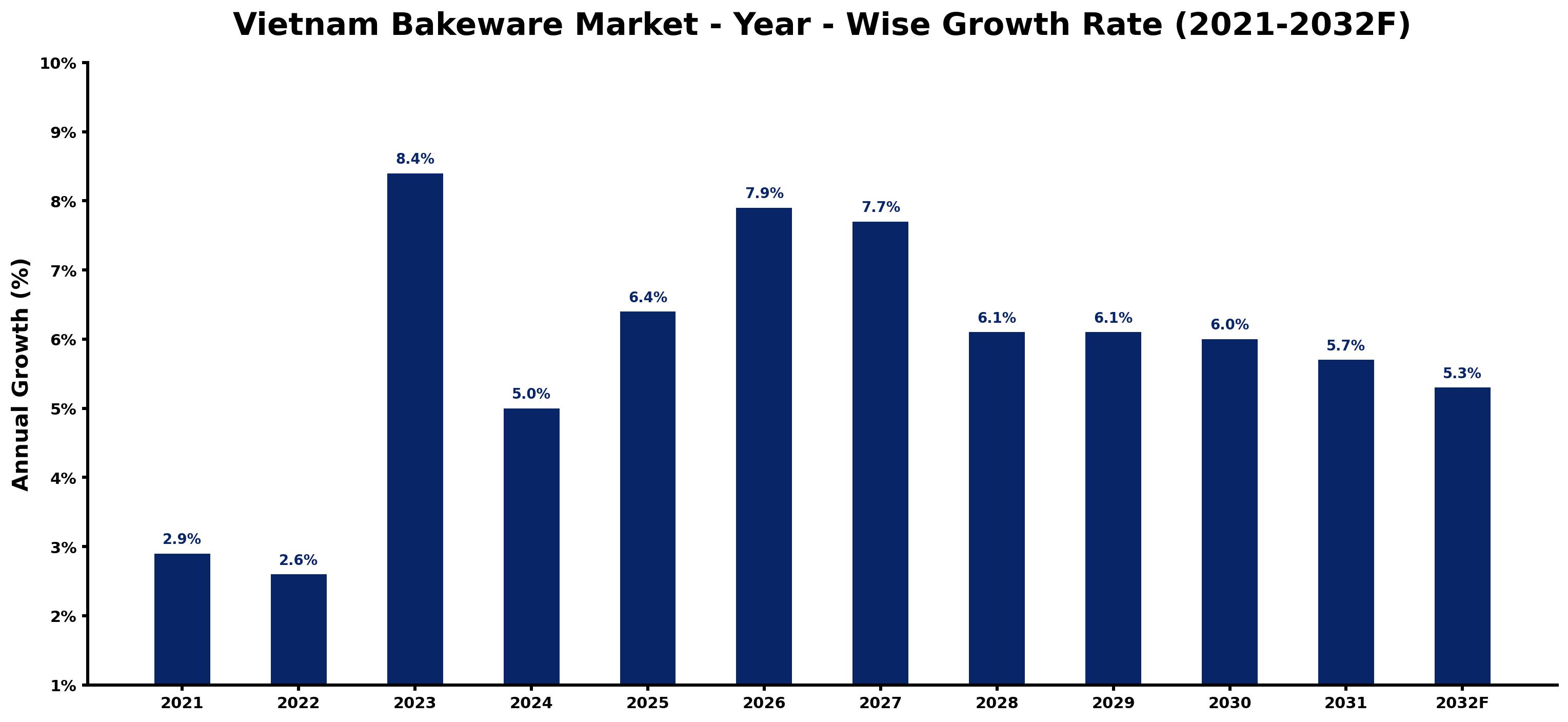
The table below presents the year wise growth rates along with the key drivers influencing the market
| Year | Growth Rate | Major Drivers |
| 2021 | 2.9% | Consumers increasingly embrace home baking, shifting market dynamics toward bakeware products. |
| 2022 | 2.6% | Local manufacturers enhance production capabilities, improving product variety and accessibility. |
| 2023 | 8.4% | E-commerce platforms flourish, expanding reach for bakeware brands across urban centers. |
| 2024 | 5.0% | Innovative bakeware designs cater to health-conscious consumers seeking sustainable materials. |
| 2025 | 6.4% | Rising disposable incomes empower households to invest more in quality bakeware. |
| 2026 | 7.9% | Culinary tourism promotes baking culture, inspiring local artisans to create unique items. |
| 2027 | 7.7% | Rural urbanization enhances access to baking supplies and increases market penetration. |
| 2028 | 6.1% | Social media influences baking trends, driving younger demographics to purchase bakeware. |
| 2029 | 6.1% | Collaborations between chefs and brands spark interest in specialized bakeware collections. |
| 2030 | 6.0% | Home cooking trends solidify, prompting consistent demand for versatile bakeware solutions. |
| 2031 | 5.7% | Sustainability concerns lead to innovations in eco-friendly baking materials and packaging. |
| 2032 | 5.3% | Technological advances streamline production, enabling mass customization of bakeware products. |
Note - Market size estimations and growth projections presented in this report are based on 6Wresearch's advanced forecasting approach, validated with industry datasets as of June 2026.
Vietnam Bakeware Market Synopsis
The Vietnam Bakeware Market is projected to reach 7.9% and witness significant growth during the forecast period (2026-2032). The market encompasses the production, distribution, and sale of various bakeware products essential for baking and cooking, including cake pans, baking sheets, muffin trays, and assorted accessories. This market dynamics reflect evolving consumer behavior, with increasing interest in home baking and cooking, influenced by lifestyle changes and wider access to baking-related media.
Vietnam Bakeware Market Growth Drivers
A number of factors contribute to the growth of the Vietnam bakeware market, making it an attractive sector for both existing and new entrants. Firstly, the rising trend of home baking has become a significant driver, with more consumers engaging in baking as a leisure activity. This trend is bolstered by the proliferation of cooking shows and social media platforms that showcase baking tutorials. Secondly, urbanization continues to reshape lifestyles, leading to a demand for convenient and easy-to-use bakeware products.
- The increasing availability of diverse bakeware options encourages consumer experimentation with recipes, thereby boosting sales.
- A growing number of cafés and bakeries enhances the need for high-quality bakeware products, providing ample opportunities for manufacturers.
- Health-conscious consumers are shifting towards homemade baked goods, which fosters demand for quality bakeware designed for healthier cooking methods.
- The influence of food bloggers on social media platforms has elevated the visibility of baking as a popular home activity, further driving product interest.
- Seasonal events and festivities are increasingly characterized by baking activities, leading to spikes in demand for bakeware during certain periods.
Vietnam Bakeware Market Challenges and Restraints
Despite its growth potential, the Vietnam bakeware market faces several challenges. Foremost among these are the proliferation of low-cost alternatives and counterfeit products. These imitations can undermine established brands and frustrate consumers seeking quality. Furthermore, price sensitivity among consumers influences purchasing decisions, often skewing preference towards budget options despite potential quality issues. Maintaining high-quality standards is vital for customer satisfaction and long-term brand reputation.
- The presence of counterfeit items poses a risk to brand integrity and consumer trust.
- Quality assurance in products becomes paramount, as any defects can severely impact a brand's reputation.
- Market saturation with low-cost products may lead to harmful price wars among manufacturers.
- Shifts in consumer preferences towards minimalism may affect demand for certain types of bakeware.
- Economic uncertainties can lead to reduced discretionary spending, impacting sales of bakeware items.
Vietnam Bakeware Market Trends and Opportunities
The landscape of the Vietnam bakeware market is rapidly evolving, presenting numerous trends and opportunities. As home baking becomes more fashionable, manufacturers are encouraged to innovate their product lines with sustainable materials to appeal to eco-conscious consumers. The increasing integration of technology in the kitchen also opens avenues for smart bakeware products that cater to tech-savvy culinary enthusiasts. Additionally, customization options are gaining traction, as consumers seek unique items that reflect personal style.
- Enhanced focus on sustainability is prompting manufacturers to adopt eco-friendly materials in production.
- The shift towards smart kitchen appliances suggests a future opportunity for tech-enabled bakeware products.
- Collaborations with influencers and chefs on social media can effectively boost brand visibility and appeal.
- Packaging innovations aimed at enhancing product shelf-life will become a competitive differentiator.
- Growth in the e-commerce sector provides a platform for increased reach and convenience in a post-pandemic environment.
Vietnam Bakeware Market Government Investment and Initiatives
Government policies in Vietnam increasingly aim to bolster local manufacturing, including the bakeware sector. Initiatives designed to support entrepreneurship and innovation are expected to enhance production efficiency and quality in the industry. Furthermore, investment in infrastructure improvements will streamline supply chain processes, ensuring product availability. The government is also promoting consumer awareness regarding high-quality products, which is beneficial for established bakeware manufacturers competing with low-cost alternatives.
Vietnam Bakeware Market Latest Developments (May 2025 - June 2026)
Recent developments in the Vietnam bakeware market highlight a focus on product innovation and enhanced consumer outreach. Many manufacturers are adopting technology-driven solutions to improve production processes and product designs. Marketing strategies are increasingly leveraging social media platforms to engage the baking community effectively. Furthermore, collaborations between manufacturers and restaurants or bakeries are becoming more frequent, facilitating product testing and consumer feedback integration into new designs.
Vietnam Bakeware Market - Key Attractiveness of the Report
- 10 Years of Market Numbers
- Historical Data Starting from 2022 to 2025
- Base Year: 2025
- Forecast Data until 2032
- Key Performance Indicators Impacting the Market
- Major Upcoming Developments and Projects
Key Highlights of the Report:
- Vietnam Bakeware Market Outlook
- Market Size of Vietnam Bakeware Market, 2025
- Forecast of Vietnam Bakeware Market, 2032
- Historical Data and Forecast of Vietnam Bakeware Revenues & Volume for the Period 2022-2032F
- Vietnam Bakeware Market Trend Evolution
- Vietnam Bakeware Market Drivers and Challenges
- Vietnam Bakeware Price Trends
- Vietnam Bakeware Porter's Five Forces
- Vietnam Bakeware Industry Life Cycle
- Historical Data and Forecast of Vietnam Bakeware Market Revenues & Volume By Product Type for the Period 2022-2032F
- Historical Data and Forecast of Vietnam Bakeware Market Revenues & Volume By Ceramic for the Period 2022-2032F
- Historical Data and Forecast of Vietnam Bakeware Market Revenues & Volume By Aluminium for the Period 2022-2032F
- Historical Data and Forecast of Vietnam Bakeware Market Revenues & Volume By Cast Iron for the Period 2022-2032F
- Historical Data and Forecast of Vietnam Bakeware Market Revenues & Volume By Stainless Steel for the Period 2022-2032F
- Historical Data and Forecast of Vietnam Bakeware Market Revenues & Volume By Glass for the Period 2022-2032F
- Historical Data and Forecast of Vietnam Bakeware Market Revenues & Volume By Others for the Period 2022-2032F
- Historical Data and Forecast of Vietnam Bakeware Market Revenues & Volume By Applications for the Period 2022-2032F
- Historical Data and Forecast of Vietnam Bakeware Market Revenues & Volume By Commercial for the Period 2022-2032F
- Historical Data and Forecast of Vietnam Bakeware Market Revenues & Volume By Household for the Period 2022-2032F
- Vietnam Bakeware Import Export Trade Statistics
- Market Opportunity Assessment By Product Type
- Market Opportunity Assessment By Applications
- Vietnam Bakeware Top Companies Market Share
- Vietnam Bakeware Competitive Benchmarking By Technical and Operational Parameters
- Vietnam Bakeware Company Profiles
- Vietnam Bakeware Key Strategic Recommendations






































