Vietnam Ballast Water Treatment Market Size, Share & Growth Rate
The Vietnam Ballast Water Treatment Market was estimated at USD 481 Million in 2025 and is projected to reach USD 680 Million by 2032, growing at a CAGR of 5.1% from 2026 to 2032. This growth is propelled by the increasing regulatory pressures on maritime operations to prevent the introduction of invasive species, alongside a robust expansion in the country's shipping industry. As Vietnam amplifies its maritime infrastructure and aligns with international environmental standards, demand for effective ballast water treatment solutions is anticipated to rise sharply.
Vietnam Ballast Water Treatment Market Year-wise Growth Rate and Key Drivers
This graph highlights how the Vietnam Ballast Water Treatment Market has steadily grown over the years, supported by major growth factors.
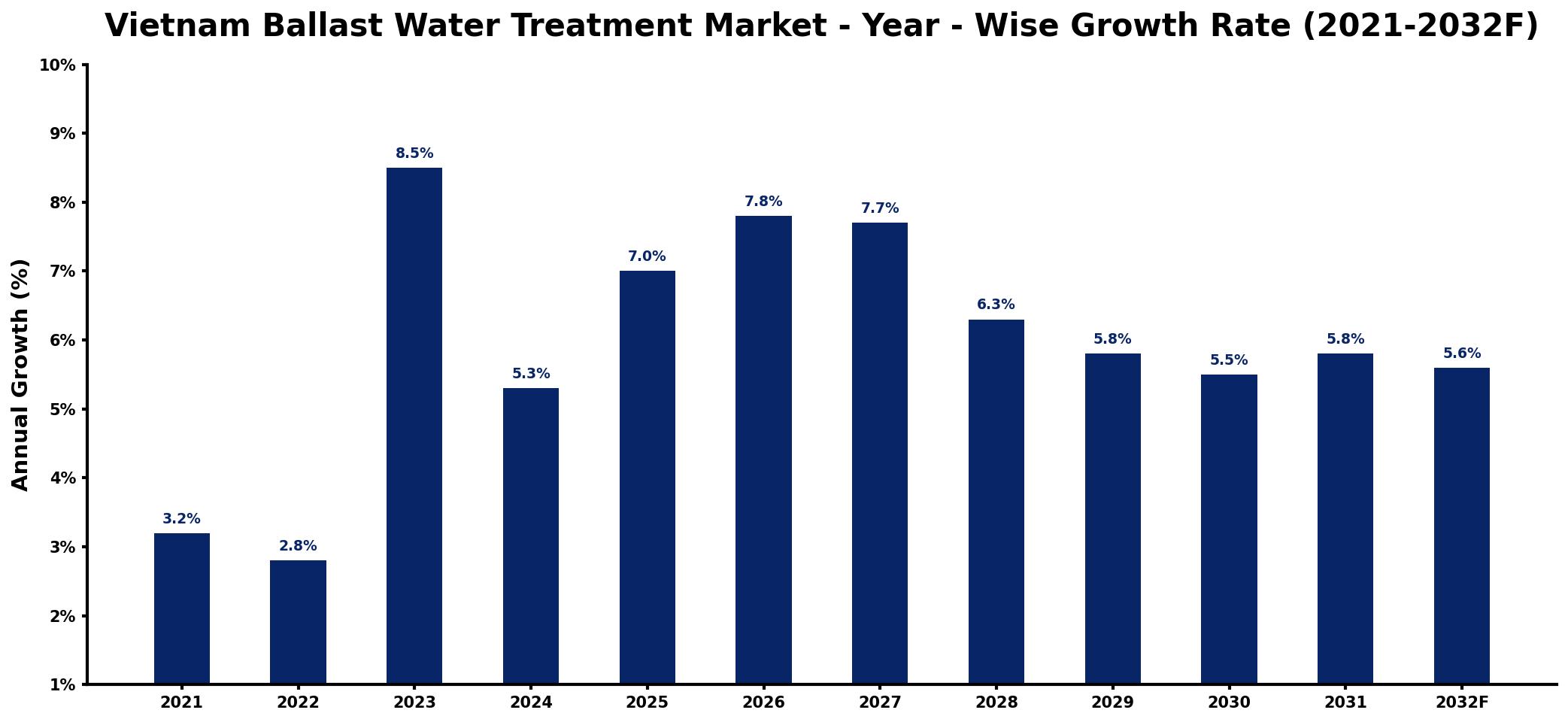
The table below presents the year‑wise growth rates along with the key drivers influencing the market
| Year | Growth Rate | Major Drivers |
| 2021 | 3.2% | Rising environmental regulation compliance |
| 2022 | 2.8% | Expansion of shipping industry fleet |
| 2023 | 8.5% | Increased investment in sustainability |
| 2024 | 5.3% | Growing maritime safety awareness |
| 2025 | 7.0% | Technological advancements in filtration |
| 2026 | 7.8% | Strengthened international trade agreements |
| 2027 | 7.7% | Higher demand for eco-friendly solutions |
| 2028 | 6.3% | Increased shipping routes and logistics |
| 2029 | 5.8% | Enhanced government incentives for compliance |
| 2030 | 5.5% | Rising consumer preference for sustainability |
| 2031 | 5.8% | Growth in marine biodiversity initiatives |
| 2032 | 5.6% | Emerging markets expanding shipping operations |
Note: Market size estimations and growth projections presented in this report are based on 6Wresearch's proprietary forecasting methodology, utilizing the latest available industry data, government publications, and primary research inputs.
Vietnam Ballast Water Treatment Market Synopsis
The most compelling force shaping the Vietnam ballast water treatment market is the stringent adherence to environmental regulations. With growing awareness of the ecological risks posed by invasive species entering local waters, the government and maritime authorities are enforcing rules that compel shipping companies to invest in effective ballast water management systems.
Additionally, as global trade expands, Vietnam's strategic location as a maritime hub necessitates efficient and compliant shipping practices. This demand is compelling vessel operators to seek advanced technologies that not only meet regulatory standards but also ensure operational efficiency and sustainability.
Vietnam Ballast Water Treatment Market Key Takeaways
- The market is driven by increasing regulatory compliance and environmental awareness.
- Shipping companies face pressure to adopt effective ballast water treatment solutions.
- COVID-19 has impacted operations and highlighted the need for resilient supply chains.
- Major players are focusing on innovative technologies for effective ballast water management.
- Future growth will heavily rely on Vietnams maritime infrastructure improvements.
Evaluation of Restraints in Vietnam Ballast Water Treatment Market
Despite promising growth, the Vietnam ballast water treatment market contends with several restraints. The primary concern revolves around compliance complexities associated with international environmental regulations. Shipping companies often grapple with selecting the right treatment technologies that can not only satisfy these stringent criteria but also fit their operational constraints. Additional factors, such as the potential for increased operational costs and the need for comprehensive training for personnel on new systems, may further complicate adoption rates. This multifaceted compliance landscape requires ongoing adaptation, creating uncertainty that can hinder investments in ballast water treatment systems.
Vietnam Ballast Water Treatment Market Trends
The Vietnam ballast water treatment market is currently witnessing several pivotal trends. Increasing investments in green technologies are becoming a focal point, as more vessel operators prioritize sustainable solutions to meet regulatory requirements. Furthermore, the integration of digital technologies, such as remote monitoring and predictive maintenance, is gaining traction, enhancing the efficiency and reliability of ballast water treatment systems. These trends reflect a broader commitment within the maritime sector to align with global sustainability goals while ensuring compliance.
Vietnam Ballast Water Treatment Market Opportunities
The evolving regulatory environment presents substantial growth and investment opportunities within the Vietnam ballast water treatment market. Companies that can innovate and deliver adaptable, cost-effective treatment solutions stand to gain significantly. Additionally, as Vietnam continues to enhance its maritime infrastructure, partnerships between technology providers and shipping firms can unlock new avenues for collaboration. The increased focus on eco-friendly practices and technologies also indicates potential for attracting foreign investment aimed at advancing Vietnams shipping capabilities.
Government Initiatives in the Vietnam Ballast Water Treatment Market
The Vietnamese government is actively promoting initiatives to bolster compliance with international environmental standards in the maritime sector. Public spending is directed towards enhancing maritime infrastructure and enforcing regulations designed to manage ballast water effectively. Incentives for the adoption of eco-friendly technologies are also on the rise, reflecting a strategic commitment to environmental sustainability in maritime operations. These initiatives are crucial as they shape a favorable environment for investment and innovation in ballast water treatment solutions.
Future Insights of the Vietnam Ballast Water Treatment Market
Looking ahead to 2026-2032, the Vietnam ballast water treatment market is poised for substantial expansion. As regulations tighten and global pressure mounts to protect marine ecosystems, shipping companies will increasingly turn to advanced treatment solutions. The ongoing modernization of Vietnams shipping infrastructure, coupled with rising international trade, is set to further augment market growth. Additionally, the push for sustainability within the industry will drive continued investment in innovative technologies, paving the way for a more robust and compliant maritime sector.
Vietnam Ballast Water Treatment Market Latest Developments (2025 - 2026)
Recent developments in the Vietnam ballast water treatment market indicate a shift towards more adaptive and integrated solutions. The industry is witnessing increased collaboration among technology providers to enhance system efficiency and compliance. Companies are also exploring advancements in remote diagnostics and maintenance, enabling operators to minimize downtime while ensuring adherence to regulatory standards. Furthermore, market players are responding to the post-pandemic landscape by adapting their strategies, focusing on resilience and sustainability.
Vietnam Ballast Water Treatment Market - Key Attractiveness of the Report
- 10 Years of Market Numbers
- Historical Data Starting from 2022 to 2025
- Base Year: 2025
- Forecast Data until 2032
- Key Performance Indicators Impacting the Market
- Major Upcoming Developments and Projects
Key Highlights of the Report:
- Vietnam Ballast Water Treatment Market Outlook
- Market Size of Vietnam Ballast Water Treatment Market, 2025
- Forecast of Vietnam Ballast Water Treatment Market, 2032
- Historical Data and Forecast of Vietnam Ballast Water Treatment Revenues & Volume for the Period 2022-2032F
- Vietnam Ballast Water Treatment Market Trend Evolution
- Vietnam Ballast Water Treatment Market Drivers and Challenges
- Vietnam Ballast Water Treatment Price Trends
- Vietnam Ballast Water Treatment Porter's Five Forces
- Vietnam Ballast Water Treatment Industry Life Cycle
- Historical Data and Forecast of Vietnam Ballast Water Treatment Market Revenues & Volume By Technology for the Period 2022-2032F
- Historical Data and Forecast of Vietnam Ballast Water Treatment Market Revenues & Volume By Physical Disinfection for the Period 2022-2032F
- Historical Data and Forecast of Vietnam Ballast Water Treatment Market Revenues & Volume By Mechanical Method for the Period 2022-2032F
- Historical Data and Forecast of Vietnam Ballast Water Treatment Market Revenues & Volume By Chemical Method for the Period 2022-2032F
- Historical Data and Forecast of Vietnam Ballast Water Treatment Market Revenues & Volume By Service for the Period 2022-2032F
- Historical Data and Forecast of Vietnam Ballast Water Treatment Market Revenues & Volume By Installation & Calibration for the Period 2022-2032F
- Historical Data and Forecast of Vietnam Ballast Water Treatment Market Revenues & Volume By Performance Measurement for the Period 2022-2032F
- Historical Data and Forecast of Vietnam Ballast Water Treatment Market Revenues & Volume By Recommissioning for the Period 2022-2032F
- Vietnam Ballast Water Treatment Import Export Trade Statistics
- Market Opportunity Assessment By Technology
- Market Opportunity Assessment By Service
- Vietnam Ballast Water Treatment Top Companies Market Share
- Vietnam Ballast Water Treatment Competitive Benchmarking By Technical and Operational Parameters
- Vietnam Ballast Water Treatment Company Profiles
- Vietnam Ballast Water Treatment Key Strategic Recommendations






































