Vietnam Blue-veined Cheese Market Size, Share & Growth Rate
The Vietnam Blue-veined Cheese Market was estimated at USD 1280 Million in 2025 and is projected to reach USD 1815 Million by 2032, growing at a CAGR of 5.1% from 2026 to 2032. This growth trajectory is fueled by the increasing consumer demand for gourmet foods, particularly in urban areas. As culinary trends continue to evolve, more Vietnamese consumers are embracing the sophisticated flavors and unique characteristics of blue-veined cheeses, leading to greater acceptance and incorporation into various dishes.
Vietnam Blue-veined Cheese Market Growth Rate Analysis (2021-2032)
The Vietnam blue-veined cheese market has exhibited a notable upward trend, highlighted by a robust 8.2% growth in 2023, driven by increasing consumer demand for premium dairy products and a rising interest in gourmet cheeses. Following a moderate growth of 2.9% in 2022, a resurgence can be attributed to greater culinary exploration among Vietnamese consumers and enhanced distribution channels, facilitated by digitalization and improved logistics infrastructure. Projections suggest steady growth with a forecasted increase of 7% in 2025 and 8.1% in 2026, as more local producers invest in quality and innovation. This sustained interest underscores the maturing palate of Vietnamese consumers and the expanding culinary market, positioning blue-veined cheese as a staple for indulgence.
Vietnam Blue-veined Cheese Market Year-wise Growth Rate and Key Drivers
This graph highlights how the Vietnam Blue-veined Cheese Market has steadily grown over the past five years, supported by major growth factors.
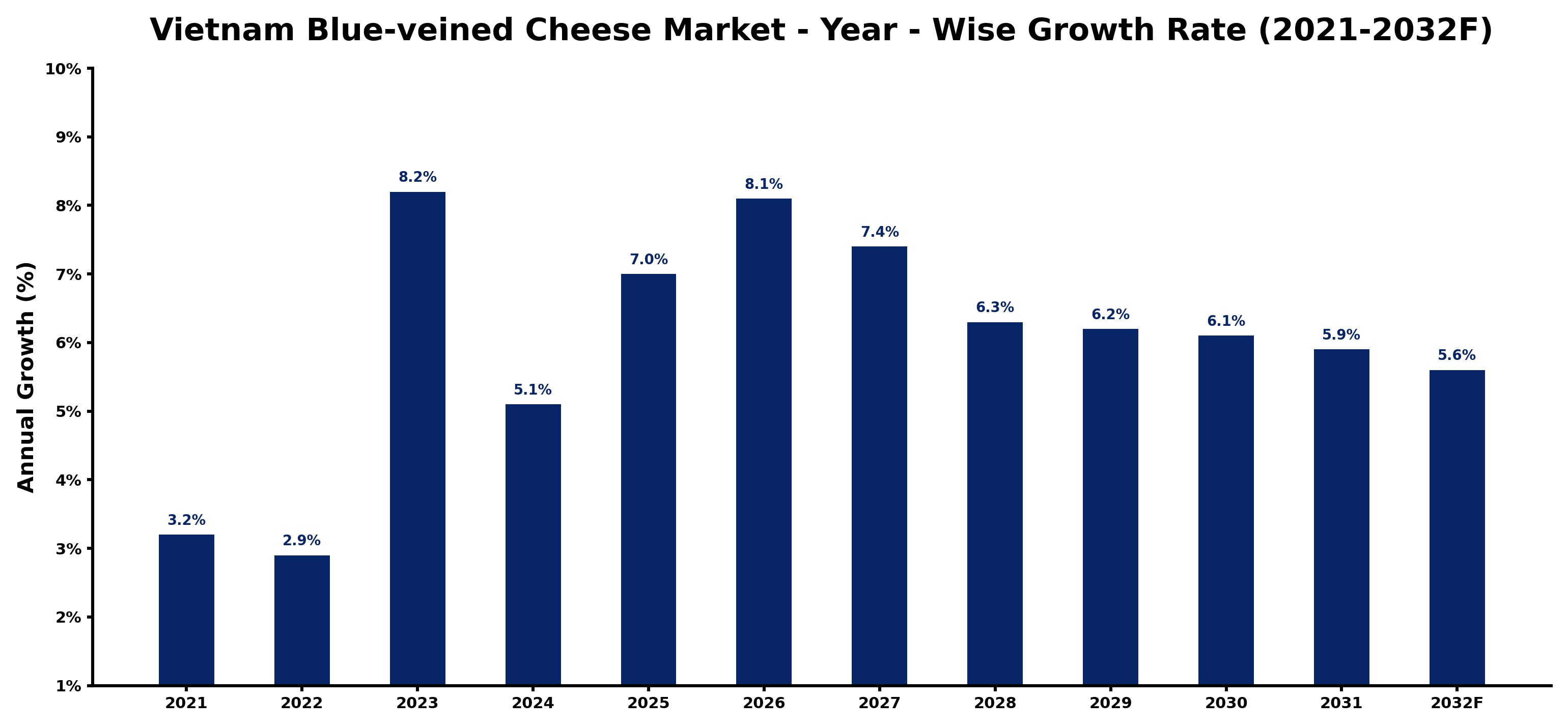
The table below presents the year‑wise growth rates along with the key drivers influencing the market
| Year | Growth Rate | Major Drivers |
| 2021 | 3.2% | Artisanal cheese popularity increased |
| 2022 | 2.9% | Local production capacity expanded |
| 2023 | 8.2% | Health consciousness drove demand |
| 2024 | 5.1% | Gourmet food trends influenced choices |
| 2025 | 7.0% | Culinary tourism enhanced awareness |
| 2026 | 8.1% | Social media marketing gained traction |
| 2027 | 7.4% | Food pairing education improved sales |
| 2028 | 6.3% | Sustainable sourcing attracted consumers |
| 2029 | 6.2% | Cheese festivals promoted local varieties |
| 2030 | 6.1% | Export opportunities expanded significantly |
| 2031 | 5.9% | Innovative flavors attracted new customers |
| 2032 | 5.6% | Plant-based alternatives gained interest |
Note - Market size estimations and growth projections presented in this report are based on 6Wresearch’s advanced forecasting approach, validated with industry datasets as of June 2026.
Vietnam Blue-veined Cheese Market Synopsis
The most significant force shaping the Vietnam Blue-veined Cheese market is the growing interest in diverse culinary experiences among consumers. This shift is not merely a fleeting trend; it represents a fundamental change in how Vietnamese diners view cheese, particularly in upscale dining and gourmet settings.
Moreover, the influence of Western culinary practices is expanding, pushing the boundaries of traditional Vietnamese cuisine. As restaurants and cafes begin to feature blue-veined cheese on their menus, consumer exposure and acceptance are steadily increasing, providing fertile ground for market growth.
Vietnam Blue-veined Cheese Market Key Takeaways
- Consumer interest in premium and artisanal food products is driving demand for blue-veined cheese.
- Urban areas show higher adoption rates as culinary diversity continues to expand.
- The influence of Western cuisine is pivotal in changing local taste preferences.
- Distribution challenges are being mitigated by the rise in online sales channels.
- Local producers are responding to market needs with innovative product offerings.
Evaluation of Restraints in Vietnam Blue-veined Cheese Market
Despite the promising growth prospects, the Vietnam Blue-veined Cheese market faces several substantial restraints. A significant limitation is the low level of consumer awareness regarding blue-veined cheeses, which are not deeply ingrained in traditional Vietnamese cuisine. This cultural hurdle, combined with limited expertise in high-quality cheese production, presents challenges for local manufacturers looking to cater to growing demand. Additionally, regulatory hurdles such as import restrictions and stringent labeling requirements further complicate the market landscape, often hampering the introduction of international products that could enhance consumer familiarity.
Vietnam Blue-veined Cheese Market Trends
Current trends indicate an increasing use of blue-veined cheese in gourmet dishes and cheese platters within restaurants. This rise is accompanied by a broader acceptance of international flavors among consumers. Additionally, social media plays a crucial role in shaping food trends, with influencers spotlighting gourmet cheese as a must-try delicacy, thus generating buzz and interest.
Furthermore, innovative marketing strategies are emerging, focusing on the health benefits and unique flavor profiles of blue-veined cheeses, appealing to health-conscious consumers. As the market evolves, sustainability will also become a focal point, with more producers seeking to incorporate environmentally friendly practices in cheese production.
Vietnam Blue-veined Cheese Market Opportunities
Significant growth opportunities exist within the Vietnam Blue-veined Cheese market, particularly for local producers aiming to elevate their product quality. Engaging in partnerships with restaurants and specialty food retailers can help introduce blue-veined cheese to a broader audience. Additionally, the potential for growth in online sales channels represents a critical avenue for reaching consumers directly, especially in urban areas where convenience is paramount. Lastly, focusing on educational marketing strategies to raise awareness about blue-veined cheese can bridge the gap between consumers and producers, fostering increased demand.
Government Initiatives in the Vietnam Blue-veined Cheese Market
The Vietnamese government has been promoting agricultural diversification and modernization, which indirectly supports the dairy sector, including specialty cheese production. Various public spending initiatives are aimed at enhancing food safety and quality standards, benefiting local cheese manufacturers. Additionally, programs encouraging the importation of international dairy products are in place, aimed at increasing consumer awareness and supporting market development.
Future Insights of the Vietnam Blue-veined Cheese Market
Looking ahead to 2026-2032, the Vietnam Blue-veined Cheese market is expected to see continued expansion, driven by a combination of changing consumer preferences and improved culinary experiences. The increasing globalization of tastes will likely propel blue-veined cheese into mainstream Vietnamese dining. As local producers improve quality and branding, and as international influences persist, the market will become increasingly competitive. A focus on education and market penetration strategies will also be vital as the industry prepares to meet the growing demand.
Vietnam Blue-veined Cheese Market Latest Developments (May 2025 - June 2026)
Recent industry developments indicate a burgeoning interest in blue-veined cheese among food service operators, leading to enhanced partnerships between local producers and restaurants. Innovations in packaging and distribution are being explored to facilitate better access to consumers. Additionally, promotional campaigns are being launched to highlight the versatility and unique flavors of blue-veined cheeses, further driving consumer interest.
Vietnam Blue-veined Cheese Market - Key Attractiveness of the Report
- 10 Years of Market Numbers
- Historical Data Starting from 2022 to 2025
- Base Year: 2025
- Forecast Data until 2032
- Key Performance Indicators Impacting the Market
- Major Upcoming Developments and Projects
Key Highlights of the Report:
- Vietnam Blue-veined Cheese Market Outlook
- Market Size of Vietnam Blue-veined Cheese Market, 2025
- Forecast of Vietnam Blue-veined Cheese Market, 2032F
- Historical Data and Forecast of Vietnam Blue-veined Cheese Revenues & Volume for the Period 2022-2032F
- Vietnam Blue-veined Cheese Market Trend Evolution
- Vietnam Blue-veined Cheese Market Drivers and Challenges
- Vietnam Blue-veined Cheese Price Trends
- Vietnam Blue-veined Cheese Porter's Five Forces
- Vietnam Blue-veined Cheese Industry Life Cycle
- Historical Data and Forecast of Vietnam Blue-veined Cheese Market Revenues & Volume By Product Type for the Period 2022-2032F
- Historical Data and Forecast of Vietnam Blue-veined Cheese Market Revenues & Volume By Gorgonzola Cheese for the Period 2022-2032F
- Historical Data and Forecast of Vietnam Blue-veined Cheese Market Revenues & Volume By Roquefort Cheese for the Period 2022-2032F
- Historical Data and Forecast of Vietnam Blue-veined Cheese Market Revenues & Volume By Stilton Cheese for the Period 2022-2032F
- Historical Data and Forecast of Vietnam Blue-veined Cheese Market Revenues & Volume By Cashel Blue for the Period 2022-2032F
- Historical Data and Forecast of Vietnam Blue-veined Cheese Market Revenues & Volume By Danablu for the Period 2022-2032F
- Historical Data and Forecast of Vietnam Blue-veined Cheese Market Revenues & Volume By Danish Blue cheese for the Period 2022-2032F
- Historical Data and Forecast of Vietnam Blue-veined Cheese Market Revenues & Volume By Other for the Period 2022-2032F
- Historical Data and Forecast of Vietnam Blue-veined Cheese Market Revenues & Volume By Production Types for the Period 2022-2032F
- Historical Data and Forecast of Vietnam Blue-veined Cheese Market Revenues & Volume By Processed Cheese for the Period 2022-2032F
- Historical Data and Forecast of Vietnam Blue-veined Cheese Market Revenues & Volume By Natural Cheese for the Period 2022-2032F
- Historical Data and Forecast of Vietnam Blue-veined Cheese Market Revenues & Volume By Sources for the Period 2022-2032F
- Historical Data and Forecast of Vietnam Blue-veined Cheese Market Revenues & Volume By Cow for the Period 2022-2032F
- Historical Data and Forecast of Vietnam Blue-veined Cheese Market Revenues & Volume By Goat for the Period 2022-2032F
- Historical Data and Forecast of Vietnam Blue-veined Cheese Market Revenues & Volume By Sheep for the Period 2022-2032F
- Historical Data and Forecast of Vietnam Blue-veined Cheese Market Revenues & Volume By Reindeer for the Period 2022-2032F
- Historical Data and Forecast of Vietnam Blue-veined Cheese Market Revenues & Volume By Yak for the Period 2022-2032F
- Historical Data and Forecast of Vietnam Blue-veined Cheese Market Revenues & Volume By Textures for the Period 2022-2032F
- Historical Data and Forecast of Vietnam Blue-veined Cheese Market Revenues & Volume By Hard Cheese for the Period 2022-2032F
- Historical Data and Forecast of Vietnam Blue-veined Cheese Market Revenues & Volume By Semi Hard Cheese for the Period 2022-2032F
- Historical Data and Forecast of Vietnam Blue-veined Cheese Market Revenues & Volume By Semi-Soft Cheese for the Period 2022-2032F
- Historical Data and Forecast of Vietnam Blue-veined Cheese Market Revenues & Volume By Soft Cheese for the Period 2022-2032F
- Historical Data and Forecast of Vietnam Blue-veined Cheese Market Revenues & Volume By Distribution Channels for the Period 2022-2032F
- Historical Data and Forecast of Vietnam Blue-veined Cheese Market Revenues & Volume By Manufacturer for the Period 2022-2032F
- Historical Data and Forecast of Vietnam Blue-veined Cheese Market Revenues & Volume By Retail Shops for the Period 2022-2032F
- Historical Data and Forecast of Vietnam Blue-veined Cheese Market Revenues & Volume By Specialty Shops for the Period 2022-2032F
- Historical Data and Forecast of Vietnam Blue-veined Cheese Market Revenues & Volume By Wholesalers for the Period 2022-2032F
- Historical Data and Forecast of Vietnam Blue-veined Cheese Market Revenues & Volume By Online shops for the Period 2022-2032F
- Historical Data and Forecast of Vietnam Blue-veined Cheese Market Revenues & Volume By Portals for the Period 2022-2032F
- Vietnam Blue-veined Cheese Import Export Trade Statistics
- Market Opportunity Assessment By Product Type
- Market Opportunity Assessment By Production Types
- Market Opportunity Assessment By Sources
- Market Opportunity Assessment By Textures
- Market Opportunity Assessment By Distribution Channels
- Vietnam Blue-veined Cheese Top Companies Market Share
- Vietnam Blue-veined Cheese Competitive Benchmarking By Technical and Operational Parameters
- Vietnam Blue-veined Cheese Company Profiles
- Vietnam Blue-veined Cheese Key Strategic Recommendations






































