Vietnam Boron Compounds Market Size, Share & Growth Rate
The Vietnam Boron Compounds Market was estimated at USD 210 Million in 2025 and is projected to reach USD 297 Million by 2032, growing at a CAGR of 5.1% from 2026 to 2032. This anticipated growth is largely propelled by the increasing utilization of boron compounds across key sectors, particularly agriculture and glass manufacturing. As Vietnam continues its infrastructure modernization and expansion in agricultural practices, the demand for high-quality boron compounds is expected to rise, fostering innovation and sustainable practices in these industries.
Vietnam Boron Compounds Market Year-wise Growth Rate and Key Drivers
This graph highlights how the Vietnam Boron Compounds Market has steadily grown over the years, supported by major growth factors.
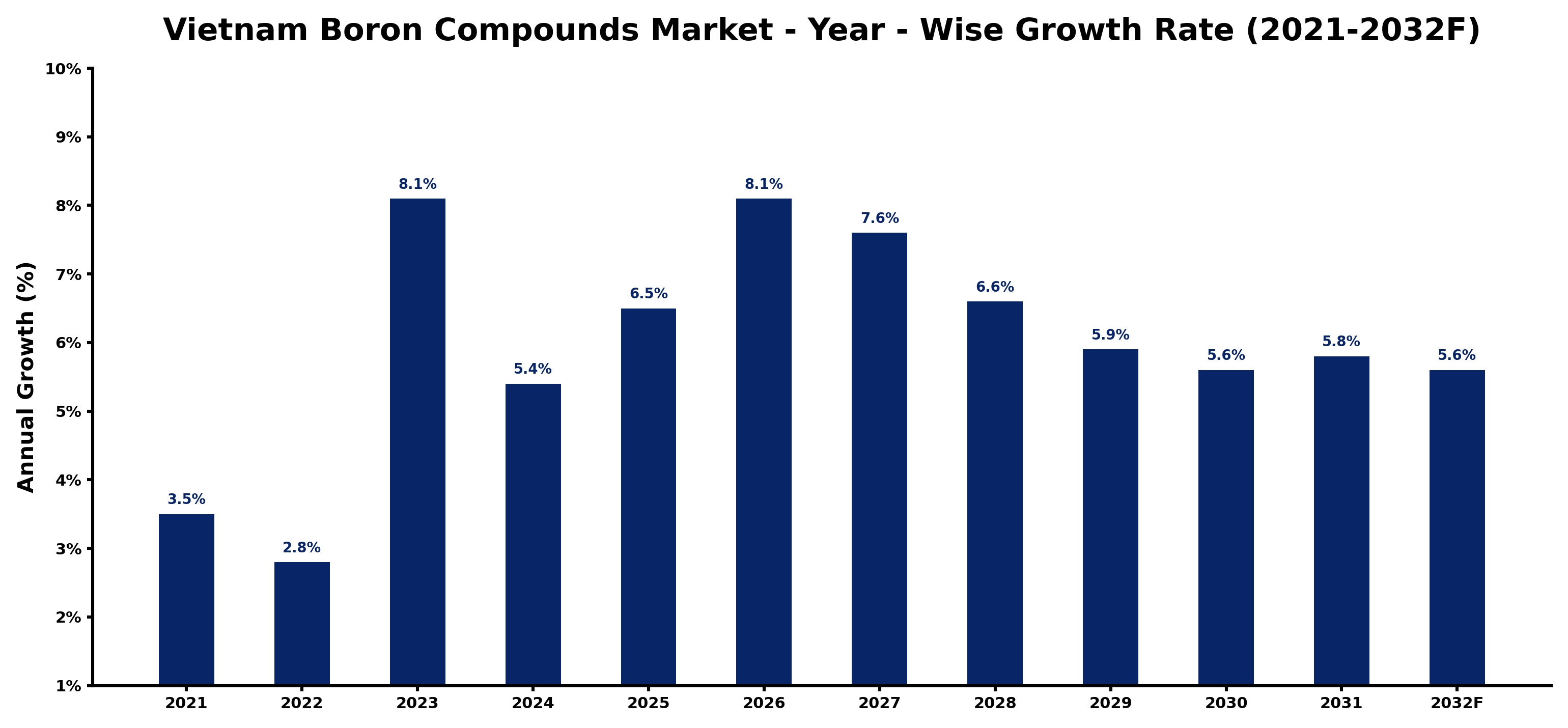
The table below presents the year‑wise growth rates along with the key drivers influencing the market
| Year | Growth Rate | Major Drivers |
| 2021 | 3.5% | Increased agricultural applications growth |
| 2022 | 2.8% | Construction sector demand expansion |
| 2023 | 8.1% | Industrial applications driving consumption |
| 2024 | 5.4% | Technological advancements enhancing production |
| 2025 | 6.5% | Rising demand for glass products |
| 2026 | 8.1% | Growing awareness of health benefits |
| 2027 | 7.6% | Sustainable practices gaining traction |
| 2028 | 6.6% | Emerging markets expanding consumption |
| 2029 | 5.9% | Innovative product development initiatives |
| 2030 | 5.6% | Enhanced distribution networks improving access |
| 2031 | 5.8% | Strategic partnerships boosting market presence |
| 2032 | 5.6% | Regulatory support encouraging investments |
Note - Market size estimations and growth projections presented in this report are based on 6Wresearch’s advanced forecasting approach, validated with industry datasets as of June 2026.
Vietnam Boron Compounds Market Synopsis
The Vietnam Boron Compounds market is experiencing a notable shift as various industries increasingly recognize the value of boron compounds. Their essential role as micronutrients in agriculture and their functionality in glass production underscore the diverse applications driving market interest. As Vietnam's economy grows, so too does the need for more sophisticated materials, including boron compounds, that enhance product quality and agricultural output.
Currently, the market benefits from significant growth in the construction and agriculture sectors, which demand more advanced materials. The dual use of boron compounds as both agricultural micronutrients and industrial stabilizers positions them uniquely within the market, creating a robust demand that appears set to strengthen as Vietnam's industries evolve.
Vietnam Boron Compounds Market Key Takeaways
- The market is projected to experience a steady CAGR of 5.1% from 2026 to 2032.
- Applications in agriculture and glass manufacturing are primary growth drivers.
- Vietnam's modernization initiatives are expected to boost demand for boron compounds.
- Limited domestic production creates challenges related to supply stability.
- Key players in the market are focusing on innovation to meet diverse sector needs.
Evaluation of Restraints in Vietnam Boron Compounds Market
Despite its promising growth trajectory, the Vietnam Boron Compounds market faces notable constraints, particularly the reliance on imported materials. This dependence not only exposes the market to fluctuations in global prices but also makes it vulnerable to supply chain disruptions. Furthermore, the dynamic regulatory landscape surrounding agriculture and manufacturing means that changes in policy can directly impact the demand for boron compounds, further complicating market stability.
Vietnam Boron Compounds Market Trends
Several trends are shaping the Vietnam Boron Compounds market. The move towards sustainable agriculture practices has increased the demand for organic boron compounds as effective micronutrient solutions. Additionally, the rising adoption of advanced glass manufacturing technologies is driving innovations in the formulation of boron compounds, enhancing their effectiveness and efficiency. These trends suggest a shift towards higher quality and sustainability in both agricultural and industrial applications.
Vietnam Boron Compounds Market Opportunities
Growth opportunities abound in the Vietnam Boron Compounds market as various sectors seek more efficient and sustainable solutions. The expanding agricultural sector, particularly with the rise of precision farming, presents a significant avenue for the adoption of boron-based fertilizers. Additionally, as the glass industry continues to innovate, there is an increasing potential for new product development that leverages boron compounds to enhance quality and performance.
Government Initiatives in the Vietnam Boron Compounds Market
The Vietnamese government has been proactive in supporting industrial growth through various initiatives aimed at enhancing agricultural productivity and modernizing construction practices. Policies encouraging research and development in sustainable agricultural practices and infrastructure projects have indirectly fostered a more favorable environment for boron compounds. Moreover, government incentives aimed at boosting domestic production capabilities could also mitigate the current reliance on imports, enhancing market stability.
Future Insights of the Vietnam Boron Compounds Market
Looking ahead to 2026-2032, the Vietnam Boron Compounds market is poised for significant growth driven by advancements in agricultural technologies and manufacturing processes. As sectors align more closely with global sustainability trends, there will be a stronger push for high-quality boron compounds that meet both performance and environmental standards. The interplay of increasing domestic demand and ongoing innovation will likely create a robust market landscape, characterized by greater resilience and adaptability.
Vietnam Boron Compounds Market Latest Developments (May 2025 - June 2026)
Recent developments in the Vietnam Boron Compounds market reflect a shift towards innovation, with several companies exploring new formulations tailored to meet the evolving needs of the agriculture and glass industries. Collaborations between research institutions and industry players have intensified, focusing on sustainable practices and enhanced efficacy of boron products. Furthermore, increased trade partnerships are emerging to mitigate the challenges of supply chain disruptions, reflecting a more resilient approach to market dynamics.
Vietnam Boron Compounds Market - Key Attractiveness of the Report
- 10 Years of Market Numbers
- Historical Data Starting from 2022 to 2025
- Base Year: 2025
- Forecast Data until 2032
- Key Performance Indicators Impacting the Market
- Major Upcoming Developments and Projects
Key Highlights of the Report:
- Vietnam Boron Compounds Market Outlook
- Market Size of Vietnam Boron Compounds Market, 2025
- Forecast of Vietnam Boron Compounds Market, 2032
- Historical Data and Forecast of Vietnam Boron Compounds Revenues & Volume for the Period 2022-2032F
- Vietnam Boron Compounds Market Trend Evolution
- Vietnam Boron Compounds Market Drivers and Challenges
- Vietnam Boron Compounds Price Trends
- Vietnam Boron Compounds Porter's Five Forces
- Vietnam Boron Compounds Industry Life Cycle
- Historical Data and Forecast of Vietnam Boron Compounds Market Revenues & Volume By Type for the Period 2022-2032F
- Historical Data and Forecast of Vietnam Boron Compounds Market Revenues & Volume By Borax for the Period 2022-2032F
- Historical Data and Forecast of Vietnam Boron Compounds Market Revenues & Volume By Boric acid for the Period 2022-2032F
- Historical Data and Forecast of Vietnam Boron Compounds Market Revenues & Volume By Boric oxide for the Period 2022-2032F
- Historical Data and Forecast of Vietnam Boron Compounds Market Revenues & Volume By Sodium perborate for the Period 2022-2032F
- Historical Data and Forecast of Vietnam Boron Compounds Market Revenues & Volume By Application for the Period 2022-2032F
- Historical Data and Forecast of Vietnam Boron Compounds Market Revenues & Volume By Borosilicate glass for the Period 2022-2032F
- Historical Data and Forecast of Vietnam Boron Compounds Market Revenues & Volume By Fiberglass for the Period 2022-2032F
- Historical Data and Forecast of Vietnam Boron Compounds Market Revenues & Volume By Agriculture for the Period 2022-2032F
- Historical Data and Forecast of Vietnam Boron Compounds Market Revenues & Volume By Ceramics for the Period 2022-2032F
- Historical Data and Forecast of Vietnam Boron Compounds Market Revenues & Volume By Detergents & Soaps for the Period 2022-2032F
- Historical Data and Forecast of Vietnam Boron Compounds Market Revenues & Volume By Photography for the Period 2022-2032F
- Historical Data and Forecast of Vietnam Boron Compounds Market Revenues & Volume By Tanning for the Period 2022-2032F
- Historical Data and Forecast of Vietnam Boron Compounds Market Revenues & Volume By Cellulose insulation for the Period 2022-2032F
- Vietnam Boron Compounds Import Export Trade Statistics
- Market Opportunity Assessment By Type
- Market Opportunity Assessment By Application
- Vietnam Boron Compounds Top Companies Market Share
- Vietnam Boron Compounds Competitive Benchmarking By Technical and Operational Parameters
- Vietnam Boron Compounds Company Profiles
- Vietnam Boron Compounds Key Strategic Recommendations






































