Vietnam Borosilicate Glass Market Size, Share & Growth Rate
The Vietnam Borosilicate Glass Market was estimated at USD 277 Million in 2025 and is projected to reach USD 390 Million by 2032, growing at a CAGR of 5.0% from 2026 to 2032. This growth trajectory is largely driven by the burgeoning pharmaceutical and chemical industries, where the demand for high-quality, heat-resistant glass is paramount. Additionally, the rising consumer preference for premium glass products in household applications significantly propels market expansion.
Vietnam Borosilicate Glass Market Year-wise Growth Rate and Key Drivers
This graph highlights how the Vietnam Borosilicate Glass Market has steadily grown over the years, supported by major growth factors.
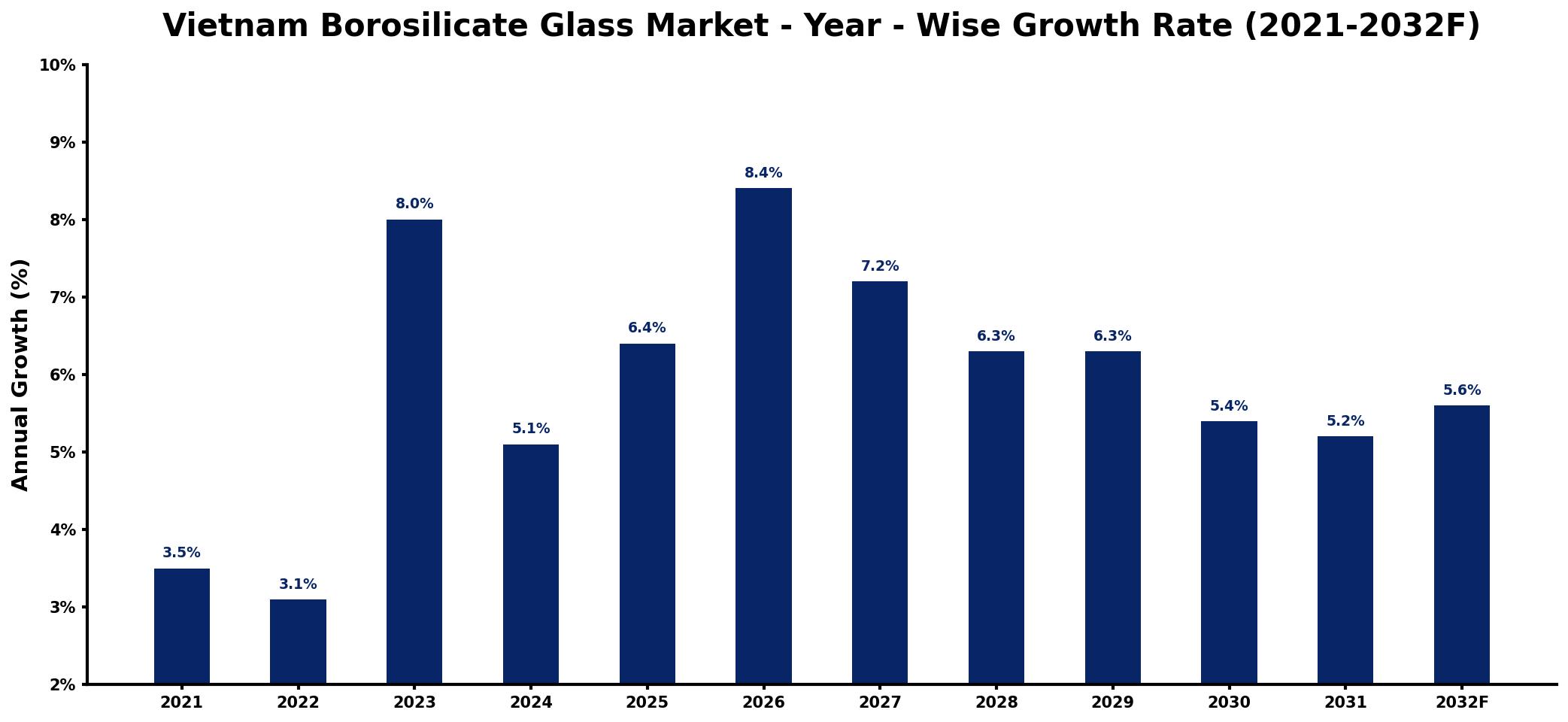
The table below presents the year‑wise growth rates along with the key drivers influencing the market
| Year | Growth Rate | Major Drivers |
| 2021 | 3.5% | Rising demand from laboratories |
| 2022 | 3.1% | Increased investment in research |
| 2023 | 8.0% | Growth in pharmaceutical sector |
| 2024 | 5.1% | Expansion of food packaging industry |
| 2025 | 6.4% | Surge in consumer electronics production |
| 2026 | 8.4% | Advancements in chemical applications |
| 2027 | 7.2% | Growing trend in eco-friendly products |
| 2028 | 6.3% | Increased exports to neighboring countries |
| 2029 | 6.3% | Rising popularity in homeware |
| 2030 | 5.4% | growing emerging market penetration |
| 2031 | 5.2% | Innovations in industrial applications |
| 2032 | 5.6% | enhanced product quality standards |
Note: Market size estimations and growth projections presented in this report are based on 6Wresearch's proprietary forecasting methodology, utilizing the latest available industry data, government publications, and primary research inputs.
Vietnam Borosilicate Glass Market Synopsis
The strongest force shaping the Vietnam borosilicate glass market is the increasing demand from the pharmaceutical sector. As this industry grows, the necessity for specialized glassware that offers exceptional thermal and chemical resistance becomes critical, facilitating a steady rise in borosilicate glass utilization.
Moreover, the market benefits from advancements in manufacturing technologies that enhance the quality and precision of borosilicate products. The intersection of innovation and demand for laboratory equipment further solidifies the position of borosilicate glass in both commercial and domestic applications.
Vietnam Borosilicate Glass Market Key Takeaways
- Rising demand from the pharmaceutical and chemical sectors is driving significant market growth.
- Exceptional thermal and chemical properties make borosilicate glass essential in laboratory environments.
- The resurgence of economic activities post-COVID-19 is aiding the recovery of the market.
- Increased household consumption of premium glass products is further boosting market potential.
- Advancements in manufacturing technology are enhancing product quality and precision.
Evaluation of Restraints in Vietnam Borosilicate Glass Market
Despite the positive market outlook, several restraints impact the Vietnam borosilicate glass sector. A primary challenge lies in meeting stringent quality standards required for laboratory and scientific applications, which demand precise manufacturing processes. Furthermore, the market's specialized nature may limit widespread demand, creating barriers for new entrants and reducing competitive dynamics. As manufacturers strive to maintain quality while scaling production, navigating these challenges will be crucial for sustainable growth.
Vietnam Borosilicate Glass Market Trends
Current trends in the Vietnam borosilicate glass market include a growing emphasis on sustainable manufacturing practices, driven by global environmental concerns. Additionally, there is a notable shift toward the use of borosilicate glass in renewable energy applications, such as solar panels. This aligns with the countrys focus on green energy initiatives. Furthermore, advancements in smart glass technologies are anticipated to gain traction, promoting innovative applications across various sectors.
Vietnam Borosilicate Glass Market Opportunities
Genuine growth opportunities in the Vietnam borosilicate glass market can be found in the expansion of laboratory and pharmaceutical facilities. As these industries continue to develop, the need for specialized glassware is expected to increase. Moreover, the rising interest in eco-friendly household products provides a niche for manufacturers to introduce innovative and premium borosilicate glass items. Investment in research and development to create high-tech applications also presents lucrative avenues for growth.
Government Initiatives in the Vietnam Borosilicate Glass Market
The Vietnamese government has been actively supporting industrial development through various policies aimed at enhancing the manufacturing sector. Initiatives focused on boosting the pharmaceutical and chemical industries indirectly benefit the borosilicate glass market by fostering an environment that encourages the use of high-quality materials. Additionally, public spending on research and development within these sectors is likely to spur demand for specialized glass products.
Future Insights of the Vietnam Borosilicate Glass Market
Looking ahead to the 2026-2032 period, the Vietnam borosilicate glass market is poised for robust growth fueled by continuous innovations in technology and increasing industrial applications. The ongoing expansion in pharmaceuticals and the rise of premium consumer products are expected to sustain this momentum. Furthermore, the ongoing emphasis on sustainability will drive manufacturers to explore eco-friendly alternatives, positioning borosilicate glass as a leading material for the future.
Vietnam Borosilicate Glass Market Latest Developments (2025 - 2026)
Recent developments in the Vietnam borosilicate glass market reveal a trend toward technological advancements and increased product diversity. Key players are focusing on the integration of innovative designs and sustainable manufacturing practices. The market is witnessing a shift with the introduction of new applications in the renewable energy sector, indicating a broadening of use cases for borosilicate glass. Additionally, collaborations between manufacturers and research institutions are expected to enhance product quality and open new avenues for growth.
Vietnam Borosilicate Glass Market - Key Attractiveness of the Report
- 10 Years of Market Numbers
- Historical Data Starting from 2022 to 2025
- Base Year: 2025
- Forecast Data until 2032
- Key Performance Indicators Impacting the Market
- Major Upcoming Developments and Projects
Key Highlights of the Report:
- Vietnam Borosilicate Glass Market Outlook
- Market Size of Vietnam Borosilicate Glass Market, 2025
- Forecast of Vietnam Borosilicate Glass Market, 2032
- Historical Data and Forecast of Vietnam Borosilicate Glass Revenues & Volume for the Period 2022-2032F
- Vietnam Borosilicate Glass Market Trend Evolution
- Vietnam Borosilicate Glass Market Drivers and Challenges
- Vietnam Borosilicate Glass Price Trends
- Vietnam Borosilicate Glass Porter's Five Forces
- Vietnam Borosilicate Glass Industry Life Cycle
- Historical Data and Forecast of Vietnam Borosilicate Glass Market Revenues & Volume By Type for the Period 2022-2032F
- Historical Data and Forecast of Vietnam Borosilicate Glass Market Revenues & Volume By High Borosilicate Glass for the Period 2022-2032F
- Historical Data and Forecast of Vietnam Borosilicate Glass Market Revenues & Volume By Medium Borosilicate Glass for the Period 2022-2032F
- Historical Data and Forecast of Vietnam Borosilicate Glass Market Revenues & Volume By Application for the Period 2022-2032F
- Historical Data and Forecast of Vietnam Borosilicate Glass Market Revenues & Volume By Solar Energy Tubes for the Period 2022-2032F
- Historical Data and Forecast of Vietnam Borosilicate Glass Market Revenues & Volume By Heat Glassware for the Period 2022-2032F
- Historical Data and Forecast of Vietnam Borosilicate Glass Market Revenues & Volume By Laboratory Glassware for the Period 2022-2032F
- Historical Data and Forecast of Vietnam Borosilicate Glass Market Revenues & Volume By Pharmaceutical Packaging for the Period 2022-2032F
- Historical Data and Forecast of Vietnam Borosilicate Glass Market Revenues & Volume By Chemical Tubes for the Period 2022-2032F
- Historical Data and Forecast of Vietnam Borosilicate Glass Market Revenues & Volume By Others for the Period 2022-2032F
- Vietnam Borosilicate Glass Import Export Trade Statistics
- Market Opportunity Assessment By Type
- Market Opportunity Assessment By Application
- Vietnam Borosilicate Glass Top Companies Market Share
- Vietnam Borosilicate Glass Competitive Benchmarking By Technical and Operational Parameters
- Vietnam Borosilicate Glass Company Profiles
- Vietnam Borosilicate Glass Key Strategic Recommendations






































