Vietnam Bottle Filling Machine Market Size, Share & Growth Rate
The Vietnam Bottle Filling Machine Market was estimated at USD 245 Million in 2025 and is projected to reach USD 347 Million by 2032, growing at a CAGR of 5.1% from 2026 to 2032. This growth is primarily fueled by the booming beverage sector, which encompasses bottled water, soft drinks, and alcoholic beverages. As consumer preferences shift toward convenience and packaged drinks, manufacturers are increasingly investing in advanced filling technologies to enhance production efficiency and maintain product quality.
Vietnam Bottle Filling Machine Market Year-wise Growth Rate and Key Drivers
This graph highlights how the Vietnam Bottle Filling Machine Market has steadily grown over the years, supported by major growth factors.
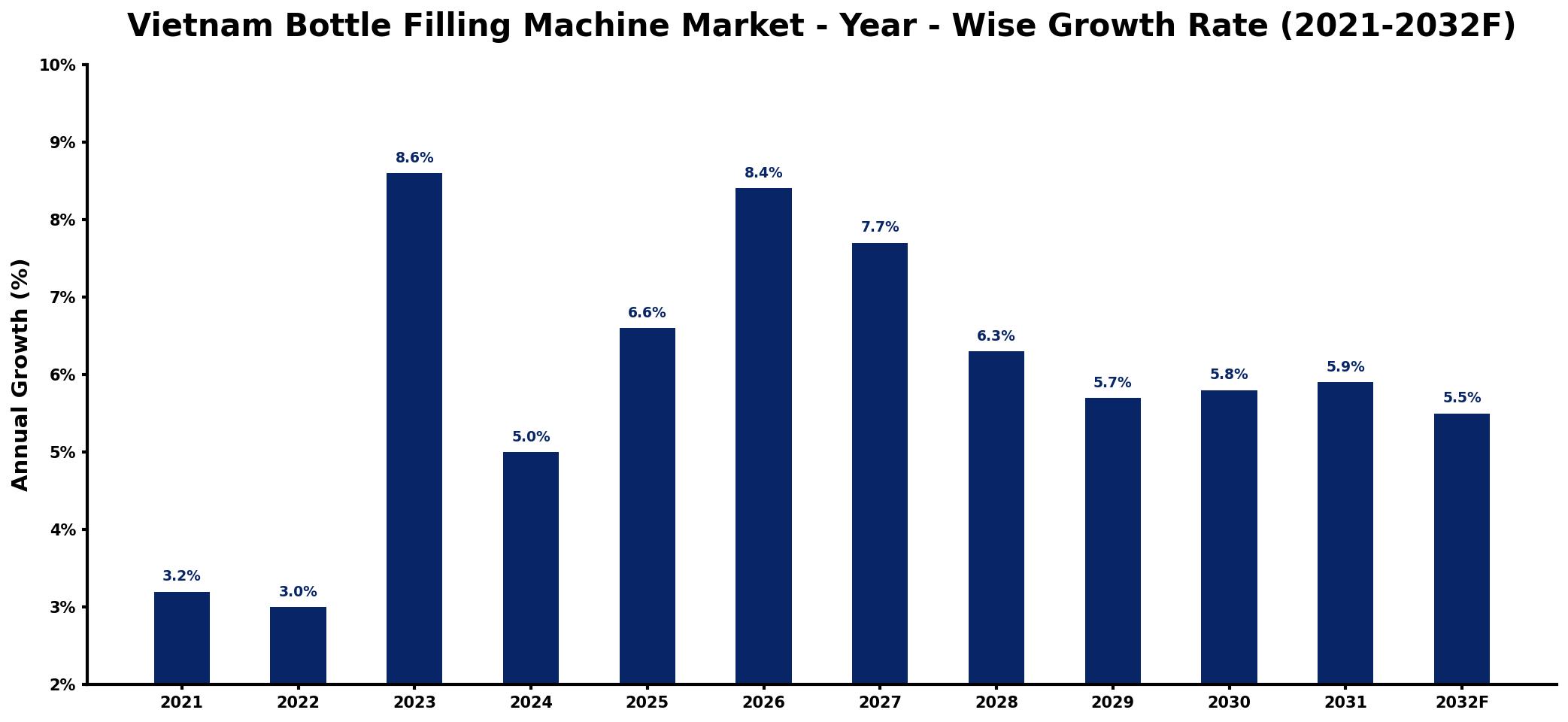
The table below presents the year‑wise growth rates along with the key drivers influencing the market
| Year | Growth Rate | Major Drivers |
| 2021 | 3.2% | Rising consumer beverage demand |
| 2022 | 3.0% | Increased investment in automation |
| 2023 | 8.6% | Expansion of production capabilities |
| 2024 | 5.0% | Growing demand for sustainable packaging |
| 2025 | 6.6% | Emergence of new beverage categories |
| 2026 | 8.4% | Technological advancements in production |
| 2027 | 7.7% | Strengthening supply chain networks |
| 2028 | 6.3% | Growth of e-commerce distribution channels |
| 2029 | 5.7% | Increased focus on operational efficiency |
| 2030 | 5.8% | Rising health-conscious consumer trends |
| 2031 | 5.9% | increased production capacity utilization |
| 2032 | 5.5% | Investment in innovative production techniques |
Note: Market size estimations and growth projections presented in this report are based on 6Wresearch's proprietary forecasting methodology, utilizing the latest available industry data, government publications, and primary research inputs.
Vietnam Bottle Filling Machine Market Synopsis
The Vietnam bottle filling machine market has entered a dynamic phase characterized by rising demand for automated solutions. As production capacities expand to meet the growing consumption of bottled beverages, these machines have become indispensable in ensuring efficiency and precision in filling operations.
In Vietnam, both local manufacturers and international suppliers are vying for a stake in this competitive landscape. The focus is on offering tailored solutions that align with the specific needs of Vietnamese producers, who are keen on optimizing their operations amid evolving consumer expectations.
Vietnam Bottle Filling Machine Market Key Takeaways
- The market is projected to achieve a substantial growth trajectory driven by the expanding beverage industry.
- Technological advancements are enhancing the efficiency and accuracy of filling machines.
- Local manufacturers are increasingly competing with international brands by offering customized solutions.
- Consumer trends favor packaged beverages, necessitating advancements in filling technology.
- Regulatory requirements are driving the need for machines that ensure food safety and sustainability.
Evaluation of Restraints in Vietnam Bottle Filling Machine Market
Despite its growth potential, the Vietnam bottle filling machine market faces several restraints that may impede progress. The rapid pace of technological innovation necessitates constant upgrades and adaptations by manufacturers. Furthermore, evolving consumer preferences, particularly towards health and eco-friendliness, require filling machines that accommodate organic products and diverse container sizes. The challenge of ensuring compliance with stringent food safety regulations also places pressure on manufacturers to deliver high-quality solutions without compromising efficiency.
Vietnam Bottle Filling Machine Market Trends
Currently, a significant trend in the Vietnam bottle filling machine market is the increasing automation of filling processes. Advanced technologies, including AI and IoT, are being integrated into filling machines to enhance operational efficiency and reduce human error. Additionally, as sustainability becomes a key concern, there is a growing shift towards machines designed to minimize waste and energy consumption, aligning with the broader global movement towards environmentally friendly practices.
Vietnam Bottle Filling Machine Market Opportunities
The Vietnam bottle filling machine market presents numerous growth and investment opportunities. Manufacturers can capitalize on the rising demand for specialty beverages, including health-oriented and organic products, by developing versatile machines capable of accommodating varied filling requirements. Additionally, the potential for expanding into rural markets, where access to packaged goods is increasing, offers a fertile ground for growth in both the beverage and bottle filling sectors.
Government Initiatives in the Vietnam Bottle Filling Machine Market
The Vietnamese government has been proactive in supporting the beverage and manufacturing sectors through various initiatives. Policies aimed at enhancing industrial productivity and encouraging investment in modern technology are prominent. Furthermore, government programs that promote sustainability in production practices are increasingly influential, creating a conducive environment for manufacturers of bottle filling machines to adopt eco-friendly technologies and meet new regulatory standards.
Future Insights of the Vietnam Bottle Filling Machine Market
Looking ahead to 2026-2032, the Vietnam bottle filling machine market is poised for robust growth. As consumer demand continues to evolve, manufacturers will need to innovate and adapt to stay competitive. The emphasis on automation, efficiency, and sustainable practices will likely shape the market landscape. Additionally, as the beverage sector diversifies, filling machines that can handle a variety of product types and sizes will become increasingly vital.
Vietnam Bottle Filling Machine Market Latest Developments (2025 - 2026)
In recent months, the bottle filling machine market in Vietnam has experienced notable advancements, particularly in automation and technology integration. Manufacturers are focusing on enhancing the capabilities of filling machines to accommodate a wider array of beverage types. Additionally, industry players are exploring partnerships and collaborations to leverage new technologies that improve efficiency and reduce production costs. Such developments are setting the stage for a more competitive landscape in the coming years.
Vietnam Bottle Filling Machine Market - Key Attractiveness of the Report
- 10 Years of Market Numbers
- Historical Data Starting from 2022 to 2025
- Base Year: 2025
- Forecast Data until 2032
- Key Performance Indicators Impacting the Market
- Major Upcoming Developments and Projects
Key Highlights of the Report:
- Vietnam Bottle Filling Machine Market Outlook
- Market Size of Vietnam Bottle Filling Machine Market, 2025
- Forecast of Vietnam Bottle Filling Machine Market, 2032
- Historical Data and Forecast of Vietnam Bottle Filling Machine Revenues & Volume for the Period 2022-2032F
- Vietnam Bottle Filling Machine Market Trend Evolution
- Vietnam Bottle Filling Machine Market Drivers and Challenges
- Vietnam Bottle Filling Machine Price Trends
- Vietnam Bottle Filling Machine Porter's Five Forces
- Vietnam Bottle Filling Machine Industry Life Cycle
- Historical Data and Forecast of Vietnam Bottle Filling Machine Market Revenues & Volume By Bottle Type for the Period 2022-2032F
- Historical Data and Forecast of Vietnam Bottle Filling Machine Market Revenues & Volume By PET Bottles for the Period 2022-2032F
- Historical Data and Forecast of Vietnam Bottle Filling Machine Market Revenues & Volume By Glass Bottles for the Period 2022-2032F
- Historical Data and Forecast of Vietnam Bottle Filling Machine Market Revenues & Volume By Others for the Period 2022-2032F
- Historical Data and Forecast of Vietnam Bottle Filling Machine Market Revenues & Volume By Application for the Period 2022-2032F
- Historical Data and Forecast of Vietnam Bottle Filling Machine Market Revenues & Volume By Food Products for the Period 2022-2032F
- Historical Data and Forecast of Vietnam Bottle Filling Machine Market Revenues & Volume By Beverages for the Period 2022-2032F
- Historical Data and Forecast of Vietnam Bottle Filling Machine Market Revenues & Volume By Chemicals & Pharmaceuticals for the Period 2022-2032F
- Historical Data and Forecast of Vietnam Bottle Filling Machine Market Revenues & Volume By Cosmetics for the Period 2022-2032F
- Vietnam Bottle Filling Machine Import Export Trade Statistics
- Market Opportunity Assessment By Bottle Type
- Market Opportunity Assessment By Application
- Vietnam Bottle Filling Machine Top Companies Market Share
- Vietnam Bottle Filling Machine Competitive Benchmarking By Technical and Operational Parameters
- Vietnam Bottle Filling Machine Company Profiles
- Vietnam Bottle Filling Machine Key Strategic Recommendations






































