Vietnam Bulletproof Glass Market Size, Share & Growth Rate
The Vietnam Bulletproof Glass Market was estimated at USD 921 Million in 2025 and is projected to reach USD 1307 Million by 2032, growing at a CAGR of 5.1% from 2026 to 2032. This growth trajectory is primarily driven by increasing security concerns and escalating investments from both government and private sectors in protective solutions against ballistic threats. As urbanization rises and infrastructure demands grow, the market is expected to thrive, particularly in high-security facilities and vehicles.
Vietnam Bulletproof Glass Market Year-wise Growth Rate and Key Drivers
This graph highlights how the Vietnam Bulletproof Glass Market has steadily grown over the years, supported by major growth factors.
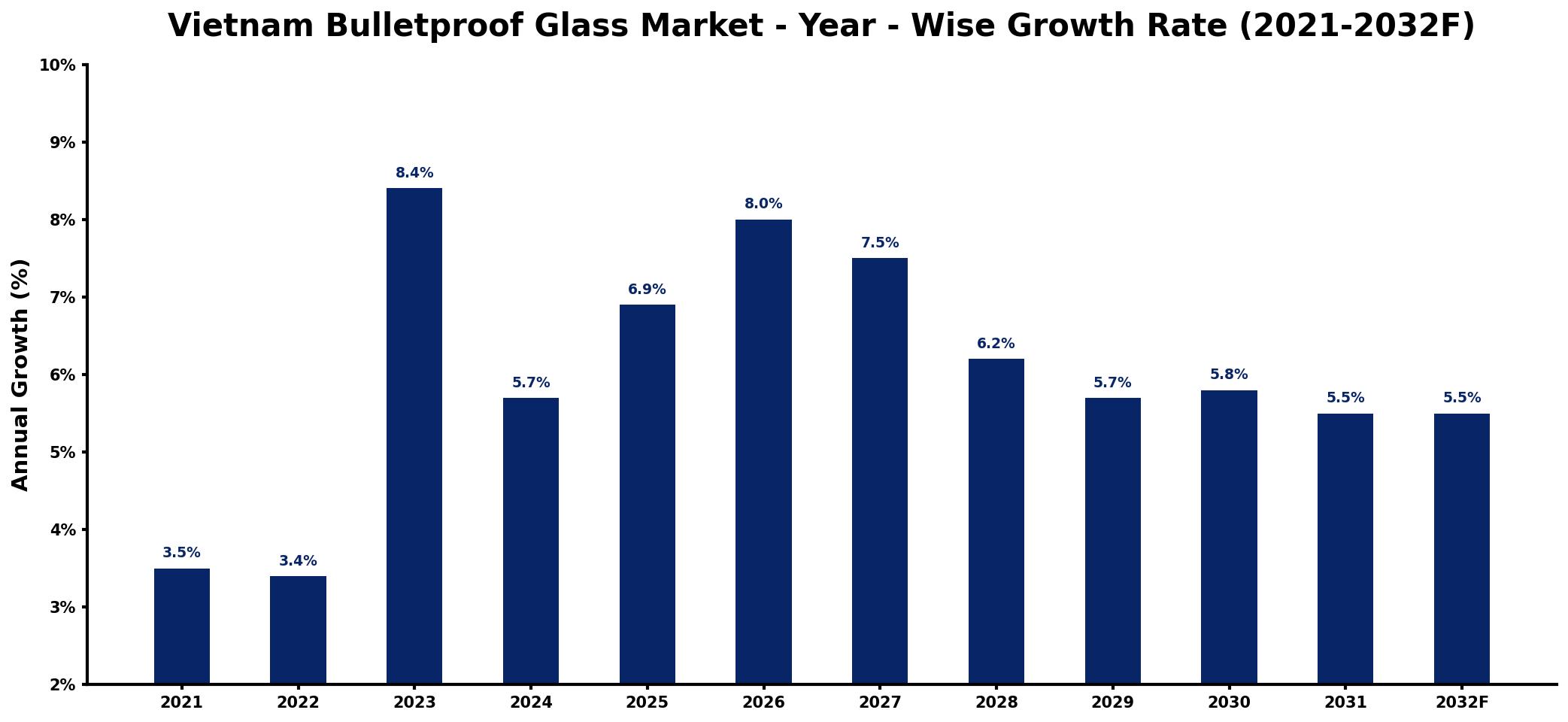
The table below presents the year‑wise growth rates along with the key drivers influencing the market
| Year | Growth Rate | Major Drivers |
| 2021 | 3.5% | Rising security concerns driving demand |
| 2022 | 3.4% | Increased investment in safety measures |
| 2023 | 8.4% | Growing urbanization boosting infrastructure projects |
| 2024 | 5.7% | Expansion of automotive safety regulations |
| 2025 | 6.9% | Surge in construction sector investments |
| 2026 | 8.0% | Heightened awareness of personal safety |
| 2027 | 7.5% | Development of advanced security technologies |
| 2028 | 6.2% | Increased demand from public transport |
| 2029 | 5.7% | Growth in luxury vehicle market |
| 2030 | 5.8% | Rising threats driving protective solutions |
| 2031 | 5.5% | Evolving building codes enhancing requirements |
| 2032 | 5.5% | Strengthened regulations on safety standards |
Note: Market size estimations and growth projections presented in this report are based on 6Wresearch's proprietary forecasting methodology, utilizing the latest available industry data, government publications, and primary research inputs.
Vietnam Bulletproof Glass Market Synopsis
The most significant force shaping the Vietnam Bulletproof Glass Market today is the growing demand for advanced security measures across various sectors. With rising threats from crime and terrorism, businesses and government agencies alike are prioritizing the installation of ballistic-resistant glass in their facilities to ensure safety and security.
Additionally, the defense sector's continual evolution and the need for upgraded protective technologies are pivotal in driving market growth. The strategic focus on enhancing the durability and performance of bulletproof glass aligns well with the increasing investments from law enforcement and military organizations, further solidifying this market's relevance.
Vietnam Bulletproof Glass Market Key Takeaways
- The market is poised for substantial growth, driven by heightened security awareness and defense sector demands.
- Technological advancements are crucial for improving bulletproof glass performance and durability.
- Government investments in security infrastructure are significant growth catalysts.
- Export opportunities are being explored as local manufacturers adapt to global standards.
- The trend toward urbanization is creating an increased need for security solutions in high-risk areas.
Evaluation of Restraints in Vietnam Bulletproof Glass Market
Despite the promising outlook for the Vietnam Bulletproof Glass Market, certain constraints limit its full potential. Chief among these is the competitive landscape that features a mix of local and international players. These companies often engage in price wars, which can affect profitability. Moreover, the need for sustainable manufacturing practices is becoming increasingly vital, as consumers and regulatory bodies seek environmentally responsible solutions. Adapting to these expectations without compromising quality is a challenge that market participants must navigate carefully.
Vietnam Bulletproof Glass Market Trends
Key trends shaping the Vietnam Bulletproof Glass Market include the integration of smart technology into glass products, which enhances safety features. Another emerging trend is the customization of bulletproof glass for specific applications, from financial institutions to military vehicles. Additionally, the rise of green building practices is influencing manufacturers to adopt eco-friendly materials and processes, addressing both environmental concerns and customer preferences.
Vietnam Bulletproof Glass Market Opportunities
There are significant growth opportunities within the Vietnam Bulletproof Glass Market, particularly in government projects aimed at upgrading infrastructure. Investments in high-security installations for banks, airports, and embassies are increasing. Moreover, as international trade develops, Vietnamese manufacturers could tap into export markets, expanding their reach and bolstering production capacities. Collaborative ventures with global firms can also facilitate technology transfer and innovation.
Government Initiatives in the Vietnam Bulletproof Glass Market
The Vietnamese government is actively promoting initiatives aimed at enhancing national security through improved infrastructure. This includes increasing public spending on defense and security technologies, which directly impacts the demand for bulletproof glass. Programs that support local manufacturers in research and development of advanced materials are also in place, facilitating innovation and boosting domestic production capabilities.
Future Insights of the Vietnam Bulletproof Glass Market
Looking ahead to 2026-2032, the Vietnam Bulletproof Glass Market is set to evolve, driven by continual technological advancements and heightened security demands. As urban areas expand and security concerns intensify, the need for robust protective solutions will only increase. Moreover, as government support strengthens and private sector investment ramps up, the market is likely to see innovations that further enhance the effectiveness and applications of bulletproof glass.
Vietnam Bulletproof Glass Market Latest Developments (2025 - 2026)
Recent industry developments indicate a shift toward greater customization and the integration of smart technology in bulletproof glass products. Manufacturers are increasingly focusing on meeting specific client needs, especially in high-security applications. As the market progresses, collaborations with technology firms are becoming more prevalent, leading to enhanced product offerings and improved security features tailored to various sectors.
Vietnam Bulletproof Glass Market - Key Attractiveness of the Report
- 10 Years of Market Numbers
- Historical Data Starting from 2022 to 2025
- Base Year: 2025
- Forecast Data until 2032
- Key Performance Indicators Impacting the Market
- Major Upcoming Developments and Projects
Key Highlights of the Report:
- Vietnam Bulletproof Glass Market Outlook
- Market Size of Vietnam Bulletproof Glass Market, 2025
- Forecast of Vietnam Bulletproof Glass Market, 2032
- Historical Data and Forecast of Vietnam Bulletproof Glass Revenues & Volume for the Period 2022-2032F
- Vietnam Bulletproof Glass Market Trend Evolution
- Vietnam Bulletproof Glass Market Drivers and Challenges
- Vietnam Bulletproof Glass Price Trends
- Vietnam Bulletproof Glass Porter's Five Forces
- Vietnam Bulletproof Glass Industry Life Cycle
- Historical Data and Forecast of Vietnam Bulletproof Glass Market Revenues & Volume By Type for the Period 2022-2032F
- Historical Data and Forecast of Vietnam Bulletproof Glass Market Revenues & Volume By Solid Acrylic for the Period 2022-2032F
- Historical Data and Forecast of Vietnam Bulletproof Glass Market Revenues & Volume By Traditional Laminated for the Period 2022-2032F
- Historical Data and Forecast of Vietnam Bulletproof Glass Market Revenues & Volume By Polycarbonate for the Period 2022-2032F
- Historical Data and Forecast of Vietnam Bulletproof Glass Market Revenues & Volume By Glass-clad Polycarbonate for the Period 2022-2032F
- Historical Data and Forecast of Vietnam Bulletproof Glass Market Revenues & Volume By Other Types for the Period 2022-2032F
- Historical Data and Forecast of Vietnam Bulletproof Glass Market Revenues & Volume By End-user Industry for the Period 2022-2032F
- Historical Data and Forecast of Vietnam Bulletproof Glass Market Revenues & Volume By Automotive for the Period 2022-2032F
- Historical Data and Forecast of Vietnam Bulletproof Glass Market Revenues & Volume By Buildings and Construction for the Period 2022-2032F
- Historical Data and Forecast of Vietnam Bulletproof Glass Market Revenues & Volume By Defense for the Period 2022-2032F
- Historical Data and Forecast of Vietnam Bulletproof Glass Market Revenues & Volume By Other End-user Industries for the Period 2022-2032F
- Vietnam Bulletproof Glass Import Export Trade Statistics
- Market Opportunity Assessment By Type
- Market Opportunity Assessment By End-user Industry
- Vietnam Bulletproof Glass Top Companies Market Share
- Vietnam Bulletproof Glass Competitive Benchmarking By Technical and Operational Parameters
- Vietnam Bulletproof Glass Company Profiles
- Vietnam Bulletproof Glass Key Strategic Recommendations






































