Vietnam Car Air Fresheners Market Size, Share & Growth Rate
The Vietnam Car Air Fresheners Market was estimated at USD 1465 Million in 2025 and is projected to reach USD 2380 Million by 2032, growing at a CAGR of 7.2% from 2026 to 2032. This robust growth trajectory is primarily driven by an expanding automotive sector and a growing consumer emphasis on interior aesthetics and comfort. As car ownership rises, so does the demand for products that enhance the driving experience, including innovative air fresheners designed to eliminate odors and create a pleasant ambiance.
Vietnam Car Air Fresheners Market Year-wise Growth Rate and Key Drivers
This graph highlights how the Vietnam Car Air Fresheners Market has steadily grown over the years, supported by major growth factors.
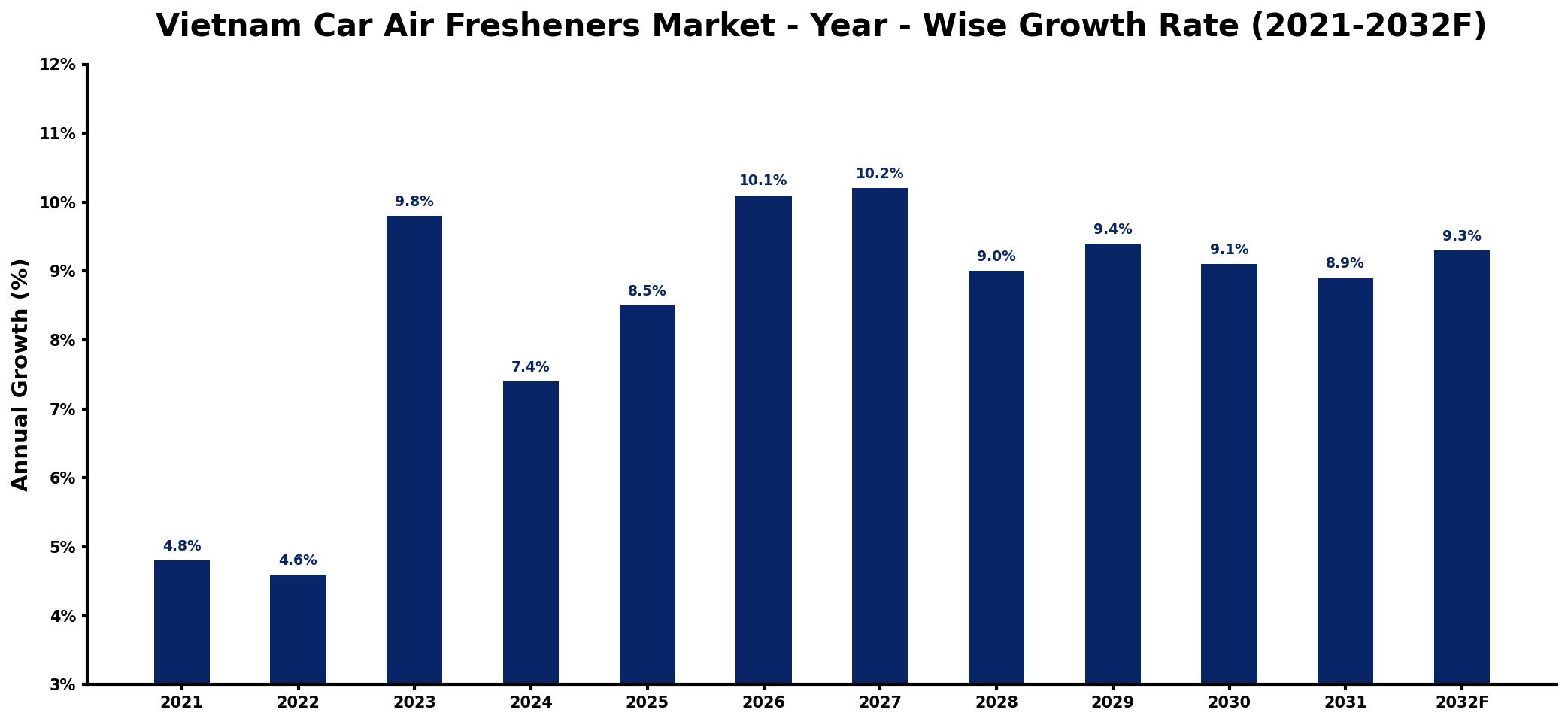
The table below presents the year‑wise growth rates along with the key drivers influencing the market
| Year | Growth Rate | Major Drivers |
| 2021 | 4.8% | Rising disposable income levels |
| 2022 | 4.6% | Increased consumer awareness trends |
| 2023 | 9.8% | Growing urbanization and mobility |
| 2024 | 7.4% | Expansion of retail distribution channels |
| 2025 | 8.5% | Surge in online shopping preferences |
| 2026 | 10.1% | Introduction of innovative fragrances |
| 2027 | 10.2% | Higher demand for premium products |
| 2028 | 9.0% | Increased tourism and travel activities |
| 2029 | 9.4% | Rising environmental consciousness among consumers |
| 2030 | 9.1% | Strong marketing and advertising campaigns |
| 2031 | 8.9% | Growth in automotive sector demand |
| 2032 | 9.3% | Development of sustainable product options |
Note: Market size estimations and growth projections presented in this report are based on 6Wresearch's proprietary forecasting methodology, utilizing the latest available industry data, government publications, and primary research inputs.
Vietnam Car Air Fresheners Market Synopsis
The Vietnamese car air fresheners market is thriving amid the nations rapidly growing automotive industry. Car owners are becoming increasingly aware of the importance of maintaining a fresh and inviting interior environment, leading to a surge in the demand for a diverse range of air freshener products.
From traditional hanging scents to advanced technological solutions that ensure long-lasting freshness, the market is adapting to meet changing consumer preferences. With a focus on hygiene and comfort, the market is on an optimistic growth path, reflecting broader trends in automotive care.
Vietnam Car Air Fresheners Market Key Takeaways
- Vietnam's automotive expansion is a primary driver of demand for car air fresheners.
- Innovative, sustainable product offerings are gaining traction among environmentally-conscious consumers.
- Distribution channels face intense competition, requiring brands to optimize shelf placement and visibility.
- The post-COVID recovery has led to renewed interest in health-oriented fragrance options.
- Key market players are focusing on research and development to cater to evolving consumer expectations.
Evaluation of Restraints in Vietnam Car Air Fresheners Market
Despite the promising growth outlook, the Vietnam car air fresheners market faces several constraints. Environmental concerns regarding traditional air fresheners have prompted a shift towards sustainable options, creating a challenge for established brands to innovate while meeting these new demands. Additionally, intense competition among numerous brands complicates distribution strategies, as companies must ensure compliance with safety and labeling regulations to maintain market access. This landscape requires ongoing adaptability and commitment to sustainability from market participants.
Vietnam Car Air Fresheners Market Trends
Current trends in the Vietnam car air fresheners market reflect a significant shift towards organic and non-toxic products as consumers prioritize health and wellness. Additionally, the advent of smart air fresheners equipped with technology that allows for customizable scent diffusion is gaining traction. As more drivers engage with their vehicles as personal spaces, the demand for unique and long-lasting fragrances that cater to individual preferences is increasing. Furthermore, the rise of e-commerce platforms is revolutionizing distribution channels, offering consumers greater access to a variety of product options.
Vietnam Car Air Fresheners Market Opportunities
Opportunities for growth in the Vietnam car air fresheners market lie in the development of eco-friendly products and innovative scent delivery systems. There is significant potential in targeting younger consumers who are increasingly seeking personalized experiences and sustainable options. Additionally, partnerships with automotive manufacturers for integrated scent solutions could create new avenues for growth. With ongoing urbanization and rising disposable incomes, the market is ripe for brands willing to invest in product innovation and consumer education.
Government Initiatives in the Vietnam Car Air Fresheners Market
The Vietnamese government has been actively promoting policies aimed at improving environmental sustainability, which directly impacts the car air fresheners market. Initiatives encouraging the use of eco-friendly materials and products are fostering a shift towards greener alternatives. Public spending on automotive infrastructure and mobility improvements also supports the growing automotive sector, indirectly benefiting related markets, including car air fresheners. Such governmental efforts are aligning with consumer trends towards health and environmental consciousness.
Future Insights of the Vietnam Car Air Fresheners Market
Looking ahead to 2026-2032, the Vietnam car air fresheners market is poised for significant evolution. As consumers increasingly recognize the importance of interior car hygiene, the demand for innovative and sustainable air freshening solutions will likely grow. Technological advancements will continue to shape the market, with smart air fresheners that offer customizable options becoming a staple. Furthermore, the anticipated increase in automotive sales and a greater focus on customer comfort will propel market expansion, making this an exciting period for investors and stakeholders alike.
Vietnam Car Air Fresheners Market Latest Developments (2025 - 2026)
Recent developments in the Vietnam car air fresheners market have showcased a trend towards diversification and innovation. Companies are launching new product lines featuring natural and organic ingredients in response to shifting consumer preferences. Additionally, strategic partnerships are emerging, focusing on integrating scent solutions into automotive manufacturing processes. This period has seen an increased emphasis on online sales channels, as brands adapt to changing consumer behavior post-pandemic.
Vietnam Car Air Fresheners Market - Key Attractiveness of the Report
- 10 Years of Market Numbers
- Historical Data Starting from 2022 to 2025
- Base Year: 2025
- Forecast Data until 2032
- Key Performance Indicators Impacting the Market
- Major Upcoming Developments and Projects
Key Highlights of the Report:
- Vietnam Car Air Fresheners Market Outlook
- Market Size of Vietnam Car Air Fresheners Market, 2025
- Forecast of Vietnam Car Air Fresheners Market, 2032
- Historical Data and Forecast of Vietnam Car Air Fresheners Revenues & Volume for the Period 2022-2032F
- Vietnam Car Air Fresheners Market Trend Evolution
- Vietnam Car Air Fresheners Market Drivers and Challenges
- Vietnam Car Air Fresheners Price Trends
- Vietnam Car Air Fresheners Porter's Five Forces
- Vietnam Car Air Fresheners Industry Life Cycle
- Historical Data and Forecast of Vietnam Car Air Fresheners Market Revenues & Volume By Product for the Period 2022-2032F
- Historical Data and Forecast of Vietnam Car Air Fresheners Market Revenues & Volume By Gel & Cans for the Period 2022-2032F
- Historical Data and Forecast of Vietnam Car Air Fresheners Market Revenues & Volume By Spray/Aerosol for the Period 2022-2032F
- Historical Data and Forecast of Vietnam Car Air Fresheners Market Revenues & Volume By Paper Car Air Fresheners for the Period 2022-2032F
- Historical Data and Forecast of Vietnam Car Air Fresheners Market Revenues & Volume By Vents & Clips for the Period 2022-2032F
- Historical Data and Forecast of Vietnam Car Air Fresheners Market Revenues & Volume By End-User for the Period 2022-2032F
- Historical Data and Forecast of Vietnam Car Air Fresheners Market Revenues & Volume By Sports Car for the Period 2022-2032F
- Historical Data and Forecast of Vietnam Car Air Fresheners Market Revenues & Volume By Mid-range Car for the Period 2022-2032F
- Historical Data and Forecast of Vietnam Car Air Fresheners Market Revenues & Volume By SUV for the Period 2022-2032F
- Historical Data and Forecast of Vietnam Car Air Fresheners Market Revenues & Volume By Others for the Period 2022-2032F
- Historical Data and Forecast of Vietnam Car Air Fresheners Market Revenues & Volume By Fragrance for the Period 2022-2032F
- Historical Data and Forecast of Vietnam Car Air Fresheners Market Revenues & Volume By Scented for the Period 2022-2032F
- Historical Data and Forecast of Vietnam Car Air Fresheners Market Revenues & Volume By UnScented for the Period 2022-2032F
- Vietnam Car Air Fresheners Import Export Trade Statistics
- Market Opportunity Assessment By Product
- Market Opportunity Assessment By End-User
- Market Opportunity Assessment By Fragrance
- Vietnam Car Air Fresheners Top Companies Market Share
- Vietnam Car Air Fresheners Competitive Benchmarking By Technical and Operational Parameters
- Vietnam Car Air Fresheners Company Profiles
- Vietnam Car Air Fresheners Key Strategic Recommendations






































