Vietnam Car Clock Market Size, Share & Growth Rate
The Vietnam Car Clock Market was estimated at USD 383 Million in 2025 and is projected to reach USD 542 Million by 2032, growing at a CAGR of 5.1% from 2026 to 2032. This growth trajectory is driven primarily by the expanding automotive sector and a rising consumer interest in enhancing vehicle interiors with stylish yet functional accessories. As more Vietnamese citizens embrace car ownership, the demand for high-quality car clocks that integrate advanced features is expected to intensify.
Vietnam Car Clock Market Year-wise Growth Rate and Key Drivers
This graph highlights how the Vietnam Car Clock Market has steadily grown over the years, supported by major growth factors.
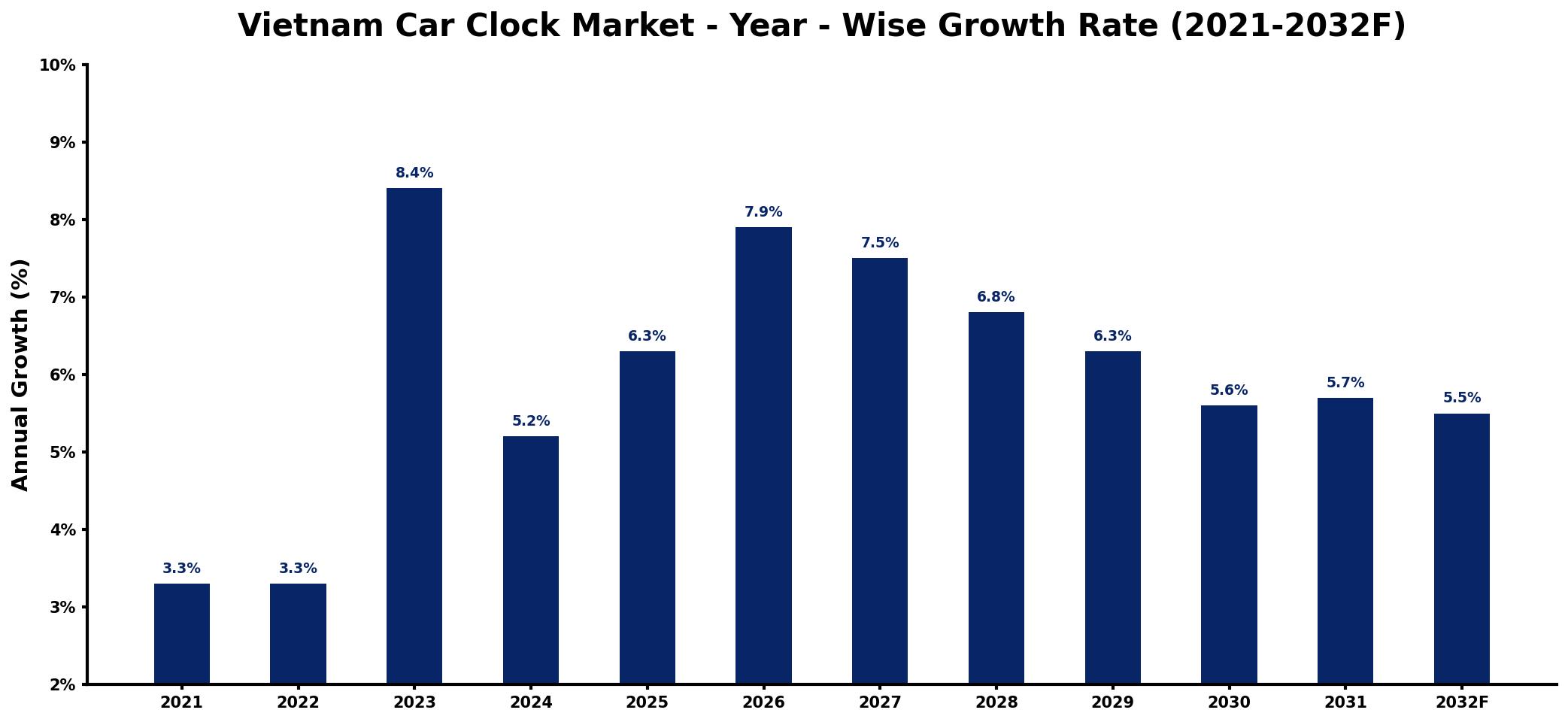
The table below presents the year‑wise growth rates along with the key drivers influencing the market
| Year | Growth Rate | Major Drivers |
| 2021 | 3.3% | Rising automotive ownership trends |
| 2022 | 3.3% | Increased consumer disposable income |
| 2023 | 8.4% | Growth in automotive accessories market |
| 2024 | 5.2% | Expansion of automotive retail networks |
| 2025 | 6.3% | Technological advancements in accessories |
| 2026 | 7.9% | Rising demand for smart devices |
| 2027 | 7.5% | Increased focus on vehicle customization |
| 2028 | 6.8% | expanding manufacturing base activity |
| 2029 | 6.3% | Surge in automotive aftermarket services |
| 2030 | 5.6% | Growing awareness of vehicle safety |
| 2031 | 5.7% | growing emerging market penetration |
| 2032 | 5.5% | Increase in eco-friendly vehicle sales |
Note: Market size estimations and growth projections presented in this report are based on 6Wresearch's proprietary forecasting methodology, utilizing the latest available industry data, government publications, and primary research inputs.
Vietnam Car Clock Market Synopsis
Recently, the Vietnam Car Clock Market has experienced significant momentum due to increased vehicle registrations and consumer appreciation for automotive aesthetics. However, as technology advances and integrated digital clocks become standard, the market faces an evolving landscape that will require adaptation by manufacturers and suppliers.
Despite these challenges, the market remains poised for growth, with consumers increasingly valuing the dual role of car clocks as both functional components and decorative elements. Innovations such as integration with multimedia systems are becoming essential, reflecting the changing expectations of modern drivers.
Vietnam Car Clock Market Key Takeaways
- The Vietnam Car Clock Market is set for steady growth with a projected CAGR of 5.1% from 2026 to 2032.
- Consumer preference for aesthetically appealing and multifunctional automotive accessories is a key growth driver.
- Technological advancements, including GPS and multimedia integrations, are shaping new product offerings.
- The market is recovering from COVID-19 disruptions, and vehicle production is gradually stabilizing.
- Standalone car clocks face competition from built-in digital clock systems, requiring innovation from manufacturers.
Evaluation of Restraints in Vietnam Car Clock Market
The Vietnam Car Clock Market faces several restraints that can limit its growth potential. As vehicles become increasingly sophisticated, integrated digital clocks are being standardised across many models, which may deter consumers from purchasing standalone car clocks. Furthermore, maintaining consumer interest in design and functionality amidst rapid technological advancements will be crucial for market players. A delicate balance between traditional clock designs and modern, tech-savvy features will be necessary to attract and retain customers in this evolving landscape.
Vietnam Car Clock Market Trends
Current trends in the Vietnam Car Clock Market include a noticeable shift toward designs that complement the overall interior aesthetics of vehicles. Consumers are increasingly looking for clocks that not only tell time but also enhance the visual appeal of their car interiors. Moreover, the integration of smart features such as Bluetooth connectivity and synchronization with smartphones is becoming commonplace, as drivers seek to elevate their driving experience. With the rise of electric and hybrid vehicles, there's also a growing interest in eco-friendly materials for car accessories, including clocks.
Vietnam Car Clock Market Opportunities
The Vietnam Car Clock Market offers numerous opportunities for growth and innovation. One promising avenue lies in developing advanced clock systems that integrate seamlessly with in-car technology, catering to the tech-savvy demographic. As the demand for personalized car interiors rises, manufacturers can capitalize on this trend by offering customizable clock designs that resonate with individual driver preferences. Additionally, targeting the aftermarket segment with stylish and high-tech clock options can provide a substantial revenue stream for businesses willing to innovate.
Government Initiatives in the Vietnam Car Clock Market
The Vietnamese government is actively promoting the automotive industry through various initiatives aimed at boosting local manufacturing and encouraging foreign investment. Policies supporting the development of the automotive supply chain are likely to benefit the car clock market, as they will enhance the overall quality and competitiveness of domestic products. Furthermore, public investments in infrastructure improvements may lead to an increased number of vehicles on the road, consequently driving demand for automotive accessories, including car clocks.
Future Insights of the Vietnam Car Clock Market
Looking ahead to 2026-2032, the Vietnam Car Clock Market is expected to continue its upward trajectory, driven by increasing vehicle ownership rates and evolving consumer preferences. The demand for stylish and functional automotive accessories is set to rise, presenting opportunities for innovation in design and technology. As the automotive landscape changes with the introduction of more electric and smart vehicles, car clocks that align with these advancements are likely to gain traction, reinforcing the market's growth potential.
Vietnam Car Clock Market Latest Developments (2025 - 2026)
In the recent months, the Vietnam Car Clock Market has witnessed a surge in interest as manufacturers focus on developing clocks that cater to a digitally inclined consumer base. This includes the introduction of models that offer integration with mobile apps and smart systems. Additionally, the ongoing recovery of the automotive sector post-COVID-19 has prompted companies to ramp up production capabilities and introduce innovative designs to meet the growing demand for premium in-car accessories.
Vietnam Car Clock Market - Key Attractiveness of the Report
- 10 Years of Market Numbers
- Historical Data Starting from 2022 to 2025
- Base Year: 2025
- Forecast Data until 2032
- Key Performance Indicators Impacting the Market
- Major Upcoming Developments and Projects
Key Highlights of the Report:
- Vietnam Car Clock Market Outlook
- Market Size of Vietnam Car Clock Market, 2025
- Forecast of Vietnam Car Clock Market, 2032
- Historical Data and Forecast of Vietnam Car Clock Revenues & Volume for the Period 2022-2032F
- Vietnam Car Clock Market Trend Evolution
- Vietnam Car Clock Market Drivers and Challenges
- Vietnam Car Clock Price Trends
- Vietnam Car Clock Porter's Five Forces
- Vietnam Car Clock Industry Life Cycle
- Historical Data and Forecast of Vietnam Car Clock Market Revenues & Volume By Type for the Period 2022-2032F
- Historical Data and Forecast of Vietnam Car Clock Market Revenues & Volume By Analog Type for the Period 2022-2032F
- Historical Data and Forecast of Vietnam Car Clock Market Revenues & Volume By Digital Type for the Period 2022-2032F
- Historical Data and Forecast of Vietnam Car Clock Market Revenues & Volume By Application for the Period 2022-2032F
- Historical Data and Forecast of Vietnam Car Clock Market Revenues & Volume By Passenger Cars for the Period 2022-2032F
- Historical Data and Forecast of Vietnam Car Clock Market Revenues & Volume By Commercial Vehicles for the Period 2022-2032F
- Vietnam Car Clock Import Export Trade Statistics
- Market Opportunity Assessment By Type
- Market Opportunity Assessment By Application
- Vietnam Car Clock Top Companies Market Share
- Vietnam Car Clock Competitive Benchmarking By Technical and Operational Parameters
- Vietnam Car Clock Company Profiles
- Vietnam Car Clock Key Strategic Recommendations






































