Vietnam Carbon Credit Market Size, Share & Growth Rate
The Vietnam Carbon Credit Market was estimated at USD 927 Million in 2025 and is projected to reach USD 1319 Million by 2032, growing at a CAGR of 5.2% from 2026 to 2032. This growth trajectory is primarily fueled by Vietnam's commitment to sustainability and compliance with international climate agreements, as well as increasing investments in renewable energy and afforestation projects. As businesses strive to meet their emission reduction targets, the market is set to become a pivotal component of Vietnam's environmental strategy.
Vietnam Carbon Credit Market Year-wise Growth Rate and Key Drivers
This graph highlights how the Vietnam Carbon Credit Market has steadily grown over the years, supported by major growth factors.
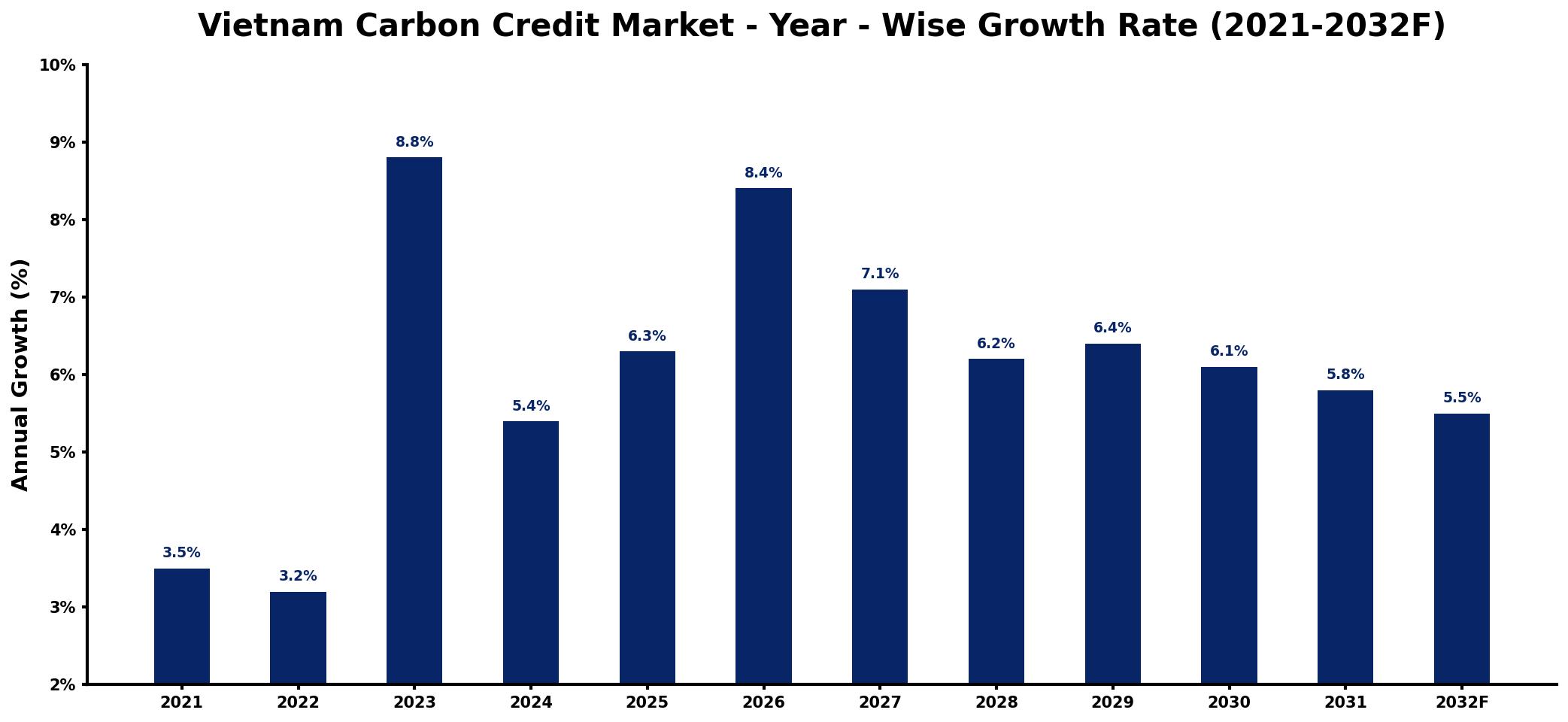
The table below presents the year‑wise growth rates along with the key drivers influencing the market
| Year | Growth Rate | Major Drivers |
| 2021 | 3.5% | Rising demand for renewable energy |
| 2022 | 3.2% | Increased investments in sustainability |
| 2023 | 8.8% | Growth in eco-friendly technologies |
| 2024 | 5.4% | Expansion of green finance initiatives |
| 2025 | 6.3% | Boost in regulatory support frameworks |
| 2026 | 8.4% | Surge in corporate sustainability commitments |
| 2027 | 7.1% | Development of low-emission projects |
| 2028 | 6.2% | Growing awareness of climate change |
| 2029 | 6.4% | increased domestic production output |
| 2030 | 6.1% | growing emerging market penetration |
| 2031 | 5.8% | Increased consumer preference for sustainability |
| 2032 | 5.5% | growing downstream application demand |
Note: Market size estimations and growth projections presented in this report are based on 6Wresearch's proprietary forecasting methodology, utilizing the latest available industry data, government publications, and primary research inputs.
Vietnam Carbon Credit Market Synopsis
In recent years, the Vietnam Carbon Credit Market has emerged as a crucial player in the nation's efforts to reduce greenhouse gas emissions. Driven by governmental commitments to sustainability, this market is witnessing a surge in carbon credit projects that focus on renewable energy and reforestation initiatives.
As part of a larger trend of prioritizing environmental accountability, companies across various sectors are increasingly investing in carbon credits to offset their emissions. This momentum highlights the role of carbon credits not just as regulatory instruments, but as strategic assets that align with corporate sustainability goals.
Vietnam Carbon Credit Market Key Takeaways
- Vietnam's carbon credit market is poised for significant growth, driven by strong government policies and international climate agreements.
- Investment in renewable energy and afforestation projects is a primary driver of carbon credit generation.
- Challenges exist in measuring and verifying carbon footprints, which impacts market participation.
- The COVID-19 pandemic temporarily slowed market momentum but has led to renewed focus on sustainability post-pandemic.
- Major industry players are enhancing their capabilities in carbon credit consultancy and trading.
Evaluation of Restraints in Vietnam Carbon Credit Market
The Vietnam Carbon Credit Market faces notable challenges that can impede its growth trajectory. A critical issue is the need for accurate carbon footprint measurement and verification, which is vital for maintaining credibility and trust in carbon credit transactions. Additionally, the evolving landscape of international climate agreements and domestic regulations creates an environment where market participants must continuously adapt to stay compliant. This uncertainty can deter potential investors and slow down project development in a sector where clarity and reliability are paramount.
Vietnam Carbon Credit Market Trends
Current trends in the Vietnam Carbon Credit Market reveal a marked shift towards digital verification and blockchain technologies aimed at enhancing transparency and efficiency in transactions. There's also an increasing emphasis on corporate social responsibility, encouraging companies to prioritize sustainability as a core business strategy. As stakeholders increasingly recognize the necessity of measurable environmental actions, innovative financing mechanisms such as green bonds are becoming more prevalent to support carbon offset projects.
Vietnam Carbon Credit Market Opportunities
With the Vietnamese government's focus on reducing carbon emissions, there are substantial growth opportunities for businesses that invest in sustainable projects. The surge in demand for clean energy solutions and afforestation programs presents a fertile ground for carbon credit generation. Furthermore, as more corporations aim to achieve net-zero targets, the need for reliable carbon credit trading platforms will continue to rise, paving the way for new entrants in the market.
Government Initiatives in the Vietnam Carbon Credit Market
The Vietnamese government has established various initiatives to bolster the carbon credit market, including supportive policies and regulatory frameworks aimed at promoting sustainability. These initiatives encompass investment incentives for renewable energy projects and afforestation efforts, as well as active participation in global climate agreements. By prioritizing carbon reduction strategies, the government is not only addressing environmental concerns but also enhancing Vietnam's attractiveness as a destination for green investments.
Future Insights of the Vietnam Carbon Credit Market
Looking towards the future, the Vietnam Carbon Credit Market is expected to evolve significantly by 2032. As more companies prioritize sustainability and carbon neutrality, the demand for carbon credits will likely surge. Enhanced regulatory support combined with technological advancements will facilitate smoother carbon credit transactions, while the increasing public awareness of climate issues will further encourage participation. Overall, the market is on track to become a cornerstone of Vietnam's climate action efforts.
Vietnam Carbon Credit Market Latest Developments (2025 - 2026)
In recent months, the Vietnam Carbon Credit Market has witnessed several developments aimed at enhancing its robustness and appeal. Initiatives to streamline the process of carbon credit trading are being discussed, focusing on reducing bureaucratic hurdles. Moreover, collaborations between the government and private sectors are becoming more common, with various stakeholders looking to align their efforts toward achieving shared sustainability goals. These developments indicate a concerted effort to strengthen the market's infrastructure and increase participation.
Vietnam Carbon Credit Market - Key Attractiveness of the Report
- 10 Years of Market Numbers
- Historical Data Starting from 2022 to 2025
- Base Year: 2025
- Forecast Data until 2032
- Key Performance Indicators Impacting the Market
- Major Upcoming Developments and Projects
Key Highlights of the Report:
- Vietnam Carbon Credit Market Outlook
- Market Size of Vietnam Carbon Credit Market, 2025
- Forecast of Vietnam Carbon Credit Market, 2032
- Historical Data and Forecast of Vietnam Carbon Credit Revenues & Volume for the Period 2022-2032F
- Vietnam Carbon Credit Market Trend Evolution
- Vietnam Carbon Credit Market Drivers and Challenges
- Vietnam Carbon Credit Price Trends
- Vietnam Carbon Credit Porter's Five Forces
- Vietnam Carbon Credit Industry Life Cycle
- Historical Data and Forecast of Vietnam Carbon Credit Market Revenues & Volume By Sector for the Period 2022-2032F
- Historical Data and Forecast of Vietnam Carbon Credit Market Revenues & Volume By Energy for the Period 2022-2032F
- Historical Data and Forecast of Vietnam Carbon Credit Market Revenues & Volume By Transportation for the Period 2022-2032F
- Historical Data and Forecast of Vietnam Carbon Credit Market Revenues & Volume By Residential And Commercial Buildings for the Period 2022-2032F
- Historical Data and Forecast of Vietnam Carbon Credit Market Revenues & Volume By Industry for the Period 2022-2032F
- Historical Data and Forecast of Vietnam Carbon Credit Market Revenues & Volume By Agriculture for the Period 2022-2032F
- Historical Data and Forecast of Vietnam Carbon Credit Market Revenues & Volume By Forestry for the Period 2022-2032F
- Historical Data and Forecast of Vietnam Carbon Credit Market Revenues & Volume By Water And Wastewater for the Period 2022-2032F
- Vietnam Carbon Credit Import Export Trade Statistics
- Market Opportunity Assessment By Sector
- Vietnam Carbon Credit Top Companies Market Share
- Vietnam Carbon Credit Competitive Benchmarking By Technical and Operational Parameters
- Vietnam Carbon Credit Company Profiles
- Vietnam Carbon Credit Key Strategic Recommendations






































