Vietnam Casual Pants Market Summary
The vietnam casual pants market was estimated at USD 731 Million in 2025 and is projected to reach USD 1039 Million by 2032, growing at a CAGR of 8.4% from 2026 to 2032.
Vietnam Casual Pants Market Year-wise Growth Rate and Key Drivers
This graph highlights how the Vietnam Casual Pants Market has steadily grown over the past five years, supported by major growth factors.
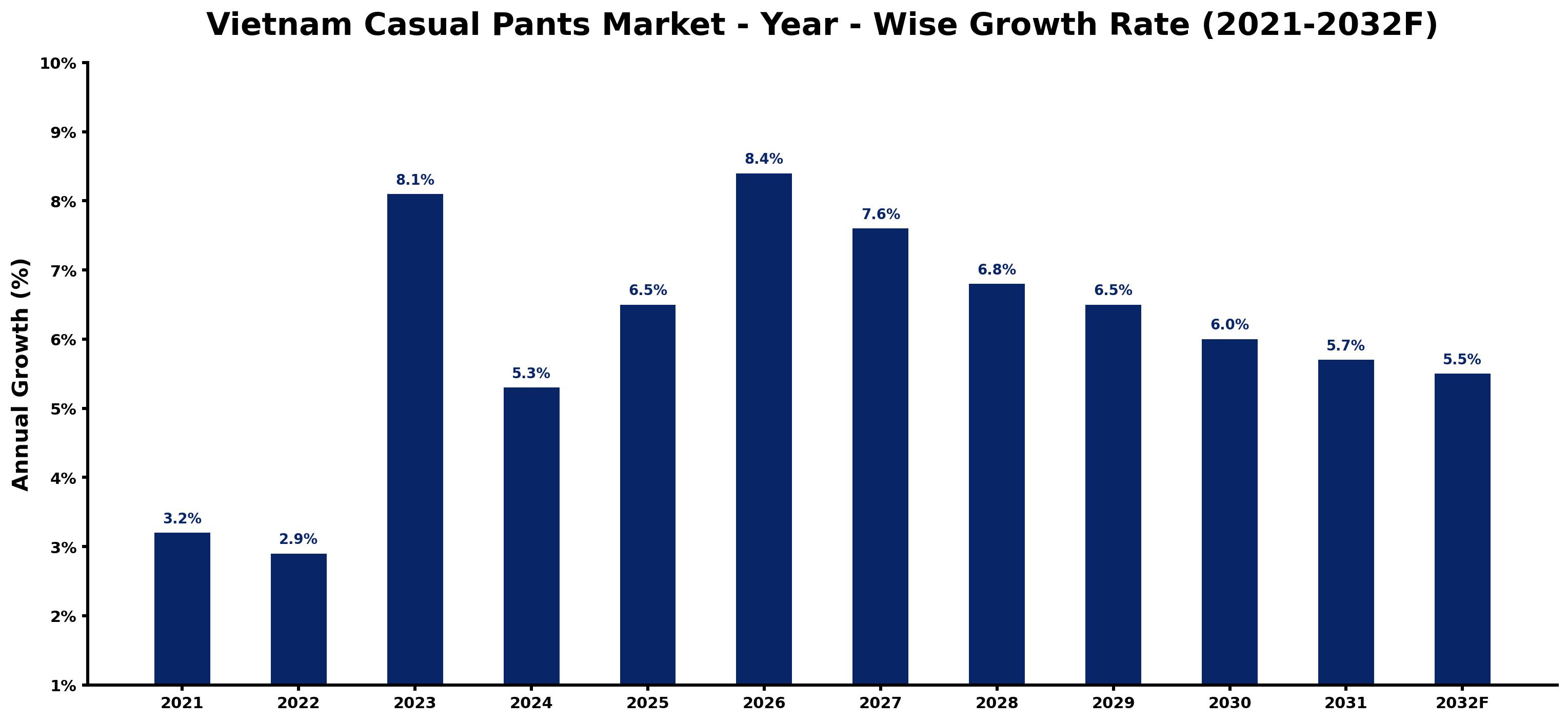
The table below presents the year wise growth rates along with the key drivers influencing the market
| Year | Growth Rate | Major Drivers |
| 2021 | 3.2% | Post-lockdown retail projects in Vietnam spurred a demand for casual, comfortable attire. |
| 2022 | 2.9% | E-commerce platforms experienced a surge in interest for casual pants among millennials. |
| 2023 | 8.1% | Urbanization trends led to increased casual dressing norms in cities across Vietnam. |
| 2024 | 5.3% | Influencer culture significantly shaped consumer preferences towards stylish casual pants options. |
| 2025 | 6.5% | Rural economic growth prompted expanded distribution networks for casual pants retailers. |
| 2026 | 8.4% | Sustainable fashion initiatives gained traction, encouraging eco-friendly casual pants production. |
| 2027 | 7.6% | Vietnam's manufacturing relocation attracted international brands seeking casual apparel opportunities. |
| 2028 | 6.8% | Festival culture in Vietnam highlighted casual pants as a preferred choice for attendees. |
| 2029 | 6.5% | Technological innovations streamlined production processes, enhancing casual pants quality and affordability. |
| 2030 | 6.0% | Health-conscious lifestyles motivated consumers to prioritize comfort in casual clothing selections. |
| 2031 | 5.7% | International travel resurgence influenced casual pants styles, merging global fashion with local tastes. |
| 2032 | 5.5% | Work-from-home policies solidified the casual pants segment as a staple in wardrobes. |
Note - Market size estimations and growth projections presented in this report are based on 6Wresearch's advanced forecasting approach, validated with industry datasets as of June 2026.
Vietnam Casual Pants Market Synopsis
The Vietnam Casual Pants Market is projected to reach 8.4% and witness significant growth during the forecast period (2026-2032). This growth trajectory is primarily driven by evolving fashion trends and an increasing consumer preference for comfortable and versatile clothing. As casualwear becomes increasingly accepted in both professional environments and leisure contexts, the demand for various styles of casual pants has been on the rise. The market features a multitude of casual pants offerings, including denim, khaki, and jogger styles, addressing diverse consumer tastes.
Vietnam Casual Pants Market Growth Drivers
The growth of the Vietnam Casual Pants Market can be attributed to several key factors:
- The shift towards casual attire in workplaces has resulted in a marked increase in demand for casual pants, as consumers seek comfort without sacrificing style.
- The exponential rise of e-commerce platforms has made casual pants more accessible to a broader audience, facilitating easier purchasing decisions across various demographics.
- Global fashion trends have influenced local styles, encouraging consumers to embrace contemporary designs and innovative fabrics that enhance the appeal of casual pants.
- The popularity of fast fashion retailers has also contributed to the availability of diverse casual pants styles, allowing consumers to easily update their wardrobes with the latest trends.
- Increasing disposable incomes among the Vietnamese population are driving consumer spending on fashion, particularly in the casual clothing segment.
Vietnam Casual Pants Market Challenges and Restraints
Despite the promising growth, the Vietnam Casual Pants Market faces several challenges:
- Rapidly changing consumer preferences necessitate ongoing innovation from manufacturers to keep pace with evolving fashion trends, which can strain resources and development timelines.
- Competition from international brands and lower-cost imports poses a significant threat to local manufacturers, compelling them to enhance quality and design to differentiate their products.
- The market's reliance on trends means that consumer interest can shift unpredictably, making it difficult to maintain consistent sales and product relevance.
- Environmental sustainability is becoming a key concern for consumers, urging manufacturers to adopt eco-friendly practices, which may incur higher production costs.
- Economic fluctuations and uncertainties could impact consumer spending habits, potentially leading to reduced sales in the casual pants segment.
Vietnam Casual Pants Market COVID-19 Impact
The COVID-19 pandemic had a substantial impact on the Vietnam Casual Pants Market. With many individuals working from home and social interactions restricted, the demand for formal attire declined significantly. Conversely, a notable surge in interest for comfortable and loungewear-style casual pants emerged, as consumers adapted to more relaxed fashion styles while at home. This shift prompted manufacturers to pivot their collections towards designs that emphasize comfort and versatility, better suited for remote work and indoor leisure activities.
Vietnam Casual Pants Market Government Investment and Initiatives
The Vietnamese government has been actively involved in supporting the fashion and apparel sector through various initiatives aimed at promoting local production. Investments in infrastructure, including improvements in transportation and logistics, are enhancing the efficiency of supply chains for garment manufacturers. Additionally, government policies encouraging sustainable practices in clothing production reflect a commitment to environmental stewardship, which is becoming increasingly important in global fashion markets. Public spending on technology and innovation supports manufacturers in modernizing their operations, positioning them to compete more effectively in both domestic and international markets.
Vietnam Casual Pants Market Latest Developments (May 2025 - June 2026)
Between May 2025 and June 2026, the Vietnam Casual Pants Market has experienced several notable developments. The industry has seen an uptick in collaborations between local designers and international brands, fostering a blend of traditional Vietnamese aesthetics with contemporary casual wear elements. Innovations in fabric technology have emerged, leading to the introduction of more breathable and eco-friendly materials in casual pants production. Furthermore, retail strategies have evolved, with a significant emphasis on omnichannel approaches, allowing consumers to enjoy a seamless shopping experience across various platforms.
Vietnam Casual Pants Market - Key Attractiveness of the Report
- 10 Years of Market Numbers
- Historical Data Starting from 2022 to 2025
- Base Year: 2025
- Forecast Data until 2032
- Key Performance Indicators Impacting the Market
- Major Upcoming Developments and Projects
Key Highlights of the Report:
- Vietnam Casual Pants Market Outlook
- Market Size of Vietnam Casual Pants Market, 2025
- Forecast of Vietnam Casual Pants Market, 2032
- Historical Data and Forecast of Vietnam Casual Pants Revenues & Volume for the Period 2022-2032F
- Vietnam Casual Pants Market Trend Evolution
- Vietnam Casual Pants Market Drivers and Challenges
- Vietnam Casual Pants Price Trends
- Vietnam Casual Pants Porter's Five Forces
- Vietnam Casual Pants Industry Life Cycle
- Historical Data and Forecast of Vietnam Casual Pants Market Revenues & Volume By Type for the Period 2022-2032F
- Historical Data and Forecast of Vietnam Casual Pants Market Revenues & Volume By Men's Pant for the Period 2022-2032F
- Historical Data and Forecast of Vietnam Casual Pants Market Revenues & Volume By Women's Pants for the Period 2022-2032F
- Historical Data and Forecast of Vietnam Casual Pants Market Revenues & Volume By ???l???t??n for the Period 2022-2032F
- Historical Data and Forecast of Vietnam Casual Pants Market Revenues & Volume By ??????lt? ?t?r?? for the Period 2022-2032F
- Historical Data and Forecast of Vietnam Casual Pants Market Revenues & Volume By ?u??rm?rk?t & ??ll for the Period 2022-2032F
- Historical Data and Forecast of Vietnam Casual Pants Market Revenues & Volume By ?-??mm?r?? for the Period 2022-2032F
- Vietnam Casual Pants Import Export Trade Statistics
- Market Opportunity Assessment By Type
- Market Opportunity Assessment By ???l???t??n
- Vietnam Casual Pants Top Companies Market Share
- Vietnam Casual Pants Competitive Benchmarking By Technical and Operational Parameters
- Vietnam Casual Pants Company Profiles
- Vietnam Casual Pants Key Strategic Recommendations






































