Vietnam Cellulose Acetate Fiber Market Size, Share & Growth Rate
The Vietnam Cellulose Acetate Fiber Market was estimated at USD 333 Million in 2025 and is projected to reach USD 471 Million by 2032, growing at a CAGR of 5.1% from 2026 to 2032. This growth trajectory is fueled by the rising demand for sustainable and innovative materials in the fashion industry. With consumers increasingly leaning towards eco-friendly alternatives, cellulose acetate fibers are positioned as an attractive option due to their softness and versatility in various applications.
Vietnam Cellulose Acetate Fiber Market Year-wise Growth Rate and Key Drivers
This graph highlights how the Vietnam Cellulose Acetate Fiber Market has steadily grown over the years, supported by major growth factors.
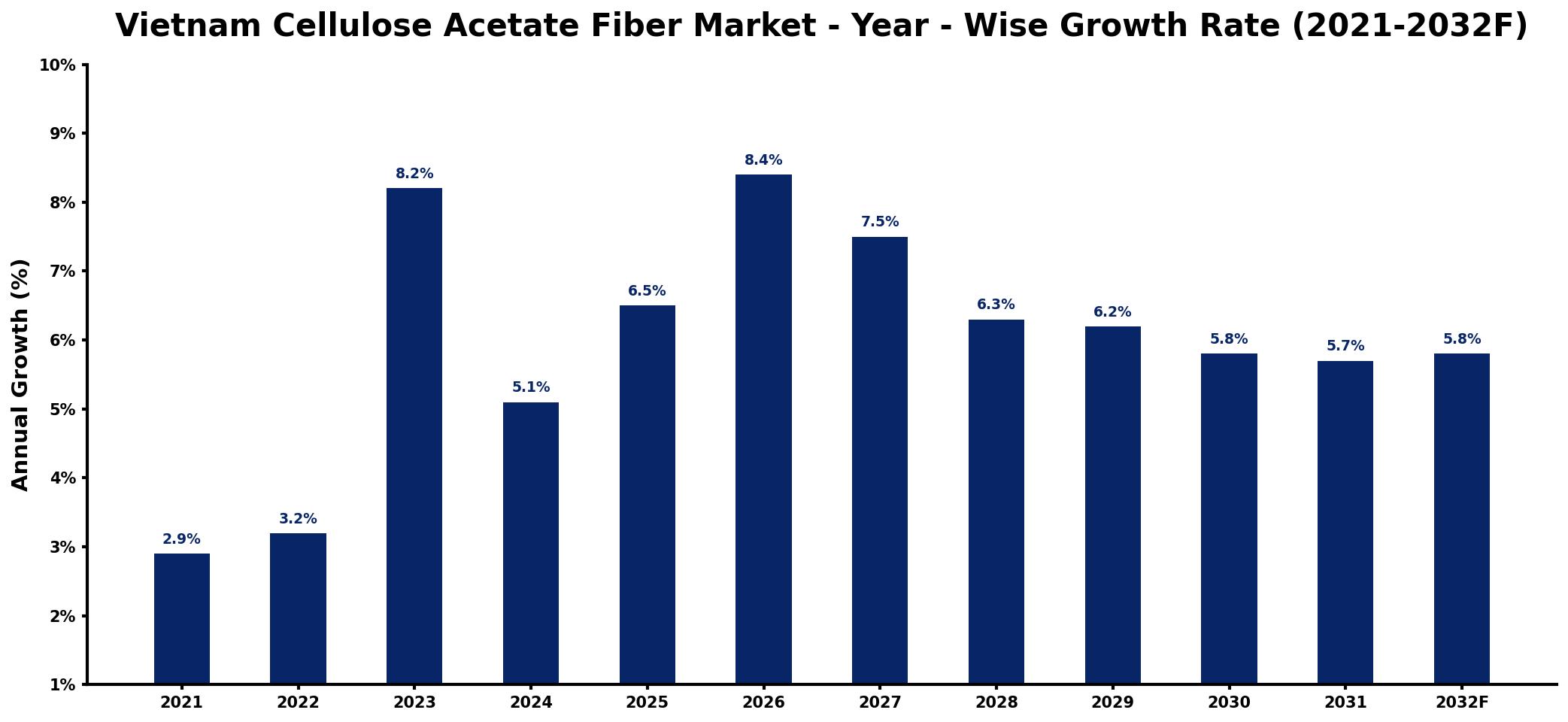
The table below presents the year‑wise growth rates along with the key drivers influencing the market
| Year | Growth Rate | Major Drivers |
| 2021 | 2.9% | Rising demand from textiles industry |
| 2022 | 3.2% | Growth in sustainable packaging solutions |
| 2023 | 8.2% | Increased investments in manufacturing |
| 2024 | 5.1% | Expansion of automotive sector applications |
| 2025 | 6.5% | stronger distribution network expansion |
| 2026 | 8.4% | rising procurement volume requirements |
| 2027 | 7.5% | expanding industrial usage applications |
| 2028 | 6.3% | Increased adoption in home furnishings |
| 2029 | 6.2% | Demand growth from food packaging |
| 2030 | 5.8% | Rising popularity in construction materials |
| 2031 | 5.7% | enhanced product quality standards |
| 2032 | 5.8% | Increased focus on biodegradable alternatives |
Note: Market size estimations and growth projections presented in this report are based on 6Wresearch's proprietary forecasting methodology, utilizing the latest available industry data, government publications, and primary research inputs.
Vietnam Cellulose Acetate Fiber Market Synopsis
As Vietnam's textile industry evolves, the demand for cellulose acetate fibers is gaining traction among fashion designers and textile manufacturers. These fibers are particularly favored for their excellent dyeing properties and adaptability, making them suitable for a range of garments and accessories.
Emerging trends toward sustainable fashion are further driving interest in cellulose acetate fibers, which are derived from renewable sources like wood pulp. This positions them as a compelling alternative in a market increasingly influenced by eco-conscious consumer behavior.
Vietnam Cellulose Acetate Fiber Market Key Takeaways
- Significant growth is anticipated in the Vietnam cellulose acetate fiber market, reaching USD 471 Million by 2032.
- Eco-friendliness and versatility are key attributes driving demand for these fibers in the fashion sector.
- Companies need to enhance consumer awareness about cellulose acetate fibers to foster market acceptance.
- Technological advancements are paving the way for innovative applications and new blends of cellulose acetate fibers.
- Post-pandemic recovery trends indicate a resurgence in demand for cellulose acetate fiber products.
Evaluation of Restraints in Vietnam Cellulose Acetate Fiber Market
Despite the positive outlook, several factors are constraining growth within the Vietnam cellulose acetate fiber market. Limited consumer awareness poses a challenge, as many potential buyers may not fully understand the benefits of cellulose acetate over traditional materials like cotton and polyester. Additionally, the market's competitive landscape is dominated by more established fibers, making it imperative for cellulose acetate fiber producers to launch targeted marketing campaigns. By educating both consumers and industry stakeholders about the unique properties of cellulose acetate fibers, companies can work to overcome these obstacles and expand their market share.
Vietnam Cellulose Acetate Fiber Market Trends
Several trends are shaping the future of the Vietnam cellulose acetate fiber market. The shift towards sustainable textiles is becoming increasingly pronounced, with more designers prioritizing eco-friendly materials in their collections. Additionally, advancements in fiber technology have led to the creation of new cellulose acetate formulations that enhance durability while retaining softness and dyeing capabilities. Furthermore, the adaptation of the fashion industry to post-pandemic consumer preferences is driving demand for versatile and comfortable clothing, where cellulose acetate fibers are emerging as a preferred choice.
Vietnam Cellulose Acetate Fiber Market Opportunities
The Vietnam cellulose acetate fiber market is ripe with growth opportunities, particularly in the realm of sustainable and innovative fabric solutions. As global environmental awareness rises, there is increasing potential for manufacturers to invest in research and development to create eco-friendly blends and applications. Expanding into non-textile applications, such as packaging materials and industrial products, can also open new avenues for revenue. Overall, there is a significant opportunity for growth by aligning production efforts with the increasing demand for sustainable, high-performance fibers.
Government Initiatives in the Vietnam Cellulose Acetate Fiber Market
The Vietnamese government is actively supporting the textile and fiber industry through various initiatives aimed at promoting sustainable practices and technological advancements. Policies encouraging the use of eco-friendly materials are being implemented, alongside investments in infrastructure to facilitate the growth of innovative fiber solutions. Additionally, public funding aimed at research and development in sustainable materials is becoming more prevalent, providing a conducive environment for the cellulose acetate fiber sector to thrive.
Future Insights of the Vietnam Cellulose Acetate Fiber Market
Looking ahead to the period from 2026 to 2032, the Vietnam cellulose acetate fiber market is set for significant evolution driven by sustainable fashion trends and technological advancements. As awareness about eco-friendly options continues to grow, more brands are likely to incorporate cellulose acetate fibers into their product lines. Additionally, ongoing research into enhancing the properties and applications of cellulose acetate will likely yield innovative solutions that meet emerging consumer demands. This trajectory suggests a robust future for the market as it aligns itself with the global shift towards sustainability.
Vietnam Cellulose Acetate Fiber Market Latest Developments (2025 - 2026)
Recent developments in the Vietnam cellulose acetate fiber market have included innovations in fiber production technologies aimed at enhancing sustainability and reducing environmental impact. Companies are increasingly focusing on creating blends that incorporate recycled materials, which not only meet consumer demands but also address waste reduction. Furthermore, collaborations between textile manufacturers and research institutions have been gaining traction, fostering advancements in fiber characteristics and applications across different sectors.
Vietnam Cellulose Acetate Fiber Market - Key Attractiveness of the Report
- 10 Years of Market Numbers
- Historical Data Starting from 2022 to 2025
- Base Year: 2025
- Forecast Data until 2032
- Key Performance Indicators Impacting the Market
- Major Upcoming Developments and Projects
Key Highlights of the Report:
- Vietnam Cellulose Acetate Fiber Market Outlook
- Market Size of Vietnam Cellulose Acetate Fiber Market, 2025
- Forecast of Vietnam Cellulose Acetate Fiber Market, 2032
- Historical Data and Forecast of Vietnam Cellulose Acetate Fiber Revenues & Volume for the Period 2022-2032F
- Vietnam Cellulose Acetate Fiber Market Trend Evolution
- Vietnam Cellulose Acetate Fiber Market Drivers and Challenges
- Vietnam Cellulose Acetate Fiber Price Trends
- Vietnam Cellulose Acetate Fiber Porter's Five Forces
- Vietnam Cellulose Acetate Fiber Industry Life Cycle
- Historical Data and Forecast of Vietnam Cellulose Acetate Fiber Market Revenues & Volume By Type for the Period 2022-2032F
- Historical Data and Forecast of Vietnam Cellulose Acetate Fiber Market Revenues & Volume By Plastic for the Period 2022-2032F
- Historical Data and Forecast of Vietnam Cellulose Acetate Fiber Market Revenues & Volume By Fiber for the Period 2022-2032F
- Historical Data and Forecast of Vietnam Cellulose Acetate Fiber Market Revenues & Volume By Application for the Period 2022-2032F
- Historical Data and Forecast of Vietnam Cellulose Acetate Fiber Market Revenues & Volume By Photographic Films for the Period 2022-2032F
- Historical Data and Forecast of Vietnam Cellulose Acetate Fiber Market Revenues & Volume By Cigarette Filters for the Period 2022-2032F
- Historical Data and Forecast of Vietnam Cellulose Acetate Fiber Market Revenues & Volume By Tapes & Labels for the Period 2022-2032F
- Historical Data and Forecast of Vietnam Cellulose Acetate Fiber Market Revenues & Volume By Textiles & Apparel for the Period 2022-2032F
- Vietnam Cellulose Acetate Fiber Import Export Trade Statistics
- Market Opportunity Assessment By Type
- Market Opportunity Assessment By Application
- Vietnam Cellulose Acetate Fiber Top Companies Market Share
- Vietnam Cellulose Acetate Fiber Competitive Benchmarking By Technical and Operational Parameters
- Vietnam Cellulose Acetate Fiber Company Profiles
- Vietnam Cellulose Acetate Fiber Key Strategic Recommendations






































