Vietnam Chain Drivers Market Size, Share & Growth Rate
The Vietnam Chain Drivers Market was estimated at USD 1425 Million in 2025 and is projected to reach USD 2329 Million by 2032, growing at a CAGR of 7.3% from 2026 to 2032. This growth trajectory is fueled by the expanding industrial landscape in Vietnam, particularly within automotive, food and beverage, and logistics sectors, where efficiency and automation are key. Enhanced production capabilities and government incentives further bolster the demand for reliable chain transmission solutions.
Vietnam Chain Drivers Market Year-wise Growth Rate and Key Drivers
This graph highlights how the Vietnam Chain Drivers Market has steadily grown over the years, supported by major growth factors.
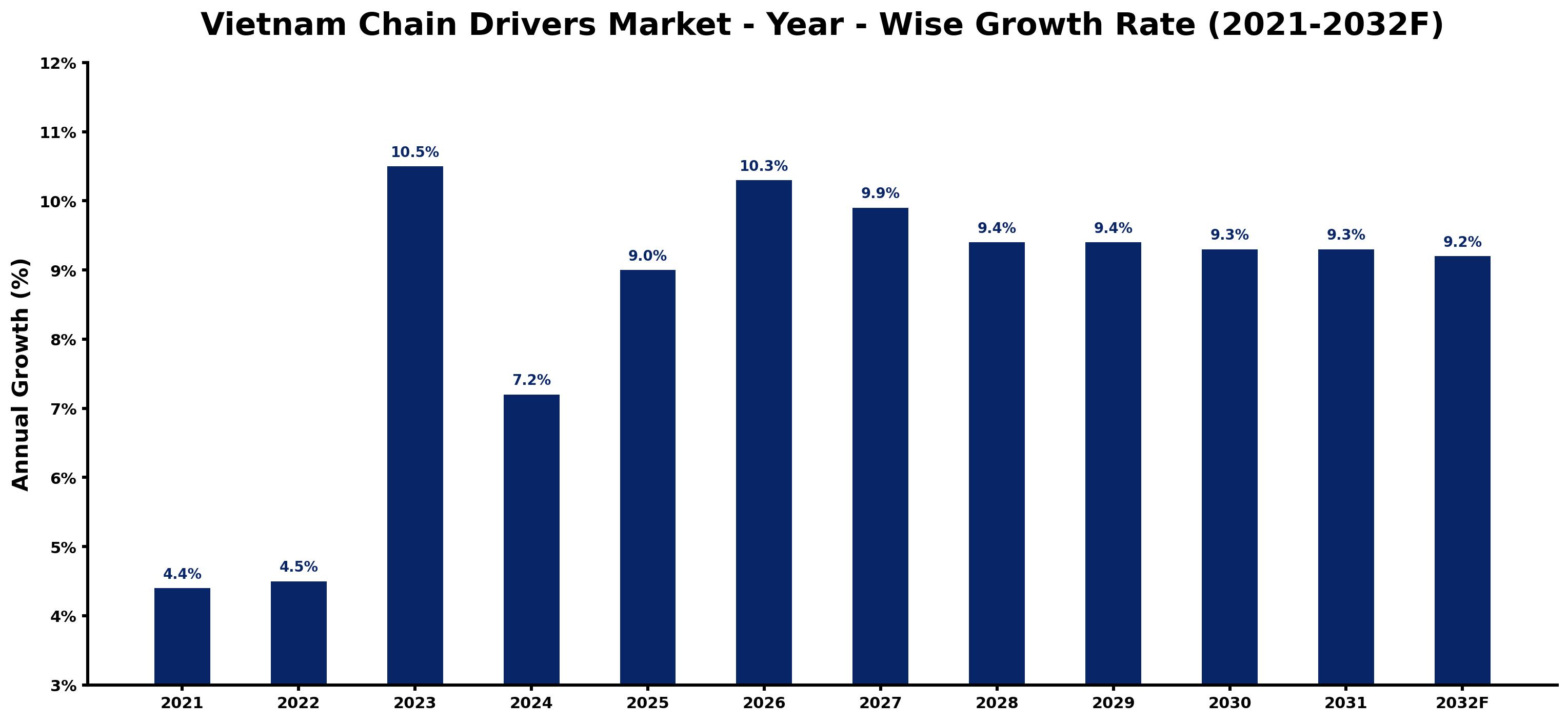
The table below presents the year‑wise growth rates along with the key drivers influencing the market
| Year | Growth Rate | Major Drivers |
| 2021 | 4.4% | Government infrastructure modernization initiatives |
| 2022 | 4.5% | Increasing smart city development projects |
| 2023 | 10.5% | Increasing industrial automation investments |
| 2024 | 7.2% | Increasing smart city development projects |
| 2025 | 9.0% | Increasing smart city development projects |
| 2026 | 10.3% | Expansion of commercial construction activities |
| 2027 | 9.9% | Increasing adoption of advanced technologies |
| 2028 | 9.4% | Rising electricity demand across industries |
| 2029 | 9.4% | Increasing industrial infrastructure investments |
| 2030 | 9.3% | Increasing industrial automation investments |
| 2031 | 9.3% | Increasing adoption of advanced technologies |
| 2032 | 9.2% | Government infrastructure modernization initiatives |
Note - Market size estimations and growth projections presented in this report are based on 6Wresearch’s advanced forecasting approach, validated with industry datasets as of June 2026.
Vietnam Chain Drivers Market Synopsis
The Vietnam Chain Drivers market is currently experiencing a phase of robust growth, underpinned by the vibrant industrial and manufacturing sectors that form the backbone of the economy. Roller chains and conveyor chains are essential components, facilitating power transmission and material handling across various applications.
As industries pivot towards more automated systems to enhance productivity, the demand for both standard and customized chain solutions is on the rise. This shift not only highlights the importance of high-quality, durable chains but also reflects the increased focus on low-maintenance options that cater to diverse industrial needs.
Vietnam Chain Drivers Market Key Takeaways
- The market's growth is driven by rising automation and the burgeoning manufacturing sector.
- Increased investments and government support play a pivotal role in market dynamics.
- Product quality and reliability remain crucial factors for customers in selecting chain solutions.
- Manufacturers are adapting to evolving market demands by offering customized chain drivers.
- The recovery from COVID-19 has led to renewed interest in power transmission systems.
Evaluation of Restraints in Vietnam Chain Drivers Market
Despite its growth potential, the Vietnam Chain Drivers market faces notable restraints. A significant challenge is the demand-supply gap for skilled labor, which is crucial for the installation and maintenance of chain drivers. A shortage of qualified technicians can lead to delays that hinder customer satisfaction and project timelines. Additionally, the market contends with competition from alternative power transmission technologies, such as belt drives and gear drives. To remain competitive, manufacturers must not only emphasize the reliability and efficiency of chain drivers but also navigate fluctuating steel prices that affect production costs.
Vietnam Chain Drivers Market Trends
Key trends shaping the Vietnam Chain Drivers market include an accelerated shift towards automation, with many industries adopting advanced technologies to streamline operations. This transition amplifies the need for high-performance chain systems capable of supporting automated processes. Furthermore, the trend towards sustainable manufacturing practices is influencing product development, leading to innovations in eco-friendly chain materials and designs. As industries continue to focus on efficiency and reliability, smart chain solutions integrated with IoT are also beginning to surface, heralding a new era for the market.
Vietnam Chain Drivers Market Opportunities
Significant growth opportunities exist within the Vietnam Chain Drivers market, particularly in sectors experiencing rapid expansion. The automotive industry, for instance, is increasingly investing in advanced manufacturing technologies, thereby heightening the demand for innovative chain solutions. Additionally, the food and beverage sector's ongoing evolution presents opportunities for customized chain drivers that meet stringent hygiene and efficiency standards. As foreign investments continue to flow into Vietnam, the overall manufacturing landscape is poised for transformation, creating a fertile ground for growth and innovation in the chain drivers market.
Government Initiatives in the Vietnam Chain Drivers Market
The Vietnamese government has introduced several initiatives aimed at bolstering industrial growth and competitiveness. These include tax incentives for manufacturers, support for technology transfer, and funding for infrastructure development. By fostering a favorable business environment, the government encourages investments in automation and modernization, which directly benefits the Chain Drivers market. Such policies not only aim to elevate Vietnam as a manufacturing hub in Southeast Asia but also enhance productivity across various sectors that rely heavily on chain transmission systems.
Future Insights of the Vietnam Chain Drivers Market
Looking ahead to 2026-2032, the Vietnam Chain Drivers market is set to experience significant evolution driven by continuous industrialization and an increasing emphasis on automation. As industries seek to optimize their processes, the demand for advanced chain solutions that offer higher efficiency, durability, and low maintenance will likely soar. Furthermore, as the market adapts to technological advancements, we can expect a greater integration of smart technologies within chain systems. Overall, the outlook is positive, with numerous growth avenues shaping a dynamic and competitive market landscape.
Vietnam Chain Drivers Market Latest Developments (May 2025 - June 2026)
Recent developments in the Vietnam Chain Drivers market reflect an ongoing commitment to innovation and quality. As manufacturers navigate post-pandemic recovery, many have adopted flexible production techniques to meet the increasing demand for customized solutions. The trend towards automation continues to drive product development, with several companies investing in research and development to create high-performance, low-maintenance chain systems. Additionally, strategic collaborations among industry players are emerging, aiming to leverage shared technology and resources to enhance market competitiveness.
Vietnam Chain Drivers Market - Key Attractiveness of the Report
- 10 Years of Market Numbers
- Historical Data Starting from 2022 to 2025
- Base Year: 2025
- Forecast Data until 2032
- Key Performance Indicators Impacting the Market
- Major Upcoming Developments and Projects
Key Highlights of the Report:
- Vietnam Chain Drivers Market Outlook
- Market Size of Vietnam Chain Drivers Market, 2025
- Forecast of Vietnam Chain Drivers Market, 2032
- Historical Data and Forecast of Vietnam Chain Drivers Revenues & Volume for the Period 2022-2032F
- Vietnam Chain Drivers Market Trend Evolution
- Vietnam Chain Drivers Market Drivers and Challenges
- Vietnam Chain Drivers Price Trends
- Vietnam Chain Drivers Porter's Five Forces
- Vietnam Chain Drivers Industry Life Cycle
- Historical Data and Forecast of Vietnam Chain Drivers Market Revenues & Volume By Product Type for the Period 2022-2032F
- Historical Data and Forecast of Vietnam Chain Drivers Market Revenues & Volume By Roller Chains for the Period 2022-2032F
- Historical Data and Forecast of Vietnam Chain Drivers Market Revenues & Volume By Silent Chains for the Period 2022-2032F
- Historical Data and Forecast of Vietnam Chain Drivers Market Revenues & Volume By Leaf Chains for the Period 2022-2032F
- Historical Data and Forecast of Vietnam Chain Drivers Market Revenues & Volume By Others for the Period 2022-2032F
- Historical Data and Forecast of Vietnam Chain Drivers Market Revenues & Volume By Applications for the Period 2022-2032F
- Historical Data and Forecast of Vietnam Chain Drivers Market Revenues & Volume By Industrial Sector for the Period 2022-2032F
- Historical Data and Forecast of Vietnam Chain Drivers Market Revenues & Volume By Heavy Equipment Industry for the Period 2022-2032F
- Historical Data and Forecast of Vietnam Chain Drivers Market Revenues & Volume By Agricultural Equipment Industry for the Period 2022-2032F
- Historical Data and Forecast of Vietnam Chain Drivers Market Revenues & Volume By Others for the Period 2022-2032F
- Vietnam Chain Drivers Import Export Trade Statistics
- Market Opportunity Assessment By Product Type
- Market Opportunity Assessment By Applications
- Vietnam Chain Drivers Top Companies Market Share
- Vietnam Chain Drivers Competitive Benchmarking By Technical and Operational Parameters
- Vietnam Chain Drivers Company Profiles
- Vietnam Chain Drivers Key Strategic Recommendations






































