Vietnam Chromium Sulphate Market Size, Share & Growth Rate
The Vietnam Chromium Sulphate Market was estimated at USD 1440 Million in 2025 and is projected to reach USD 2051 Million by 2032, growing at a CAGR of 5.2% from 2026 to 2032. This growth trajectory is primarily driven by the surging demand in the leather tanning industry, which is benefiting from the robust expansion of the fashion and automotive sectors. The rising production of leather goods, coupled with increasing consumption levels, further propels the market for chromium sulphate in Vietnam.
Vietnam Chromium Sulphate Market Year-wise Growth Rate and Key Drivers
This graph highlights how the Vietnam Chromium Sulphate Market has steadily grown over the years, supported by major growth factors.
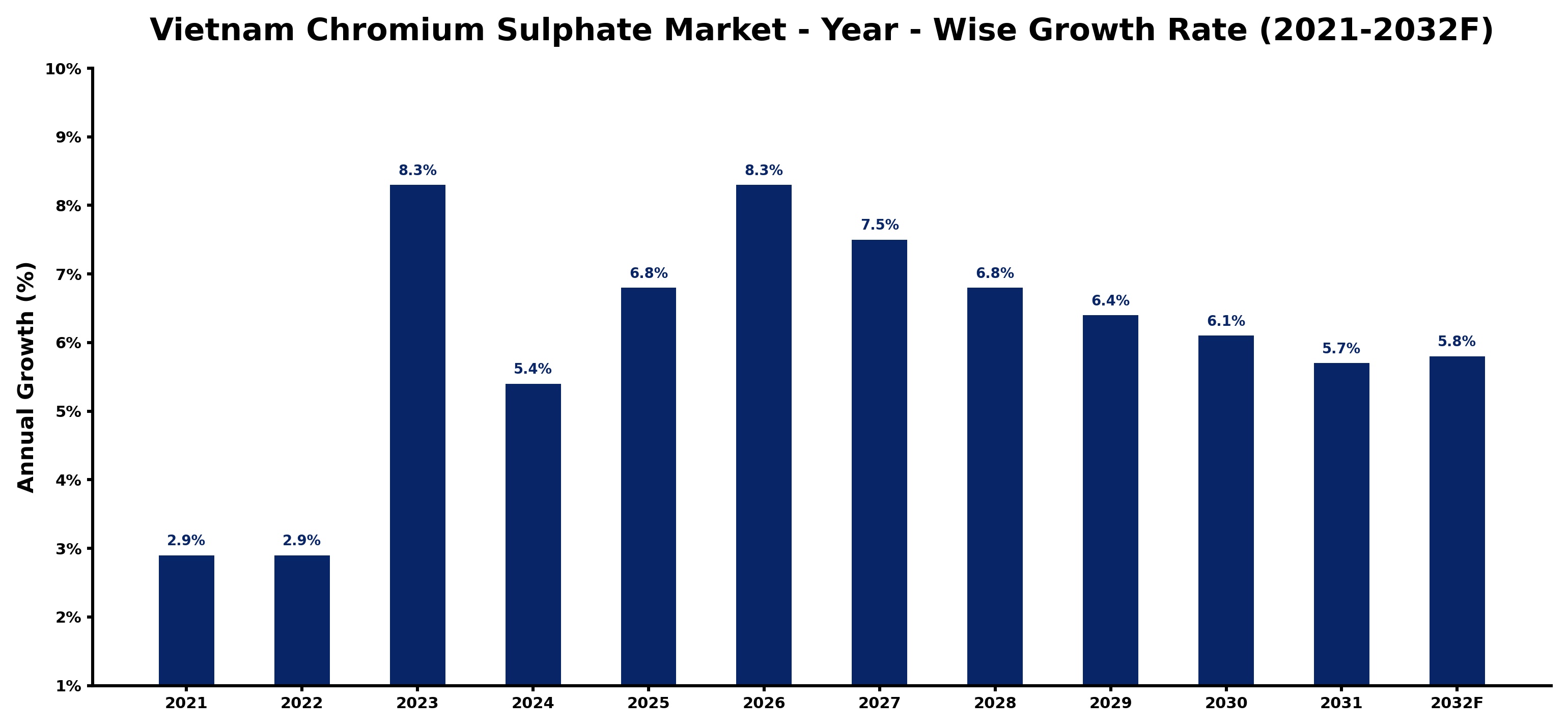
The table below presents the year‑wise growth rates along with the key drivers influencing the market
| Year | Growth Rate | Major Drivers |
| 2021 | 2.9% | Rising demand from leather industry |
| 2022 | 2.9% | Increased production capacity expansion |
| 2023 | 8.3% | Growth in construction sector demands |
| 2024 | 5.4% | Automotive sector driving consumption increase |
| 2025 | 6.8% | Agricultural applications expanding usage base |
| 2026 | 8.3% | Technological advancements enhancing production |
| 2027 | 7.5% | Export opportunities boosting market growth |
| 2028 | 6.8% | Sustainability trends encouraging eco-friendly practices |
| 2029 | 6.4% | Regulatory support for local manufacturers |
| 2030 | 6.1% | Investment in infrastructure projects rising |
| 2031 | 5.7% | Consumer awareness of product benefits |
| 2032 | 5.8% | Collaborations enhancing market reach |
Note - Market size estimations and growth projections presented in this report are based on 6Wresearch’s advanced forecasting approach, validated with industry datasets as of June 2026.
Vietnam Chromium Sulphate Market Synopsis
The Vietnam Chromium Sulphate market has recently gained momentum, driven by an uptick in leather and textile production. As the country embraces industrial growth, the market is poised for sustained demand, particularly in tanning applications and textile dyeing processes. Looking ahead, the momentum is expected to continue, with enhanced quality requirements and eco-friendly practices shaping the market landscape.
While the immediate past has been marked by challenges, including pandemic-related disruptions, the future holds promise for resilience and growth. The confluence of domestic and export demands is positioning the Vietnam Chromium Sulphate market for significant opportunities as industries adapt and innovate in response to evolving consumer preferences.
Vietnam Chromium Sulphate Market Key Takeaways
- Steady growth projected at a CAGR of 5.2% until 2032, reflecting strong demand in the leather industry.
- Key applications in tanning and textile dyeing processes drive market expansion.
- Environmental regulations pose ongoing challenges, demanding innovation and compliance from manufacturers.
- COVID-19 disruptions highlighted vulnerabilities in supply chains, emphasizing the need for resilience.
- The increasing sophistication of consumer preferences is pushing for higher quality in leather products, enhancing chromium sulphate's role.
Evaluation of Restraints in Vietnam Chromium Sulphate Market
The Vietnam Chromium Sulphate market faces significant restraints primarily due to stringent environmental regulations surrounding the use of chromium compounds. Companies must navigate complex compliance landscapes that can impose additional costs related to waste management and process adaptation. Moreover, the fluctuating trends within the fashion and leather industries can directly influence the demand for chromium sulphate, requiring businesses to be agile in their production strategies. These challenges necessitate a concerted effort to balance operational efficiency with environmental stewardship.
Vietnam Chromium Sulphate Market Trends
Current trends indicate a shift towards sustainable practices within the leather and textile industries, leading to innovations in chromium sulphate production and application methods. Companies are increasingly exploring eco-friendly alternatives and improved waste management solutions. Additionally, the rise of digital technology in production processes is enhancing efficiency and quality control. There is a growing emphasis on product differentiation, as manufacturers strive to meet the rising expectations of environmentally conscious consumers.
Vietnam Chromium Sulphate Market Opportunities
The outlook for the Vietnam Chromium Sulphate market presents numerous opportunities, particularly in the realms of research and development. Investing in eco-friendly alternatives and innovative tanning solutions can position companies favorably in a competitive landscape. Additionally, expanding export capabilities to meet international demand represents a substantial growth avenue. The collaboration between industry stakeholders to enhance the sustainability of chromium processes further opens new avenues for investment and growth.
Government Initiatives in the Vietnam Chromium Sulphate Market
The Vietnamese government is actively supporting the growth of the leather and textile industries through various initiatives aimed at enhancing sustainability and competitiveness. Programs focusing on technological upgrades and environmentally friendly practices are being promoted to ensure compliance with international standards. Additionally, public investment in infrastructure improvements is anticipated to boost the efficiency of supply chains, indirectly benefiting the chromium sulphate market.
Future Insights of the Vietnam Chromium Sulphate Market
From 2026 to 2032, the Vietnam Chromium Sulphate market is expected to evolve significantly, driven by the dual forces of consumer demand and regulatory pressures. The push for high-quality leather products will remain strong, urging manufacturers to refine their processes. As companies adapt to both market needs and environmental standards, opportunities for innovation will proliferate, fostering a more sustainable and resilient market landscape.
Vietnam Chromium Sulphate Market Latest Developments (May 2025 - June 2026)
In recent months, the Vietnam Chromium Sulphate market has seen a notable pivot towards sustainable manufacturing practices, with several initiatives launched to reduce environmental impact. Furthermore, industry collaborations are emerging to address regulatory compliance challenges, facilitating knowledge sharing and technological advancements. As market players begin to implement new sustainable technologies, the market's evolution is closely tied to the broader trends in environmental responsibility.
Vietnam Chromium Sulphate Market - Key Attractiveness of the Report
- 10 Years of Market Numbers
- Historical Data Starting from 2022 to 2025
- Base Year: 2025
- Forecast Data until 2032
- Key Performance Indicators Impacting the Market
- Major Upcoming Developments and Projects
Key Highlights of the Report:
- Vietnam Chromium Sulphate Market Outlook
- Market Size of Vietnam Chromium Sulphate Market, 2025
- Forecast of Vietnam Chromium Sulphate Market, 2032
- Historical Data and Forecast of Vietnam Chromium Sulphate Revenues & Volume for the Period 2022-2032F
- Vietnam Chromium Sulphate Market Trend Evolution
- Vietnam Chromium Sulphate Market Drivers and Challenges
- Vietnam Chromium Sulphate Price Trends
- Vietnam Chromium Sulphate Porter's Five Forces
- Vietnam Chromium Sulphate Industry Life Cycle
- Historical Data and Forecast of Vietnam Chromium Sulphate Market Revenues & Volume By Products for the Period 2022-2032F
- Historical Data and Forecast of Vietnam Chromium Sulphate Market Revenues & Volume By Basic Chromium Sulphate 21%-23% for the Period 2022-2032F
- Historical Data and Forecast of Vietnam Chromium Sulphate Market Revenues & Volume By Basic Chromium Sulphate 24%-26% for the Period 2022-2032F
- Historical Data and Forecast of Vietnam Chromium Sulphate Market Revenues & Volume By Applications for the Period 2022-2032F
- Historical Data and Forecast of Vietnam Chromium Sulphate Market Revenues & Volume By Tanning Agent for the Period 2022-2032F
- Historical Data and Forecast of Vietnam Chromium Sulphate Market Revenues & Volume By Dyeing for the Period 2022-2032F
- Historical Data and Forecast of Vietnam Chromium Sulphate Market Revenues & Volume By Painting & Coating for the Period 2022-2032F
- Vietnam Chromium Sulphate Import Export Trade Statistics
- Market Opportunity Assessment By Products
- Market Opportunity Assessment By Applications
- Vietnam Chromium Sulphate Top Companies Market Share
- Vietnam Chromium Sulphate Competitive Benchmarking By Technical and Operational Parameters
- Vietnam Chromium Sulphate Company Profiles
- Vietnam Chromium Sulphate Key Strategic Recommendations






































