Vietnam Clutch Housing Market Size, Share & Growth Rate
The Vietnam Clutch Housing Market was estimated at USD 473 Million in 2025 and is projected to reach USD 669 Million by 2032, growing at a CAGR of 5.1% from 2026 to 2032. This trajectory is fueled by the robust expansion of the automotive industry, particularly the increasing output of commercial vehicles. As urbanization accelerates and the population expands, the demand for reliable transportation solutions enhances the appeal for clutch housing components, vital for efficient vehicle operation.
Vietnam Clutch Housing Market Year-wise Growth Rate and Key Drivers
This graph highlights how the Vietnam Clutch Housing Market has steadily grown over the years, supported by major growth factors.
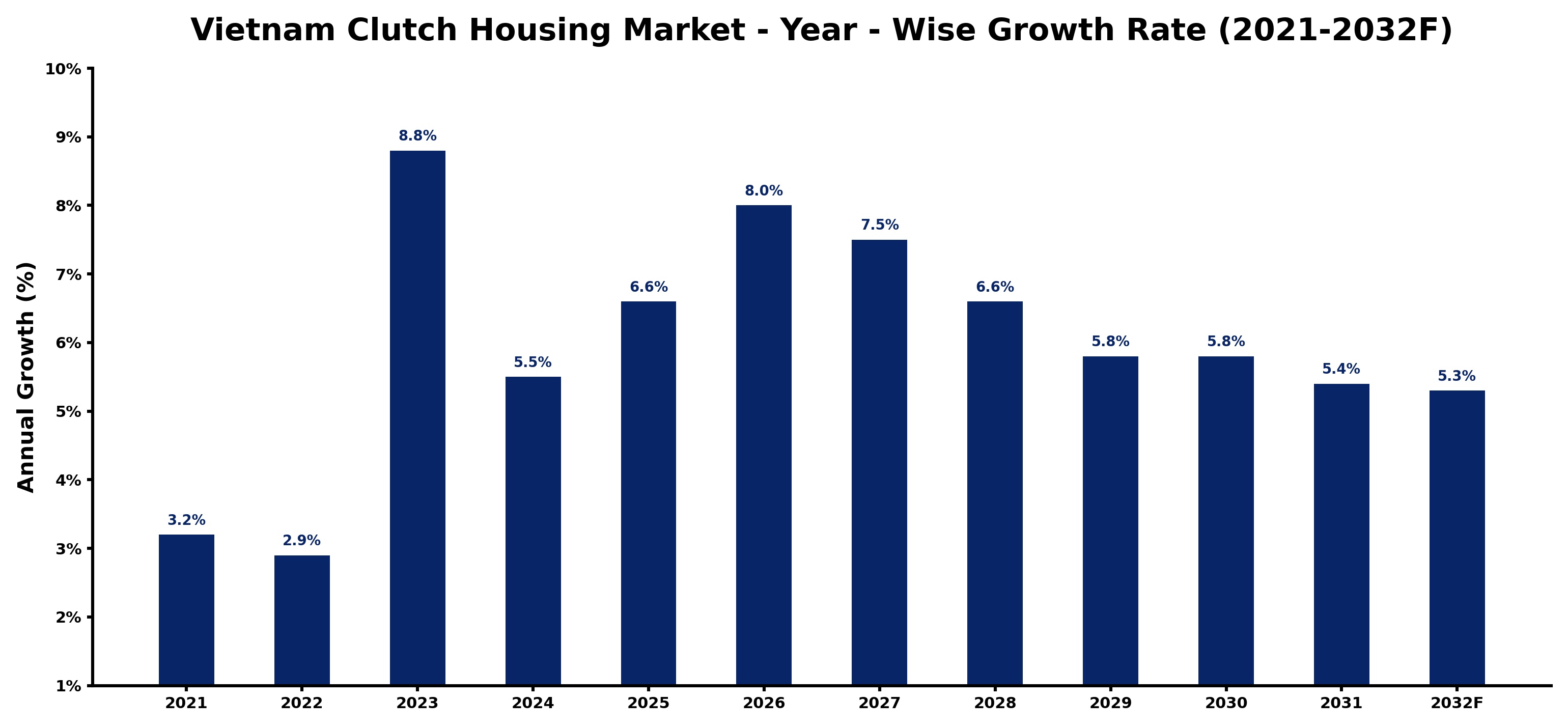
The table below presents the year‑wise growth rates along with the key drivers influencing the market
| Year | Growth Rate | Major Drivers |
| 2021 | 3.2% | Capacity optimization initiatives boosted clutch housing production efficiency |
| 2022 | 2.9% | Automotive assembly line upgrades drive precision clutch housing production |
| 2023 | 8.8% | Foreign investments in automotive sector boost clutch housing production capacity |
| 2024 | 5.5% | Foreign direct investments boosted local clutch housing production capabilities |
| 2025 | 6.6% | Foreign investments boosted local production capabilities for clutch housings |
| 2026 | 8.0% | Foreign direct investment boosts local clutch housing manufacturing capabilities |
| 2027 | 7.5% | Foreign investments drive automation in clutch housing manufacturing operations |
| 2028 | 6.6% | Automotive assembly line upgrades fueled clutch housing production efficiency |
| 2029 | 5.8% | Foreign investments boost local clutch housing manufacturing capabilities |
| 2030 | 5.8% | Export driven automation adoption boosts clutch housing manufacturing efficiency |
| 2031 | 5.4% | Strategic production line upgrades boosted clutch housing manufacturing efficiency |
| 2032 | 5.3% | Foreign investments boosted automotive clutch housing production capacity |
Note - Market size estimations and growth projections presented in this report are based on 6Wresearch's advanced forecasting approach, validated with industry datasets as of June 2026.
Vietnam Clutch Housing Market Synopsis
Recent growth in the Vietnam Clutch Housing market reflects a resilient automotive sector, particularly following the challenges posed during the COVID-19 pandemic. While initial disruptions slowed production and led to demand fluctuations, the market is now poised for recovery as automotive manufacturing regains momentum.
Looking ahead, the outlook remains optimistic, with anticipated innovations in clutch technologies and materials poised to enhance market dynamics. The push for fuel-efficient vehicles complements ongoing urbanization, further solidifying the role of clutch housing in Vietnam's automotive landscape.
Vietnam Clutch Housing Market Key Takeaways
- The market is closely linked to the automotive industry's growth and vehicle production rates.
- Technological advancements in clutch materials and designs are driving innovation in the sector.
- The demand for commercial vehicles remains a key growth factor.
- COVID-19 pandemic effects are receding, paving the way for a robust market recovery.
- Urbanization and population growth in Vietnam are fueling transportation demands, impacting clutch housing needs.
Evaluation of Restraints in Vietnam Clutch Housing Market
The Vietnam Clutch Housing market faces several constraints that can impact its growth trajectory. The dependence on the automotive industry's performance can lead to volatility, particularly during economic downturns when consumer spending on vehicles may decline. Additionally, fluctuating government policies and trade regulations can affect manufacturing dynamics and supply chains. Market participants must remain vigilant and adaptable, utilizing strategic planning to mitigate risks associated with these external factors.
Vietnam Clutch Housing Market Trends
Current trends indicate a shift towards the adoption of lightweight and durable materials for clutch housings, aimed at enhancing vehicle performance and fuel efficiency. There is also a growing focus on sustainability, as manufacturers seek to develop environmentally friendly products that comply with increasing regulations. Additionally, the integration of advanced technologies in clutch systems, such as digital monitoring tools, is becoming increasingly prevalent, providing end-users with enhanced operational capabilities and insights.
Vietnam Clutch Housing Market Opportunities
Genuine growth opportunities lie in the ongoing modernization of Vietnam's automotive industry. As local manufacturers strive to meet international standards, there is potential for investment in research and development to create innovative clutch housing solutions. Furthermore, emerging electric and hybrid vehicle markets present a unique avenue for tailored clutch housing designs that cater to new drivetrain technologies, offering a promising landscape for market players.
Government Initiatives in the Vietnam Clutch Housing Market
Vietnam's government has initiated several policies aimed at boosting the automotive sector, which directly impacts the clutch housing market. Programs designed to promote green technology and sustainable manufacturing practices are gaining traction, aligning with global environmental standards. Incentives for local production, alongside investments in infrastructure, are expected to enhance market conditions for clutch housing components in the coming years.
Future Insights of the Vietnam Clutch Housing Market
The future of the Vietnam Clutch Housing market from 2026 to 2032 is expected to be characterized by sustained growth, driven by the revival of the automotive industry and technological advancements. As vehicle manufacturers increasingly focus on producing more fuel-efficient and technologically advanced vehicles, the demand for innovative clutch housing solutions will continue to rise. The market's ability to adapt to changing consumer preferences and technological demands will be crucial to capturing future growth opportunities.
Vietnam Clutch Housing Market Latest Developments (May 2025 - June 2026)
Recent developments within the Vietnam Clutch Housing market reveal a marked shift towards increased collaboration between manufacturers and automotive OEMs. There has been a noticeable uptick in investments focused on R&D for advanced clutch technologies, driven by the push for fuel-efficient vehicles. Additionally, industry players are enhancing their supply chain capabilities in response to the challenges faced during the pandemic, positioning themselves for long-term success in a rapidly evolving market environment.
Vietnam Clutch Housing Market - Key Attractiveness of the Report
- 10 Years of Market Numbers
- Historical Data Starting from 2022 to 2025
- Base Year: 2025
- Forecast Data until 2032
- Key Performance Indicators Impacting the Market
- Major Upcoming Developments and Projects
Key Highlights of the Report:
- Vietnam Clutch Housing Market Outlook
- Market Size of Vietnam Clutch Housing Market, 2025
- Forecast of Vietnam Clutch Housing Market, 2032
- Historical Data and Forecast of Vietnam Clutch Housing Revenues & Volume for the Period 2022-2032F
- Vietnam Clutch Housing Market Trend Evolution
- Vietnam Clutch Housing Market Drivers and Challenges
- Vietnam Clutch Housing Price Trends
- Vietnam Clutch Housing Porter's Five Forces
- Vietnam Clutch Housing Industry Life Cycle
- Historical Data and Forecast of Vietnam Clutch Housing Market Revenues & Volume By Type for the Period 2022-2032F
- Historical Data and Forecast of Vietnam Clutch Housing Market Revenues & Volume By Heavy Clutch Housing for the Period 2022-2032F
- Historical Data and Forecast of Vietnam Clutch Housing Market Revenues & Volume By Large Clutch Housing for the Period 2022-2032F
- Historical Data and Forecast of Vietnam Clutch Housing Market Revenues & Volume By Small Clutch Housing for the Period 2022-2032F
- Historical Data and Forecast of Vietnam Clutch Housing Market Revenues & Volume By Application for the Period 2022-2032F
- Historical Data and Forecast of Vietnam Clutch Housing Market Revenues & Volume By OEM(Original Equipment Manufacturers) for the Period 2022-2032F
- Historical Data and Forecast of Vietnam Clutch Housing Market Revenues & Volume By Aftermarket for the Period 2022-2032F
- Historical Data and Forecast of Vietnam Clutch Housing Market Revenues & Volume By Material Type for the Period 2022-2032F
- Historical Data and Forecast of Vietnam Clutch Housing Market Revenues & Volume By Cast Iron for the Period 2022-2032F
- Historical Data and Forecast of Vietnam Clutch Housing Market Revenues & Volume By Aluminium for the Period 2022-2032F
- Historical Data and Forecast of Vietnam Clutch Housing Market Revenues & Volume By Others for the Period 2022-2032F
- Vietnam Clutch Housing Import Export Trade Statistics
- Market Opportunity Assessment By Type
- Market Opportunity Assessment By Application
- Market Opportunity Assessment By Material Type
- Vietnam Clutch Housing Top Companies Market Share
- Vietnam Clutch Housing Competitive Benchmarking By Technical and Operational Parameters
- Vietnam Clutch Housing Company Profiles
- Vietnam Clutch Housing Key Strategic Recommendations






































