Vietnam Coated Fabric Market Size, Share & Growth Rate
The Vietnam Coated Fabric Market was estimated at USD 436 Million in 2025 and is projected to reach USD 615 Million by 2032, growing at a CAGR of 5.0% from 2026 to 2032. This growth trajectory is fueled by an increasing demand for durable materials across various sectors, particularly in automotive and outdoor applications, as well as expanding tourism activities that require high-quality upholstery solutions. Additionally, governmental support for the textile industry further enhances the market's prospects, paving the way for innovation and competitive manufacturing practices.
Vietnam Coated Fabric Market Growth Rate Analysis (2021-2032)
The Vietnam coated fabric market has experienced a notable upward trend over the past few years, with growth rates of 3.4% in 2021 and 2.7% in 2022 reflecting initial post-pandemic recovery. A significant rebound occurred in 2023, with an impressive growth of 8.3%, driven primarily by increasing consumer demand in sectors such as automotive and construction. The momentum is expected to continue, with forecasts suggesting further growth of 5.6% in 2024 and peaking at 8.0% in 2026, thanks to advancements in technology and sustainable practices. However, growth is projected to stabilize around 5.5% by 2030, as manufacturers adapt to evolving regulatory frameworks and infrastructure developments.
Vietnam Coated Fabric Market Year-wise Growth Rate and Key Drivers
This graph highlights how the Vietnam Coated Fabric Market has steadily grown over the past five years, supported by major growth factors.
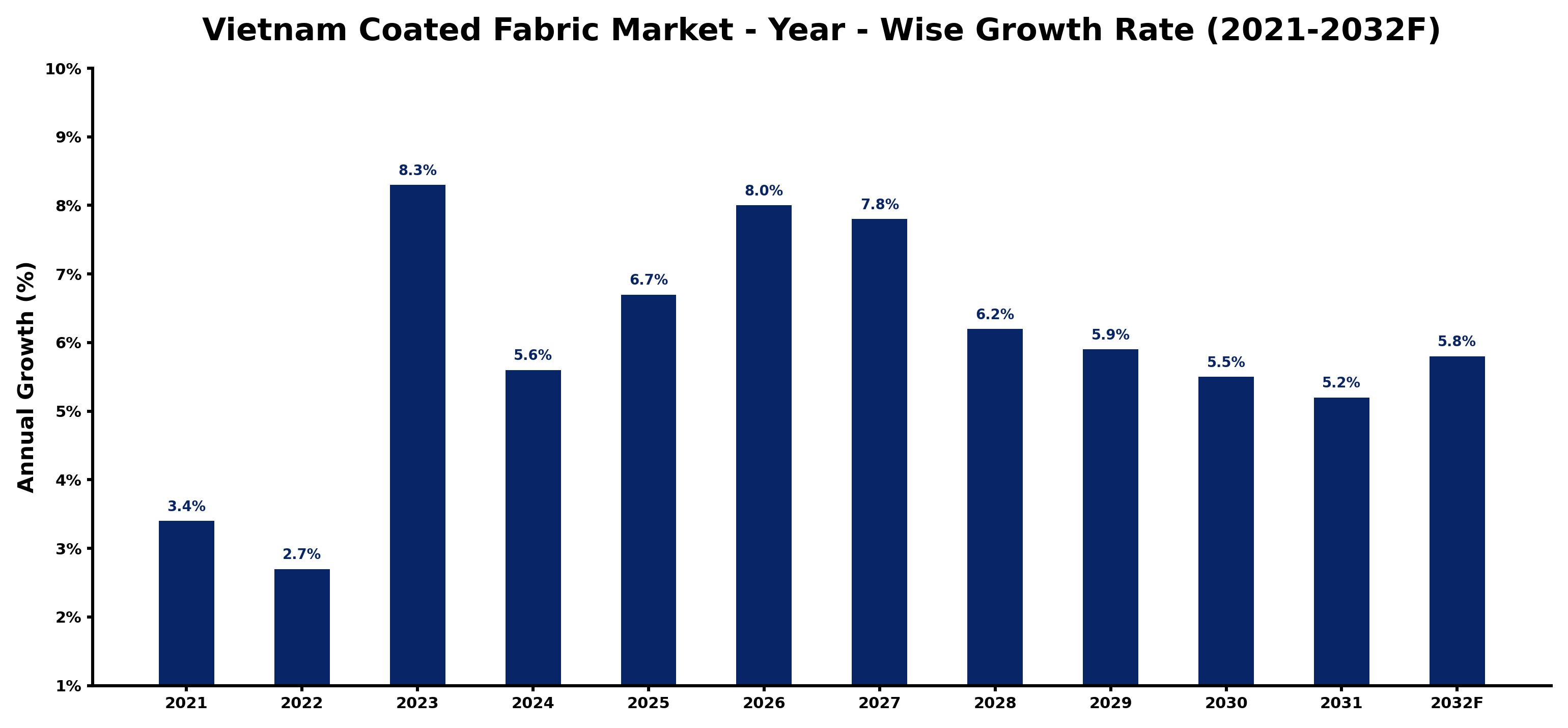
The table below presents the year‑wise growth rates along with the key drivers influencing the market
| Year | Growth Rate | Major Drivers |
| 2021 | 3.4% | Expansion of commercial construction activities |
| 2022 | 2.7% | Increasing industrial automation investments |
| 2023 | 8.3% | Expansion of commercial construction activities |
| 2024 | 5.6% | Expansion of manufacturing activities |
| 2025 | 6.7% | Increasing adoption of advanced technologies |
| 2026 | 8.0% | Increasing industrial automation investments |
| 2027 | 7.8% | Increasing smart city development projects |
| 2028 | 6.2% | Increasing smart city development projects |
| 2029 | 5.9% | Increasing industrial automation investments |
| 2030 | 5.5% | Government infrastructure modernization initiatives |
| 2031 | 5.2% | Expansion of transportation and logistics networks |
| 2032 | 5.8% | Expansion of manufacturing activities |
Note - Market size estimations and growth projections presented in this report are based on 6Wresearch's advanced forecasting approach, validated with industry datasets as of June 2026.
Vietnam Coated Fabric Market Synopsis
In recent years, the Vietnam Coated Fabric Market has emerged as a crucial segment within the broader textile and materials industry. The integration of advanced manufacturing techniques and the adoption of high-performance coatings have positioned Vietnam as a significant player in the global supply chain, catering to diverse industrial needs.
As Vietnam continues to enhance its industrial capabilities, the demand for coated fabrics—characterized by their versatility and resistance to environmental factors—has witnessed a marked increase. This trend is particularly evident within sectors such as automotive and outdoor recreation, where the need for reliable and aesthetically appealing materials is paramount.
Vietnam Coated Fabric Market Key Takeaways
- The market is poised for steady growth, driven by rising consumer demand for durable and weather-resistant materials.
- Government initiatives aimed at bolstering the textile sector significantly influence market development.
- Technological advancements play a key role in enhancing the performance and appeal of coated fabrics.
- Environmental sustainability remains a focal point, pushing manufacturers to innovate in eco-friendly practices.
- Tourism sector growth is creating new avenues for coated fabric applications in upholstery and interior design.
Evaluation of Restraints in Vietnam Coated Fabric Market
Despite its promising outlook, the Vietnam Coated Fabric Market faces several constraints that could hinder its growth. Increasing environmental regulations necessitate significant adjustments in manufacturing processes, as the industry must comply with stricter standards on chemical usage and waste management. Furthermore, the reliance on global supply chains exposes the market to potential disruptions, particularly in raw material sourcing, which can lead to fluctuations in prices and availability. Manufacturers must navigate these challenges while maintaining a commitment to sustainability and innovation.
Vietnam Coated Fabric Market Trends
Currently, there is a notable shift towards sustainable production practices, with many manufacturers investing in eco-friendly materials and processes. This trend aligns with global consumer preferences for environmentally responsible products. Additionally, technological advancements are leading to improved coating technologies, enhancing the durability and functionality of coated fabrics. The increasing integration of smart textiles into various applications further indicates a transformative phase for the market.
Vietnam Coated Fabric Market Opportunities
The growth potential in the Vietnam Coated Fabric Market is substantial, particularly in the automotive and outdoor sectors. As these industries expand, there is a demand for innovative and high-performance materials that can withstand extreme conditions. Moreover, the rise of tourism offers new prospects for coated fabrics in the hospitality sector, with applications in decorative upholstery and practical outdoor gear. Strategic partnerships and investments in research and development can further unlock opportunities for market players.
Government Initiatives in the Vietnam Coated Fabric Market
The Vietnamese government has implemented several initiatives aimed at strengthening the textile and garment industry, recognizing its vital role in the national economy. These initiatives include support for technological upgrades, incentives for sustainable practices, and efforts to boost exports. By fostering an environment conducive to growth, the government aims to position Vietnam as a competitive leader in the global coated fabric market.
Future Insights of the Vietnam Coated Fabric Market
Looking ahead to 2026-2032, the Vietnam Coated Fabric Market is expected to experience significant transformations driven by evolving consumer preferences and technological advancements. The focus on sustainability will intensify, urging manufacturers to innovate continually and develop eco-friendlier products. Furthermore, as Vietnam's manufacturing capabilities expand, there is likely to be a greater emphasis on exports, establishing the country as a central hub in the coated fabrics supply chain.
Vietnam Coated Fabric Market Latest Developments (May 2025 - June 2026)
Recently, there has been a noticeable uptick in collaborations between textile manufacturers and technology firms to enhance production processes and product offerings. Efforts to incorporate sustainable materials have been particularly prominent, with several companies launching initiatives aimed at reducing their environmental footprint. Additionally, the market is witnessing an increase in demand for specialty coated fabrics tailored for specific industrial applications, reflecting a dynamic shift in consumer needs.
Vietnam Coated Fabric Market - Key Attractiveness of the Report
- 10 Years of Market Numbers
- Historical Data Starting from 2022 to 2025
- Base Year: 2025
- Forecast Data until 2032
- Key Performance Indicators Impacting the Market
- Major Upcoming Developments and Projects
Key Highlights of the Report:
- Vietnam Coated Fabric Market Outlook
- Market Size of Vietnam Coated Fabric Market, 2025
- Forecast of Vietnam Coated Fabric Market, 2032F
- Historical Data and Forecast of Vietnam Coated Fabric Revenues & Volume for the Period 2022-2032F
- Vietnam Coated Fabric Market Trend Evolution
- Vietnam Coated Fabric Market Drivers and Challenges
- Vietnam Coated Fabric Price Trends
- Vietnam Coated Fabric Porter's Five Forces
- Vietnam Coated Fabric Industry Life Cycle
- Historical Data and Forecast of Vietnam Coated Fabric Market Revenues & Volume By Product for the Period 2022-2032F
- Historical Data and Forecast of Vietnam Coated Fabric Market Revenues & Volume By Polymer-coated Fabric for the Period 2022-2032F
- Historical Data and Forecast of Vietnam Coated Fabric Market Revenues & Volume By Rubber-coated Fabric for the Period 2022-2032F
- Historical Data and Forecast of Vietnam Coated Fabric Market Revenues & Volume By Fabric-backed Wall Coverings for the Period 2022-2032F
- Historical Data and Forecast of Vietnam Coated Fabric Market Revenues & Volume By Application for the Period 2022-2032F
- Historical Data and Forecast of Vietnam Coated Fabric Market Revenues & Volume By Transportation for the Period 2022-2032F
- Historical Data and Forecast of Vietnam Coated Fabric Market Revenues & Volume By Protective Clothing for the Period 2022-2032F
- Historical Data and Forecast of Vietnam Coated Fabric Market Revenues & Volume By Industrial for the Period 2022-2032F
- Historical Data and Forecast of Vietnam Coated Fabric Market Revenues & Volume By Roofing, Awnings & Canopies for the Period 2022-2032F
- Historical Data and Forecast of Vietnam Coated Fabric Market Revenues & Volume By Furniture & Seating for the Period 2022-2032F
- Historical Data and Forecast of Vietnam Coated Fabric Market Revenues & Volume By Others for the Period 2022-2032F
- Vietnam Coated Fabric Import Export Trade Statistics
- Market Opportunity Assessment By Product
- Market Opportunity Assessment By Application
- Vietnam Coated Fabric Top Companies Market Share
- Vietnam Coated Fabric Competitive Benchmarking By Technical and Operational Parameters
- Vietnam Coated Fabric Company Profiles
- Vietnam Coated Fabric Key Strategic Recommendations






































