Vietnam Cognitive Analytics Market Size & Growth Rate (2026-2032)
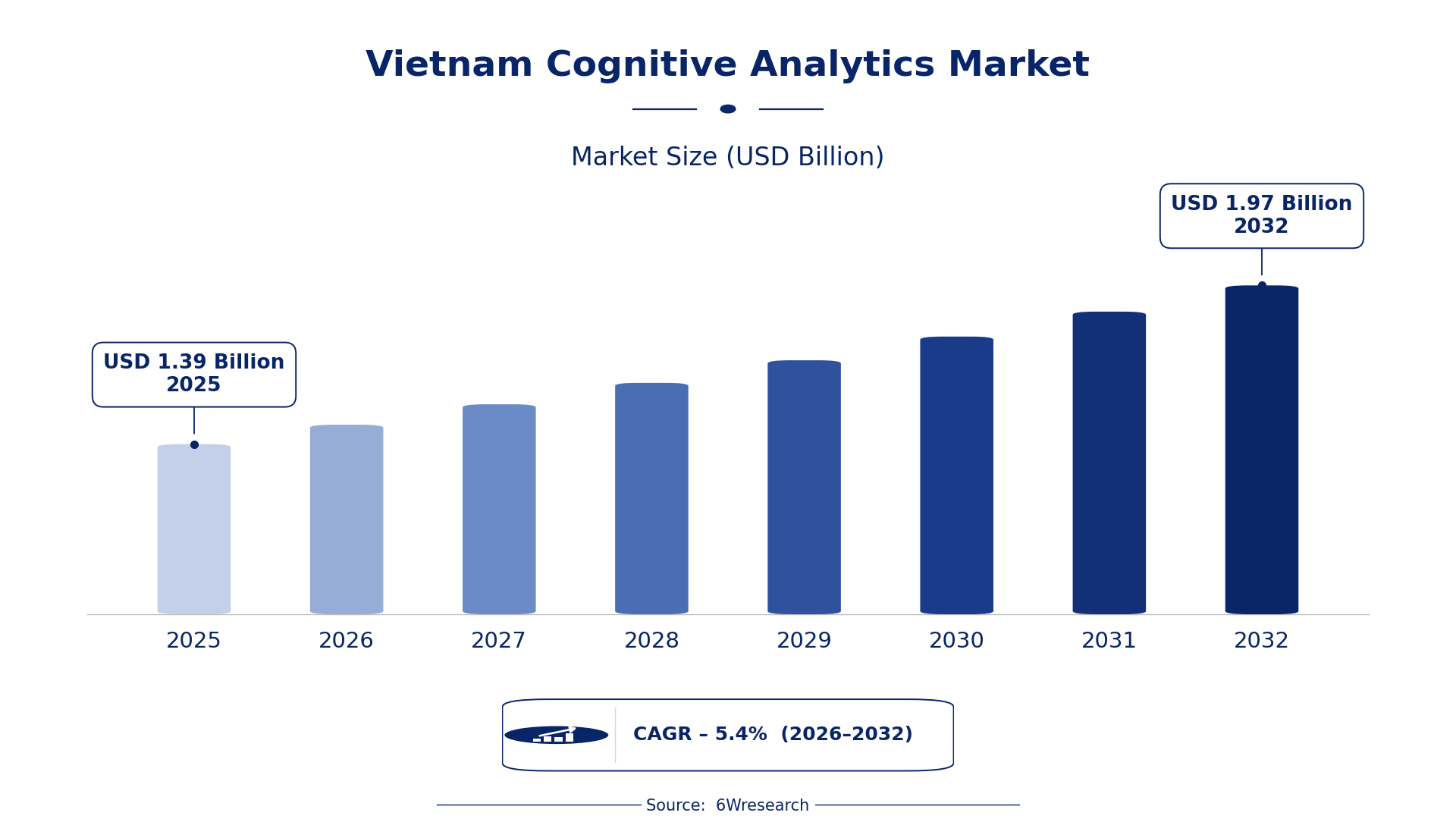
The Vietnam Cognitive Analytics Market was estimated at USD 1386 Million in 2025 and is projected to reach USD 1968 Million by 2032, growing at a CAGR of 5.4% from 2026 to 2032.
Vietnam Cognitive Analytics Market Synopsis
In Vietnam, the cognitive analytics market is rapidly gaining traction as businesses strive to harness the power of data-driven insights. Companies are increasingly integrating AI technologies to analyze massive volumes of data, enabling them to make informed decisions that enhance their competitive edge.
This market is not just about technology; it’s about transforming business strategies. Organizations are using cognitive analytics to predict customer behavior, optimize supply chains, and improve overall operational efficiency, reflecting a substantial shift in how data is perceived and utilized in Vietnam.
Vietnam Cognitive Analytics Market Year-wise Growth Rate and Key Drivers
This graph illustrates the annual growth rates of the Vietnam Cognitive Analytics Market from 2021 to 2032, highlighting a steady upward trajectory and projected expansion over the forecast period.
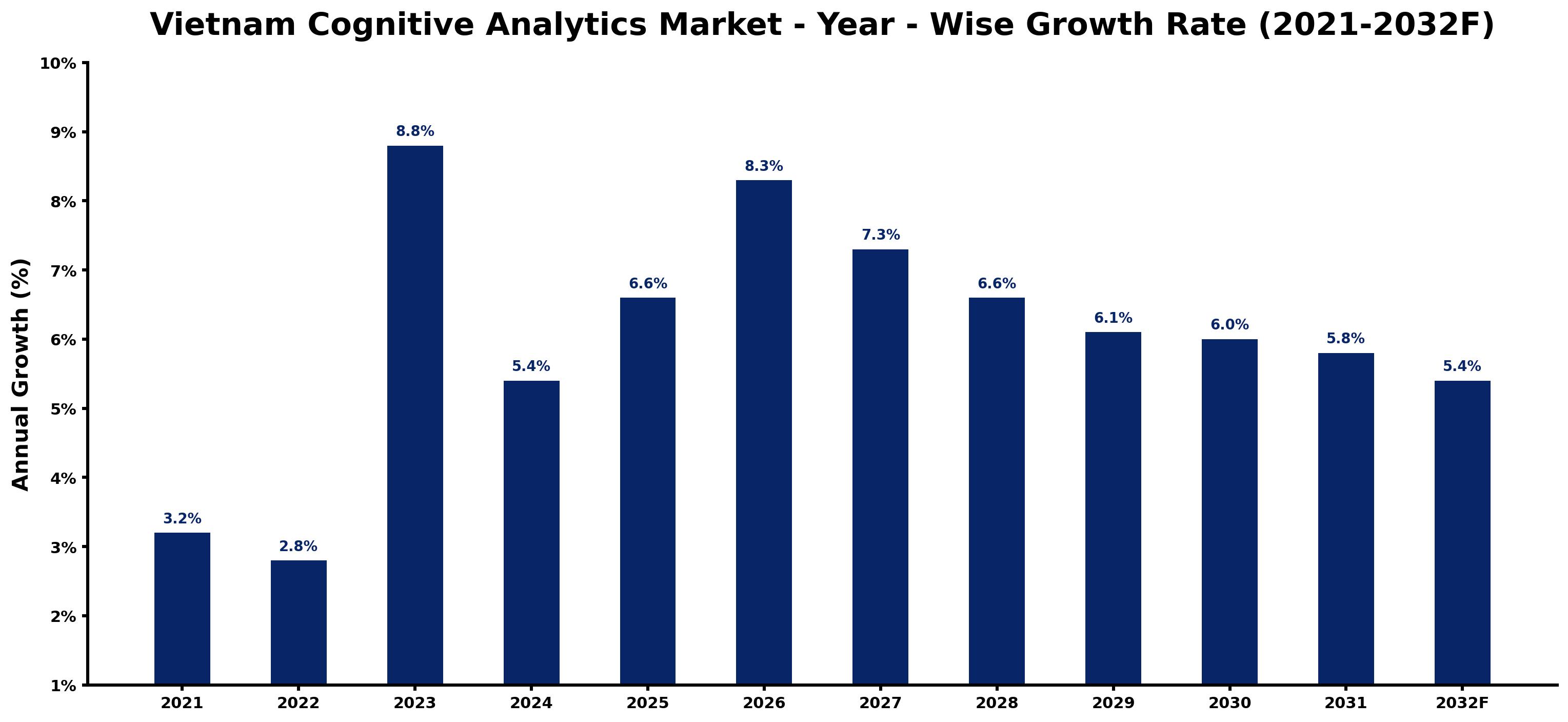
The table below presents the year‑wise growth rates along with the key drivers influencing the market
| Year | Growth Rate | Major Drivers |
| 2021 | 3.2% | Vietnamese startups adopting AI for market predictions. |
| 2022 | 2.8% | Government's AI Strategy 2020 boosting cognitive tech investments. |
| 2023 | 8.8% | Surge in e-commerce driving analytics adoption in Vietnam. |
| 2024 | 5.4% | Local universities enhancing AI curriculum for skilled workforce. |
| 2025 | 6.6% | Increased foreign direct investment in tech innovation sectors. |
| 2026 | 8.3% | Growing interest in personalized marketing analytics among retailers. |
| 2027 | 7.3% | Healthcare sector integrating cognitive analytics for patient insights. |
| 2028 | 6.6% | Telecom companies expanding AI capabilities for network optimization. |
| 2029 | 6.1% | Government's support for smart agriculture utilizing cognitive tools. |
| 2030 | 6.0% | Digital transformation mandates in banking driving analytics usage. |
| 2031 | 5.8% | Rise of cloud computing adoption enhancing data analytics capacity. |
| 2032 | 5.4% | Local enterprises fostering partnerships with AI technology providers. |
Note: Market size estimations and growth projections presented in this report are based on 6Wresearch's proprietary forecasting methodology, utilizing the latest available industry data, government publications, and primary research inputs.
Vietnam Cognitive Analytics Market Key Takeaways
Below are some of the specific key takeaways from the market, including:
- The market is driven by the increasing demand for actionable insights from data.
- Government initiatives supporting digital transformation are boosting market growth.
- COVID-19 accelerated the adoption of cognitive analytics across various sectors.
- Educational gaps regarding cognitive analytics’ benefits remain a challenge.
- Data quality and privacy issues are critical considerations for businesses.
Evaluation of Restraints in Vietnam Cognitive Analytics Market
One of the most pressing restraints in the Vietnam cognitive analytics market is the widespread lack of understanding among businesses regarding the capabilities and benefits of these advanced technologies. Many organizations are hesitant to invest in cognitive analytics, fearing high costs and complexity in integration with existing systems. on top of that, issues surrounding data quality, accessibility, and privacy present significant barriers that companies must navigate to fully realize the potential of cognitive analytics. Without targeted education and support, the market may struggle to reach its full capacity.
Vietnam Cognitive Analytics Market Trends
Several trends are shaping the cognitive analytics landscape in Vietnam. Businesses are increasingly adopting AI-driven solutions to enhance customer personalization, leading to improved satisfaction and loyalty. The rise of big data technologies is also prompting companies to invest in cognitive analytics to manage and interpret vast amounts of unstructured data effectively. on top of that, the collaborative efforts between tech firms and educational institutions are fostering a skilled workforce capable of leveraging these advanced analytics tools.
Vietnam Cognitive Analytics Market Opportunities
There are substantial growth opportunities in the Vietnam cognitive analytics market, particularly within sectors such as retail, healthcare, and finance. As organizations prioritize data-driven strategies, the demand for customized cognitive solutions is set to rise. Additionally, the growth of data-driven startups presents a unique opportunity for established firms to collaborate and innovate, ultimately driving market expansion. Investment in training and awareness programs will also pave the way for increased adoption of cognitive analytics across various industries.
Government Initiatives in the Vietnam Cognitive Analytics Market
The Vietnamese government is taking proactive steps to foster a conducive environment for the cognitive analytics market. With a focus on digital transformation, public policies are increasingly aligning with technological advancements, enhancing the regulatory framework for businesses. These initiatives are vital for ensuring that Vietnam remains competitive in the global digital economy.
- A national digital transformation strategy launched in 2025 aims to integrate advanced analytics into public sector operations.
- Current initiatives include partnerships between government agencies and private firms to promote cognitive technologies across various industries.
- Ongoing training programs for workforce upskilling are being implemented to create a talent pool proficient in data analytics.
- A planned regulatory framework expected to be introduced by 2026 will address data privacy and security concerns in the analytics domain.
Future Insights of the Vietnam Cognitive Analytics Market
Looking ahead to 2026-2032, the Vietnam cognitive analytics market is expected to experience steady growth, driven by an increasing number of businesses recognizing the value of data insights. As AI technology continues to evolve, companies will seek more sophisticated analytics solutions to stay competitive. The integration of cognitive analytics with other emerging technologies, such as IoT and blockchain, will likely create new avenues for innovation and operational excellence. The focus on enhancing customer experiences will remain a key driver for investment in this space.
Vietnam Cognitive Analytics Market Latest Developments
Recent activity in the Vietnam cognitive analytics market highlights a surge in innovation and investment as companies seek to enhance their analytical capabilities. Over the past year, organizations have increasingly prioritized cognitive analytics as a strategic imperative, leading to numerous developments in the field.
- A major technology vendor launched an AI-powered analytics platform in early 2025, aimed at small and medium enterprises.
- An initiative that began in late 2025 focuses on enhancing data analytics capabilities within the healthcare sector, improving patient care services.
- Several partnerships between local tech startups and global analytics firms are currently underway to develop tailored cognitive solutions.
- A rollout of a new educational program designed to boost data literacy among business leaders is expected to begin in Q2 2026.
Vietnam Cognitive Analytics Market - Key Attractiveness of the Report
- 10 Years of Market Numbers
- Historical Data Starting from 2022 to 2025
- Base Year: 2025
- Forecast Data until 2032
- Key Performance Indicators Impacting the Market
- Major Upcoming Developments and Projects
What are the government’s priorities regarding cognitive analytics?
Key Highlights of the Report:
- Vietnam Cognitive Analytics Market Outlook
- Market Size of Vietnam Cognitive Analytics Market, 2025
- Forecast of Vietnam Cognitive Analytics Market, 2032
- Historical Data and Forecast of Vietnam Cognitive Analytics Revenues & Volume for the Period 2022-2032F
- Vietnam Cognitive Analytics Market Trend Evolution
- Vietnam Cognitive Analytics Market Drivers and Challenges
- Vietnam Cognitive Analytics Price Trends
- Vietnam Cognitive Analytics Porter's Five Forces
- Vietnam Cognitive Analytics Industry Life Cycle
- Historical Data and Forecast of Vietnam Cognitive Analytics Market Revenues & Volume By Application for the Period 2022-2032F
- Historical Data and Forecast of Vietnam Cognitive Analytics Market Revenues & Volume By Automation for the Period 2022-2032F
- Historical Data and Forecast of Vietnam Cognitive Analytics Market Revenues & Volume By Intelligent Virtual Assistants for the Period 2022-2032F
- Historical Data and Forecast of Vietnam Cognitive Analytics Market Revenues & Volume By Behavioral Analysis for the Period 2022-2032F
- Historical Data and Forecast of Vietnam Cognitive Analytics Market Revenues & Volume By Biometrics for the Period 2022-2032F
- Historical Data and Forecast of Vietnam Cognitive Analytics Market Revenues & Volume By Others for the Period 2022-2032F
- Historical Data and Forecast of Vietnam Cognitive Analytics Market Revenues & Volume By Component for the Period 2022-2032F
- Historical Data and Forecast of Vietnam Cognitive Analytics Market Revenues & Volume By Platform for the Period 2022-2032F
- Historical Data and Forecast of Vietnam Cognitive Analytics Market Revenues & Volume By Service for the Period 2022-2032F
- Historical Data and Forecast of Vietnam Cognitive Analytics Market Revenues & Volume By Technology for the Period 2022-2032F
- Historical Data and Forecast of Vietnam Cognitive Analytics Market Revenues & Volume By Machine Learning (ML) for the Period 2022-2032F
- Historical Data and Forecast of Vietnam Cognitive Analytics Market Revenues & Volume By Human Computer Interaction for the Period 2022-2032F
- Historical Data and Forecast of Vietnam Cognitive Analytics Market Revenues & Volume By Natural Language Processing (NLP) for the Period 2022-2032F
- Historical Data and Forecast of Vietnam Cognitive Analytics Market Revenues & Volume By Deep Learning for the Period 2022-2032F
- Historical Data and Forecast of Vietnam Cognitive Analytics Market Revenues & Volume By Deployment Mode for the Period 2022-2032F
- Historical Data and Forecast of Vietnam Cognitive Analytics Market Revenues & Volume By On-premise for the Period 2022-2032F
- Historical Data and Forecast of Vietnam Cognitive Analytics Market Revenues & Volume By Cloud for the Period 2022-2032F
- Historical Data and Forecast of Vietnam Cognitive Analytics Market Revenues & Volume By Hybrid for the Period 2022-2032F
- Historical Data and Forecast of Vietnam Cognitive Analytics Market Revenues & Volume By Industry for the Period 2022-2032F
- Historical Data and Forecast of Vietnam Cognitive Analytics Market Revenues & Volume By BFSI for the Period 2022-2032F
- Historical Data and Forecast of Vietnam Cognitive Analytics Market Revenues & Volume By Retail and eCommerce for the Period 2022-2032F
- Historical Data and Forecast of Vietnam Cognitive Analytics Market Revenues & Volume By Telecommunication and IT for the Period 2022-2032F
- Historical Data and Forecast of Vietnam Cognitive Analytics Market Revenues & Volume By Healthcare and Life Sciences for the Period 2022-2032F
- Historical Data and Forecast of Vietnam Cognitive Analytics Market Revenues & Volume By Manufacturing for the Period 2022-2032F
- Historical Data and Forecast of Vietnam Cognitive Analytics Market Revenues & Volume By Government and Defense for the Period 2022-2032F
- Historical Data and Forecast of Vietnam Cognitive Analytics Market Revenues & Volume By Media and Entertainment for the Period 2022-2032F
- Historical Data and Forecast of Vietnam Cognitive Analytics Market Revenues & Volume By Organization Size for the Period 2022-2032F
- Historical Data and Forecast of Vietnam Cognitive Analytics Market Revenues & Volume By Large Enterprises for the Period 2022-2032F
- Historical Data and Forecast of Vietnam Cognitive Analytics Market Revenues & Volume By Small and Medium-Sized Enterprises (SMEs) for the Period 2022-2032F
- Vietnam Cognitive Analytics Import Export Trade Statistics
- Market Opportunity Assessment By Application
- Market Opportunity Assessment By Component
- Market Opportunity Assessment By Technology
- Market Opportunity Assessment By Deployment Mode
- Market Opportunity Assessment By Industry
- Market Opportunity Assessment By Organization Size
- Vietnam Cognitive Analytics Top Companies Market Share
- Vietnam Cognitive Analytics Competitive Benchmarking By Technical and Operational Parameters
- Vietnam Cognitive Analytics Company Profiles
- Vietnam Cognitive Analytics Key Strategic Recommendations






































