Vietnam Commercial Boiler Market Size, Share & Growth Rate
The Vietnam Commercial Boiler Market was estimated at USD 184 Million in 2025 and is projected to reach USD 258 Million by 2032, growing at a CAGR of 4.9% from 2026 to 2032. This upward trajectory is predominantly fueled by the expansion of the hospitality and industrial sectors in Vietnam, where efficient heating solutions are critical. As businesses increasingly prioritize energy efficiency and sustainability, the demand for advanced commercial boiler systems is expected to rise significantly.
Vietnam Commercial Boiler Market Year-wise Growth Rate and Key Drivers
This graph highlights how the Vietnam Commercial Boiler Market has steadily grown over the years, supported by major growth factors.
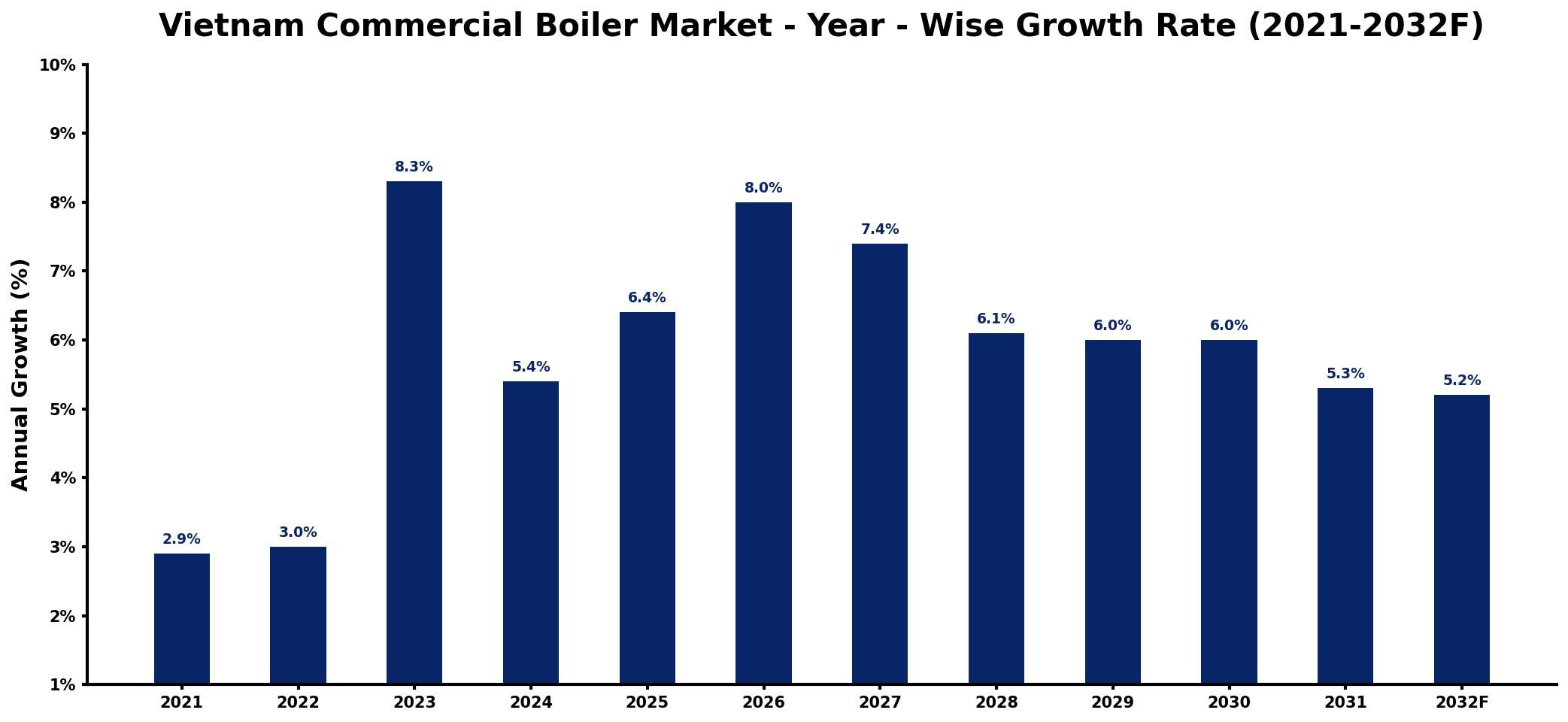
The table below presents the year‑wise growth rates along with the key drivers influencing the market
| Year | Growth Rate | Major Drivers |
| 2021 | 2.9% | Rising energy efficiency regulations |
| 2022 | 3.0% | Growing industrial production capacity |
| 2023 | 8.3% | Increased infrastructure development projects |
| 2024 | 5.4% | Expanding hospitality sector demands |
| 2025 | 6.4% | Surge in renewable energy investments |
| 2026 | 8.0% | Strengthened environmental sustainability initiatives |
| 2027 | 7.4% | Higher demand for energy solutions |
| 2028 | 6.1% | Advancements in technology adoption |
| 2029 | 6.0% | Growing urbanization and population growth |
| 2030 | 6.0% | Increased focus on energy independence |
| 2031 | 5.3% | Emerging markets driving innovation |
| 2032 | 5.2% | Strengthening regulatory compliance requirements |
Note: Market size estimations and growth projections presented in this report are based on 6Wresearch's proprietary forecasting methodology, utilizing the latest available industry data, government publications, and primary research inputs.
Vietnam Commercial Boiler Market Synopsis
The Vietnam commercial boiler market exhibits a distinct demand for high-efficiency heating and hot water systems, particularly from sectors like hospitality and manufacturing. Companies are seeking reliable solutions to meet operational needs while adhering to stricter environmental regulations, driving a shift toward cleaner boiler technologies.
Furthermore, the ongoing transition to sustainable energy practices has prompted many businesses to invest in retrofitting existing systems. This not only enhances operational efficiency but also aligns with national goals for reducing carbon emissions, creating a dynamic environment for innovation and growth in the commercial boiler segment.
Vietnam Commercial Boiler Market Key Takeaways
- Rising demand from the hospitality and industrial sectors fuels market growth.
- The shift toward energy-efficient and environmentally friendly boiler technologies is gaining momentum.
- Regulatory pressure is driving businesses to upgrade to cleaner heating solutions.
- COVID-19 impacted demand but led to increased focus on maintenance and retrofitting services.
- Major companies are expanding their offerings to address evolving customer needs.
Evaluation of Restraints in Vietnam Commercial Boiler Market
Despite the promising growth, the Vietnam commercial boiler market faces significant challenges. Strict energy efficiency and emissions regulations require manufacturers to heavily invest in research and development. This necessity can increase production costs, potentially translating to higher prices for end-users. Additionally, the fluctuating economic climate and supply chain disruptions have affected businesses' willingness to invest in new technologies, hindering the market's overall expansion. Companies must navigate these obstacles carefully while striving to provide competitive and compliant solutions.
Vietnam Commercial Boiler Market Trends
Emerging trends in the Vietnam commercial boiler market are strongly influenced by technological advancements and sustainability efforts. The integration of IoT and automation into boiler systems is becoming prevalent, allowing for enhanced monitoring and control. This trend not only improves efficiency but also aids in predictive maintenance, reducing downtime.
Moreover, the growing emphasis on renewable energy sources is prompting the development of hybrid systems that combine traditional boilers with alternative energy options. These innovations reflect a commitment to sustainability and energy conservation, aligning with the government's push for cleaner technologies.
Vietnam Commercial Boiler Market Opportunities
The Vietnam commercial boiler market presents several lucrative opportunities, particularly in the realm of innovation and sustainability. Companies focusing on developing advanced boiler technologies that meet stringent efficiency standards can tap into a growing customer base eager to reduce operational costs and environmental impact. Additionally, the retrofit and maintenance segment offers a promising avenue as businesses seek to upgrade existing systems rather than invest in entirely new installations.
Furthermore, collaboration with government initiatives aimed at promoting energy efficiency can unlock additional funding and resources for manufacturers and service providers. This strategic alignment can drive growth and foster long-term partnerships within the industry.
Government Initiatives in the Vietnam Commercial Boiler Market
The Vietnamese government is actively promoting initiatives to enhance energy efficiency across various sectors, including the commercial boiler market. Policies aimed at reducing carbon emissions and promoting the adoption of cleaner technologies are becoming increasingly stringent. Government programs often provide incentives for businesses that invest in energy-efficient systems, creating a conducive environment for innovation and growth. Public spending on infrastructure development further supports the demand for reliable heating solutions, positioning the commercial boiler market favorably for future expansion.
Future Insights of the Vietnam Commercial Boiler Market
Looking forward to the period between 2026 and 2032, the Vietnam commercial boiler market is expected to continue its upward trajectory. The integration of advanced technologies, combined with a strong push towards sustainability, will likely dominate market dynamics. As industries embrace greener alternatives, the demand for innovative boiler solutions that align with regulatory requirements will increase.
Moreover, as the economy recovers from the impacts of COVID-19, pent-up demand from the hospitality and manufacturing sectors will stimulate market growth. Companies that adapt quickly to changing regulations and consumer expectations will find themselves well-positioned in this evolving landscape.
Vietnam Commercial Boiler Market Latest Developments (2025 - 2026)
Recent developments in the Vietnam commercial boiler market indicate a shift towards more sophisticated and sustainable boiler systems. Manufacturers are increasingly investing in R&D to enhance product efficiency and reduce emissions. Additionally, partnerships between technology providers and boiler manufacturers are emerging to create integrated solutions that cater to evolving industry demands. The emphasis on maintenance services has also grown, as businesses look to extend the lifespan of existing systems while adhering to new regulatory standards.
Vietnam Commercial Boiler Market - Key Attractiveness of the Report
- 10 Years of Market Numbers
- Historical Data Starting from 2022 to 2025
- Base Year: 2025
- Forecast Data until 2032
- Key Performance Indicators Impacting the Market
- Major Upcoming Developments and Projects
Key Highlights of the Report:
- Vietnam Commercial Boiler Market Outlook
- Market Size of Vietnam Commercial Boiler Market, 2025
- Forecast of Vietnam Commercial Boiler Market, 2032
- Historical Data and Forecast of Vietnam Commercial Boiler Revenues & Volume for the Period 2022-2032F
- Vietnam Commercial Boiler Market Trend Evolution
- Vietnam Commercial Boiler Market Drivers and Challenges
- Vietnam Commercial Boiler Price Trends
- Vietnam Commercial Boiler Porter's Five Forces
- Vietnam Commercial Boiler Industry Life Cycle
- Historical Data and Forecast of Vietnam Commercial Boiler Market Revenues & Volume By Fuel Type for the Period 2022-2032F
- Historical Data and Forecast of Vietnam Commercial Boiler Market Revenues & Volume By Natural Gas for the Period 2022-2032F
- Historical Data and Forecast of Vietnam Commercial Boiler Market Revenues & Volume By Oil for the Period 2022-2032F
- Historical Data and Forecast of Vietnam Commercial Boiler Market Revenues & Volume By Coal for the Period 2022-2032F
- Historical Data and Forecast of Vietnam Commercial Boiler Market Revenues & Volume By Others for the Period 2022-2032F
- Historical Data and Forecast of Vietnam Commercial Boiler Market Revenues & Volume By Technology for the Period 2022-2032F
- Historical Data and Forecast of Vietnam Commercial Boiler Market Revenues & Volume By Condensing for the Period 2022-2032F
- Historical Data and Forecast of Vietnam Commercial Boiler Market Revenues & Volume By Non-Condensing for the Period 2022-2032F
- Historical Data and Forecast of Vietnam Commercial Boiler Market Revenues & Volume By Capacity for the Period 2022-2032F
- Historical Data and Forecast of Vietnam Commercial Boiler Market Revenues & Volume By Less than 10 MMBtu/hr for the Period 2022-2032F
- Historical Data and Forecast of Vietnam Commercial Boiler Market Revenues & Volume By 10-50 MMBtu/hr for the Period 2022-2032F
- Historical Data and Forecast of Vietnam Commercial Boiler Market Revenues & Volume By Others for the Period 2022-2032F
- Historical Data and Forecast of Vietnam Commercial Boiler Market Revenues & Volume By End User for the Period 2022-2032F
- Historical Data and Forecast of Vietnam Commercial Boiler Market Revenues & Volume By Offices for the Period 2022-2032F
- Historical Data and Forecast of Vietnam Commercial Boiler Market Revenues & Volume By Hospitals for the Period 2022-2032F
- Historical Data and Forecast of Vietnam Commercial Boiler Market Revenues & Volume By Educational Institutions for the Period 2022-2032F
- Historical Data and Forecast of Vietnam Commercial Boiler Market Revenues & Volume By Lodging for the Period 2022-2032F
- Historical Data and Forecast of Vietnam Commercial Boiler Market Revenues & Volume By Others for the Period 2022-2032F
- Vietnam Commercial Boiler Import Export Trade Statistics
- Market Opportunity Assessment By Fuel Type
- Market Opportunity Assessment By Technology
- Market Opportunity Assessment By Capacity
- Market Opportunity Assessment By End User
- Vietnam Commercial Boiler Top Companies Market Share
- Vietnam Commercial Boiler Competitive Benchmarking By Technical and Operational Parameters
- Vietnam Commercial Boiler Company Profiles
- Vietnam Commercial Boiler Key Strategic Recommendations






































