Vietnam Compostable Plastic Market Size, Share & Growth Rate
The Vietnam Compostable Plastic Market was estimated at USD 166 Million in 2025 and is projected to reach USD 235 Million by 2032, growing at a CAGR of 5.1% from 2026 to 2032. This growth trajectory is bolstered by heightened environmental awareness and the rising need for sustainable alternatives to traditional plastics. As both consumers and businesses pivot towards eco-friendly solutions, the demand for compostable plastics is accelerating, particularly within the packaging and foodservice sectors.
Vietnam Compostable Plastic Market Year-wise Growth Rate and Key Drivers
This graph highlights how the Vietnam Compostable Plastic Market has steadily grown over the years, supported by major growth factors.
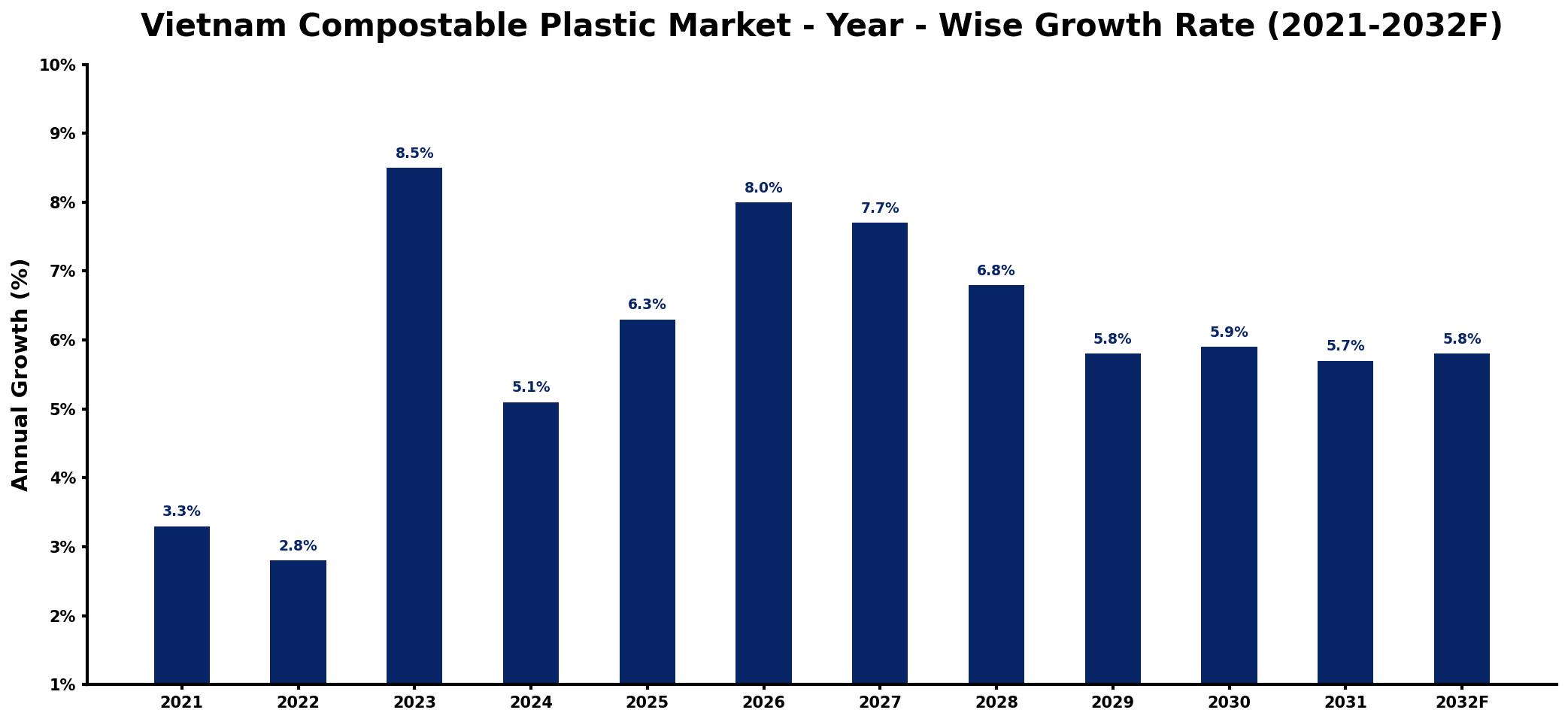
The table below presents the year‑wise growth rates along with the key drivers influencing the market
| Year | Growth Rate | Major Drivers |
| 2021 | 3.3% | Rising environmental awareness campaigns |
| 2022 | 2.8% | Government incentives for sustainable practices |
| 2023 | 8.5% | Increased demand from food packaging |
| 2024 | 5.1% | Growing consumer preference for eco-friendly |
| 2025 | 6.3% | Expansion of retail sustainability initiatives |
| 2026 | 8.0% | Investment in innovative materials research |
| 2027 | 7.7% | Strengthening regulations on waste management |
| 2028 | 6.8% | Emergence of new market players |
| 2029 | 5.8% | Rising interest in biodegradable alternatives |
| 2030 | 5.9% | Collaboration between industries and NGOs |
| 2031 | 5.7% | Adoption of circular economy principles |
| 2032 | 5.8% | growing commercial sector adoption |
Note: Market size estimations and growth projections presented in this report are based on 6Wresearch's proprietary forecasting methodology, utilizing the latest available industry data, government publications, and primary research inputs.
Vietnam Compostable Plastic Market Synopsis
A significant force shaping the Vietnam compostable plastic market is the increasing regulatory framework aimed at curbing plastic waste and promoting sustainability. Government initiatives are laying the groundwork for widespread adoption, pushing industries to transition towards biodegradable solutions in their operations.
Additionally, growing consumer consciousness regarding environmental issues further propels market demand. As individuals become more informed about their ecological footprint, the preference for compostable plastics over conventional options is rising, creating opportunities for innovation and investment.
Vietnam Compostable Plastic Market Key Takeaways
- The market is driven by regulatory pressures and environmental advocacy.
- There is a noticeable shift in consumer behavior favoring sustainable products.
- Challenges related to composting infrastructure pose operational hurdles.
- COVID-19 has temporarily influenced market dynamics but renewed interest is emerging.
- Government incentives are playing a crucial role in market growth and adoption.
Evaluation of Restraints in Vietnam Compostable Plastic Market
Despite the promising growth outlook, the Vietnam compostable plastic market grapples with significant constraints, particularly regarding the current lack of adequate composting and recycling infrastructure. These logistical challenges hinder both manufacturers and consumers, as the absence of proper disposal and treatment facilities can diminish the effectiveness of compostable products. Further complicating the situation is the need for increased public awareness and education about compostable plastics and their disposal methods, which remains limited.
Vietnam Compostable Plastic Market Trends
The market is witnessing several key trends. Firstly, an increasing number of companies are integrating innovative materials that enhance the biodegradability of plastic products. Secondly, there is a surge in collaborations among businesses aiming to improve supply chain sustainability through compostable packaging solutions. Lastly, consumer campaigns advocating for environmental stewardship are influencing purchasing patterns, compelling brands to adopt greener practices.
Vietnam Compostable Plastic Market Opportunities
The growth potential in the Vietnam compostable plastic market lies primarily in expanding production capabilities and enhancing technological innovations in material development. New investments aimed at establishing more robust composting facilities can significantly alleviate existing limitations. Moreover, tapping into emerging sectors such as e-commerce and food delivery offers abundant opportunities for eco-friendly packaging solutions, aligning product offerings with consumer preferences.
Government Initiatives in the Vietnam Compostable Plastic Market
The Vietnamese government has taken proactive steps to promote the use of compostable plastics through various policies and public programs. Initiatives aimed at raising awareness about plastic pollution, coupled with regulations encouraging sustainable product development, serve as critical drivers for market growth. Furthermore, public investments in waste management and recycling infrastructure are gradually paving the way for wider acceptance and implementation of compostable solutions.
Future Insights of the Vietnam Compostable Plastic Market
Looking ahead to 2026-2032, the Vietnam compostable plastic market is poised for continued expansion. As regulatory frameworks become more stringent and consumer preferences further shift towards sustainability, market players will need to innovate constantly. This proactive approach will likely result in enhanced product offerings and diversified applications, ensuring that the market remains robust and competitive.
Vietnam Compostable Plastic Market Latest Developments (2025 - 2026)
In the recent months leading up to mid-2026, the Vietnam compostable plastic market has seen a flurry of activity focused on technological advancements in biodegradable materials. Companies are increasingly investing in R&D to enhance product performance while maintaining sustainability. Additionally, partnerships between businesses and governmental bodies are being forged to improve composting infrastructure, thus enabling better end-of-life solutions for compostable plastics.
Vietnam Compostable Plastic Market - Key Attractiveness of the Report
- 10 Years of Market Numbers
- Historical Data Starting from 2022 to 2025
- Base Year: 2025
- Forecast Data until 2032
- Key Performance Indicators Impacting the Market
- Major Upcoming Developments and Projects
Key Highlights of the Report:
- Vietnam Compostable Plastic Market Outlook
- Market Size of Vietnam Compostable Plastic Market, 2025
- Forecast of Vietnam Compostable Plastic Market, 2032
- Historical Data and Forecast of Vietnam Compostable Plastic Revenues & Volume for the Period 2022-2032F
- Vietnam Compostable Plastic Market Trend Evolution
- Vietnam Compostable Plastic Market Drivers and Challenges
- Vietnam Compostable Plastic Price Trends
- Vietnam Compostable Plastic Porter's Five Forces
- Vietnam Compostable Plastic Industry Life Cycle
- Historical Data and Forecast of Vietnam Compostable Plastic Market Revenues & Volume By Type for the Period 2022-2032F
- Historical Data and Forecast of Vietnam Compostable Plastic Market Revenues & Volume By Home Compostable Plastic for the Period 2022-2032F
- Historical Data and Forecast of Vietnam Compostable Plastic Market Revenues & Volume By Others for the Period 2022-2032F
- Historical Data and Forecast of Vietnam Compostable Plastic Market Revenues & Volume By End-Use for the Period 2022-2032F
- Historical Data and Forecast of Vietnam Compostable Plastic Market Revenues & Volume By Bags for the Period 2022-2032F
- Historical Data and Forecast of Vietnam Compostable Plastic Market Revenues & Volume By Agriculture and Horticulture for the Period 2022-2032F
- Historical Data and Forecast of Vietnam Compostable Plastic Market Revenues & Volume By Medical Devices for the Period 2022-2032F
- Historical Data and Forecast of Vietnam Compostable Plastic Market Revenues & Volume By Automotive for the Period 2022-2032F
- Historical Data and Forecast of Vietnam Compostable Plastic Market Revenues & Volume By Consumer Electronics for the Period 2022-2032F
- Historical Data and Forecast of Vietnam Compostable Plastic Market Revenues & Volume By Disposable Housewares for the Period 2022-2032F
- Historical Data and Forecast of Vietnam Compostable Plastic Market Revenues & Volume By Others for the Period 2022-2032F
- Historical Data and Forecast of Vietnam Compostable Plastic Market Revenues & Volume By Sales Channel for the Period 2022-2032F
- Historical Data and Forecast of Vietnam Compostable Plastic Market Revenues & Volume By Direct Company Sale for the Period 2022-2032F
- Historical Data and Forecast of Vietnam Compostable Plastic Market Revenues & Volume By Direct Import for the Period 2022-2032F
- Historical Data and Forecast of Vietnam Compostable Plastic Market Revenues & Volume By Distributors for the Period 2022-2032F
- Historical Data and Forecast of Vietnam Compostable Plastic Market Revenues & Volume By Traders for the Period 2022-2032F
- Vietnam Compostable Plastic Import Export Trade Statistics
- Market Opportunity Assessment By Type
- Market Opportunity Assessment By End-Use
- Market Opportunity Assessment By Sales Channel
- Vietnam Compostable Plastic Top Companies Market Share
- Vietnam Compostable Plastic Competitive Benchmarking By Technical and Operational Parameters
- Vietnam Compostable Plastic Company Profiles
- Vietnam Compostable Plastic Key Strategic Recommendations






































