Vietnam Computer Numerically Controlled Market Size, Share & Growth Rate
The Vietnam Computer Numerically Controlled Market was estimated at USD 282 Million in 2025 and is projected to reach USD 399 Million by 2032, growing at a CAGR of 5.1% from 2026 to 2032. This steady growth trajectory is primarily driven by the increasing industrial automation and the pressing demand for precision manufacturing in sectors such as automotive, aerospace, and electronics. As these industries evolve, the need for advanced machining solutions becomes ever more critical, positioning CNC technology as a cornerstone of manufacturing competitiveness in Vietnam.
Vietnam Computer Numerically Controlled Market Year-wise Growth Rate and Key Drivers
This graph highlights how the Vietnam Computer Numerically Controlled Market has steadily grown over the years, supported by major growth factors.
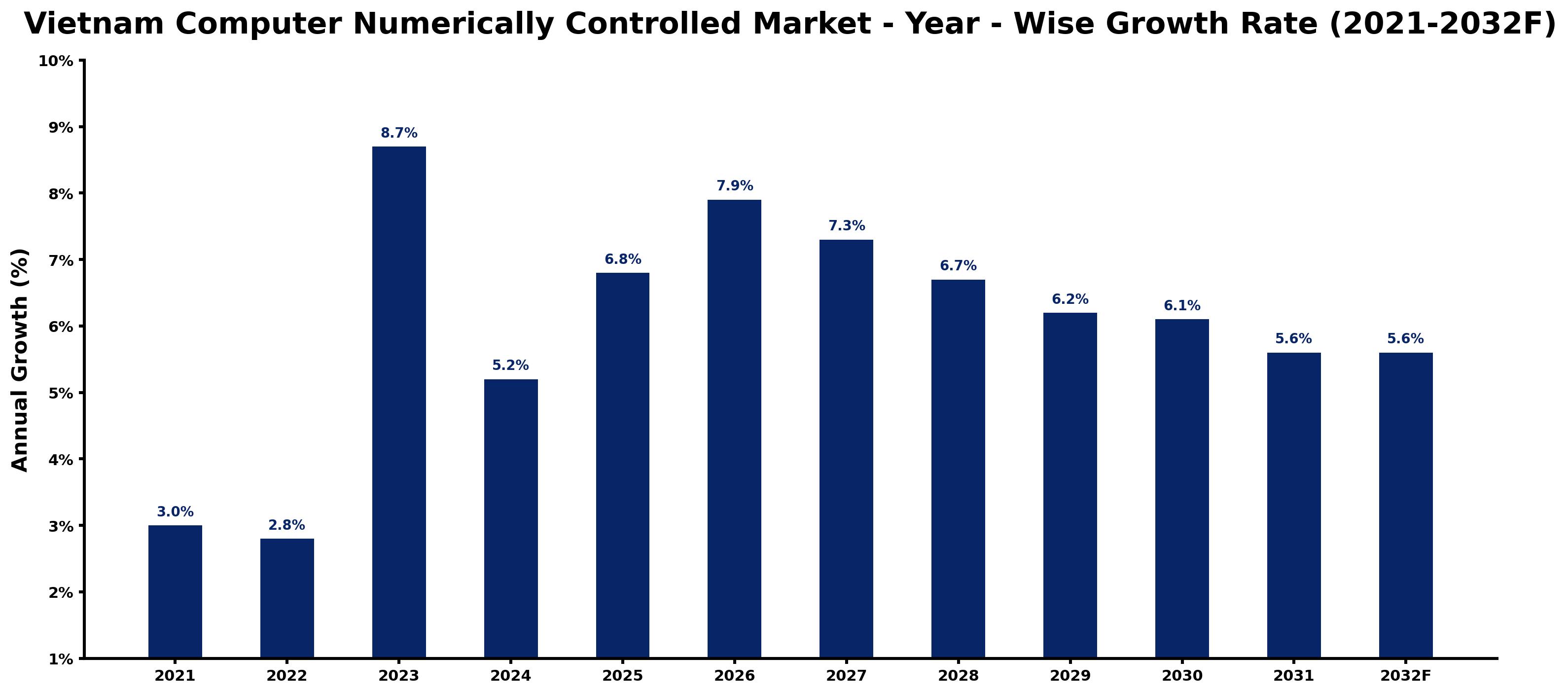
The table below presents the year‑wise growth rates along with the key drivers influencing the market
| Year | Growth Rate | Major Drivers |
| 2021 | 3.0% | Government infrastructure modernization initiatives |
| 2022 | 2.8% | Government infrastructure modernization initiatives |
| 2023 | 8.7% | Government infrastructure modernization initiatives |
| 2024 | 5.2% | Rapid growth in telecom and data center sectors |
| 2025 | 6.8% | Expansion of commercial construction activities |
| 2026 | 7.9% | Expansion of manufacturing activities |
| 2027 | 7.3% | Growing renewable energy integration projects |
| 2028 | 6.7% | Increasing smart city development projects |
| 2029 | 6.2% | Increasing industrial automation investments |
| 2030 | 6.1% | Expansion of manufacturing activities |
| 2031 | 5.6% | Growing renewable energy integration projects |
| 2032 | 5.6% | Increasing adoption of advanced technologies |
Note - Market size estimations and growth projections presented in this report are based on 6Wresearch’s advanced forecasting approach, validated with industry datasets as of June 2026.
Vietnam Computer Numerically Controlled Market Synopsis
A pivotal force shaping the Vietnam Computer Numerically Controlled Market is the rapid adoption of automation across various sectors. Industries are increasingly recognizing that CNC machines enable not just efficiency but also the production of intricate components that meet modern quality standards.
Additionally, the surge in local manufacturing capabilities fueled by both domestic and international players is transforming the landscape. This influx of diverse CNC machines, coupled with technological advancements and robust government support, is enhancing the competitive edge of Vietnamese manufacturers in the global market.
Vietnam Computer Numerically Controlled Market Key Takeaways
- The market is poised for growth, with significant investments in automation and precision manufacturing technologies.
- Demand is primarily driven by the automotive, aerospace, electronics, and metalworking industries.
- Technological advancements and software integration are critical for optimizing the use of CNC machines.
- Government initiatives focusing on advanced manufacturing and skill development are vital for market expansion.
- Challenges such as initial capital costs and the need for skilled operators may influence market dynamics.
Evaluation of Restraints in Vietnam Computer Numerically Controlled Market
Despite the promising outlook, several restraints hinder the Vietnam CNC market's potential. The initial investment cost for acquiring CNC machines remains a significant barrier, particularly for small and medium-sized enterprises (SMEs) that may struggle to allocate the necessary capital. Furthermore, a shortage of skilled CNC operators and technicians complicates the effective deployment of these technologies. Addressing these issues through training initiatives and cost-effective solutions is essential for broader market penetration and maximizing the advantages of CNC technology.
Vietnam Computer Numerically Controlled Market Trends
Emerging trends are shaping the CNC market landscape significantly. The integration of Internet of Things (IoT) technologies into CNC machinery is enhancing real-time monitoring and predictive maintenance, increasing operational efficiency. Additionally, there is a growing shift towards collaborative robots (cobots), which are being increasingly utilized alongside CNC machines to streamline production processes. Eco-friendly manufacturing practices are also gaining traction, encouraging the development of more sustainable CNC solutions that meet global environmental standards.
Vietnam Computer Numerically Controlled Market Opportunities
Numerous opportunities abound for growth and investment within the Vietnamese CNC market. The rising trend of digitalization in manufacturing presents an avenue for businesses to enhance their operational efficiency through smart manufacturing solutions. Furthermore, as Vietnam positions itself as a manufacturing hub in Southeast Asia, investments in infrastructure and technology are likely to rise. This not only augments the need for advanced CNC machines but also encourages the development of localized production capabilities, thereby enhancing the domestic supply chain.
Government Initiatives in the Vietnam Computer Numerically Controlled Market
The Vietnamese government is playing an instrumental role in the advancement of the CNC market. By promoting policies that encourage the adoption of advanced manufacturing technologies, the government aims to bolster the nation's industrial base. Initiatives focused on enhancing vocational training and technical education are also key, helping to develop a skilled workforce capable of operating and maintaining CNC machines. Public investment in research and development further supports innovation in this sector, ensuring that Vietnam remains competitive on a global scale.
Future Insights of the Vietnam Computer Numerically Controlled Market
Looking ahead to 2026-2032, the Vietnam Computer Numerically Controlled Market is expected to witness transformative changes. Continued emphasis on automation and efficiency in manufacturing will propel demand for CNC technologies. Furthermore, as industries evolve to meet stricter quality and production standards, the ability of CNC machines to produce complex parts with precision will be a critical factor. The anticipated growth in sectors like aerospace and automotive, combined with rising foreign investments, will solidify Vietnam's position in the global CNC landscape.
Vietnam Computer Numerically Controlled Market Latest Developments (May 2025 - June 2026)
Recent developments in the Vietnam CNC market reflect a clear trend towards technological innovation and collaboration. Industry players are increasingly focusing on incorporating cutting-edge technologies, such as AI-driven predictive analytics, into CNC systems. Moreover, joint ventures and partnerships among domestic and foreign companies are becoming commonplace, aimed at enhancing production capabilities and expanding market reach. This collaborative approach not only drives innovation but also contributes to the overall growth of the manufacturing sector.
Vietnam Computer Numerically Controlled Market - Key Attractiveness of the Report
- 10 Years of Market Numbers
- Historical Data Starting from 2022 to 2025
- Base Year: 2025
- Forecast Data until 2032
- Key Performance Indicators Impacting the Market
- Major Upcoming Developments and Projects
Key Highlights of the Report:
- Vietnam Computer Numerically Controlled Market Outlook
- Market Size of Vietnam Computer Numerically Controlled Market, 2025
- Forecast of Vietnam Computer Numerically Controlled Market, 2032
- Historical Data and Forecast of Vietnam Computer Numerically Controlled Revenues & Volume for the Period 2022-2032F
- Vietnam Computer Numerically Controlled Market Trend Evolution
- Vietnam Computer Numerically Controlled Market Drivers and Challenges
- Vietnam Computer Numerically Controlled Price Trends
- Vietnam Computer Numerically Controlled Porter's Five Forces
- Vietnam Computer Numerically Controlled Industry Life Cycle
- Historical Data and Forecast of Vietnam Computer Numerically Controlled Market Revenues & Volume By Tool Type for the Period 2022-2032F
- Historical Data and Forecast of Vietnam Computer Numerically Controlled Market Revenues & Volume By Lathes for the Period 2022-2032F
- Historical Data and Forecast of Vietnam Computer Numerically Controlled Market Revenues & Volume By Mills for the Period 2022-2032F
- Historical Data and Forecast of Vietnam Computer Numerically Controlled Market Revenues & Volume By Routers for the Period 2022-2032F
- Historical Data and Forecast of Vietnam Computer Numerically Controlled Market Revenues & Volume By Grinders for the Period 2022-2032F
- Historical Data and Forecast of Vietnam Computer Numerically Controlled Market Revenues & Volume By Others for the Period 2022-2032F
- Historical Data and Forecast of Vietnam Computer Numerically Controlled Market Revenues & Volume By Industry Vertical for the Period 2022-2032F
- Historical Data and Forecast of Vietnam Computer Numerically Controlled Market Revenues & Volume By Aerospace & Defense for the Period 2022-2032F
- Historical Data and Forecast of Vietnam Computer Numerically Controlled Market Revenues & Volume By Automobile for the Period 2022-2032F
- Historical Data and Forecast of Vietnam Computer Numerically Controlled Market Revenues & Volume By Electronics for the Period 2022-2032F
- Historical Data and Forecast of Vietnam Computer Numerically Controlled Market Revenues & Volume By Healthcare for the Period 2022-2032F
- Historical Data and Forecast of Vietnam Computer Numerically Controlled Market Revenues & Volume By Industry Machinery for the Period 2022-2032F
- Historical Data and Forecast of Vietnam Computer Numerically Controlled Market Revenues & Volume By Others for the Period 2022-2032F
- Vietnam Computer Numerically Controlled Import Export Trade Statistics
- Market Opportunity Assessment By Tool Type
- Market Opportunity Assessment By Industry Vertical
- Vietnam Computer Numerically Controlled Top Companies Market Share
- Vietnam Computer Numerically Controlled Competitive Benchmarking By Technical and Operational Parameters
- Vietnam Computer Numerically Controlled Company Profiles
- Vietnam Computer Numerically Controlled Key Strategic Recommendations






































