Vietnam Converted Paper Products Market Summary
The vietnam converted paper products market was estimated at USD 342 Million in 2025 and is projected to reach USD 483 Million by 2032, growing at a CAGR of 7.7% from 2026 to 2032.
Vietnam Converted Paper Products Market Year-wise Growth Rate and Key Drivers
This graph highlights how the Vietnam Converted Paper Products Market has steadily grown over the past five years, supported by major growth factors.
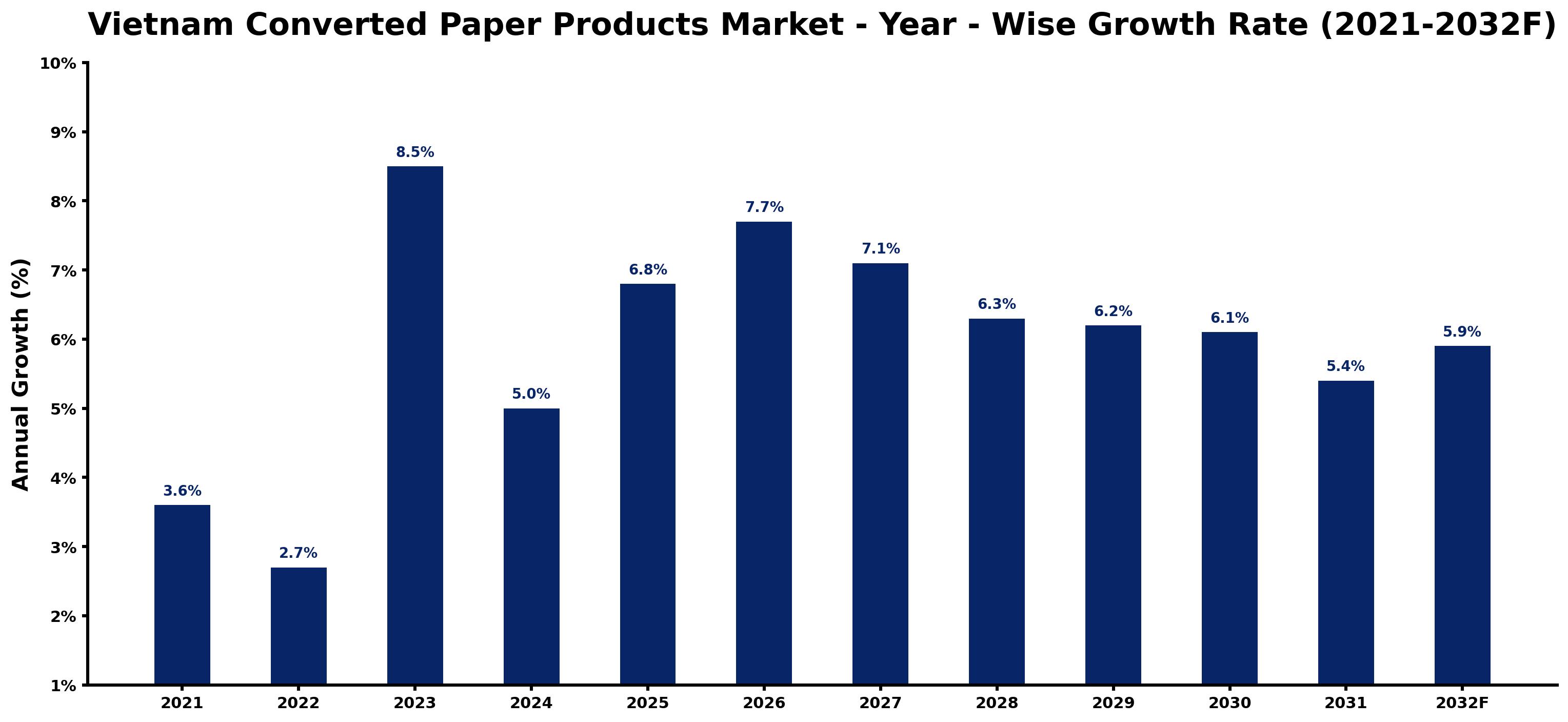
The table below presents the year wise growth rates along with the key drivers influencing the market
| Year | Growth Rate | Major Drivers |
| 2021 | 3.6% | Post-lockdown retail projects emphasize sustainable materials for product differentiation. |
| 2022 | 2.7% | Manufacturing relocation trends highlight Vietnam's cost-effective labor and production capabilities. |
| 2023 | 8.5% | Corporate sustainability agendas increasingly prioritize eco-friendly packaging solutions for consumers. |
| 2024 | 5.0% | E-commerce platforms expand, boosting demand for convenient and eco-conscious packaging options. |
| 2025 | 6.8% | Growing awareness of environmental issues influences consumer choices towards recycled products. |
| 2026 | 7.7% | Technological investments enhance efficiency in converted paper product manufacturing processes. |
| 2027 | 7.1% | Urbanization continues, increasing the consumption of packaged goods across major cities. |
| 2028 | 6.3% | Retail sector shifts towards online sales, amplifying the need for durable packaging materials. |
| 2029 | 6.2% | International partnerships foster innovation in sustainable paper product development and design. |
| 2030 | 6.1% | Rural electrification initiatives drive demand for localized packaging solutions for regional markets. |
| 2031 | 5.4% | Corporate responsibility initiatives advocate for the reduction of plastic usage in packaging. |
| 2032 | 5.9% | Consumer preferences evolve, emphasizing recyclable and biodegradable materials in all sectors. |
Note - Market size estimations and growth projections presented in this report are based on 6Wresearch's advanced forecasting approach, validated with industry datasets as of June 2026.
Vietnam Converted Paper Products Market Synopsis
The Vietnam Converted Paper Products Market is projected to reach 7.7% and witness significant growth during the forecast period (2026-2032). This market is integral to fulfilling the increasing demand for a diverse range of paper-based products across Vietnam. Encompassing packaging materials, tissues, stationery, and sanitary items, the Vietnam Converted Paper Products market is influenced by the rapidly growing e-commerce sector and the rising consumption of convenience products. The expansion of both domestic and international manufacturers within the region highlights the market's potential, driven by strategic investments aimed at capturing a growing consumer base and leveraging Vietnam's advantageous geographic position for regional exports. A prevailing trend in market activity is the focus on product innovation, cost-efficiency, and sustainability, which are essential for maintaining a competitive edge.
Vietnam Converted Paper Products Market Growth Drivers
The drivers of the Vietnam Converted Paper Products market are numerous and closely linked to the evolving consumer landscape and economic conditions.
- The rapid expansion of the e-commerce industry has fundamentally transformed consumer habits, with an escalating demand for paper-based packaging solutions such as corrugated boxes and cartons. This surge is largely attributed to the increase in online retail activities, necessitating effective packaging for safe delivery.
- Changing lifestyles in urban areas, combined with a growing preference for convenience, have increased the consumption of tissue and sanitary paper products. Rising disposable incomes allow consumers to invest in these products, further driving market growth.
- Vietnam's large and diverse consumer base plays a critical role in sustaining demand for various converted paper products. The demographic landscape supports a wide array of product categories, from basic stationery to high-demand packaging solutions.
- The strategic geographical location of Vietnam within Southeast Asia enhances its attractiveness as a manufacturing hub. Companies are increasingly establishing production facilities to cater not only to the domestic market but also to export markets within the region.
- Sustainability has emerged as a significant factor influencing market dynamics. Companies are increasingly adopting eco-friendly practices and materials, reflecting the growing consumer preference for environmentally responsible products.
Vietnam Converted Paper Products Market Challenges and Restraints
Despite the promising outlook for the Vietnam Converted Paper Products market, several challenges can impede its growth. Environmental issues surrounding paper production and waste disposal have come to the forefront, pressuring companies to adopt sustainable and recyclable materials.
- The push for sustainability necessitates investment in eco-friendly practices, which can initially strain financial resources for many companies. Balancing profitability with responsible environmental stewardship remains a significant challenge.
- Intense competition from alternative packaging solutions, particularly plastic and biodegradable materials, poses an additional hurdle. The Vietnam Converted Paper Products market must effectively communicate the advantages of paper-based products, especially regarding recyclability and environmental impact.
- Rising raw material costs, including fluctuations in pulp prices and energy costs, can negatively affect the profit margins of companies involved in the production of converted paper products.
- To mitigate these challenges, companies must continuously innovate and optimize production processes. Embracing advanced technologies and efficient manufacturing techniques is vital for maintaining competitiveness in this dynamic environment.
- Compliance with strict environmental regulations also requires ongoing adjustments to operational practices, placing additional pressure on companies to remain current with industry standards.
Vietnam Converted Paper Products Market Government Investment and Initiatives
The Vietnamese government has recognized the significance of the Converted Paper Products market and is actively investing in initiatives to bolster its development. Public spending on infrastructure improvements enhances transportation networks critical for manufacturing and distribution.
- The government has introduced policies that promote sustainable production practices, encouraging companies to adopt eco-friendly technologies and materials in line with global environmental standards.
- Investment incentives are provided to attract foreign direct investment in the paper products sector, fostering collaboration between local and international manufacturers to enhance production capabilities.
- Vocational training programs aimed at workforce development are being implemented, ensuring that the industry has access to skilled labor, particularly in areas related to sustainable manufacturing and technological innovation.
- The government is also exploring partnerships with private enterprises to boost research and development efforts focused on sustainable materials and production methodologies.
- Regulatory frameworks are being established to facilitate sustainable forest management practices, ensuring a steady supply of raw materials while minimizing environmental impact.
Vietnam Converted Paper Products Market Latest Developments (May 2025 - June 2026)
Recent developments within the Vietnam Converted Paper Products market have been influenced by shifting consumer preferences and operational adaptations to the post-pandemic landscape. A marked increase in demand for hygiene products has continued following the pandemic, elevating the need for tissues and sanitary items.
- There has been a notable push towards embracing innovative packaging solutions, as consumers increasingly prioritize sustainable options, emphasizing the use of recycled and eco-friendly materials.
- Digital transformation has accelerated, with many companies enhancing their e-commerce platforms to cater to changing consumer behaviors, which favor direct-to-consumer sales and contactless shopping experiences.
- Collaborations across the value chain, from suppliers to retailers, have increased as companies seek to streamline operations and enhance logistics, particularly in response to the surging demand from the e-commerce sector.
- Investment in machinery and technology to improve production efficiency and reduce waste has been prioritized, ensuring the market can meet rising demand while adhering to sustainability goals.
- The overall sentiment within the market reflects a commitment to innovation and adaptation, positioning the Vietnam Converted Paper Products market favorably for future growth.
Vietnam Converted Paper Products Market - Key Attractiveness of the Report
- 10 Years of Market Numbers
- Historical Data Starting from 2022 to 2025
- Base Year: 2025
- Forecast Data until 2032
- Key Performance Indicators Impacting the Market
- Major Upcoming Developments and Projects
Key Highlights of the Report:
- Vietnam Converted Paper Products Market Outlook
- Market Size of Vietnam Converted Paper Products Market, 2025
- Forecast of Vietnam Converted Paper Products Market, 2032
- Historical Data and Forecast of Vietnam Converted Paper Products Revenues & Volume for the Period 2022-2032F
- Vietnam Converted Paper Products Market Trend Evolution
- Vietnam Converted Paper Products Market Drivers and Challenges
- Vietnam Converted Paper Products Price Trends
- Vietnam Converted Paper Products Porter's Five Forces
- Vietnam Converted Paper Products Industry Life Cycle
- Historical Data and Forecast of Vietnam Converted Paper Products Market Revenues & Volume By Type for the Period 2022-2032F
- Historical Data and Forecast of Vietnam Converted Paper Products Market Revenues & Volume By Paperboard Container for the Period 2022-2032F
- Historical Data and Forecast of Vietnam Converted Paper Products Market Revenues & Volume By Sanitary Paper Product for the Period 2022-2032F
- Historical Data and Forecast of Vietnam Converted Paper Products Market Revenues & Volume By Stationery Product for the Period 2022-2032F
- Historical Data and Forecast of Vietnam Converted Paper Products Market Revenues & Volume By Paper Bag And Coated And Treated Paper for the Period 2022-2032F
- Historical Data and Forecast of Vietnam Converted Paper Products Market Revenues & Volume By Other for the Period 2022-2032F
- Historical Data and Forecast of Vietnam Converted Paper Products Market Revenues & Volume By End-Users for the Period 2022-2032F
- Historical Data and Forecast of Vietnam Converted Paper Products Market Revenues & Volume By Packaging & Wrapping for the Period 2022-2032F
- Historical Data and Forecast of Vietnam Converted Paper Products Market Revenues & Volume By Food Service for the Period 2022-2032F
- Historical Data and Forecast of Vietnam Converted Paper Products Market Revenues & Volume By Printing for the Period 2022-2032F
- Historical Data and Forecast of Vietnam Converted Paper Products Market Revenues & Volume By Others for the Period 2022-2032F
- Vietnam Converted Paper Products Import Export Trade Statistics
- Market Opportunity Assessment By Type
- Market Opportunity Assessment By End-Users
- Vietnam Converted Paper Products Top Companies Market Share
- Vietnam Converted Paper Products Competitive Benchmarking By Technical and Operational Parameters
- Vietnam Converted Paper Products Company Profiles
- Vietnam Converted Paper Products Key Strategic Recommendations






































