Vietnam Conveyors Systems Market Size, Share & Growth Rate
The Vietnam Conveyors Systems Market was estimated at USD 1389 Million in 2025 and is projected to reach USD 1973 Million by 2032, growing at a CAGR of 5.1% from 2026 to 2032. This growth trajectory is primarily driven by the burgeoning manufacturing and logistics sectors, as companies increasingly recognize the value of automation in enhancing productivity and efficiency. Furthermore, the expansion of e-commerce in Vietnam is spurring the demand for advanced conveyor systems that facilitate quick and efficient material handling.
Vietnam Conveyors Systems Market Year-wise Growth Rate and Key Drivers
This graph highlights how the Vietnam Conveyors Systems Market has steadily grown over the years, supported by major growth factors.
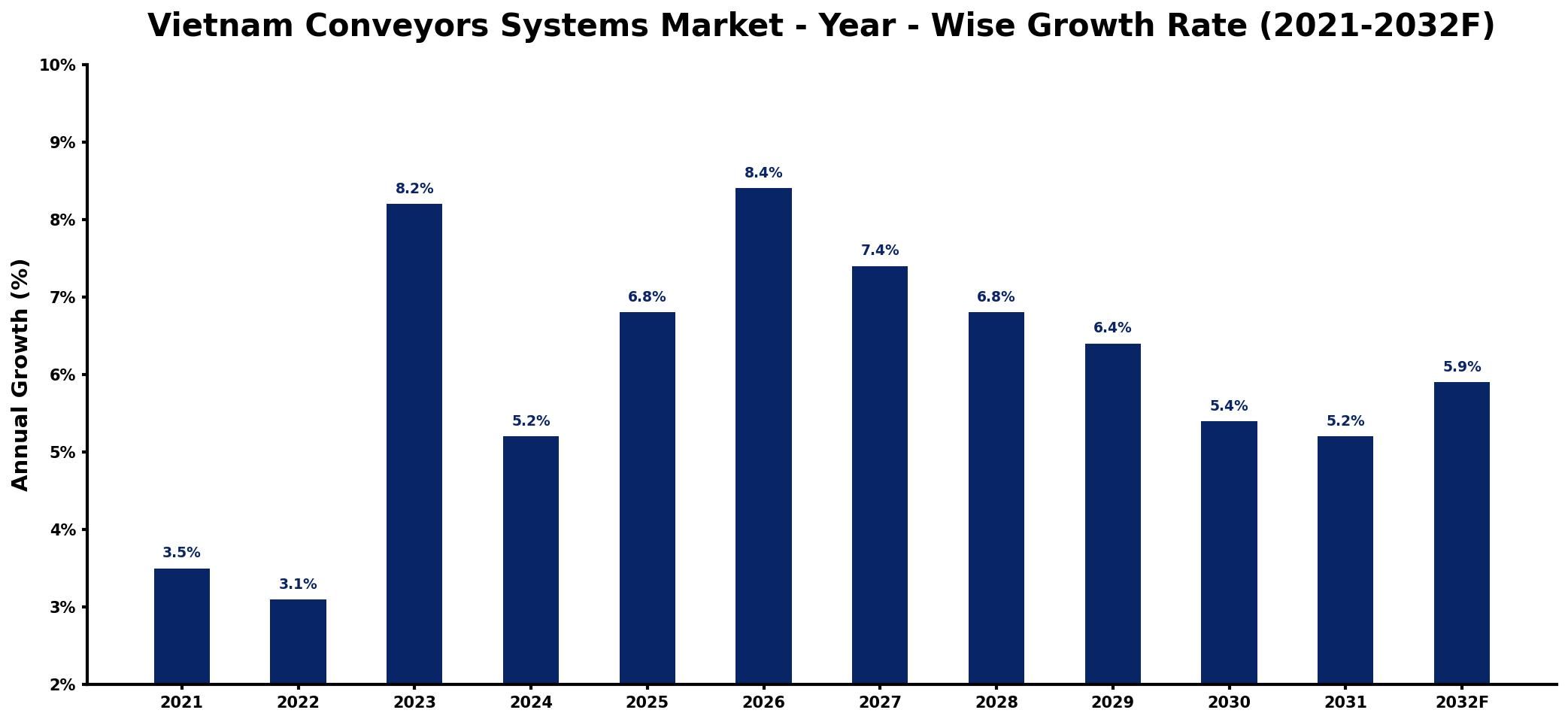
The table below presents the year‑wise growth rates along with the key drivers influencing the market
| Year | Growth Rate | Major Drivers |
| 2021 | 3.5% | Rising manufacturing sector demand |
| 2022 | 3.1% | Infrastructure investments increasing rapidly |
| 2023 | 8.2% | E-commerce logistics expanding significantly |
| 2024 | 5.2% | Automated solutions gaining traction |
| 2025 | 6.8% | Food processing industry growth |
| 2026 | 8.4% | Retail sector modernization efforts |
| 2027 | 7.4% | improved processing technologies adoption |
| 2028 | 6.8% | Construction industry project expansions |
| 2029 | 6.4% | Technological advancements driving efficiency |
| 2030 | 5.4% | Increased export activities emerging |
| 2031 | 5.2% | Sustainability initiatives influencing investments |
| 2032 | 5.9% | Urbanization fueling logistics requirements |
Note: Market size estimations and growth projections presented in this report are based on 6Wresearch's proprietary forecasting methodology, utilizing the latest available industry data, government publications, and primary research inputs.
Vietnam Conveyors Systems Market Synopsis
The most significant force shaping the Vietnam conveyors systems market today is the rapid push towards automation across multiple industries. As manufacturing processes become more complex and demand for speed in logistics heightens, conveyor systems are now indispensable for streamlining operations and reducing reliance on manual labor.
This market is benefitting from Vietnam's ongoing industrialization and modernization efforts, which are transforming traditional manufacturing practices. The rising focus on improving supply chain efficiencies and reducing operational costs is further driving the adoption of conveyor technologies that can adapt to diverse material handling needs.
Vietnam Conveyors Systems Market Key Takeaways
- The market is expected to witness a robust CAGR of 5.1%, reflecting strong growth potential driven by industrial automation.
- Automation is increasingly prioritized by industries looking to improve operational efficiencies and reduce labor costs.
- The e-commerce boom is significantly impacting demand for conveyor systems as companies seek to optimize logistics operations.
- Infrastructure development will be crucial to overcoming existing logistical constraints within the market.
- Key market players are focusing on innovation and advanced technology to meet diverse client needs across various sectors.
Evaluation of Restraints in Vietnam Conveyors Systems Market
Despite the promising outlook for the Vietnam conveyors systems market, several constraints hinder its full potential. Infrastructure limitations pose a notable challenge; inadequate transportation networks can result in inefficiencies and bottlenecks within logistics operations. Additionally, existing traffic congestion complicates the movement of materials, making it essential for companies to navigate these hurdles to fully capitalize on conveyor technology's benefits. The interplay between these factors requires innovative solutions and collaboration between public and private sectors to enhance overall system effectiveness.
Vietnam Conveyors Systems Market Trends
A clear trend in the Vietnam conveyors systems market is the shift towards integrated automation solutions. Companies are increasingly investing in smart conveyor systems that incorporate IoT and AI capabilities, allowing for real-time monitoring and enhanced decision-making. Moreover, sustainability is gaining traction, with manufacturers seeking eco-friendly conveyor options that minimize energy consumption. These trends indicate a significant technological evolution that aligns with global industrial practices, positioning the Vietnamese market for future competitiveness.
Vietnam Conveyors Systems Market Opportunities
The greatest opportunities for growth in the Vietnam conveyors systems market lie within the rising demand for customized solutions tailored to specific industry needs. With sectors such as food and beverage, pharmaceuticals, and automotive requiring specialized conveyor systems, there is ample room for innovation. Furthermore, as Vietnam continues to position itself as a manufacturing hub in Southeast Asia, foreign investment and collaboration in conveyor technology development can lead to significant advancements in efficiency and scalability.
Government Initiatives in the Vietnam Conveyors Systems Market
The Vietnamese government is taking proactive steps to enhance industrial capabilities through various initiatives, including investments in infrastructure upgrades and automation incentives. Policies promoting the adoption of Industry 4.0 practices are encouraging companies to modernize their processes, including material handling systems. These initiatives not only support local manufacturers but also attract foreign investment, fostering an environment conducive to growth in the conveyors systems market.
Future Insights of the Vietnam Conveyors Systems Market
Looking ahead to 2026-2032, the Vietnam conveyors systems market is set to evolve rapidly, driven by continued industrialization and digital transformation. As companies increasingly seek to optimize their supply chains and enhance operational efficiencies, the demand for sophisticated conveyor solutions will surge. Additionally, a stronger focus on sustainability will likely shape future innovations in conveyor technology, further solidifying Vietnams position as a competitive player in the global market.
Vietnam Conveyors Systems Market Latest Developments (2025 - 2026)
Recent developments in the Vietnam conveyors systems market highlight an increasing emphasis on automation and intelligent technology integrations. Many manufacturers are exploring collaborative robotics and advanced sensors to enhance conveyor operations. Simultaneously, there is a notable increase in partnerships between local firms and global technology leaders aimed at developing next-generation conveyor systems tailored for the evolving needs of various industries.
Vietnam Conveyors Systems Market - Key Attractiveness of the Report
- 10 Years of Market Numbers
- Historical Data Starting from 2022 to 2025
- Base Year: 2025
- Forecast Data until 2032
- Key Performance Indicators Impacting the Market
- Major Upcoming Developments and Projects
Key Highlights of the Report:
- Vietnam Conveyors Systems Market Outlook
- Market Size of Vietnam Conveyors Systems Market, 2025
- Forecast of Vietnam Conveyors Systems Market, 2032
- Historical Data and Forecast of Vietnam Conveyors Systems Revenues & Volume for the Period 2022-2032F
- Vietnam Conveyors Systems Market Trend Evolution
- Vietnam Conveyors Systems Market Drivers and Challenges
- Vietnam Conveyors Systems Price Trends
- Vietnam Conveyors Systems Porter's Five Forces
- Vietnam Conveyors Systems Industry Life Cycle
- Historical Data and Forecast of Vietnam Conveyors Systems Market Revenues & Volume By Type for the Period 2022-2032F
- Historical Data and Forecast of Vietnam Conveyors Systems Market Revenues & Volume By Roller for the Period 2022-2032F
- Historical Data and Forecast of Vietnam Conveyors Systems Market Revenues & Volume By Flat Belt for the Period 2022-2032F
- Historical Data and Forecast of Vietnam Conveyors Systems Market Revenues & Volume By Wheel for the Period 2022-2032F
- Historical Data and Forecast of Vietnam Conveyors Systems Market Revenues & Volume By Vertical for the Period 2022-2032F
- Historical Data and Forecast of Vietnam Conveyors Systems Market Revenues & Volume By Others for the Period 2022-2032F
- Historical Data and Forecast of Vietnam Conveyors Systems Market Revenues & Volume By Location for the Period 2022-2032F
- Historical Data and Forecast of Vietnam Conveyors Systems Market Revenues & Volume By In-floor for the Period 2022-2032F
- Historical Data and Forecast of Vietnam Conveyors Systems Market Revenues & Volume By On-floor for the Period 2022-2032F
- Historical Data and Forecast of Vietnam Conveyors Systems Market Revenues & Volume By Overhead for the Period 2022-2032F
- Historical Data and Forecast of Vietnam Conveyors Systems Market Revenues & Volume By Load for the Period 2022-2032F
- Historical Data and Forecast of Vietnam Conveyors Systems Market Revenues & Volume By Unit Load for the Period 2022-2032F
- Historical Data and Forecast of Vietnam Conveyors Systems Market Revenues & Volume By Bulk Load for the Period 2022-2032F
- Historical Data and Forecast of Vietnam Conveyors Systems Market Revenues & Volume By Application for the Period 2022-2032F
- Historical Data and Forecast of Vietnam Conveyors Systems Market Revenues & Volume By Food & Beverages for the Period 2022-2032F
- Historical Data and Forecast of Vietnam Conveyors Systems Market Revenues & Volume By Pharmaceuticals for the Period 2022-2032F
- Historical Data and Forecast of Vietnam Conveyors Systems Market Revenues & Volume By Supply chain & Logistics for the Period 2022-2032F
- Historical Data and Forecast of Vietnam Conveyors Systems Market Revenues & Volume By Manufacturing for the Period 2022-2032F
- Historical Data and Forecast of Vietnam Conveyors Systems Market Revenues & Volume By Mining for the Period 2022-2032F
- Historical Data and Forecast of Vietnam Conveyors Systems Market Revenues & Volume By Others for the Period 2022-2032F
- Vietnam Conveyors Systems Import Export Trade Statistics
- Market Opportunity Assessment By Type
- Market Opportunity Assessment By Location
- Market Opportunity Assessment By Load
- Market Opportunity Assessment By Application
- Vietnam Conveyors Systems Top Companies Market Share
- Vietnam Conveyors Systems Competitive Benchmarking By Technical and Operational Parameters
- Vietnam Conveyors Systems Company Profiles
- Vietnam Conveyors Systems Key Strategic Recommendations






































